
Yo-ho, fellow Dickensians! To celebrate the birthday of the world’s greatest novelist and Day 400 of the Dickens Club, your co-hosts have compiled a list of our favorite moments in the books we’ve read thus far, roughly comprising the first half of Dickens’s career as a novelist. This includes all the novels from Pickwick to Martin Chuzzlewit, along with Sketches by Boz, American Notes, Pictures from Italy (criminally underrated!) and the Christmas Books. At this stage of his career—as he prepared to write Dombey & Son—Dickens was only just beginning to experiment with plotting his stories in advance. What’s remarkable is that so many of the memorable moments on this list seem to have been invented on the fly, from the overflow of his remarkable imagination. What a name he had already made for himself!
“Making a Night of It” (From Sketches by Boz)
If you need a laugh-filled bromance with comic blunders of Pickwickian proportions, “Making a Night Of It” is the Sketch for you. At the time I commented: “Many laugh-out-loud moments; the piece is brilliantly written, as witty as all get-out, and I positively had to stop reading–due to laughter–when we came to ‘five door knockers’ among the possessions ‘feloniously obtained’ by our dissolute partners in plastered crime.”

In his Sketches, published between 1833-36, Dickens was in what our member, Lenny, called his “writing lab,” toying with characters and scenes of London life in these shorter pieces, written for Bell’s Miscellany, the Morning Chronicle, and other publications. Many themes, images, settings, and even characters from his novels can be glimpsed in embryo throughout these years. Even then, there is plenty to delight in, with his wit and incomparable observational powers; nothing escapes his notice, and he even gets to give a nod to his obsession with door-knockers! —Rach
The First Appearance of Mr Jingle
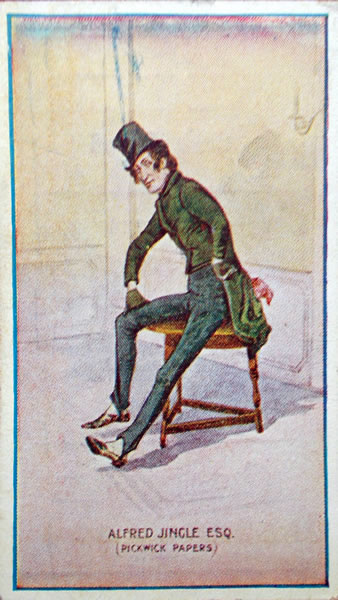
For a book that would revolutionize English literature, The Pickwick Papers—which opens with a droll parody of a Parliamentary meeting—doesn’t immediately grab the reader’s attention. Things begin to pick up in the second chapter, when the Pickwickians find themselves traveling by coach with a curious gentleman in a green coat and a top hat, and a habit of speaking in dashes and fragments (“not worth splitting a guinea… I call; you spin—first time—woman—woman—bewitching woman!”). Robert Douglas-Fairhurst notes that Dickens was likely cribbing Jingle’s staccato delivery from a comic actor named Charles Mathews, but in Boz’s hands Jingle becomes a completely unique character, and one of the most memorable eccentrics in a career full of them. — Boze
The First Appearance of Mr Samuel Weller

–and by this I mean, pretty much ANYTHING SAM WELLER. I don’t know how often I’ve employed a Wellerism myself this past year—and even had a little dialogue in Wellerisms with Boze and the Dickens Fellowship on twitter. Sam has been a highlight of our first year reading together. I loved Dr. Christian’s video lecture that he shared with us, with its emphasis on the importance of Sam in Dickens’s career, calling June 1836 (the month he first shows up at the White Hart Inn), the most important month in Dickens’s life. But learning about how his character catapulted Dickens into celebrity status, a “household word,” was only a proof of what every reader already knows: Sam is an incomparably brilliant creation. Everybody needs a Sam. —Rach
Christmas at Dingley Dell
The subject of Christmas seemed to awaken something in Dickens—an energy, an “enthoosymoosy”—that yielded some of his best work. The three chapters comprising the Christmas sequence in Pickwick Papers—the arrival at Dingley Dell, the story of Gabriel Grub, and the Pickwickians attempting to ice-skate, with nearly fatal results—demonstrate the young Dickens’s love of the holiday and his delight in writing festive scenes. The slow accumulation of detail—the blowing of key-bugles, the cracking of whips over frost, barrels of oysters, hot brandy-and-water, pub windows ornamented with sprigs of holly and red berries—conjures an atmosphere that presages the Christmas celebrations in his later books. And in “The Story of the Goblins Who Stole a Sexton,” Dickens rehearses the events of A Christmas Carol, six years early. — Boze
Pickwick Meets Mr Jingle in the Fleet Prison
Jinglism is a recurring theme here, apparently! I’ll just add that, with every reread of Pickwick, I am more and more moved by Pickwick’s encounter with Jingle in the Fleet prison. It never fails to make me cry—unlikely thing, for a man who has conned our heroes and ruined several prospects for their happiness (Mr Tupman, Miss Wardle). Nonetheless, you must admit, Jingle is like a light in a dark room—albeit, a flashing reflective light, unlike the Pickwickian “sun”–and he can’t help but illumine your world. So, when we unexpectedly encounter our favorite trickster in the Fleet prison, where he is hungry and ragged and has pawned all he owned, it is downright heartbreaking to see that light squelched. He hasn’t lost his personality, but he has lost heart and energy—and nearly his life, most likely. Pickwick’s ability to overcome his just anger in order to help lift Jingle and job out of the situation—becoming almost fatherly in his care of them—is one of the most beautiful moments in literature. —Rach
For a heartbreaking moment from the ‘80s adaptation, here’s the brilliant Patrick Malahide:
The Dissolution of Fagin’s Gang
In Pickwick Papers the twenty-four-year-old Dickens had written what was, by some accounts, the bestselling novel of the nineteenth-century. Wanting to prove that he was more than just a comic novelist, for his second book Dickens went in the opposite direction, writing a story of youthful degradation and urban squalor. What’s remarkable about Oliver Twist is that, for much of the story, Dickens didn’t know where it was going—when a theater manager asked him how the book, then being released in monthly installments, was going to end, Dickens allegedly said he had no clue. Which makes the climax of the story—one of Dickens’s best—all the more impressive. Dickens has used every storytelling trick in his bag of tricks to make us care for Fagin, Bill, Nancy and the rest, and as they meet their seemingly foredoomed fates, he conjures an emotional catharsis to rival Breaking Bad. — Boze

The Wooing of Mr Cucumber (Nicholas Nickleby)
For his third novel, Dickens, like a mad inventor in a lab, attempted to combine the comic foibles of the Pickwick gang with the drama and pathos of Oliver. The result is one of his longest, baggiest, funniest novels, a book where it sometimes feels as though Dickens is sitting at his desk inventing new ways to keep himself awake and amused from scene to scene. Nicholas Nickleby reaches its comedic high point in chapter 41, in which the widowed Mrs Nickleby is accosted by a strange gentleman in a black velvet cap who tosses cucumbers over the wall into her garden. Mr Cucumber (never named in the story but what else would you call him?) proceeds to woo Mrs Nickleby by boasting of his imagined fishing fleets and oyster beds in the Indian Ocean. Sort of a forgotten character even in the longer adaptations, the leek-throwing gentleman seems to prefigure the taloned shopkeeper (“Oh my lungs and liver! Goroo! Goroo!”) in David Copperfield. — Boze
“Who Calls So Loud?”: The Final Episodes of the Rees/Petherbridge Nicholas Nickleby
I talk about the unsurpassable 8.5-hour filmed stage adaptation of Nicholas Nickleby any chance I get, so here goes, again! (Spoiler free.) I enjoyed the entire journey that the group made with Nicholas, Kate, Noggs, and Smike: from Marnie’s diaries to the group chats. Some of us watched (or rewatched) the stage adaptation, but Boze was waiting to finish the last two episodes until he came out to Oregon in December, and what a joy it was. The way they pay off one of the funniest scenes in any adaptation (the Crummles’ fast & loose, happy-ending rendition of Romeo and Juliet) with a heart-rending scene near the finale, is perfect; the way the final tableau ends is…beyond perfect. That slight deviation from the book that makes it, somehow, even more faithful to the original. Something for which Dickens himself would have leapt out of his seat in tears to give a standing ovation. —Rach
Murders, Bells, and Corpse Candles: The Gothic Opening of Barnaby Rudge
Barnaby came as such a surprise–to me personally, and to the group. It was the one with which I was least familiar, having read it so long ago (while obsessed completely with another Dickens), that I’d all but forgotten the plot and characters. But with the opening chapters, we realize we’re not in typical Dickensland here, but in the realm of the historical gothic, with its zig-zagged-roofed old inn, full of personality; a mysterious stranger; a clerk’s story about a ghost connected to a double-murder of twenty-two years before. All this, with talking ravens and revolution…what’s not to love? —Rach
The Dream World of A Christmas Carol
Harry Stone has persuasively shown how A Christmas Carol combines the fairy-tale plots of Dickens’s childhood reading with his own youthful memories of abandonment and neglect. Much of the story—like Andrew Lloyd Weber’s Cats—takes place in a single night, in a liminal space, in a sort of dream world that operates on dream logic. Dickens deftly prepares the reader for the arrival of Jacob Marley’s ghost with a series of ghostly events—the ringing of a bell, a phantom carriage—that makes the apparition, when it finally appears, seem wholly credible. The scene after Marley’s departure in which Scrooge awaits the coming of the next ghost, peering through his chamber window at a London shrouded in spectral fog, is one of Dickens’s eeriest and most evocative. At this stage in his career Dickens could work the fantastical and numinous into his stories effortlessly, but never at the expense of his core message about the importance of looking after society’s most vulnerable. — Boze
What are some of your favorite moments, friends?
 All the (Dickensian) Year Round
What a wonderful selection of moments… and a great post, too, both of you.
Makes me wish I had stumbled upon the Dickens Club earlier! I’m doing my best to catch up, I promise!
I suppose if I had to list a highlight (having joined in time for Martin Chuzzlewit) I would most likely cite the delight I had in much of the Pecksniffery of that novel.
I have taken the time to read through the earlier posts (so far Pickwick to Nickleby) and have delighted in many of the observations of the club members. I also followed the read of Chuzzlewit with reading Pickwick for the very first time, followed in close succession by The Old Curiosity Shop. Plenty of Dickens to have delighted in so recently, and certainly hungry for more.
Thanks for taking the time to write such wonderful posts and for all the organisation it must take to run this club so well 😀
I’m trying to clear the decks in time for Dombey and Son (which I am very much looking forward to)
LikeLiked by 2 people
Oh Rob, thank you so, so much…this is unbelievably encouraging to hear!!! And gosh, I’m simply AMAZED by how much you’ve caught up in the short time you’ve had. I’m so incredibly grateful you’re in this group!!!
LikeLiked by 2 people
I was also amazed by Rudge but also Chuzzlewit, two of Dickens’ best early works. Under rated novels both of them. So much of the dark and light that mingles in the later works is in those books. I miss reading Barnaby Rudge and want to go back to as soon as I can.
LikeLiked by 2 people
Beautifully put, Henry…and I had the same reaction re: Barnaby, I missed it as soon as it was done. I feel that I didn’t give it as much time and thoughtful reflection as it deserved!
LikeLike
Rach and Boze!
What a magnificent tour de force! You captured these ten unforgettable “moments” in Dickens masterfully. With Dickensian flare and aplumb.
Each of your illuminating entries deserves a comment/compliment. I will refrain. But, just to note how expertly you captured the staggering range of Dickens’ imagination, keen observation, deeply caring and compassionate heart. Dickens preaches the Gospel of caring for the vulnerable and speaking truth to power like no one else. He doesn’t “tell,” but “shows.”
For me, pondering the the “energy, [and] ‘enthoosymoosy'” of Dickens is like a spiritual meditation. Whence this phenomenon of brilliant insight, inexhaustible plots and characters, unforgettable moments that highlight the chiaroscuro of our human condition?
Ah. Such a gift you two are giving us through the Dickens Chronological Reading Club and this recapitulation of comic, tragic, and wondrous moments.
Thank you!
Daniel
LikeLiked by 4 people
Thank you so, so much–what beautiful comments!!! I Agree that Dickens illuminates our understanding of the human condition–his characters so often seeming more “real” than the “real”–and his themes a true meditation, a coherent “way of life”!
LikeLike
I don’t really want to do a list of all my favorite moments from the books this group has discussed so far since there are so many of them. If I limited myself to five, they’d probably all end up being from my favorite book and that wouldn’t seem fair. Besides I actually didn’t read along with the group for two of my favorites, Oliver Twist and Nicholas Nickleby, since I’d already reread them recently at the time. So instead, I’ll mention some of my favorite discussions that I’ve read.
I enjoyed reading about the different critical perspectives on Nancy from Oliver Twist and I was gratified that those in group loved her since she’s one of my favorite of that book’s characters. It was also really interesting to read about the different takes on Little Nell of The Old Curiosity Shop and how some fans viewed as an archetypal saint and others viewed her as a realistic depiction of a kid who has had to grow up really fast and take on a parental role with her guardian. (I don’t think those two ideas are necessarily incompatible with each other BTW.)
I thought Boze made an interesting idea of the mad gentleman next door in Nicholas Nickleby being like a parody of Shakespeare’s King Lear. I hadn’t thought of that, but it makes sense.
I really liked the article Chris shared giving Steven Marcus’s take on Martin Chuzzlewit and the one about the role of time in A Christmas Carol (though the part about excrement was kind of weird.)
I know this is something I enjoyed but probably no one else did, but I really liked getting to write about some children’s books that were inspired by A Christmas Carol and which I recommend.
And, yes, it was gratifying that a reread of Barnaby Rudge confirmed my memory that it was great and that others here got a kick out of it too. It was also nice to read about others enjoying characters like Smike, Nancy, the Marchioness and John Browdie. Since most people I know personally don’t read Dickens much and critics and academic types generally regard him a lesser classic author, it makes me feel less alone. (Along different lines, it was nice to find that I’m not the only Dickens fan who doesn’t consider Mrs. Gamp that hilarious.)
LikeLiked by 1 person
A lovely and inspirational dialogue Rach and Boze. It brought back so many wonderful memories about our year’s worth of reading and also allowed the rest of us to see where our “moderators’ (your) interests lie.
I’m gonna be kinda the outlier here as I think I enjoyed taking on the “Sketches” the most. So much breadth, so much depth, so much psychological and sociological detail–that I became totally caught up and mesmerized by the very young Dickens’ writing skills. The various STORIES–as I now call them, really showcase a talent, that right out of the gate captures the reader’s interest in people, events, places, the passing of time, the abundance of life, death, tragedy, and poverty as they existed in early 19th-century London. Schemers, heroes, heroines, prostitutes, muffin boys, circus acts, curiosity shops, starving mothers, pictures of audience members at the circus, members of Parliament, young pastors–the list and variety just goes on and on. 56+ stories! What a blast, and what a showcase for a very young, very talented and energetic writer! Boz, Indeed!
As a side note, if I were an English PhD. candidate looking for a dissertation topic, and I loved reading Dickens’ work, I’d devote a good 3-4 hundred pages to a comprehensive analysis of these first 56+ stories. That is something that really needs to be done–if it hasn’t been done already! Or, if I were an English professor eyeing a sabbatical, this would make a wonderful topic–to study and write IN DEPTH about this early set of Dickens’ work.
LikeLiked by 1 person
Lenny, what a wonderful reflection!!!!! I agree with you completely as to the engagement with them, and that they really need to be studied and written about more! I highlighted “Making a Night of It” here as just something utterly fun, but to represent the larger project of going through the Sketches as a whole… the richness! Dickens was really, to paraphrase Hamlet, the chronicle of the time. 🖤 Boze and I have gone back (in the midst of the other chronological reading) to reread one Sketch per week, in order…actually, tonight, Monday night, is our Sketch night 😍
I miss it too…we could have spent the entire reading club just on the Sketches!!!!
LikeLike
LikeLiked by 1 person
And a happy Walentine’s Day (belatedly) to all of the Inimitables!
Lenny has thrown down the gauntlet:
“As a side note, if I were an English PhD. candidate looking for a dissertation topic, and I loved reading Dickens’ work, I’d devote a good 3-4 hundred pages to a comprehensive analysis of these first 56+ stories. That is something that really needs to be done–if it hasn’t been done already! Or, if I were an English professor eyeing a sabbatical, this would make a wonderful topic–to study and write IN DEPTH about this early set of Dickens’ work.”
Whose going to take up this noble task?!?
Blessings, All,
Daniel
LikeLiked by 3 people