
WHEREIN WE REVISIT OUR final weeks (weeks 7-9) of Bleak House (WEEKs 82-84 OF THE DICKENS CHRONOLOGICAL READING CLUB 2022-24); WITH A CHAPTER SUMMARY AND DISCUSSION WRAP-UP; including a final thematic wrap-up and a look-ahead to our break between reads.

by the members of the #DickensClub, edited/compiled by Rach
Friends, what a journey we’ve had over the past two months, with what many consider to be not only Dickens’s greatest novel, but the greatest novel of the nineteenth century. We’ve had a lot to cover, even with the extra reading time allotted, so if you have time for nothing else, I’d highly suggest taking a closer look at the wrap-up of last Saturday’s online discussion, and, above all, the final thematic wrap-up.
A heartfelt “Thank you” for joining us on this labyrinthine journey, whether you’ve been commenting on the posts, or in our online chat, or reading along with us!
For quick reference:
- General Mems
- Bleak House, Chs 50-67 (Weeks 7 & 8): A Summary
- Discussion Wrap-Up (Weeks 7 & 8)
- Online Discussion Wrap-Up
- Bleak House: A Final Thematic Wrap-Up
- A Look-Ahead to Our Break Between Reads, & Our Next Read, Hard Times
General Mems
Thank you to all who joined us last Saturday for our online discussion of Bleak House! What a lovely group we have. Thank you for your understanding as Boze and I have postponed the final wrap up by a week–we hope you’ll enjoy the little wrap-up of our online chat, too!
Note: Our Dickens Chronological Reading Club has been UPDATED for the third (and final?) time recently. Hope you have a chance to take a look if you haven’t already.
If you’re counting, today is Day 588 (and week 85) in our #DickensClub! Today we’re wrapping up Bleak House, our eighteenth read of the group. Please feel free to comment below this post for any final thoughts, or use the hashtag #DickensClub if you’re commenting on twitter.
No matter where you’re at in the reading process, a huge “thank you” for reading along with us. Heartfelt thanks to our dear Dickens Fellowship, The Dickens Society, and the Charles Dickens Letters Project for retweets, and to all those liking, sharing, and encouraging our Club, including Gina Dalfonzo, Dr. Christian Lehmann and Dr. Pete Orford. Huge “thank you” also to The Circumlocution Office (on twitter also!) for providing such a marvelous online resource for us.
And for any more recent members or for those who might be interested in joining: the revised two-and-a-half year reading schedule can be found here. For Boze’s marvelous introduction to Bleak House and for our reading schedule, please click here. For Chris’s supplementary intro reading material, please click here. If you’ve been reading along with us but aren’t yet on the Member List, we would love to add you! Please feel free to message Rach here on the site, or on twitter.
Bleak House, Chs 50-67 (Weeks 7-9): A Summary
(NOTE: THE BELOW ILLUSTRATIONS ARE BY “PHIZ,” HABLOT KNIGHT BROWNE, FROM THE ORIGINAL EDITION, AND HAVE BEEN DOWNLOADED FROM THE MARVELOUS CHARLES DICKENS ILLUSTRATED GALLERY. THANK YOU!)
After Caddy’s baby is born, Esther attends to Caddy in her illness. Dr Woodcourt’s advice and care are sought and helps her through her recovery. Meanwhile, Ada appears, to Esther, to grow a little distant and troubled.

Woodcourt also continues faithful to his promise to Esther and his friendship to Richard, whose financial situation and ability to afford Vholes’ services is growing more and more dire. When Esther and Ada visit Richard at his dingy lodgings, Ada reveals that she will not be coming back with Esther, but she will stay with her husband, Richard—Richard and Ada had been secretly married since she’d come of age, and she will stay with her husband.
Esther, Woodcourt, and Jarndyce visit Mr George in prison. In spite of their best efforts, George will not be persuaded to accept a lawyer to defend him; if his own honest truth won’t suffice, than he’d rather not bother. Mrs Bagnet has a solution: if anyone can persuade him, his mother can. (George has made out that he was alone in the world.) She is determined to find her.
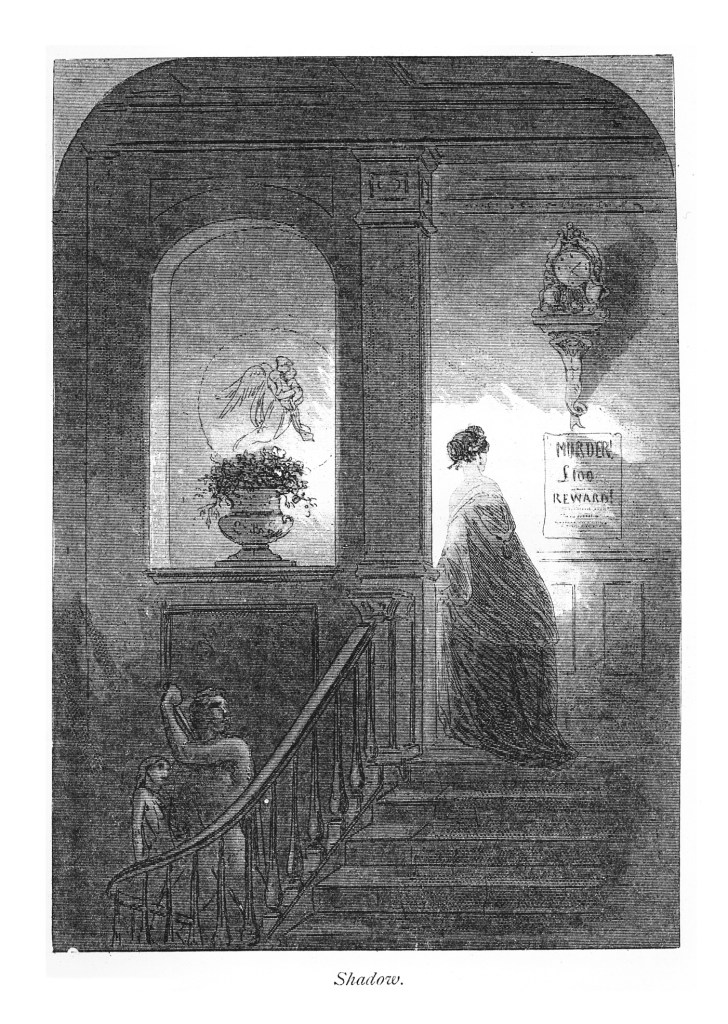
Meanwhile, with the aid of Mr Bucket, Sir Leicester Dedlock is determined to find the murderer of Mr Tulkinghorn. What he—Bucket—has not yet disclosed is that he has received a half-dozen letters lately, accusing Lady Dedlock. He discusses Lady Dedlock’s nightly walks with the footman Mercury, who says that she had been out walking the night of Tulkinghorn’s death.
Bucket then reveals to Sir Leicester the result of his investigations, and several people are called in: the Chadbands, Smallweed, and Mrs Bagnet. Mrs Chadband had been a servant to the Miss Barbary who took her sister’s child out of wedlock without Lady Dedlock’s knowledge, and who testifies that the child of Honoria Barbary—now Lady Dedlock—is alive and well. Smallweed says that he knows of Lady Dedlock’s relationship with, and child by, Captain Hawdon, and is blackmails Sir Leicester for money, though the letters are already in Bucket’s possession and Smallweed had been paid by Tulkinghorn for them. Sir Leicester learns of his wife’s “disgrace,” and comes to understand that Tulkinghorn had been sussing out the secret and holding his power over her, and that he was preparing to reveal it. Lady Dedlock is “at the heart of” the murder, though she is not the murderer, and neither is George. Mrs Snagsby is another member of the witnesses, who testifies to what she believed were her husband’s underhanded dealings.
Bucket then sends presents the real culprit: the vengeful French maid, Hortense, who had been dismissed from service and was now a lodger at the Buckets’ residence. At Bucket’s promptings, Hortense had been spied on by the amateur detective Mrs Bucket, as she had been a suspect for some time, and Mrs Bucket caught her in the act of writing the letters accusing Lady Dedlock, and inadvertently led them to the spot where the murder weapon was discarded by Hortense. Bucket arrests her.
Sir Leicester is in a state of deep shock and grief, but with a feeling of compassion towards his beloved wife.

Meanwhile, Mrs Rouncewell, whom Mrs Bagnet had discovered—through a comment made by George, and putting some circumstantial evidence together—to be George’s long unvisited mother, is on the way to the prison with Mrs Bagnet, to visit her long-lost, wayward son. George had always been her favorite son, and she reproaches him for never sending word, and for feeling ashamed of himself vis-à-vis the family. Under the persuasion of his mother at this heartfelt reunion, George agrees at last to accept legal help, but only begs one thing: that his brother, the successful ironmaster, not know of his situation right now.
We turn then to Lady Dedlock, disturbed by a letter (sent to Mrs Rouncewell), accusing Lady Dedlock of being the “murderess” of Tulkinghorn. Mrs Rouncewell didn’t believe it for a moment, but begged Lady Dedlock that if she knew of anything, or suspected anyone, which could help free her son, to please do what she could. Between that, and a last visit from Mr Guppy to warn her that all is now known to Sir Leicester, due to the visitors that had just been received at the household, Lady Dedlock writes a final farewell and apology letter to her husband and flees their London house, leaving all of her money and valuables behind her.

Sir Leicester has a stroke, and suffers from one-sided weakness and has difficulty speaking clearly, though mentally he is very much aware of the situation, and is able to feebly write in order to communicate. Mrs Rouncewell, his old housekeeper, understands him and comforts him better than anyone. He learns of his wife’s letter from Mrs Rouncewell, and has another attack; still, he makes known to her that he wants Mr Bucket fetched, and is able to communicate to Mr Bucket of the situation, and that he wants Lady Dedlock found at all costs—spare no expense—with his full forgiveness and care. Finding in Lady Dedlock’s rooms a handkerchief of Esther Summerson’s, Bucket figures out the situation and goes to George, recently freed from prison, to ask Esther’s address. In great haste, Bucket explains the situation to Jarndyce and Esther, begging Esther to quickly accompany him on this journey, thinking that Lady Dedlock is in a desperate, suicidal frame of mind, and Esther might be the one person who can reach her.
What follows, from Esther’s account, is a mad chase into the country—Boythorn’s is the only place Esther can think of, besides Jarndyce’s, that her mother might choose for refuge—stopping at police stations and inns and a place where the drowned of the river are brought, to inquire of the missing woman. During the journey, Bucket reveals his part in finding out where Jo (“Toughey”) had gotten to, and, afraid that something of the family secrets would get out, had Jo taken from the Jarndyce grounds—all because of a bribe given to Mr Skimpole for information about him. Esther is angered at Skimpole for this betrayal of Jarndyce.
After it is clear that Lady Dedlock has not been to Bleak House, they seek out Jenny, the bricklayer’s wife, who had recently been visited by Lady Dedlock. The group is reticent to give any information—it was clear that one of them had taken a watch of hers, and there is something mysterious amiss—but Jenny has returned to London. Meanwhile, the further they get into the country, the worse the weather turns. They lose Lady Dedlock’s trail, and Bucket, to the distress of Esther, who fears they might be going backwards, decides to return to London, and follow Jenny.
Sir Leicester learns of George’s return, and of the reunion with his faithful housekeeper. He asks to see George, whose presence is something familiar and comforting to Sir Leicester, as George had, as a boy, often accompanied Sir Leicester on shooting. George has his mother’s gentleness, but his own military strength, and is able to gently lift Sir Leicester to a more comfortable position, and intuit his needs. Sir Leicester also sees it as reason for hope: this son who had been gone so many years has been found…might not Lady Dedlock be found as well?
George is worried about Lady Dedlock, and the dismal weather outside, with snow and sleet growing worse at every moment.
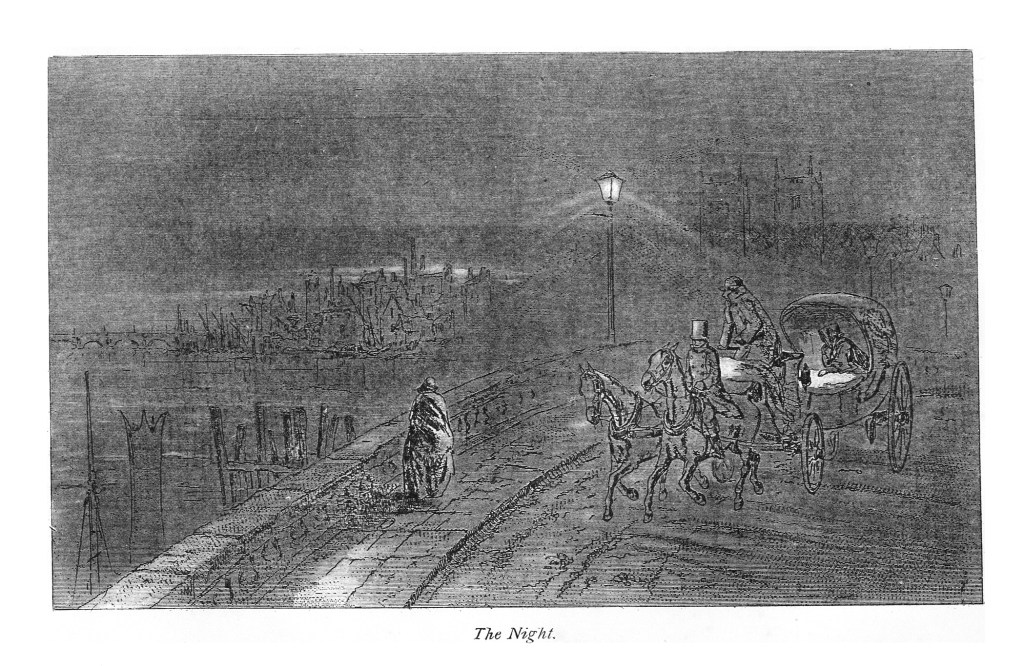
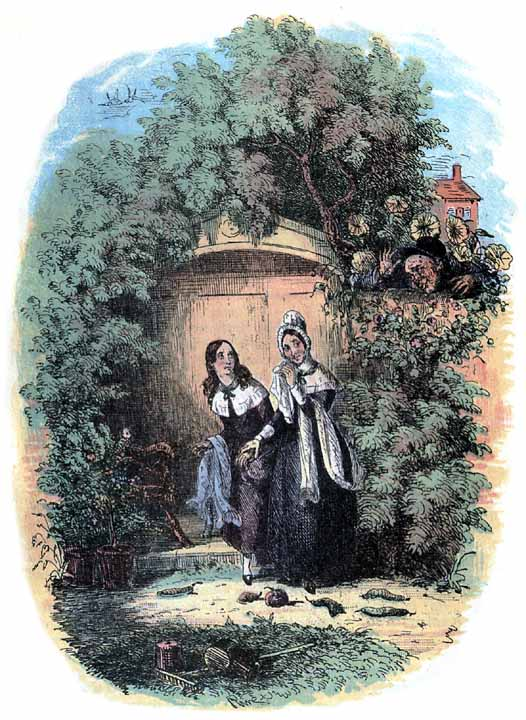
Back in London, Bucket and Esther, wearied, encounter Mr Woodcourt who had recently been visiting Richard. Woodcourt accompanies them in their search, and they end up at Snagsby’s, where Bucket explains to the suspicious Mrs Snagsby that her husband’s dealings with Jo had nothing to do with himself—they were all a matter of Tulkinghorn’s which her husband had found himself caught up in. Assuaged somewhat, she shows a letter that had been given to Guster by a shabbily-dressed woman who nonetheless seemed of noble bearing. The letter suggested the lady’s own sense of her coming death. This lady, Guster tells, had asked about a certain burying ground with “an archway, and a step, and an iron gate.”
They promptly make their way there, and find Lady Dedlock—dressed in Jenny’s clothes, with whom she had swapped places in order to put everyone off her tracks—dead.
In the midst of her grief, Esther is concerned for Richard and Ada. Meanwhile, Jarndyce has been trying to help provide for Mr Woodcourt, and secure him a place and practice in Yorkshire, where his talents are needed. Esther learns of Richard’s increasing ill-health, and his more-than-regular attendance at Chancery in spite of it. Miss Flite has added two more birds to her caged collection: the wards in Jarndyce. Ada confides in Esther that she had hoped to have weaned Richard away from Chancery by their marriage and life together. Ada is now pregnant, but fears the worst: that Richard will not live to see his own child.
Esther confronts Skimpole about his past underhanded dealings in regards to Jo, in efforts to dissuade him from continuing his visits to Richard. Jarndyce too breaks off ties with Skimpole when he hears of his resumed visits to Richard. One evening, when Esther was late in visiting Ada, Woodcourt accompanies Esther back, and Jarndyce doesn’t meet them in the usual place. This allows Woodcourt to declare his unchanging love for Esther; Esther, in distress, says that she cannot return his love.
Esther, feeling both gratitude and sorrow at the revelation from Woodcourt, resumes her next day cheerfully enough, but feels that things between herself and Jarndyce should be finally settled. When will the wedding take place? Jarndyce suggests in about a month.
They are visited by Bucket and Smallweed, the latter having found, in the midst of Krook’s masses of documents, a will in Jarndyce. Jarndyce hardly wants to touch it let alone read it, so he passes it off to Kenge, who, in unison with Vholes, thinks it may be a legitimate will of later date, and that it reduces Jarndyce’s own claims in favor of Richard and Ada. Jarndyce says he would be thrilled if that proved to be the case. The lawyers assure him that things should be settled in about a month.
Meanwhile, George is done with the shooting gallery and renting it out, as he has now been hired as Sir Leicester’s personal attendant. There is a touching reunion between the estranged Rouncewell brothers when George comes to visit the ironmaster, and the latter says that George would have been welcomed with open arms at any time. George attends the wedding of Rouncewell’s son with Rosa. George declines a place at the family business, since Sir Leicester relies on him, and he can be close to their mother.
Meanwhile, Esther is summoned to meet Jarndyce when the latter is on one of his Yorkshire visits on behalf of Woodcourt. Once there, rather than finding Jarndyce ill or some other circumstance, she, under the assumption that she was to help advise Woodcourt about his new home there—a place which Jarndyce helped him to secure—sees the inscription “Bleak House” on Woodcourt’s already very tidy and well-kept new home. Jarndyce has a conversation with Esther there, revealing that he had been in Woodcourt’s confidence about his love for Esther ever since Woodcourt’s return; hence, their familiarity with Mrs Woodcourt, whom Jarndyce longed to have near them in order for the pedigree-loving lady to grow accustomed to Esther and see her true worth. Jarndyce has seen that Esther loves Woodcourt but has sacrificed all hope of him because of gratitude and care for Jarndyce; Jarndyce encourages her to accept Woodcourt. Esther is overwhelmed by gratitude, sorrow, and joy.

Upon the return to London, Guppy, in presence of his unquenchable mother, makes a second proposal to Esther, now that he’s lawyered and housed. After another refusal, Guppy’s mother goes into hysterics, ordering Jarndyce and Esther to get out of their own home. Guppy is in a flutter of embarrassment.
Esther and Richard arrive at Chancery to hear the results of the will’s assessment. Richard and Ada had indeed been proven to be the rightful primary heirs to the Jarndyce fortune, but it is now all irrelevant, as the entire case had been eaten up in court costs–and thus it all “lapses and melts away.” Richard had, in attempts to plea to the judge, coughed up blood, and is taken home, where, gravely ill, he is visited by Esther and Jarndyce. Richard apologizes to Jarndyce for having believed him his enemy; Richard says he has been wrong all along; that Richard would love to be taken back to Bleak House, which Jarndyce welcomes him to do.
But Richard, after begging Ada’s forgiveness, dies in her arms.
“’You will forgive me all this, my Ada, before I begin the world?’
A smile irradiated his face, as she bent to kiss him. He slowly laid his face down upon her bosom, drew his arms closer round her neck, and with one parting sob began the world. Not this world, O not this! The world that sets this right.
When all was still, at a late hour, poor crazed Miss Flite came weeping to me, and told me she had given her birds their liberty.”
Meanwhile, George is successful as steward of Chesney Wold, and Phil Squod employed as a helper there. Boythorn, who had felt sorry for Sir Leicester, has not been successful in his slight attempt at reconciliation yet, as Sir Leicester is afraid of what he perceives to be condescension on Boythorn’s part when the latter tries to generously adjust his own position in favor of Sir Leicester in regards to their old property dispute. (In fact, the two men have more in common than Sir Leicester knows: shared grief at the loss of the Barbary sisters.) Lady Dedlock is buried at the Dedlock mausoleum.

“The story goes, that Sir Leicester paid some who could have spoken out, to hold their peace; but it is a lame story, feebly whispering and creeping about, and any brighter spark of life it shows soon dies away. It is known for certain that the handsome Lady Dedlock lies in the mausoleum in the park, where the trees arch darkly overhead, and the owl is heard at night making the woods ring; but whence she was brought home, to be laid among the echoes of that solitary place, or how she died, is all mystery.”
Esther’s final narrative portion recounts the status of all our old friends, from the position of being Woodcourt’s wife—and the mistress of his “Bleak House”—after seven years of marriage. She now has two daughters. Ada and her son, Richard, are now living with their cousin Mr. Jarndyce, whom they affectionately call “guardian”; all of the children love their guardian very dearly. Ada has found healing and joy again, with the help of Jarndyce and her son. Caddy’s father stays more with herself and Prince than anywhere else, still troubled by all the doings of his wife who has been seeking new philanthropic vistas after a disappointment with Borrioboola-Gha. Old Mr Turveydrop continues to bestow the sight of his great deportment upon the world, and in his affection for Peepy. Caddy has a Deaf child and learns to communicate with her treasured daughter. Charley has married a local miller, and little Emma has taken her place. Esther always has a very special affection for her “guardian,” as she still and always calls Mr Jarndyce. She and her husband have added a “Growlery” to the grounds for Mr Jarndyce’s visits.
“I never look at him, but I hear our poor dear Richard calling him a good man. To Ada and her pretty boy, he is the fondest father; to me, he is what he has ever been, and what name can I give to that!”
Her narrative ends as Woodcourt praises her beauty; a beauty which, to him, has only grown greater over the years.
“I have never known the wind to be in the East for a single moment, since the day when he took me to the porch to read the name. I remarked to him, once, that the wind seemed never in the East now: and he said, No, truly; it had finally departed from that quarter on that very day.”
Discussion Wrap-Up (Weeks 7-9)
Miscellany; Input on the Wrap-Ups
Some whimsy from Twitter (or is it “X”?):
Folks, everyone has been so kind about commenting on the wrap-ups! I mention it specifically this week just to say a huge “Thank you!” Rob, Chris, Lenny, Daniel, and all! If you have any suggestions about their content or structure, or something you’d like to see, let me know.

Daniel responds to Lenny, and I couldn’t agree more about this marvelous group:

Interconnectedness
Daniel comments on the theme of “interconnectedness” in this marvelous Tangle of a novel. (Or, as Lucy beautifully put it, this glorious “cathedral” of a novel.)

Dickens’ “Writing Lab”: Characterization; Real-Life Character Influences (Esther and Skimpole); Bleak House as “A Marvelous Ghost Story” & Part of the Gothic Tradition
Chris comments on both the fascinating sisters (the Barbarys) as well as the brothers (the Rouncewells) in the novel. She also considers whether Guppy is a Tulkinghorn-in-training. And I wholeheartedly support her idea of a mystery series featuring Mr and Mrs Bucket!

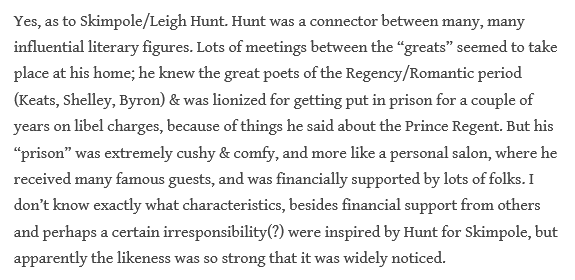
The Stationmaster comments on the real-life influences of many of our characters, and asks about the Skimpole/Leigh Hunt connection:

I responded, as to Skimpole/Hunt:
Rob refers us to Forster:

Then Rob delves deeper into the Skimpole rabbit hole (comment slideshow):

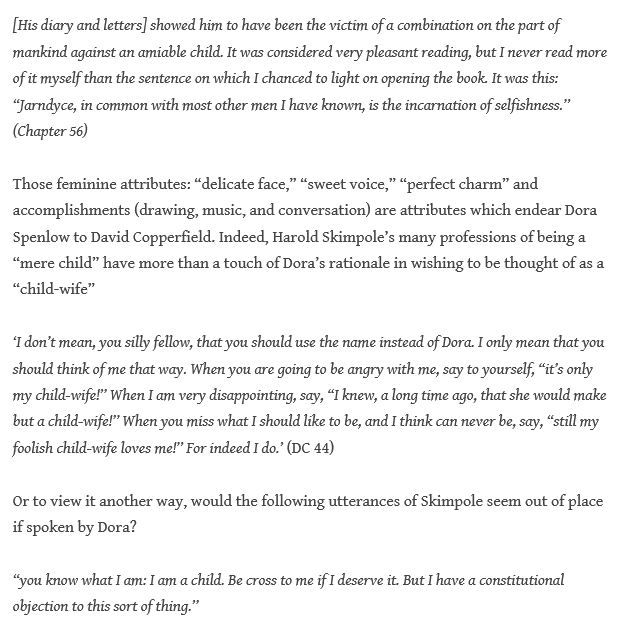

Rob G. comment
Here, Chris beautifully analyzes Bleak House in light of Jordan’s book, considering it as part of a larger Gothic tradition (comment slideshow):

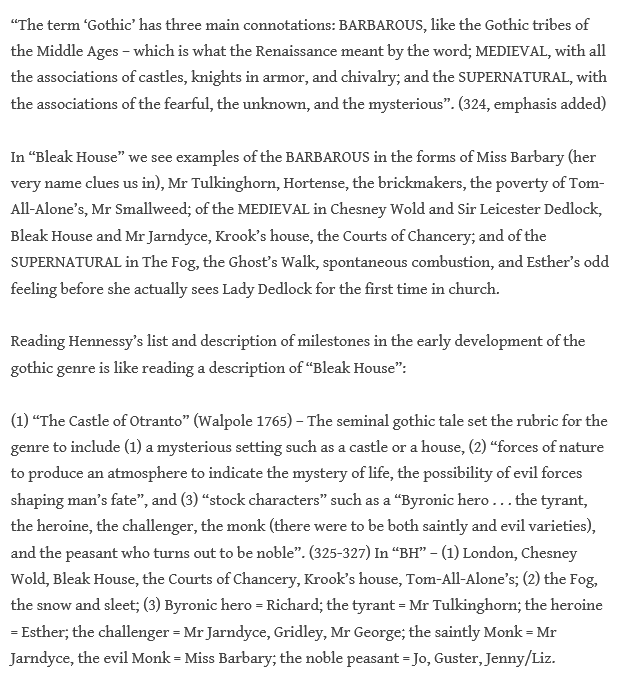

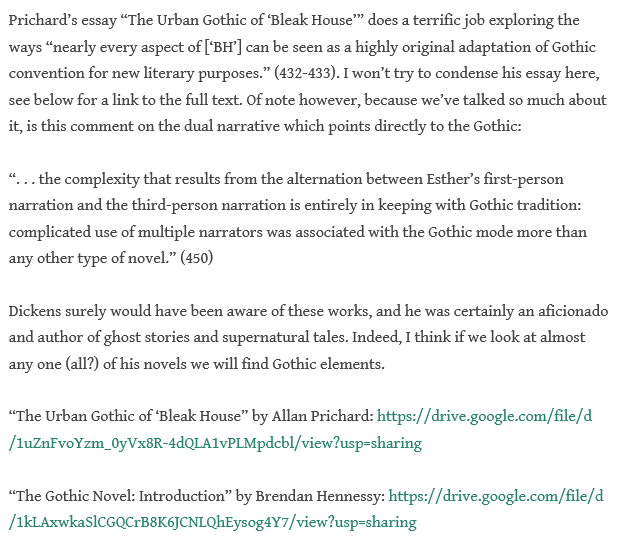
Chris M. comment
Character Spotlight: Sir Leicester Dedlock
The Stationmaster draws our attention to the fascinating characgter of Sir Leicester. (Lucy, too, in the zoom chat, discussed her love of his heroism at the end.)

Character Spotlights: The Buckets
The Stationmaster considers both halves of the Bucket couple, and particularly Mrs Bucket as “an intriguing offstage character”:

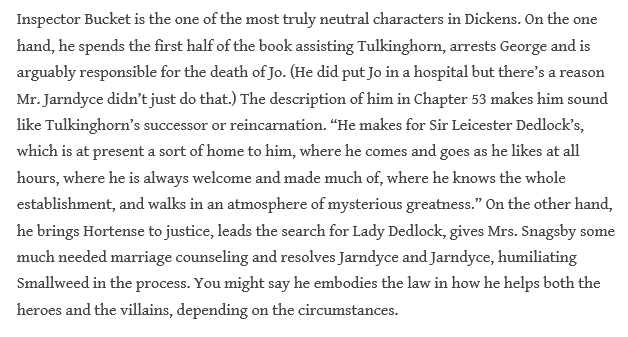
I comment on Mr Bucket:

Backstory
I’m including the full text of Chris’s marvelous section on the “backstory” of our complex characters:


Bleak House as Murder Mystery
Of course, Bleak House is a murder mystery, while including so many other elements. The Stationmaster writes:
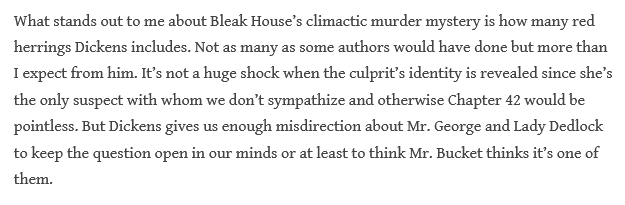
For a final question, which is part of the mystery and worthy of discussion:

Online Discussion Wrap-Up
Though we had a few members who had wanted to join but had a conflict and were unable to (Dana, Daniel), and a couple who had to leave early (Jeff, Rob), we had a lively discussion. So lively, in fact, that it is difficult to do justice to it in summary form.
Please consider these just as a few notes, which can’t capture the richness of thought! I hope you’ll add to it–or make any additional comments–below!
The 2005 Miniseries…& An Announcement!
- Huge thank you to the Stationmaster for his 5-part episode recap of the brillant 2005 miniseries of Bleak House. I asked: Who is watching? or has watched it previously?
- Several of us had: Chris, Lucy, Boze and I. Boze and I are currently on a rewatch, which will continue into the break.
- We adore the casting, particularly of Lady Dedlock and Tulkinghorn–what chemistry!–and Guppy.
- I am upset that Andrew Davies had Guppy “make” rather than “file” a declaration.
- Lucy was disappointed that they portrayed Sir Leicester’s impatience with Bucket–in the book, Bucket is revered, relied on, and sets up a temporary office in Sir Leicester’s house.
- Rob brought up the 2001 Nicholas Nickleby with Charles Dance as Ralph Nickleby, and a smashing Tilda and Fanny; Stationmaster loves the Fanny in the 2002 version.
- The sidetrack into Nickleby led to an announcement: Guess who proposed marriage this past week (Aug. 9) by reciting the whole of “Mr. Cucumber’s” speech to Mrs. Nickleby? That’s right…BOZE! Your Dickens Club Co-hosts are now officially engaged. (It has been a kind of unofficial but foregone conclusion for a while.) And, naturally, after he filed such a declaration, I naturally had no other answer than, “Barkis is willin’!”
“I have estates, ma’am…jewels, lighthouses, fish-ponds, a whalery of my own in the North Sea, and several oyster-beds of great profit in the Pacific Ocean. If you will have the kindness to step down to the Royal Exchange and to take the cocked-hat off the stoutest beadle’s head, you will find my card in the lining of the crown, wrapped up in a piece of blue paper…If you bless me with your hand and heart, you can apply to the Lord Chancellor or call out the military if necessary—sending my toothpick to the commander-in-chief will be sufficient—and so clear the house of them before the ceremony is performed. After that, love, bliss and rapture; rapture, love and bliss. Be mine, be mine!”
“Bleak House: Dickens’s Greatest Work? And/Or Your Favorite?”
- Many of us considered it his “best” work; for Henry, it was both “best” and personal “favorite”; most had other personal favorites (e.g. Chris = Little Dorrit; Rach = ATTC, Dorrit, and Pickwick; Boze = David Copperfield and Pickwick)
- Lucy felt the social satire was the most biting in this novel, especially in the 3rd person narration; “his sharpness was never exceeded”
- Henry felt that BH is the closest that Dickens gets to Shakespeare
- Rob noted that most of the Shakespeare allusions in BH are from the tragedies (Coriolanus, Othello; Miss Flite a soothsayer)
- Lucy: Esther/Lady Dedlock at the cemetery like Lear/Cordelia (Rach: “Come, let’s away to prison”/ the prison-like bars in the illustrations of this scene)
- Chris: there is so much packed into it!
- Lucy: It is like a cathedral…
…and Down the Rabbit Hole
From here, we didn’t even need to proceed with further questions, as one topic led to another…
- Henry brought up fascinating parallels with a book he is reading, The Bondwoman’s Narrative, a novel believed to have been written between 1853-1860 by Hannah Crafts, who fled from slavery in North Carolina. There is a huge Bleak House influence, including a very Tulkinghorn-like character. Henry noted that Frederick Douglass had published excerpts from Bleak House in his paper during 1853.
- Jeff had a hard time in feeling the full impact of the tragedy of BH, as so many of the issues that caused the tragedy are non-issues today, generally (e.g. having a child outside of wedlock), and this detracts from it
- Rach & Chris thought this might be part of Dickens’s point–society drives women who have made such choices to “move on”, to die (Chris references: Dickens’s work with Angela Burdett-Coutts & the importance of women in these situations to him)
- Women held to a different standard
- Stationmaster doesn’t have an issue
- Henry: the name “Dedlock” suggests that they are stuck in this position
- Chris: the Jo/Lady Dedlock connection – both must “move on”
- Lucy feels much more sympathy towards the Dedlocks, for example, than with the three young leads (Esther, Richard, Ada)
- Stationmaster: We root for Lady Dedlock
- Stationmaster: There is so little time devoted to the relationship between Allan and Esther
- Jeff feels this is a problem/weakness, and lends a disturbing tone to the whole conclusion with Jarndyce and Woodcourt, as though Esther is kind of passed off from one to another, rather than standing up for her own position
- On the subject of Dickens’s diffulty (or not) with writing women, Henry feels that this might be unfair; Adam Bede, for example, has similar issues b/c of the patriarchal system, and that was written by a woman; perhaps we underestimate these characters; perhaps Dickens is more of a feminist than he appears
- Chris recommends Supposing Bleak House, by John O. Jordan
Looking ahead…
- Hard Times coming up; 6-week schedule
- We got input from everyone about the next Zoom meeting, for Hard Times. No one had an issue with any of the dates proposed: Oct 14th, 21st, or 28th. (Note: If all things are equal, perhaps we will shoot for October 14th–that way, if everyone likes my inclusion of the online chat with the final wrap-up, we can schedule the final wrap-up for the Monday after the online meeting–i.e. a week later than it would usually be.)
Bleak House: A Final Thematic Wrap-Up
- Contrasts: Light & Dark; Comedy & Tragedy; Life and Death (Continuing this theme from the very beginning of our Club. Light/darkness–Phiz’s dual illustrations of Night/Morning during the search for Lady Dedlock.)
- Self-Definition Through Characterization; Dickens as the “Haunted Man”; “Wish Fulfillment” (Carrying on this theme from previous reads. Dickens as Jarndyce?)
- The Joys of Reading Dickens Aloud (Boze and Rach read or listened to this aloud together; Daniel and Dana have been listening; Rob loves the Miriam Margolyes version.)
- Dickens’ Women: the “Problem“ of Esther; Lady Dedlock, Mrs. Bagnet, Miss Flite (Miss Bagnet was universally popular. Divided opinions about Esther–some saw her as the example of what was wrong with Dickens’s portrayal of women; others loved her & suggested that her self-effacement was due to trauma. Lenny praised her selflessness and heroism in thinking of others first, even in her illness. For Many, Lady Dedlock a more compelling character than Esther. Miss Flite the Shakespearean truth-teller.)
- Responsibility and Debt; Am I My Brother’s Keeper?; Who Is My Neighbor? “Spiritual and Collective Responsibility”; Richard and “Spiritual and Psychological Slavery” (We discussed this from the outset, from Boze’s introduction and into the early weeks. Daniel brought this up; Skimpole as ultimate irresponsible “adult.” Daniel posted on our collective responsibility and Jo as model of where we have failed in it; also, the “slavery” of Richard and others who, ultimately, deflect their responsibility.)
- Dickens on Chancery: Impenetrable Fog, Spontaneous Combustion (The nickname “Lord Chancellor” for Krook, a place where persons’ lives are lost and ruined. Boze saw the combustion as also foreshadowing the horrors of the next century.)
- Dickens’ “Writing Lab”: Characterization & Character Arcs; Confrontations; Astute Psychological Portraits; “Neutral,” Problematic, or Offstage Characters; Bleak House as a “Gothic”; Writing Almost “On the Edge of Fantasy”; the Other Narrator (A number of members cared more of the peripheral or slightly secondary characters than the main three youthful ones, preferring the Dedlocks and Tulkinghorn, and George. Lenny brought up the confrontations “fraught with tension” between Lady Dedlock and Tulkinghorn. Henry brought up “the skulking atmosphere; the brisk, contorted prose; the perpetual sense of someone lurking”–Dickens is writing almost “on the edge of fantasy.” Jeff was frustrated by the way in which some of the issues–e.g. having a child out of wedlock–seem so out of date now that it caused him to disconnect a little from the story. Chris wrote of our phenomenal supporting characters, and the missing backstories, and the mysterious Miss Barbary. We all discussed at length the identity of the 3rd person narrator–Esther herself? Jarndyce? Chris adds thoughts from her research into this.)
- Dickens & Parentless Children (Charley and siblings; Jo; the wards in Jarndyce; Esther.)
- Doubling (Richard and Gridley. Stationmaster brought up Judy/Esther. Lucy brought up many doubles, from the various mothers, to the prodigal sons–Hawdon/Rouncewell.)
- Dickens & Shakespeare; Dickens and the Stage (Continuing this theme; Rob has been making note of the many Shakespeare allusions in the narrative. the Iago connection with Tulkinghorn. The Stationmaster wrote of some Macbeth allusions in the text.)
- Echoes of Ancient Battles (Rob made wonderful connections to the novella The Battle of Life, and real-life battles on some of the ancient grounds.)
- A “Pilgrim’s Progress” from One Novel to Another (His most complex, ambitious work yet–connecting so many stories and themes with his social commentary.)
- Forgiveness and Repentance (This ongoing theme continues in Lady Dedlock and Esther–a version of Edith Dombey and Floy–and in Sir Leicester. Also, in the Roucewells.)
- Ghosts and Memory (The Ghost’s Walk; Chris brought up the wonderful reference regarding Esther’s portion as “Ghost Story”.)
- Underlings: Power, Subservience, Sadism, Revenge, Rebellion (Tulkinghorn as the epitome of the Heep-like underling; power hungry, the need to control others, including those “above” them. Many brought up the sadistic nature of Tulkinghorn.)
- Dickens and Romanticism (A continued theme from early on in our readings; arguably contains some of Dickens’ most “poetic” prose.)
- Interconnectedness vs. “Tom-all-Alone’s” (The idea of Chancery as being at the heart of London, bringing so many lives together–only to destroy them. Rach & Boze: Jo as link between many stories, connected to the high and low, literally sweeping the “crossings” where people meet or pass one another. Chris discusses the almost unthinkably complex ways in which Dickens has his characters interconnect.)
- Telescopic Philanthropy; Colonialism; How to Do Charity Wrong (Mrs Jellyby, Mrs Pardiggle. Lenny and others brought up the implication of colonialism suggested by such “philanthropic” efforts as Mrs. Jellyby’s.)
- Dickens as “Master Heart-Breaker” (Continuing this theme from earlier works; shown especially in Lady Dedlock’s story, and Jo’s. As Lucy said, both must “move on” in the end.)
- The Reader in Dickens: We Are All Detectives (We find in Bleak House a plethora of “detectives,” most notably Mr & Mrs Bucket, Guppy, and Tulkinghorn. But we have discussed how, illustrated by multiple detectives within the story, the reader too is pulled into the detection as we interpret through the lenses of our narrators. Lenny brought up how the fog pervades our reading, too.)
A Look-Ahead to Our Break Between Reads, and Our Next Read, Hard Times
The next two weeks (14-28 August, 2023) will be our break between reads. It’s a fantastic chance to catch up if you’re feeling a bit behind, or to read something besides our Inimitable Dickens!

For those interested, the Adaptation Stationmaster posted a fantastic series of episode recaps of the 2005 BBC miniseries of Bleak House. (First post linked here.) If you’re going to watch during the break, feel free to comment under the posts, and share your reactions!
Next up: Hard Times, our nineteenth read of the group! Watch out for Boze’s introduction to Hard Times coming on Tuesday, 29 August, 2023.
 All the (Dickensian) Year Round
Rach – you’ve done it once again! So, SO well put together!
Corralling and collating all the information and all our comments from so many different sources is one thing, but you always manage to present it in such an enjoyable and readable manner!
Thank you!
LikeLiked by 1 person
I had a few more thoughts on Bleak House recently but I decided to refrain from commenting about them until this post was published because Rach had enough comments to summarize as it was. LOL. (Of course, if she wants to mention this one in her next post, the one about Hard Times, that’d be kind of nice.)
Chris wrote about wondering about the characters’ lives outside the story, mainly Capt. Hawdon. I kind of wonder about Rosa. She gets a happy ending, married to Watt Rouncewell, but how does she react when she hears the news about Lady Dedlock? No doubt she feels devastated that the woman who was like a mother figure to her, for a short time anyway, died so miserably. Does she also feel disgust at the revelation of Lady Dedlock’s sexual transgression? Or does she feel comforted that the reason Lady Dedlock coldly sent her away was apparently because she wanted to save her (Rosa) from being tainted by association? The branch of the Rouncewell family into which Rosa marries isn’t fond of the Dedlocks and would probably make her feel uncomfortable expressing any sympathy for Lady Dedlock. Then again, it’s implied that George will be hanging out with them more and he seems to sympathize with her.
Here’s another question. How would Sir Leicester feel about Esther? Would he resent her as the evidence of his wife’s disgrace? Or would he be drawn to her as a memento of sorts of Lady Dedlock, especially as she physically resembled her? Esther herself, I imagine, would probably want to avoid Sir Leicester as he’s a reminder of her traumatic relationship with her mother.
LikeLiked by 2 people
Something that stands out to me about Esther’s narration is how she presents her perspective “in the moment,” so to speak. She doesn’t often foreshadow how her opinions about the other characters will change. I’ve (affectionately) described Dickens in the past as a glutton for foreshadowing so that’s interesting to me.
The best example is Skimpole whom Esther describes fairly neutrally at first. She presents her initial reaction to his lifestyle and philosophy as “this seems wrong to me but, hey, I’ve led such a sheltered life and everyone else seems OK with it. I must be wrong.” Gradually, as the book proceeds and she’s confirmed in her negative suspicions about him, the gloves come off and she describes him in increasingly disgusted terms.
LikeLiked by 1 person
Stationmaster – these are wonderful wonderings! I love the speculation about Rosa. And if there were any question in the Ironmaster’s mind about Rosa’s suitability by association due to Lady Dedlock’s disgrace I think George, being intimate with Sir Leicester, could smooth the way by describing how Sir Leicester forgave Lady Dedlock.
I imagine that if Sir Leicester and Esther would meet they could help each other through their shared grief. It would be interesting to see how Dickens would treat such a meeting.
LikeLiked by 1 person