
Wherein The Dickens Chronological Reading Club Wraps up our third and fourth weeks (Weeks 97-98 of the #DickensClub) of Little Dorrit; including a summary and discussion wrap-up; with a look-ahead to Weeks 5 and 6.
(Banner Image: by James Mahoney; Engraved in Wood by the Dalziels.)

by the members of the #DickensClub, edited/compiled by Rach
Friends, it was difficult to choose a banner image for this portion of the reading, because there is so much to highlight from our discussion! The story of the princess and the tiny woman. Miss Wade and Harriet. Our beloved Flora Finching. (I’m beginning to think, as Lenny proposes, that this is indeed a “women’s novel”!)
Chris has beautifully analyzed the “Nobody” in “Nobody’s Fault”; Lenny, Rob, and the Stationmaster have given us so much to think about in terms of Miss Wade and Harriet; Lucy has given us some real-life doubling for engineers and inventors like Daniel Doyce; Rob and Daniel are loving Juliet Stevenson’s audiobook reading, and Dana is loving Anton Lesser’s.
Here are a few quick links:
- General Mems
- Little Dorrit, Book I, Chs 19-36 (Weeks 3 & 4): A Summary
- Discussion Wrap-Up (Weeks 3 & 4)
- A Look-Ahead to Weeks 5 & 6 of Little Dorrit (21 Nov to 4 Dec, 2023)
General Mems
Upcoming: Friendly reminder that, for those interested, the Adaptation Stationmaster will be leading us through an episode recap of the 2008 Little Dorrit miniseries after our final wrap-up! Watch the website on the week of 18 December. For those who are going to be watching (self-paced), feel free to comment under his posts to discuss your thoughts.
Also, a reminder that we will not be having a Zoom meeting on Little Dorrit until next year, due to the holidays.
If you’re counting, today is Day 686 (and week 99) in our #DickensClub! This week and next, we’ll be continuing with weeks 5 and 6 of Little Dorrit, our twentieth read as a group. Please feel free to comment below this post for the fifth and sixth weeks’ chapters, or use the hashtag #DickensClub if you’re commenting on twitter.
No matter where you’re at in the reading process, a huge “thank you” for reading along with us. Heartfelt thanks to our dear Dickens Fellowship, The Dickens Society, and the Charles Dickens Letters Project for retweets, and to all those liking, sharing, and encouraging our Club, including Gina Dalfonzo, Dr. Christian Lehmann and Dr. Pete Orford. Huge “thank you” also to The Circumlocution Office (on twitter also!) for providing such a marvellous online resource for us.And for any more recent members or for those who might be interested in joining: the revised two-and-a-half year reading schedule can be found here. If you’ve been reading along with us but aren’t yet on the Member List, we would love to add you! Please feel free to message Rach here on the site, or on twitter.
And for any more recent members or for those who might be interested in joining: the revised two-and-a-half year reading schedule can be found here. Boze’s introduction to Little Dorrit can be found here, and Chris’s supplemental reading materials for this novel can be found here. If you’ve been reading along with us but aren’t yet on the Member List, we would love to add you! Please feel free to message Rach here on the site, or on twitter.
Little Dorrit, Book I, Chs 19-36 (Weeks 3 & 4): A Summary
(Images below are from the Charles Dickens Illustrated Gallery.)
“Only think of me, father, for one little moment!”
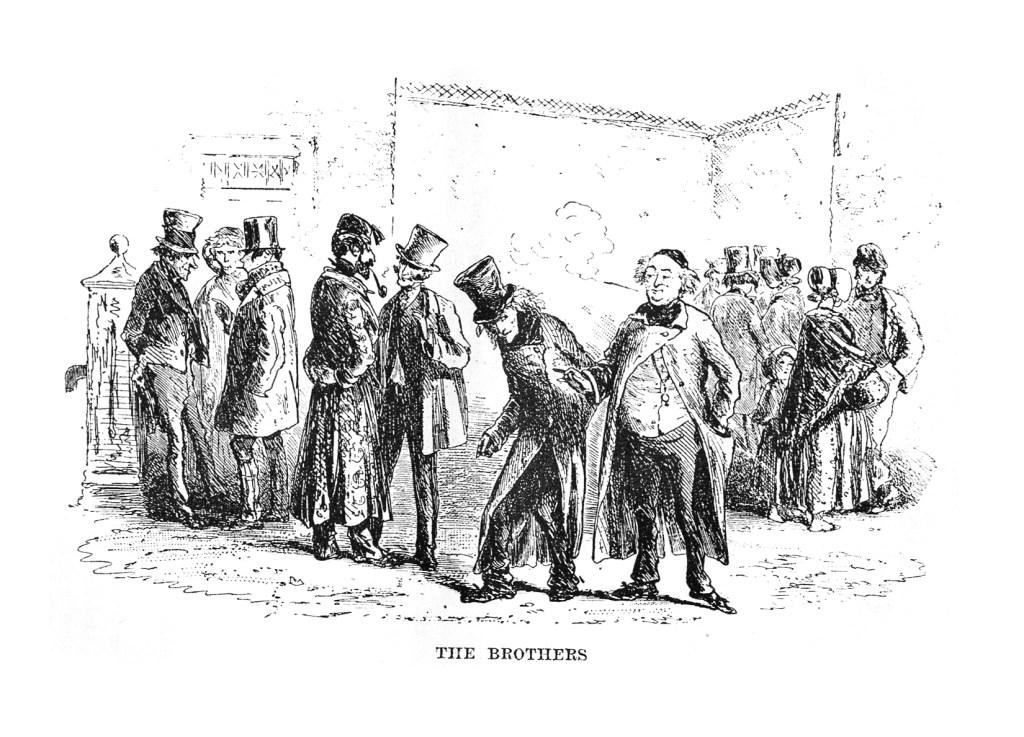
Mr Dorrit expresses to Amy his wonder that Chivery, the turnkey, is acting so strangely towards him, implying a dissatisfaction that Amy has been unable to return John Chivery’s romantic interest in her. (A side note: Is the kind of match that Mr Dorrit would have scorned in his former life, more acceptable to him now, as the idea of his daughter being united to the turnkey family would make him more comfortable in his imprisonment?) The Father of the Marshalsea bemoans his lost youth and promise, saying he wishes that Amy could have known him in the former time. Amy tries to cheer him. Through all his lamentations, Mr Dorrit seems to forget that his daughter has borne with the greatest part of the family misfortunes, as she heroically tries to provide for them all.
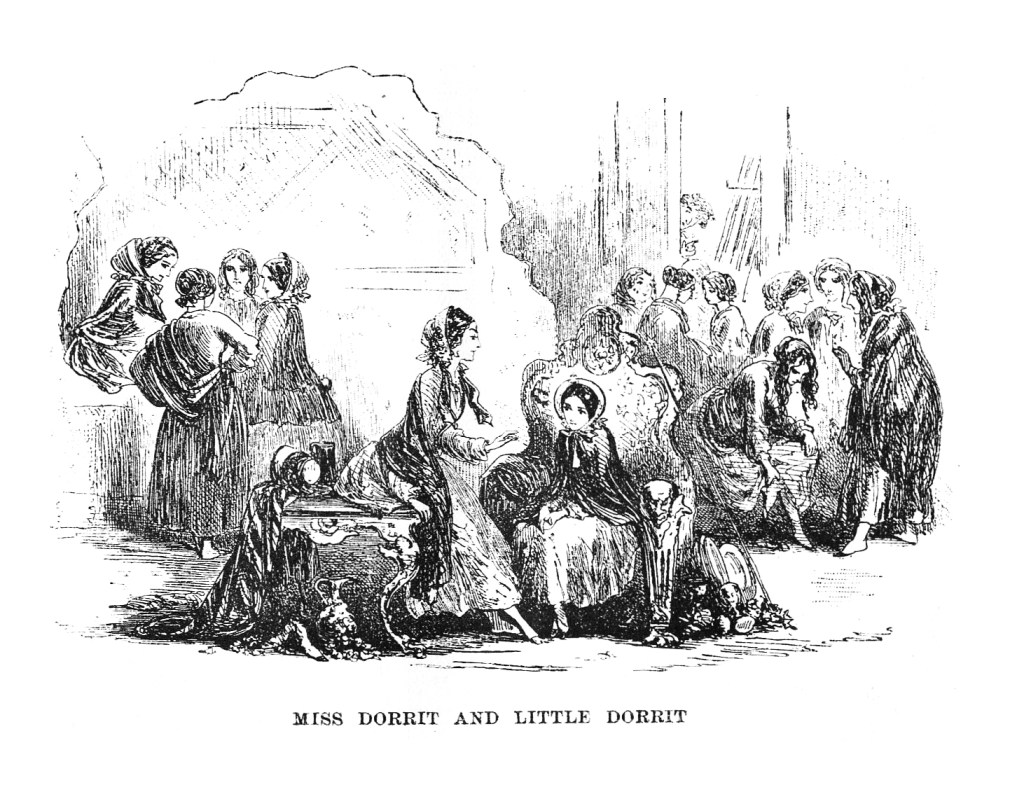
In the following chapter, we’re presented with two very different forms of pride and self-respect, in Amy and her sister Fanny. Amy ventures to the theatre where her sister is working, coming through the back entrance. Fanny is embarrassed by her presence there. Amy shows curiosity about an expensive-looking bracelet that Fanny is wearing, and Fanny takes her to visit Mrs Merdle, “bosom” of Society and wife of the great man of finance that everyone wants to invest with. Mrs Merdle explains to Amy that the bracelet was a gift for Fanny; Mrs Merdle’s son from a previous marriage, Mr Sparkler, is enraptured by Fanny, and Mrs Merdle is trying to buy Fanny off, to keep her away from her son. Fanny considers it spirited of herself to accept such a gift, to make such prideful people pay; Amy considers it distressing that her sister has been willing to, effectively, be bribed.
We then learn a little more—or rather, we are thrown further in the dark—about the mysterious Mr Merdle, darling of Society, who has some enigmatic “complaint,” some shadow of disorder in his mind. With all that wealth, why doesn’t he seem able to enjoy it? Why does the weight of the world seem to hang always on him? Why does he seem so…insubstantial? His wife was a good “investment” indeed—such a wonderful bosom on which to display all the jewels of wealth, and cover for his own mysterious insubstantiality and depression.
“Mr Merdle’s complaint. Society and he had so much to do with one another in all things else, that it is hard to imagine his complaint, if he had one, being solely his own affair. Had he that deep-seated recondite complaint, and did any doctor find it out? Patience, in the meantime, the shadow of the Marshalsea wall was a real darkening influence, and could be seen on the Dorrit Family at any stage of the sun’s course.”
Mr and Mrs Chivery confide in Arthur Clennam about their depressed son, John. Mrs Chivery is quite sure that Amy loves John, but cannot bring herself to change her situation in order to accept him. Essentially, they wonder if Arthur can gently influence her. Arthur feels some mysterious pang about all this, but wants Little Dorrit’s happiness above all. He approaches her as she walks along the Iron Bridge, and expresses some regret that she can walk with such freedom while her father can’t. Arthur comforts her, suggesting that it is good that she has such moments not only for her own sake but for others; she brings the freshness with her to cheer those in prison. Maggy then approaches them with some letters for Arthur—which Amy wasn’t supposed to know about—from Tip (who has shown no gratitude that he was let out of prison by Clennam) and Mr Dorrit. Amy, embarrassed and depressed, knows that they must be begging letters, and feels that she must go—she is better and more helpful at the Marshalsea. By this, we feel that the shadow of the Marshalsea that she has allowed herself to be engulfed in is darkening what vague hopes she has about Arthur.

Meanwhile, Daniel Doyce and Arthur Clennam have become partners, as the latter invests in the business and investigates the books to begin putting things in order. Flora visits his new workplace with Mr F’s Aunt—the latter ever comically biting and mysteriously resentful of him—and Flora, knowing Arthur’s interest in Amy Dorrit’s welfare, considers hiring her for some needlework. Pancks, too, is curious about Amy Dorrit and her family’s situation, and wants to investigate it; he will share whatever information he can find with Arthur. Arthur also vouches for Cavaletto, who is returning from the hospital and is looking to rent a room in Bleeding Heart Yard. Then, Pancks must go through the disagreeable task of “squeezing” the Yard tenants for their rent…and his boss, Casby, feels Pancks could have gotten much more out of the tenants if he had tried harder.
Mr Pancks finds Little Dorrit at Flora’s residence, where she has been hired. Flora, eager to have fresh ears for telling her story of the lost love for Arthur, is eminently kind to Amy, wanting her to eat and be comfortable and be friendly, and not be overzealous about working too hard. Though Amy was nervous about Pancks, he tells Amy not to mind him if she sees him hanging about; that he is a fortune-teller. In his very eccentric way, Amy seems to gather that he has a benevolent intention. (And she does indeed see him about the Marshalsea, hanging out with her brother, etc.)
Little Dorrit is becoming more and more withdrawn. At one point, while Arthur is to visit, Amy excuses herself from seeing him and remains in her own room, saying that she is not feeling well. She tells Maggy a story about a Princess and a little woman, the latter who has kept a treasure for so long: the shadow of a kind stranger who passed her one day long ago. No one knows about it, and the secret of this “shadow” will go to the grave with her.
Mr Pancks the “fortune-teller”—and detective—now has inquiries to make about the Dorrit family, and divides up the work with several accomplices, including John Chivery, who is happy to be distracted from his depression about Amy by doing something to serve her secretly. Pancks consults Mr Rugg as well—a lawyer that Pancks lodges with—and Mrs Rugg. Pancks has also taken a liking to John Baptist Cavalletto, who always seems to be, figuratively speaking, looking over his shoulder in fear of some person who is not there…
Arthur Clennam reluctantly visits Mrs Gowan, mother of Henry Gowan, at the latter’s invitation. Mrs Gowan is haughty and full of pretended dissatisfaction about Henry’s coming marriage to Pet, acting as though the Meagles had been ensnaring her son. (A marriage which he will get some money out of, though no position.)

While Arthur is missing Amy Dorrit who seems to be avoiding him, there is a new distress: Tattycoram has gone missing. Arthur suggests that she might have sought out Miss Wade; Arthur and Mr Meagles make inquiries about Miss Wade’s residence, and find Tattycoram there. Meagles tries to understand what has upset Tattycoram, who had finally felt one insult too many in a request that Pet had made to her. Miss Wade tells Harriet/Tatty that she can go back to the Meagles at any time and be their “slave.” Harriet refuses.

Letters are sent to Tatty/Harriet from the Meagles’, and they find out that Miss Wade and Tatty have left their residence. When Arthur visits the Meagles’s household, Pet asks Arthur confidentially to help fill the void that will be left in Pet’s absence at her marriage, and even soften their opinion of Henry Gowan. She gives him a “handful of roses.”
“When he had walked on the river’s brink in the peaceful moonlight for some half an hour, he put his hand in his breast and tenderly took out the handful of roses. Perhaps he put them to his heart, perhaps he put them to his lips, but certainly he bent down on the shore and gently launched them on the flowing river…the flowers, pale and unreal in the moonlight, floated away upon the river; and thus do greater things that once were in our breasts, and near our hearts, flow from us to the eternal seas.”

Strange things are afoot in the house of Clennam. Pancks visits one day as Amy is finishing work for Mrs Clennam, and the latter perceives that he is actually there for Amy Dorrit, who admits this, though Amy doesn’t understand why. Then Affery, frightened by a storm whose winds blow closed a door between herself and Mrs Clennam—Affery being now locked out—is offered assistance by a mysterious stranger who has some business with her husband, Flintwinch. The stranger offers to help Affery back in the house by climbing in through a window. Affery half fears he might actually murder Mrs Clennam, but he merely climbs in, and opens the door. When the stranger meets with Mrs Clennam, he calls himself Mr Blandois—though he greatly resembles the M. Rigaud whom we have previously met with—and takes an interest in the watch that Mrs Clennam keeps at her side, the last gift from her husband. Blandois jovially comments that the initials on the watch must signify a lady; Mrs Clennam says that they represent the words “do not forget.” Blandois arranges to meet with her again at another time. But Blandois doesn’t keep his appointment; he has returned to France. Flintwinch, however, is convinced that he’ll be back.

Poor Amy is in disgrace with Fanny and her father for having been seen in public walking with Mr Nandy, father of Mrs Plornish and a poor workhouse inmate. (Nandy had refused living with his daughter and son-in-law as was offered, as their finances were so strained already.) Little Dorrit is hurt by the accusations, as her father had always been kind to Nandy in private; Mr Dorrit lets the matter go, and invites Nandy up with a condescending show of kindness and pity for his infirmities. Arthur has joined them, having asked to see Mr Dorrit and Amy. (Amy had wished to retreat to her room but her father insisted she stay.) Another embarrassing scene for Amy follows, as Tip rebukes Arthur for not treating him like a gentleman. (Arthur clearly refused Tip’s begging letter, while obliging his father’s.) Mr Dorrit rebukes his son, and says that it the fault was more in Tip’s manner of approaching the request.
Arthur tries to comfort Amy in her distress at Tip’s behavior towards him. Amy then perceives that something is wrong with Arthur, and he alludes to having believed himself in love, but too old. Arthur assures Amy that he is not speaking of Flora, but of someone Amy doesn’t know. Arthur also perceives that something has been distressing her; she is paler and more withdrawn. He wonders whether she has a secret, which she denies. He asks if he might provide a lodging for her outside of the Marshalsea, but she feels she is better here.
Pancks approaches Arthur with most wonderful news about the fortunes of the Dorrit family; he hopes this matter will be settled soon, and so he asks Arthur to remain silent about it for the time.

Meanwhile, Mrs Gowan has approached Mrs Merdle—the latter being the voice and “bosom” of Society—for her opinion about whether Society will accept her son’s marriage to Miss Meagles. Mrs Merdle flatters Mrs Gowan’s fabricated sense of injury in the match—which will actually relieve Henry of debts and provide an allowance for him to study art in Italy—and tells her that Society always looks favorably on matches where money is a result. Later, Mrs Merdle reproaches her husband for not wearing his position in Society with a lighter and more careless demeanor; he is always weighed down. She asks her son, Mr Sparkler, to corroborate this. Merdle feels he has already given enough to Society.
The wedding between Pet Meagles and Henry Gowan takes place, with many Barnacles of the Circumlocution Office in attendance. Henry complains of his own sad fate—in thwarted work ambitions—to Arthur, who is annoyed that he shows such ingratitude on a day when he is gaining a wife such as Miss Meagles. Mr Meagles tries to bear it all well—but privately, he is despondent about his new son-in-law.
Pancks is finally able to tell Arthur that here is evidence that the inheritor of an unclaimed property is none other than Mr Dorrit. He is to be a free man, with a property ever increasing in value. Pancks says that he has had to borrow money for his trouble in the investigations, but he knows he will be repaid amply by Mr Dorrit for his trouble, and Arthur assures him of this. Pancks leaves Arthur to share the good news with the Dorrit family. He first goes to Amy, who is at the Casby’s home, working for Flora. Amy is overwhelmed by the news. They gently break the news to Mr Dorrit together, who is awestruck, and assures them that Pancks will be generously paid for his efforts. Arthur gives him some money to provide for immediate needs while they only wait for forms to be completed…Mr Dorrit will shortly be free.

All the Collegians of the Marshalsea are thrilled for Mr Dorrit and the family. Amy and Frederick seem to be the most awkward and resisting about flaunting their new situation before their fellow prison inmates; Fanny and Tip show off unabashedly. There is virtually a procession in the Marshalsea as the Dorrits enter the carriage to take their leave—only at the last moment do they realize that Amy is not with them. Arthur goes to find her still up in her room, having fainted before changing her clothes—she is still in her old dress. He tenderly carries her to the carriage, and asks them to take good care of her.
Discussion Wrap-Up (Weeks 3 & 4)
Miscellany and What We Loved: Juliet Stevenson’s Audiobook; Mrs Merdle; Friend-Zoning; Tip and Fanny as Characters in the Fairy Tale Tradition
Daniel and Rob have both been loving Juliet Stevenson’s audiobook narration:
The Stationmaster loves the character of Mrs Merdle, and “how obviously hypocritical she is with her talk of how she wishes she and her guests could revert to a primitive ‘natural state’ while she’s living in this big fancy house and wearing this expensive clothing and jewelry. (Remember how Squeers and Snawley eulogized nature in Nicholas Nickleby?) It seems like her parrot always shrieks when she says something obviously untrue, much like the way Mr. Dorrit ‘hems’ before saying something of which he’s ashamed.”
And he comments again:

A few other things Stationmaster noted: how “everyone is getting friend zoned in the first half of Little Dorrit,” and the satirical conversation in Chapter 33:

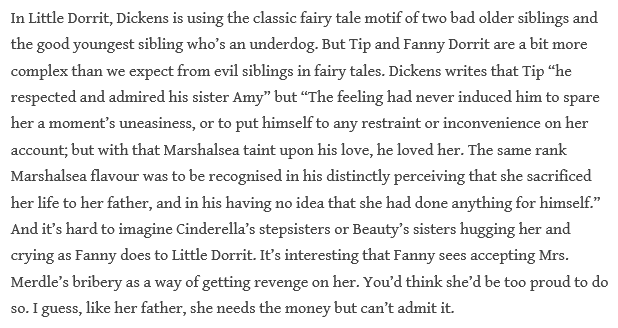
He also writes about the “classic fairy tale motif of two bad older siblings” in Tip and Fanny Dorrit:
The Women in Dickens ~ Especially Amy Dorrit
This week, we’ve shown a lot of love for Amy Dorrit, a truly unique heroine with a “poetic streak,” as the Stationmaster comments:
And Lenny, in response to the Stationmaster’s “catalogue” of Little Dorrit‘s various women, wonders whether Little Dorrit, too, is a “women’s novel,” and focuses in on our heroine, Amy:

Lucy responds:
And I agree with all of these wonderful insights:

“Angry” Women, “Soothsayers” and “Slaves”: Miss Wade and Tatty/Harriet; With a Note on Maggy and Mr F’s Aunt
Rob considers whether Miss Wade “might play a similar symbolic role to Miss Flite”:
Lenny is intrigued, and considers Miss Wade in light of a “soothsayer”:

Later, Lenny comments that he loves Miss Wade’s anger: “In fact, I wish more characters would get really angry in this novel. So much tiptoeing around, so much backing down. Time for some kind of revolution rather than mere subversion without making a social impact. This society of giving up must have totally rankled Dickens. Such passivity in the face of adversity and social stratification! Ugh!”
The Stationmaster is pondering on Dickens’s own view of these women and their “benefactors,” the “seriousness” of the women’s accusations, and how we read them today:
Lenny responds:

Lenny also wonders whether, if Tattycoram’s name, Harriet Beadle, is restored to her, it will be a vindication. The Stationmaster responds:

I respond:

And speaking of soothsayers…how about Mrs Merdle’s parrot and Mr F’s Aunt? Are they something in the tradition of Grip the Raven? Chris comments:
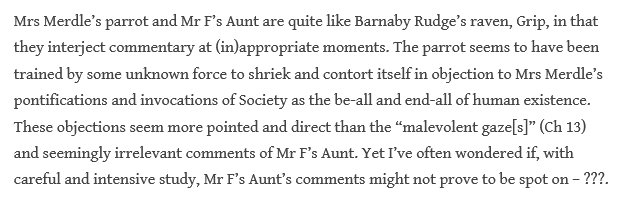
And Maggy too! The Stationmaster adds:
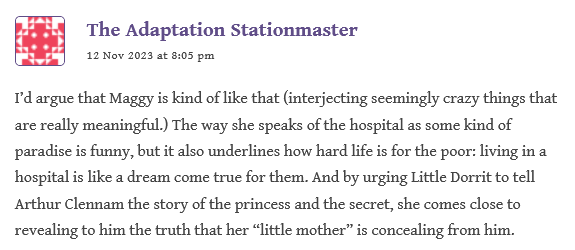
Shakespeare & Dickens: Miss Wade & Shylock
In keeping with our ongoing theme of Shakespeare and Dickens, the Stationmaster compares Miss Wade to Shylock: “Sometimes I think of Miss Wade as being like Shylock from The Merchant of Venice, a character whom the author intended to be totally evil but with whom modern audiences tend to sympathize and even agree with them on some issues instead of the protagonists. Sometimes I also think Dickens did intend us to sympathize with her on some things.”
I responded, really appreciating the Shakespeare connection: “I think, in a way, we are justified with sympathizing with Shylock because if he is asking for his pound of flesh, it is the society around him that has taught him to do so. I’m so curious now as to how everyone will react about Miss Wade…has society, or those who have brought her up, justified her cynicism? Or has she created her own hell? Hmmm…so much to ponder, & now there are some passages I want to reread in this light.”
Lenny responds that “the productions of THE MERCHANT I’ve see tend to present Shylock in radically different ways. One will show him as a sympathetic character, and the audience tends to be totally outraged by the main characters’ treatment of him throughout and at the end of the play, while another production will present him as hateful and we (in the audience) then think he received the punishment he deserved!”
Dickens & the Stage
Although the theatre hasn’t played a large part in our discussions on Little Dorrit, I thought I would give these comments their own place, in keeping with our running theme of Dickens’s relation to the stage:
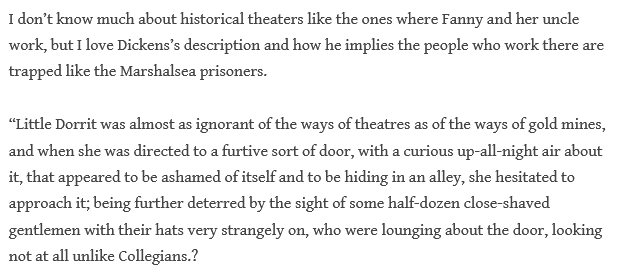
And a favorite line from Chris:

A Real-Life “Doubling”: Daniel Doyce and Robert Whitehead
Here, Lucy tells us a fascinating, real-life “doubling” story about Daniel Doyce’s counterpart:

The “Goal” of Men and Women in Society
This seemed appropriate for its own subheading in this section of the wrap-up, as it is an intriguing idea to carry over and discuss as we move on with the Dickens Club as a whole. The Stationmaster writes:

Who is the “Nobody” in “Nobody’s Fault”?
Chris gives a brilliant analysis of Dickens’s original title, Nobody’s Fault, and the somewhat elusive theme/persona that runs through this complex novel:


I respond, considering “Nobody” in the light of irresponsibility, carrying over this theme particularly from Bleak House, and as we move forward, into A Tale of Two Cities:

Character Spotlight: Flora Finching
We’ve all been thinking it, and Chris has put eloquent words to it: “Could there be a more wonderful person than Flora Finching?”


Lenny responds, discussing the depth of Flora’s character, and the “Chaplinesque” quality of hers that combines comedy with pathos:
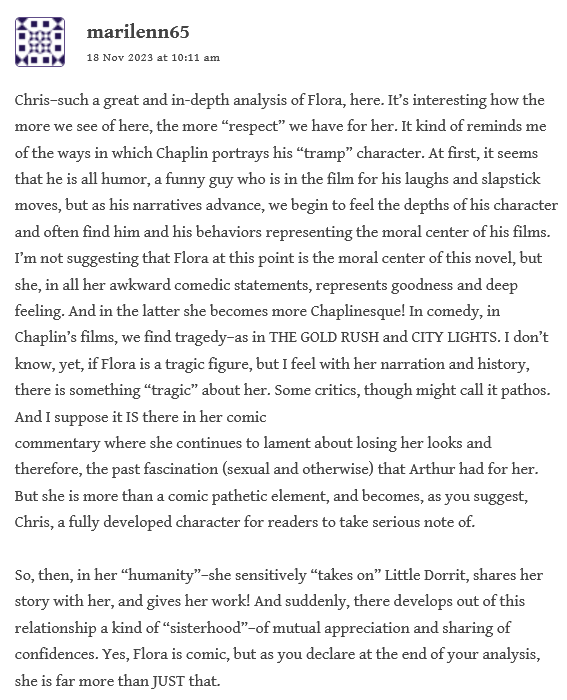
And Lucy and I give three cheers for Flora:

Character Spotlight: William Dorrit (and the 1987 Adaptation)
Lucy gives eloquent expression to the “agonising portrayal of William Dorrit,” and points us towards that wonderful and strange 1987 adaptation of Little Dorrit, where William is played by the brilliant Sir Alec Guinness:
And I will just add: Please do see this atmospheric, strange, and wonderful film! It is a favorite for Boze and me. It deliberately cuts some important threads/characters, but highlights other things in the most wonderful way. The first part is all told from the perspective of Arthur Clennam–and Amy Dorrit herself is at first little more than a quasi-invisible presence, like a spirit; she is sometimes so quietly spoken (implying that she is unheard/unseen by all) that one must lean in to catch her. Then, in the second part, we see things from her perspective, and the effect is wonderful. Sarah Pickering, Sir Alec Guinness, Miriam Margolyes…all are brilliantly portrayed.
Lenny responds to Lucy:

A Look-Ahead to Weeks 5 & 6 of Little Dorrit (21 Nov to 4 Dec, 2023)
This week and next, we’ll be reading the first half of Book II (Chapters 1-18) of Little Dorrit. These chapters constituted the monthly installments XI-XV, which were published between October 1856 and February 1857.
Feel free to comment below with your thoughts, or use the hashtag #DickensClub if you’re commenting on Twitter/X.
If you’d like to read it online, you can find it at a number of sites such The Circumlocution Office; you can download it from sites such as Gutenberg.
 All the (Dickensian) Year Round
Dear Inimitables!
There is so very much rich conversation and insight here—far too much to comment on. Thank you, All, for the enrichments!
I have various thoughts running through my porous brain! I’d like to share one key impression, which is in some ways so obvious and in other ways elusive, because it shows up in myriad forms: imprisonment.
Chris alluded to the “captive audience,” sounding the prison motif.
Imprisonment of the mind, the body, the soul. The imagination, the emotions, the hopes and dreams.
There are so many ways in which various characters in “Little Dorrit” remind us of our countless “imprisonments.”
Here are but a few:
1. The Marshalsea: The Collegians experience the most basic and physical imprisonment for insolvency, for debt.
2. Egoic preoccupation: The Oscar may go to Mr. Dorrit for his almost pathological pre-occupation with his own place (Father of the Marshalsea) and his obliviousness about the constant care and attention of Amy.
3. Irresponsibility: Tip showcases the circular, no-exit quality of chronic and incorrigible irresponsibility.
4. Wealth/status: The Merdles family is entrapped in the illusions of wealth, its privilege, its power.
5. Unforgiving, rigid religion: For me, the most disturbing imprisonment is what Mrs. Clennam experiences in her hard-hearted, unforgiving, and egregiously self-righteous “religion”:
“Great need had the rigid woman of her mystical religion, veiled in gloom and darkness, with lightnings of cursing, vengeance, and destruction, flashing through the sable clouds. Forgive us our debts as we forgive our debtors, was a prayer too poor in spirit for her. Smite Thou my debtors, Lord, wither them, crush them; do Thou as I would do, and Thou shalt have my worship: this was the impious tower of stone she built up to scale Heaven.” (Book I, chapter 5)
Oy gevalt!
As with any great literature, we are called to inquire about our own imprisonments.
Blessings, All, wishing you and yours a blessed and happy Thanksgiving!
Daniel
LikeLiked by 3 people
Terrific Daniel!
I’m not sure which is worse, the physical prisons (the Marshalsea, Mrs Clennam’s wheelchair, poverty, wealth) or the psychological ones (Ego, irresponsibility, religion). I’m thinking the psychological ones have a leg up on the physical ones because most of them are self-imposed and could be eradicated (or at least eased) by a little more self-respect and a little less image consciousness. So much of what characters in this novel do is for the benefit of others – but not in the sense that what Amy does is for the benefit of others. I mean, they posture and attitudinize so that others believe they are something they are not. This prison of keeping up appearances, of maintaining one’s image has to be the most exhausting and the most damning because, as we see in so many characters, once one begins to believe the ruse it is nigh impossible to break free of it. SPOILER ALERT – Usually the release comes from some outside source and is as unexpected as Mr Dorrit’s new-found wealth, but rarely is it ever as exciting.
LikeLiked by 3 people
Lordy, Daniel, what a wonderful way to sum up the various kinds of imprisonments the characters in LD suffer from. But not only does your list get at the personalities who “highlight” these kinds of “entrapments” but it really allows the novel’s readers a set of terms which we can feed BACK into our readings of the first 4 segments of the novel (for more understanding), but also a terminology that we can apply GOING FORWARD into the next two segments of the novel–and probably beyond that to the novel’s finish! You’re the voice of wisdom, speaking here, and it speaks loudly and clearly!
LikeLiked by 1 person
And….Hats off again to Rachel who does a masterful job of summing up the chapters from parts 3 & 4 of LITTLE DORRIT which we’ve just completed. More than her wonderful enumerations of events and characters in this segment of our reading, she has ALSO collated our various remarks and internal discussions **so fluidly** as to almost take my breath away. I don’t know how you do it, Rachel, but each time I read this part of our reading and writing experience, I come away knowing so much more about the structure and personalities of the novel than I had during my initial reading of the Dickens text. You have a knack for picking out the salient points in the huge array of analyses that we as a group devise during a two week period–and that really helps me appreciate all the more the depth of the commentary that the group creates. Kudos, Kudos to you, and many kudos to our group for its thoughtful remarks about this dark and really difficult novel….
LikeLiked by 2 people
Lenny, many thanks for your kind observations about the various entrapments, imprisonments, and confinements . . . and the personalities/characters that embody them.
And, I would like to utter a resounding and vigorous AMEN!!! to your appreciation for Rachel’s astonishing capacity to summarize, distill, synthesize, and otherwise dazzle us!
LikeLiked by 2 people
The “place” of Women in this novel–is a topic that seems unavoidable–because it appears to me that they in their roles far overshadow the roles of the men, at least in the novel’s first half. Generally, and for better or worse, depending on their circumstances, these women are the doers, the ones who make the differences during the various situations that our author creates. We’ve listed their names many times, we’ve talked lots about what they do, how they do it, and what the consequences or lack of consequences come out of their activities, but they are always verbal, mostly in the foreground, and, for what it’s worth, take over the narrative for long chunks of time.
Of course the two most prominent men in this fiction are also VERY important, and much of the novel’s activity is facilitated by them and directed toward them. They would be Arthur and Mr. Dorrit. But yet they are surrounded by women, who hover over and beside them, debate, converse, manipulate, and argue with them. And the women also talk, talk, talk among THEMSELVES! Mrs. Clennam with Amy; Amy with Maggie, Flora, Fanny, Mrs. Merdle; Miss Wade with Pet, Pet with Mrs. Merdle, and the list goes on….
With the exception, then of Arthur and Mr. Dorrit, the men are usually in the background. Mr. Merdle, Mr. Meagles, Henry Gowan, Edmund Sparkler, Tip Dorrit, John Chivery–are IN the novel, but suffer from some kind of general or specific male malaise. Merdle is obviously “ill, ” Henry Gowan is a dandy and rather stupidly shiftless, John is a hopeless romantic, Edward might well be a useless alcoholic, and Mister Meagles–another man of some money–is quite flustered in his role of parent and head of the family. Unlike the novel’s women, there’s not much talk amongst the men.
Apart from these men, Pancks the fortune teller is somewhat different: he sppears to be “shady”–a kind of nasty, dirty character, but he still shows his viability and astuteness in his various roles. He’s not quite caught the general sickness of the other characters, but he still seems questionable in his dress and his peculiar behaviors. What’s most interesting in HIS case, is that he has a “strong” but strange relationship with Amy. But much of the time his activities take place OFF the stage of the novel. He’s in the shadows–whereas the other men are sort of imperfectly characterized as just **there** in some capacity.
For me, then, it’s the women who really SHINE in the first half of this novel–the ones who are dynamic, even dynamos, at times, always surprising us with their insights, decisions and capabilities. I wouldn’t say that they are–as a group–always morally or politically correct, but their actions and THEiR consequences really set the bar pretty high, especially when compared to many of their male counterparts–whose activities and consequence “bar” is pretty low!
LikeLiked by 2 people
I confess, similar to how I feel about the description of Marseilles at the beginning of Book 1, I find myself getting impatient with the description of the Alps at the beginning of Book 2. It’s not badly written at all, but I just want to skip to the characters and the dialogue.
It is interesting though to see Dickens setting part of the story outside of England, something he hadn’t done since Martin Chuzzlewit. (Wait. Did The Battle of Life take place in another country? I forget.) He must have enjoyed it since his next book would be A Tale of Two Cities. While he views Italy and Switzerland with the eyes of an outsider, he doesn’t take portray them nearly as negatively as he does of America or France, adding to the uniqueness of this aspect of Little Dorrit.
Dickens’s main purpose, of course, in portraying Little Dorrit’s unhappiness in the lap of luxury is to positively contrast her practicality and humility with high society’s preoccupation with showing off. But you also get the impression that there’s something unhealthy about her mind, not unhealthy in the sense that she’s being immoral but unhealthy in a she’s-her-own-worst-enemy kind of way. It almost feels like she’s so used to being poor that she can’t enjoy being well off. (Remember Miss Wade’s question. Does a prisoner forgive his prison?)
Actually, if you wanted to be cynical, you could say there is something selfish about Little Dorrit’s mindset. Does she resent that her father doesn’t need her help now? Or, less cynically, does she see that he does need her help but that he doesn’t see it himself?
Believe it or not, there’s a plotline from the movie, Cinderella II: Dreams Come True that is very similar to this section of Little Dorrit. In particular, there’s a character who is the soul sister of Mrs. General. Since this book is pretty under-the-radar, it’s doubtful she was written to be an intentional homage but it hard not to wonder when she expresses a liking for prunes. If that’s a coincidence, it’s a fun one. That movie got terrible reviews so the fact that a large part of it might be a reference to Little Dorrit makes me feel less embarrassed about enjoying it as a kid.
Speaking of Mrs. General, it sounds like she’d get along well with Gradgrind. “I have mentioned to her that it is better not to wonder.”
Frederick Dorrit’s outburst in Chapter 5 is great. It’s so out of character for him that it almost feels like he’s been possessed by some supernatural entity that is foretelling doom on the Dorrits if they don’t mend their ways.
I don’t remember the marks on Rigaud’s hand that Gowan mentions in Chapter 6. Did his late wife give them to him? Does anyone want to go back and reread the first chapter of Little Dorrit to look for references to them?
I love Little Dorrit’s comparison of the English tourists in Italy to the debtors in the Marshalsea Prison, the idea being that these tourists have been “exiled” for being embarrassing to their rich families. I wonder if that was true back then or if it was just a stereotype. And I adore this quote.
“Nobody said what anything was, but everybody said what the Mrs. Generals, Mr. Eustace, or somebody else said it was… Mrs. General was in her pure element. Nobody had an opinion. There was a formation of surface going on around her on an amazing scale, and it had not a flaw of courage or honest free speech in it.”
Little Dorrit has some of the funniest social satire in all of Dickens.
Skip this paragraph if you haven’t read the book before. I’m scared it might give away too much too soon. It also contains broad spoilers for Dickens’s later books. It’s interesting to contrast Little Dorrit with earlier stories Dickens wrote. In Oliver Twist, Nicholas Nickleby and David Copperfield, the main character is born a member of the gentry but loses their money and social status somehow, only for it to be restored to them by the end of the book. This traditional fairy tale plot reflects Dickens’s own experience of his father landing in debtor’s prison, forcing him to get a lowly job at a young age. In Little Dorrit, the main character’s money and social status are restored halfway through the book but for every problem resolved by this, she gets two new ones. In Great Expectations, the character isn’t even born a member of the gentry though he wishes he had been, and, like the Dorrits, his wish suddenly falls into his lap, but his troubles, far from being resolved, are just picking up steam. Our Mutual Friend actually ends with one of its main characters giving up their social status and this is presented as a positive thing. It seems that Dickens became increasingly cynical about the gentry as he grew older or, at least, about the idea that being a member of the gentry solves all of life’s problems.
LikeLiked by 1 person
Stationmaster: Yes, I think the scratches are suggested to be from his struggle with his late wife:
“For the rest, he was large and tall in frame, had thin lips, where his thick moustache showed them at all, and a quantity of dry hair, of no definable colour, in its shaggy state, but shot with red. The hand with which he held the grating (seamed all over the back with ugly scratches newly healed), was unusually small and plump; would have been unusually white but for the prison grime.”
AND
“At length, Madame Rigaud, in an access of fury that I must ever deplore, threw herself upon me with screams of passion (no doubt those that were overheard at some distance), tore my clothes, tore my hair, lacerated my hands, trampled and trod the dust, and finally leaped over, dashing herself to death upon the rocks below. Such is the train of incidents which malice has perverted into my endeavouring to force from Madame Rigaud a relinquishment of her rights; and, on her persistence in a refusal to make the concession I required, struggling with her—assassinating her!”
(Bk 1 Ch 1)
She must have struggled very vigorously indeed for the scratch scars to remain on his hands for so long!
LikeLiked by 2 people
I love this bit about Fanny Dorrit.
‘I should think so,’ observed Miss Fanny, with a toss of her head and a glance at her sister. ‘But they would not have been recalled to our remembrance, I suspect, if Uncle hadn’t tumbled over the subject.’
‘My dear, what a curious phrase,’ said Mrs. General. ‘Would not inadvertently lighted upon, or accidentally referred to, be better?’
‘Thank you very much, Mrs. General,’ returned the young lady, ‘no, I think not. On the whole I prefer my own expression.’
This was always Miss Fanny’s way of receiving a suggestion from Mrs. General. But she always stored it up in her mind and adopted it at another time.
Fanny has a much more rebellious personality than Little Dorrit but at the end of the day, she dances to society’s tune. Little Dorrit is arguably the real rebel against social expectations for all her demureness.
Actually, it occurs to me that Little Dorrit can be considered the anti-Bounderby. Bounderby was always bragging about how hard he’d had to work to get where he was, unlike the people who had inherited wealth, but he was obviously obsessed with getting in good with those same people. Little Dorrit, whom it’s implied had a harder start in life than Bounderby really had, doesn’t brag about her life struggle but neither does she care about impressing the “old money.”
Remember how I described Little Dorrit as having structural problems? Well, here’s one of them. (Your mileage may vary on how much it’s a problem for you. I’m just saying it’s a problem for me on a first read.) We’ve probably figured by now that Rigaud knows some big secret of Mrs. Clennam’s. For most of the second half of the book, he just dances around in the background and sometimes the foreground of the story doing nothing but remind us that he knows something. It gets kind of annoying. If I were Dickens’s editor, I might have suggested revealing half the secret to the readers, though not to the characters, at the halfway point.
Contemptible and infuriating as Mrs. Gowan certainly may be, she drops a great bit of snark in Chapter 8.
‘Mother!’ cried Mr. Meagles. ‘Do you hear this! Arthur! Do you hear this!’
‘The room being of a convenient size,’ said Mrs. Gowan, looking about as she fanned herself, ‘and quite charmingly adapted in all respects to conversation, I should imagine I am audible in any part of it.’
Chapter 9 is probably Mr. F’s Aunt’s funniest hour. Interestingly, her dialogue, if not her attitude, starts to be more explicable. She says, “drat him, if he an’t come back again,” when Clennam arrives. She says, “None of your eyes at me,” when he looks at her plaintively. And she says, “he has a proud stomach, this chap,” after he declines to eat her crusts.
Reading Chapter 12, I actually started to feel sorry for the new member of parliament who is intimidated by Lord Decimus Barnacle. It’s interesting to read an outsider’s perspective on the Dorrit family’s fortunes in that chapter.
I wonder if it’s no accident that Dickens describes Arthur Clennam as being like “like a journeyman Hamlet in conversation with his father’s spirit” as he tells Pancks his life story. Both Clennam and Hamlet are melancholy and have (sort of) been sent on missions by their deceased fathers to right old wrongs and both resent their mothers. I don’t really see any thematic connections between Pancks and the Ghost though.
He doesn’t do much in the story, but I love Edmund Sparkler. He reminds me of a dumber, more passive version of Bertie Wooster from the Jeeves books by P. G. Wodehouse. It’s a good thing he’s so oblivious to everything or I might feel sorry for the guy because of how Fanny uses him.
LikeLiked by 1 person
Stationmaster, too many wonderful things to comment on here, but I just had to add in my appreciation of Mr Sparkler…he’s an absolute delight! And VERY Wodehousian! I love the way he’s played in the 2008 miniseries, and I can’t help but think that Fanny did really marry “up” in getting him–because he’s so darn sweet. Not the sharpest tool in the shed, but a good egg. (Fanny has SO much potential and is clearly intelligent, but she is determined be condescending and to fall in with the expectations of Society.)
LikeLiked by 1 person
Every time I read this story I can’t help wondering what on earth possesses Pet Meagles to be attracted to Henry Gowan let alone marry him. He may be good looking and have attractive manners – at first – but the more one gets to know him the less there is to like. The only thing I can figure is that she falls into the old my-love-will-inspire-him-to-change-and-become-the-man-he-was-meant-to-be fantasy. And if Henry’s powers of persuasion are strong enough to convince Pet of his worthiness one would think he’d be able to persuade his Barnacle relatives to set him up as he seems to expect they should.
Pet has already learned to keep things from him. She initially downplayed her injury from her fall from her mule on the way up the mountain to St. Bernard’s, only to have to remain at the Hospice an extra day because of it. Then she tells Little Dorrit to keep Arthur’s letter to her (Pet) so Henry won’t find it and inadvertently (or not) say something about it in the presence of the Dorrit family. She can also have not missed that he maintained and encouraged the association with Blandois against and more spitefully because of her objections. And the way he treats his dog makes me very worried about Pet’s (ironic name) domestic safety.
Henry Gowan is certainly his mother’s son though he is more covert than she in his delivery. She does little to disguise her snarky remarks, feigning ignorance and mis-comprehension to deflect her rude, dismissive, and outright false statements. Henry, at least, mostly speaks the truth but he does so in a way that is equally rude and dismissive and also misinterprets or misrepresents the motives and/or actions of others (especially his Barnacle relatives). Their fabricated of story that Henry had compromised himself by marrying Pet, that her beauty had trapped him, that her parents sought to entrap hi to bolster their and Pet’s social position is just so mean. Deflect, deflect, deflect – but their reflection in light of that deflection is not pretty.
LikeLiked by 3 people
I hate Mrs Gowan most. I feel she is downright evil. She is a determined liar and twister of reality, and she uses her social position to enforce her lies. She has the power.
Henry’s casual hurtfulness and opportunistic distortions are worrying, but Mrs G. is so much worse. She is ruthless. She reminds me of certain politicians in a certain part of the Middle East at the moment.
LikeLiked by 1 person
What a rich novel this is. We have extraordinary character studies like William Dorrit – who is bad enough, really, I feel, except Dickens also pities him, deeply (and so do we, of course) – and then in Mrs Gowan we have someone seriously bad. She’s much more frightening than Rigaud, who I can’t mostly take seriously. The cartoon foreigner stuff, and the moustache. He’s such a caricature. The only time he frightens me is in Henry’s ‘studio’ in his implied, unseen response to the dog.
And then the evil that Mr Merdle is. That’s subtle and difficult.
LikeLiked by 1 person
Chris: I love your opening assertion, here: “Every time I read this story I can’t help wondering what on earth possesses Pet Meagles to be attracted to Henry Gowan let alone marry him. He may be good looking and have attractive manners – at first – but the more one gets to know him the less there is to like.” This quote speaks loads about the way I and most readers feel about this relationship and marriage. There is nothing to “like” about Henry; just about everything he does (to Pet, to his mother, to his dog) makes him despicable. He may represent the apotheosis of evil in this novel. And the fact that he has attached himself to Blandois (Rigaud) is a kind of symbolic connection to the “dark” side of things (as they subversively move through the novel), as well as to his companions’ ugly conduct toward HIS wife (he literally kills her!). In this respect, his behavior to Pet really parallels that of Blandois’ treatment of his wife–only it’s not so dramatic. In the words of the song, he’s “killing her softly.” Well, perhaps not so “softly” after all; but we witness his awful behavior through the eyes of Amy who, in her letters to Arthur, describes her sad impressions of how that marriage relationship is deteriorating .
But isn’t this marriage of Henry to Minnie Meagles emblematic of a larger theme in the novel, a narrative which focuses on the rather sordid behaviors that husbands and wives direct toward one another? Affrey and Jeremiah Flintwinch really take the cake in their dysfunctional marriage, as will Fanny and Edmund Sparkler. In the one case, Affrey is brutally victimized by her husband, where she is little more than chattel to him, and in the other Fanny will torment and abuse Edmund not only to control him but to spite his stepmother. And then there is the suspicious case of Mrs. Clennam and her relationship with HER husband, and Mrs. Merdles’ anger toward Mr. Merdle’s inability to become the social maven which she claims herself to be. He is continually browbeaten by her for his social inadequacies and his regularly attending to the business of others, leading to his absenteeism as a husband. In this, he, too, is at fault!
As a foil to these flawed and decayed marriages, we see the constructive marriages of the Plornishes and the Meagles. Here, the husbands and wives act as helpmates to one another as they together find ways to survive in a world that is constantly threatening their well being.
Nevertheless, the highlighting of Pet’s marriage to Henry is of the utmost importance in this novel
Therefore…
…I think, then, that LITTLE DORRIT is constantly, either directly or indirectly, asking the question–in its presentation of these various male/female relationships–“What makes a good and satisfying marriage?” How is this nuptial fulfillment to be achieved in a world which is repeatedly challenging its fruition, its hopefulness! Perhaps, as we continue through this maze-like narrative, we’ll get some answers to this all important question….
LikeLiked by 1 person
My best guess about Pet and Gowan is that she’s so naive that his cynicism seems “cool” and impressive to her. That’s the only thing I can possibly come up with anyway. LOL
LikeLiked by 1 person
The dynamic between Fanny and Little Dorrit, with the former always asking for advice but never taking it to the point where the latter has given up trying to reason with her, feels realistic to me. Sometimes I’m probably a little like Fanny when I ask for advice.
The way Mr. Dorrit delights in his elder daughter’s engagement and totally ignores her questionable motives for agreeing to it reminds me of Mr. Gradgrind from Hard Times with his daughter, Louisa though I’d say he was slightly better than Dorrit. At least Gradgrind seemed vaguely aware that something was up since he asked Louisa if there weren’t any other guys she liked better.
I was surprised to read that “the Courier had not approved of Mr. Dorrit’s staying in the house of a friend.” I’d kind of assumed that Mr. Dorrit was unable to make friends because of his fear of anyone discovering his dark secret.
Here’s something else to love about Flora. She just happens to tell Mr. Dorrit exactly what he needs to realize about his younger daughter, mainly that he shouldn’t be ashamed of her working to support him in his distress. If only he’d listen to it!
“…and Goodness knows there was no favour in half-a-crown a-day to such a needle as herself but quite the other way and as to anything lowering in it far from it the labourer is worthy of his hire and I am sure I only wish he got it oftener and more animal food and less rheumatism in the back and legs poor soul.”
Mr. Dorrit reminds me of Mrs. Steerforth from David Copperfield, not in his personality or in his dramatic role, but in how Dickens makes me totally despise him one moment and sincerely pity him the next. His sending a “testimonial” to the inmates of the Marshalsea via John Chivery is an example of his pride and vanity but it can also be read as real compassion for those suffering the same plight as himself, especially given the questions he asks beforehand.
Speaking of John Chivery, I wanted to respond to Rach’s question about Dorrit being in favor of a match between Chivery and his daughter back in the prison days despite him being a lowly turnkey. I could be wrong, but I don’t think he actually said that he wanted them to get married. (He does in the 2008 miniseries on the grounds that this would keep Little Dorrit near him 24/7.) If John Chivery did propose to Little Dorrit and if she accepted, it would probably shame him. The impression I got from the book was that he was just worried about negative repercussions for himself if his daughter outright rejected the son of the turnkey.
It may seem strange that the social climbing Mr. Dorrit would be attracted to Mrs. General, a lowly paid companion but they’re personalities really are alike. Remember how in Chapter 2, Mrs. General was offended by the very mention of payment for her services but was quick to point out that she would be providing them for two daughters, not just one, and that her salary should reflect that. Sounds like Mr. Dorrit in his “Father of the Marshalsea” days. Maybe it’s like Bar says in Chapter 12. “Like flies to Like.”
I’ve been trying to think of a good reason why I’m sometimes annoyed by Esther Summerson’s narration in Bleak House (not all of it, mind you, just some of it) but I don’t have a problem with Little Dorrit’s letters. Technically, she does a lot of the same deferential things Esther does, such as reiterate that she’s no one special and her opinions should be taken with a grain of salt and apologizing for writing about her own problems so much. I think a lot of the reason might be because of the “framing device.” Those kinds of demurs are what I’d expect from a politely written letter, especially one from a single woman to a single man in this culture, but not from the narration of a book. The dynamic of the writer both revealing so much and concealing so much (or trying to do so anyway) also makes more sense to me in this context. Of course, Little Dorrit would want to lay her heart bare to Arthur Clennam when she has no one else on hand she can confide in about her unhappiness. And, of course, she would also be guarded, not wanting to let slip that she’s in love with him. (If anything, I’m surprised she’s so upfront about Pet’s unhappiness. You’d think she’d want to downplay that to spare his feelings.) Also, because these letters don’t bear the whole burden of portraying her character, Dickens doesn’t have to worry as much about showing her as unselfish while also having her write extensively about her personal problems. (Esther’s apologies for writing about herself just felt fake to me.) This is subjective but I also think Little Dorrit, having earned a certain amount of confidence in her judgements from having to gain employment throughout her early life, comes across as more genuinely humble and less pathetic than Esther Summerson who was browbeaten by her guardian throughout her childhood. Little Dorrit writes to Arthur Clennam that “my sending you another little letter can therefore give you no other trouble than the trouble of reading it (perhaps you may not find leisure for even that, though I hope you will someday.)” I imagine Esther would have left out the hopeful part.
LikeLiked by 2 people
I’ve always held that Amy Dorrit is far and away the best Dickens heroine. You all have done such a great job of understanding and explaining why!
LikeLiked by 1 person
It’s Christmas Carol season and even though we’re discussing Little Dorrit, I wanted to give a shoutout to some good analyses of Dickens’s Christmas writing that I’ve read recently.
The first one isn’t a book actually. It’s an introduction by Michael Slater to a volume of Dickens’s Christmas Books. Most people, including myself honestly, take the position that A Christmas Carol was the only really great Christmas book Dickens wrote and the others are only of interest to Dickens completists. But while Slater describes that one as the greatest, he argues that three others “have sufficient literary merit to be worth reading for their own sake. The traditional judgement, which hails the Carol as a masterpiece of ‘pop art’ and the rest as mere hackwork, has long been due for revision.” I regret to say that the fifth book he excludes from this is The Battle of Life since I know that one has fans in this group. Still, if you’d like to see Dickens’s non-Christmas Carol Christmas Books get some love, Slater’s introduction is worth a read.
https://archive.org/details/christmasbooks0001dick
What I’d really like to recommend, albeit mostly for the middle section, is the book, Christmas and Charles Dickens by David Parker. In it, Parker argues that the idea that the things people say only started to be associated with Christmas after the popularity of A Christmas Carol, like jolly parties with close friends and family, were actually already associated with it. Rather than having fallen out with everyone by time Dickens created Scrooge, according to Parker, Christmas was still going strong with the lower classes while having become unfashionable for a long time with the upper classes. Dickens didn’t so much reinvent the holiday (if Parker is correct) as make it “cool” for a group of people who hadn’t previously considered it. Since I’m not that interested in history, I’ll admit I skimmed most of the first half of the book, which is about the history of Christmas. But from what I did absorb, I think Parker makes a really good case, appealing as the idea of Dickens as the pioneer of modern Christmas celebrations must be for fans. Here’s a good quote.
“From the beginning of his career, the texts (Dickens) wrote about Christmas speak of the customs they describe as if they were both ancient and popular. Most of them were ancient and all of them were popular but let us for a moment suppose this not to have been the case. In order to reconcile what we read in his books with the notion that Dickens launched the modern Christmas, we should have to entertain one of two propositions: either that he persistently deluded himself or that he created a fiction not only sustained but audaciously transparent. Neither proposition features much in the literature on the subject. What we find instead is a determination to ignore what Dickens says or to explain it away. Acknowledge that he was faithfully describing popular customs, many of which had been practiced for centuries, and there is nothing left to reconcile. On the contrary, things fall briskly into place. The way opens for a clearer understanding of what he wrote about the festival and why he wrote it.”
The main reason I recommend this book is Chapter 5 of it, which contains some first-rate analysis of A Christmas Carol. I especially appreciate what he wrote about the role of the narrator and how, like Scrooge, the book starts out with a flippant attitude toward death and grows to treat it with increasing seriousness. The preceding chapters also some great analysis of what Dickens wrote about Christmas before A Christmas Carol and the chapters afterwards have some for his later Christmas Books and Stories. I was especially intrigued by what Parker wrote about the changing relationship between Christmas and grief in Dickens’s conception of the holiday. And as someone who enjoys many things that came out the Victorian era, the following passage resonated with me greatly.
“Despite the sound work of many scholars in the field, the condescension towards the Victorians which infected twentieth-century thought is hardening into dogma. A subtext repeatedly manifests itself in much that is written on the subject: ‘God, I thank thee that I am not as the Victorians were.’ There is a determination to see the Victorians only as a rum lot, blinkered and venal. Lytton Strachey’s Eminent Victorians (1918) was a jeu d’esprit. Now his way of thinking-less his wit-is earnestly proclaimed as a banner proclaiming intellectual allegiance. The Victorians were a rum lot. Every generation is more or less. The twentieth century cannot be supposed exceptional. It blithely fashioned its own blinkers and pursued its own sordid objectives. But in highlighting the failings of the Victorians, we are in danger of forgetting how astonishingly vital and creative they were. The old-fashioned way of seeing the era, as an age of innovation and reform, is no more partial than the fashionable way of seeing it as an age of power-grabbing and oppression. Victorian modes of thinking and feeling deserve more than derisive denunciation. This is something that needs to be reasserted now, especially in the academy…we are now confronted with an attitude-not just to Dickens, not just to the Victorians, but to all literature of the past-that is not just merely pharisaical: It is philistine as well. Literature is being studied so that what is found in it may be denounced. ‘Invention’ is deemed a smokescreen. Readers are urged not to be duped. Delight in literature is reduced to shameful eagerness to be duped. And it is the Victorians who are getting the worst treatment.”
https://archive.org/details/christmascharles0000park
LikeLiked by 1 person
In fairness to Mr Sparkler, he’s not wrong that Fanny is the right girl for him. Her smart, savvy, aggressive nature is the right balance for his dim, doltish, passive one. The problem is that his assessment of her – “a doosed fine gal—well educated too—with no biggodd nonsense about her” (Bk 1 Ch 21, Ch 33) – is only partially correct. Yes, she is “a doosed fine gal” in terms of her looks, but her education consisted of being “sent to day-schools by desultory starts, during three or four years” and ten weeks of dancing instruction, all orchestrated by Amy. (Bk 1 Ch 7). As to nonsense, Fanny has that in spades as our narrator tells us,”if he still believed (which there is not any reason to doubt) that she had no nonsense about her, [Sparkler] rather deceived himself”. (Bk 2 Ch 6) Fanny’s roundabout way of convincing herself to accept Sparkler, depicted as “Taking Advice” (Bk 2 Ch 14) is to the point. Fanny is so absorbed with one-upping his mother that she fails to consider, well, him. The only time she does consider him is when in company and especially when Gowan is present – then Fanny shines!
“Mr Sparkler, as if in attendance to some compact, scarcely ever spoke without first looking towards Fanny for leave. That young lady was too discreet ever to look back again; but, if Mr Sparkler had permission to speak, she remained silent; if he had not, she herself spoke. Moreover, it became plain whenever Henry Gowan attempted to perform the friendly office of drawing him out, that he was not to be drawn. And not only that, but Fanny would presently, without any pointed application in the world, chance to say something with such a sting in it that Gowan would draw back as if he had put his hand into a bee-hive.”
Sparkler becomes Fanny’s tool much like he is his mother’s tool for social climbing – he is a means to an end, a necessary encumbrance. Which is a shame because he really is a sweet guy as evidenced by his taking on a “fraternal” “good-natured proprietorship” of Amy when in company. Dim as he is, he intuitively understands they a both fish out of water in such situations.
To the comment that Amy is unable to move on, I can’t really blame her for struggling to accept her family’s new status and position. She is clear headed enough to understand that she is struggling. She, unlike her siblings, is “The Child of the Marshalsea” and cannot deny the heritage of the only life she’s known. What is difficult is that none of her family is sympathetic to her difficulty, being so absorbed in their own individual issues. Only Uncle Frederick seems to comprehend that Amy needs attention and kudos to him for speaking up for her against her family’s slights (Bk 2 Ch 5). Amy understands that their failure to acknowledge where they came empties their good fortune of its meaning. Their refusal to be more generous to, nay to see, the poor and the poverty around them sucks the “good” from their good fortune and makes it vacuous. Perhaps because Amy accepted the fact of their poverty and dealt with it, rather than try to cover it with a facade of respectability (though she did maintain the “pious fraud” to keep her father sane), it is more difficult for her to shed it.
But she keeps trying – she tries, as she’s always done, to please the people around her, the people she loves, and she makes some progress. She has found inspiration via Arthur for her progress – “I have begun to speak and understand, almost easily, the hard languages I told you about. I did not remember, at the moment when I wrote last, that you knew them both; but I remembered it afterwards, and it helped me on.” (Bk 2 Ch 11) Yet Arthur is also part of what holds her back, though I hate to think of it as holding her back – I prefer to think of it as trying not to forget. Her love for Arthur is her only remaining link to her heritage that she can act upon. In befriending Pet for Arthur’s sake she has been able to link her old world with her new one. She is doing something for Arthur and thus has a reason to correspond with him which allows her to stay in touch with her old society. And knowing the Gowan’s gives the Dorrit’s an entry into their new Society via the Gowan’s connection to the Merdle’s. Moreover, and more importantly to Amy, befriending Pet gives Amy an outlet for her nursing-motherly sympathies which are no longer required by her family. And Pet sorely needs a friend as much as Amy does, though I think Pet’s need is greater for she has absolutely no one to support her. Even when her parents come to visit for they are constrained by their fear of insulting their son-in-law (who has no fear of insulting them). So while Amy doesn’t jump into the riches and new society with both feet as does her family, she does endeavor to move forward even if by baby steps.
LikeLiked by 2 people
I just wanted to add a note about what you and Stationmaster have been discussing, in regards to Amy’s disposition about her changed circumstances. I agree that she has only known one way of life, and it must be utterly overwhelming to be suddenly thrust into such a foreign position vis-a-vis the world. I loved the little comment early on, when Little Dorrit was talking amazedly of the comfort of the Snuggery beds, and Clennam felt a kind of admiring pity that that seemed the height of comfort to her.
I don’t think there’s anything “selfish” about her being saddened by the change; I think the tender way she breaks the news to her father shows that she is happy for his sake. But she also knows him well enough to know that, as she alluded to, he might not be dealt with as gently outside. I think she intuits just how fragile his psyche is.
She had said to Arthur back in Book I, Ch 9:
“Don’t judge him, sir, as you would judge others outside the gates. He has been there so long! I never saw him outside, but I can understand that he must have grown different in some things since…He only requires to be understood.”
I think she’s not so much saddened at his not seeming to need her help anymore, as that any real connection between them has been injured by the change in circumstance. Everything is now becoming superficial! She has to say “papa” rather than “father” because it sounds better–according to Mrs General; she can’t be seen helping Pet as though she were a nurse or a servant; she can’t see her old friends anymore…Arthur, Maggy, the Plornishes, etc.
Boze & I recently watched/rewatched the film, A Man for All Seasons, and I think Amy is really a woman for “all seasons”, in poverty or riches. She is the same kind, helpful, strong spirit wherever she goes, no matter what the circumstance. She’s unspoiled by wealth. What makes her unhappy seems to me more the absolute *break* from her old life and connections that is required to keep up her father’s *appearance* of never having been in difficulties–and to keep his fragile psyche together. I think had their wealth truly made her father more comfortable, interiorly as well as exteriorly, and had made them more generous and true to their old connections as well as their new ones, she would have felt it all differently.
LikeLiked by 1 person
I also want to comment on Mr Dorrit’s response to Fanny’s engagement to Mr Sparkler:
“Mr Dorrit . . . received the communication at once with great dignity and with a large display of parental pride; his dignity dilating with the widened prospect of advantageous ground from which to make acquaintances, and his parental pride being developed by Miss Fanny’s ready sympathy with that great object of his existence. He gave her to understand that her noble ambition found harmonious echoes in his heart; and bestowed his blessing on her, as a child brimful of duty and good principle, self-devoted to the aggrandisement of the family name.” (Bk 2 Ch 15)
compared to his response to Amy after she had rejected John Chivery:
“if I was to lose the support and recognition of Chivery and his brother officers, I might starve to death here.’
AND fabricating a story to illustrate his point he suggests a course of behavior which, if not followed, basically questions Amy’s loyalty to him:
“whether it was necessary that his daughter – sister – should hazard offending the turnkey brother by being too – ha! – too plain . . . that she might lead him on . . . tolerate him – on her father’s – I should say, brother’s – account.” (Bk 1 Ch 19)
In both instances it is not the daughter’s happiness which concerns Mr Dorrit, rather it is how the prospective connection will benefit himself. I often wonder how, if Amy had married him, John Chivery would have been tolerated by the now-wealthy Dorrit family. Given the dressing-down Amy receives from her father upon Mrs General’s report of her lack of progress (Bk 2 Ch 5), I think perhaps Young John would have been too much for their sensibilities to tolerate and he and Amy would have been summarily left behind at the Marshalsea and dropped as poor relations to be ignored and swept under the proverbial carpet.
LikeLiked by 2 people
Dear friends! Please forgive the quietness recently – it has been one of those occasional weeks when a lot of things hit at once. Holiday work deadlines; the loss of our almost 19-year-old cat, Professor; getting hit with another illness (the same one, it seems, that I had some weeks back). So, it will take me a bit to catch up on everything, and I will need to postpone the wrap-up for a few days. Thankfully, my other half (Boze) will be here on Wednesday! (Let’s hope I’m better by then so that I don’t pass along this darn illness!) I was initially thinking of just doing a wrap-up of the whole of Book II as the one final “wrap-up,” but that’s a heck of a lot of material to summarize at once, and I know it’s often nice to be able to respond to others’ highlighted comments from previous weeks…so, I’ll try to have this one done a little later this week. (Hopefully Thursday!)
Thanks so much for these wonderful discussions, friends! It really is Dickens-therapy! 🙂
LikeLike
Would you like us to continue commenting about our reading in this section? Or would you like us to wait until Thursday?
Hope you feel better soon.
LikeLiked by 1 person
Oh Rach, so sorry you’re sick again, and also many condolences for the death of Professor. We certainly know the death of a pet can really destroy one, and it really takes a long while to get through it (having lost 2 horses in the last 5 years!). So just take care of yourself and concentrate on your own health!
Since there are only 20 “remarks” this time around, you just might save them for the final wrap-up–if that will make it easier for you. I’d vote for just continuing with what we have, and just call this a 36 or so chapter segment. We’ll just add to our remarks here for the next two weeks. And don’t be so hard on yourself. Make it simple–as we are ALL working our way through a very intense holiday period, and we collectively have a lot of other stuff on our minds. Lets make it easier for all of us, and therefore take some of the pressure off you and Boze. Does that sound all right with everyone???
LikeLiked by 2 people
Aw Lenny…Thank you so, so much!!! That is so kind & thoughtful. And yes, we’re all busy and moving into the busy holiday time, so I really like that idea. I’ll just slowly work on the chapter summaries for all of Book II, and we’ll have one final wrap-up of this second half of Little Dorrit, if that works for everyone! I know it is a lot of material, but it’ll force me to highlight and summarize a bit more carefully. 😉 But that will help a great deal. Thank you, Lenny & all!
I’ve already (until things hit this week) been working on an intro for A Tale of Two Cities, and some additional material that I want to post as well in the New Year … soooo much Dickens, so little time! 😂
So yes, if that works, let’s just keep commenting here for the remainder of Little Dorrit. 🎩🖤
LikeLiked by 1 person
I love the description of the chairs in Miss Wade’s home “affording plenty of space to be uncomfortable in.” LOL
Finally, in Chapter 21, we learn about the deal with Miss Wade. It’s a fascinating character study. (I’m surprised to learn that John Forster considered it the weakest in the book.) You’ve got to love the details that even when Miss Wade expresses love for someone, she does it by saying, “I could so hold her in my arms and plunge to the bottom of a river—where I would still hold her after we were both dead” and that she wants her friend, Charlotte not just to defend her to her aunt but say that she herself, Charlotte, was the cruel one. I wonder if there ever were people who condescended to Miss Wade for self-serving reasons or if they were always as nice as the ones she condemns and she was just born paranoid.
However, this brings me back to one of those structural problems I have with Little Dorrit. The subplot of Miss Wade and Tattycoram barely connects to the main plot at all, serving mainly as a red herring in the mystery of Rigaud’s disappearance. There are other subplots in Dickens that don’t connect to their novels’ main stories, like that of Uncle Lillyvick and the Kenwigses in Nicholas Nickleby or the Jellybys and the Turveydrops in Bleak House. But those are comedic subplots. (The one in Bleak House that I mentioned has a more serious satirical purpose than the one in Nicholas Nickleby but they’re both basically comedic.) Miss Wade is such a striking character that it feels like she should be the main villain, especially since she’s introduced in the book’s second chapter. Her subplot arguably commits the sin of overshadowing the main plot. That’s not a knock on the main plot, which I believe I’ve established I love. It’s just that this subplot feels a lot more unique and interesting. Sheesh, even without Miss Wade, Tattycoram’s initial situation of being trapped between two worlds, not really a member of the family, not really one of their servants, is interesting enough for her to be the lead of her own novel. I’m not sure why Dickens brought up all these intriguing concepts only to dump them somewhat randomly in Little Dorrit and do so relatively little to develop them. (If Miss Wade and Tattycoram really are supposed to be a same-sex couple as some have interpreted them as being, it’s understandable that Dickens would think that inappropriate for his original readership. But in that case, why have them be a couple at all? There are plenty of nonsexual, nonromantic reasons for Tattycoram to be both attracted to Miss Wade and frightened by that attraction, mainly that Miss Wade says the things about the Meagles family that she herself thinks but feels guilty for thinking. For modern readers, the suggestion of homosexuality is more of a distraction from the main thing Dickens wants to explore than anything else.)
Still, as Mr. Meagles says in the end, Miss Wade and Tattycoram do make good foils to Little Dorrit. She has as much reason to be bitter about her life as they do or more, but she never succumbs to bitterness, instead happily accepting whatever good fortunes she receives. And the Miss Wade subplot is interesting enough that the world would be poorer without it even if doesn’t technically work that well in the body of this novel.
Funny as it is, Flora throwaway line in Chapter 23 emphasizes how desperately lonely and miserable Arthur Clennam’s childhood was. “…fond memory recalls an occasion in youth ere yet the judgment was mature when Arthur—confirmed habit—Mr Clennam—took me down into an unused kitchen eminent for mouldiness and proposed to secrete me there for life and feed me on what he could hide from his meals when he was not at home for the holidays and on dry bread in disgrace which at that halcyon period too frequently occurred…” And while it’s part of a really dramatic, suspenseful scene, Affery saying, ” Your old sweetheart an’t far off, and she’s a blabber” makes me laugh. There’s just something so surprising about poor, browbeaten, terrified Affery suddenly saying something so bluntly negative about one of her social superiors.
Now I’m going to do that thing where I connect Little Dorrit with some seemingly random, unrelated thing. As usual, it’s something from my childhood. It’s this quote from the children’s fantasy novel, The Magician’s Nephew by C. S. Lewis. “All get what they want; they do not always like it.” I feel like that sums up Fanny Dorrit’s situation in Chapter 24 quite well. For that matter, there’s a quote from another book in the same series that beautifully sums up Miss Wade’s mindset. “They will not let us help them. They have chosen cunning instead of belief. Their prison is only in their own minds yet they are in that prison; and so afraid of being taken in (e.g. deceived) that they cannot be taken out.”
Did anyone see the revelation of Mr. Merdle’s perfidy coming? I didn’t. I was inclined to feel sorry for him up till that point. Of course, my first exposure to the story was through an adaptation, which didn’t include the detail of the man constantly hiding his hands in his sleeve cuffs like he was taking himself into custody. (Either that or they included it, and I didn’t notice it.) If I’d read the book first, that might have clued me in to the fact that he was hiding something.
LikeLike
I love this exchange.
“If the money I have sacrificed had been all my own, Mr. Rugg,’ sighed Mr. Clennam, ‘I should have cared far less.”
“Indeed, sir?” said Mr. Rugg, rubbing his hands with a cheerful air. “You surprise me. That’s singular, sir. I have generally found, in my experience, that it’s their own money people are most particular about. I have seen people get rid of a good deal of other people’s money and bear it very well: very well indeed.”
Speaking of Rugg, he might have answered my question about how sincerely his daughter was hurt by the “breach of promise” she experienced.
“He is not unlike what my daughter was, sir, when we began the Breach of Promise action of Rugg and Bawkins, in which she was Plaintiff. He takes too strong and direct an interest in the case. His feelings are worked upon. There is no getting on, in our profession, with feelings worked upon, sir.”
Then again, he might not have since his honesty is questionable.
I adore this bit with Ferdinand Barnacle!
“You don’t regard it from the right point of view. It is the point of view that is the essential thing. Regard our place from the point of view that we only ask you to leave us alone, and we are as capital a Department as you’ll find anywhere.”
“Is your place there to be left alone?” asked Clennam.
“You exactly hit it,” returned Ferdinand. “It is there with the express intention that everything shall be left alone. That is what it means. That is what it’s for. No doubt there’s a certain form to be kept up that it’s for something else, but it’s only a form. Why, good Heaven, we are nothing but forms! Think what a lot of our forms you have gone through. And you have never got any nearer to an end?”
“Never,” said Clennam.
Maybe it’s weird that I’m talking about humor so much in such a serious section of the book, but Dickens seems to invite me to do so. I sometimes think he was too ambitious including both so much humor and so much pathos, even heroism, in John Chivery’s big speeches. It’s hard to know just how we’re supposed to react to them.
“I mistaken, sir!” said Young John. “I completely mistaken on that subject! No, Mr. Clennam, don’t tell me so. On any other, if you like, for I don’t set up to be a penetrating character, and am well aware of my own deficiencies. But, I mistaken on a point that has caused me more smart in my breast than a flight of savages’ arrows could have done! I mistaken on a point that almost sent me into my grave, as I sometimes wished it would, if the grave could only have been made compatible with the tobacco-business and father and mother’s feelings! I mistaken on a point that, even at the present moment, makes me take out my pocket-handkerchief like a great girl, as people say: though I am sure I don’t know why a great girl should be a term of reproach, for every rightly constituted male mind loves ‘em great and small. Don’t tell me so, don’t tell me so!”
Speaking of John Chivery, there’s something that kind of confuses me. First, he takes Clennam into Mr. Dorrit’s old room then he takes him into another building to Little Dorrit’s room where she passed out on her last day in the Marshalsea. Wouldn’t they have been in the same building? I guess the Dorrits moved into a different one while waiting to be released but I can’t find the reference to this in the book. Anyone care to help me?
I like to think that the “one bright star” that Little Dorrit looks at in Chapter 29 is the same one that Stephen Blackpool saw in Hard Times.
LikeLiked by 1 person
I got through the end of the book so don’t read this comment if you don’t want anything spoiled!
Did I say that the quote I included from Ferdinand Barnacle’s final scene was hilarious? I mean to say the whole conversation was hilarious, but it would be too long to include in my comment.
It’s kind of refreshing when in Chapter 31, Mrs. Clennam finally admits that she had a personal grudge against Arthur’s real mother, and she wasn’t just some impartial instrument of divine justice. (“For she did wrong me! She not only sinned grievously against the Lord, but she wronged me. What Arthur’s father was to me, she made him. From our marriage day I was his dread, and that she made me.”) Disappointingly though, she falls back into her self-justification mode shortly after. (“For his good. Not for the satisfaction of my injury. What was I, and what was the worth of that, before the curse of Heaven!”)
It’s cathartic to see so many supporting characters in Little Dorrit, such as Affery, Cavalletto and Pancks, finally stand up to the people who have been pushing them around the whole story. (Flintwinch, Mrs. Clennam, Rigaud and Casby.)
You’ve got to love Mr. F’s Aunt’s final scene!
There’s something I have a hard time understanding about the ending. Would Gilbert Clennam’s codicil still be worth something to Little Dorrit if she did get it notarized? Mrs. Clennam tells Rigaud she doesn’t have much money left, implying everything she inherited has been used up. I would prefer that to be the case since Arthur Clennam wouldn’t want to marry Little Dorrit if she had money and their marriage being based on her deceiving him would real sour the happy ending. Plus, it just seems wasteful to just burn the will. I understand, of course, that the whole point is that Little Dorrit doesn’t want or need to be rich but, given how the book stresses how many people have been financially devastated by Mr. Merdle, it seems like she could have done something with the money for someone else. Those are the reasons I’d prefer the inheritance left to Little Dorrit to have been long used up. But in that case, why does Mrs. Clennam tell her “I will restore to you what I have withheld from you,” and why does she feel the need to burn the will “ceremonially?” I’m going to start recapping the 2008 miniseries adaptation soon and it’d be really great if someone could clear up this plot point for me.
For me, the theme of Little Dorrit that stands out to me the most (besides all the stuff about the different way people can be imprisoned) is pride vs. humility. Every member of the Dorrit family is obsessed with their personal dignity but their efforts to assert make them look ridiculous and contemptible. (Actually most, if not all, of the book’s really negative characters are motivated by pride of some sort or another. Mrs. Clennam. Miss Wade. Rigaud. Mrs. Gowan. Mrs. Merdle.) Little Dorrit, on the other hand, is content to fade into the background and is mostly concerned with helping others yet she’s the only one with real dignity, the character readers respect most.
This may sound ridiculous, but I feel like the book is thematically similar to the movie, Singin’ in the Rain. (Don’t read this paragraph if you haven’t seen that one.) The main character begins the movie by saying that his motto has always been “dignity.” We then see that his past was rather undignified, hilariously so. A few scenes later, his love interest boasts that she belongs to “a dignified profession.” Again, the movie quickly debunks this to our amusement. The villain of the piece is also out to preserve her dignity (“They can’t make a fool out of Lina Lamont! They can’t make a laughingstock out of Lina Lamont!”) and doesn’t care whose she has to trample over to do so, though she’s initially so vain that it doesn’t occur to her she has to deceive people to look dignified. On the other hand, the movie’s main sidekick, Cosmo, is shamelessly goofy and doesn’t seem to care about coming across as dignified at all. Yet we laugh at all the other characters who are desperate for respect while we laugh with Cosmo. Arguably, he’s the one with the most dignity throughout the story.
In other words, “those who exalt themselves will be humbled and those who humble themselves will be exalted.”
LikeLiked by 1 person
I had to read Demon Copperhead recently for my job and it got me thinking about the “Dickens plot,” which is sort of Dickens’s version of the hero’s journey and has become a foundational storytelling structure for contemporary novelists from Stephen King to J. K. Rowling (and filmmakers like Ingmar Bergman – Rach and I are currently watching Fanny & Alexander and we were struck by the numerous nods to David Copperfield). Dickens had been tinkering with the “Dickens plot” since Oliver Twist but I think it reaches a kind of apotheosis in David Copperfield – the abused and neglected orphan, at the mercy of cruel stepparents, runs away from home and into a new world, where he discovers that he possesses a considerable talent and eventually finds domesticity and a fortune. With David Copperfield – which, as Robert Douglas-Fairhust notes, came at exactly the midpoint of Dickens’s career – I think he realized that he had written the Dickensian hero’s journey in its most perfect form, and in his subsequent books, from Bleak House to Little Dorrit to, especially, Great Expectations, he set about critiquing and deconstructing the old narrative in interesting ways.
I’d also like to encourage everyone to check out the Mercury Theatre radio presentation of The Pickwick Papers, which Rach and I recently discovered on spotify. If you can believe it, Orson Welles plays Alfred Jingle and there’s something magical and a little eerie in hearing my favorite director playing my favorite character from what, depending on the time of day, might be my favorite novel.
LikeLiked by 2 people
SPOILER ALERT for the very ending of Little Dorrit, and a line from the ending of Middlemarch:
Amy and Arthur must surely be one of the happiest and most successful couples in Dickens, in terms of a fully-fleshed out couple, with a few exceptions (Sophy & Traddles!). Of course, we had David & Agnes–though a few of us were a little unsatisfied with the characterization of Agnes. There was also Nicholas and Madeleine–but we had the same issues with the latter.
Here, we have two marvelous characters and the most compelling “slow burn” romance. It is interesting to me to note just how “quiet” the ending is–in noted contrast to the “uproar” of the streets.
“They all gave place when the signing was done, and Little Dorrit and her husband walked out of the church alone. They paused for a moment on the steps of the portico, looking at the fresh perspective of the street in the autumn morning sun’s bright rays, and then went down.
“Went down into a modest life of usefulness and happiness…They went quietly down into the roaring streets, inseparable and blessed; and as they passed along in sunshine and shade, the noisy and the eager, and the arrogant and the froward and the vain, fretted and chafed, and made their usual uproar.”
It reminds me of the quiet ending of Middlemarch (here written without reference to character names):
“But the effect of her being on those around her was incalculably diffusive: for the growing good of the world is partly dependent on unhistoric acts; and that things are not so ill with you and me as they might have been, is half owing to the number who lived faithfully a hidden life, and rest in unvisited tombs.”
Dickens is marvelous at this: for all his larger-than-life characters and theatricality, he makes us feel the importance of quiet heroism in quiet lives, as an antidote to the noise of hurry and the superficiality of Society’s expectations. Of course, there is the “tragedy,” to quote George Eliot again, of things being taken for granted — “which lies in the very fact of frequency.” Just as Amy’s quiet heroism was taken for granted by all her family, with the exception of her uncle, who was the Shakespearean truth-teller (the “Fool” character), in that moment. To quote George Eliot in full:
“That element of tragedy which lies in the very fact of frequency, has not yet wrought itself into the coarse emotion of mankind; and perhaps our frames could hardly bear much of it. If we had a keen vision and feeling of all ordinary human life, it would be like hearing the grass grow and the squirrel’s heart beat, and we should die of that roar which lies on the other side of silence.”
This is the “silence” of its quiet end, in contrast to the uproar of the streets. The quiet gift that people like Amy and Arthur will always be in the world.
LikeLiked by 2 people
Little Dorrit always struck me as being more driven by the love story than other Dickens books. In many of the previous ones he wrote, the romances felt like they were included almost out of obligation. I should admit though that I saw the miniseries before I read the book and that might have influenced my perception. I guess you could argue they beefed the romance up to make the thing more marketable but if so, they didn’t have to beef it up too much from what was already in the text.
LikeLike
Oh Rach, totally. It’s a major theme, I think the one underlying all the others. I’ve been longing to post about this.
Did you notice this passage almost at the very end of Book One, after the good news has been taken to the Marshalsea:
“The prison, which could spoil so many things, had tainted Little Dorrit’s mind no more than this. Engendered as the confusion was, in compassion for the poor prisoner, her father, it was the first speck Clennam had ever seen, it was the last speck Clennam ever saw, of the prison atmosphere upon her.
He thought this, and forbore to say another word. With the thought, her purity and goodness came before him in their brightest light. The little spot made them the more beautiful.
Worn out with her own emotions, and yielding to the silence of the room, her hand slowly slackened and failed in its fanning movement, and her head dropped down on the pillow at her father’s side. Clennam rose softly, opened and closed the door without a sound, and passed from the prison, carrying the quiet with him into the turbulent streets.” (Ch 35, end)
Here, Amy herself, her truth & steadfastness, is the source of the quiet, echoed & carried by Clennam. They two alone, really, see through the commotion, the turbulence, the uproar into the heart of things. Behind all the madness & the crazed social snobbery, this is what is most real for the author, I think.
And the roaring streets is one of the things Christine Edzard’s film catches. Another reason to love it.
I do agree: that closing sentence is one of the most beautiful ever written. Second only, IMHO, to the closing lines of Middlemarch that you quote.
And now I can say that at the beginning of our read-through, I sat down & read the last chapter of Little Dorrit again, & was found sobbing on the sofa by my spouse. Sobbing, not oozing a tear or two.
LikeLike