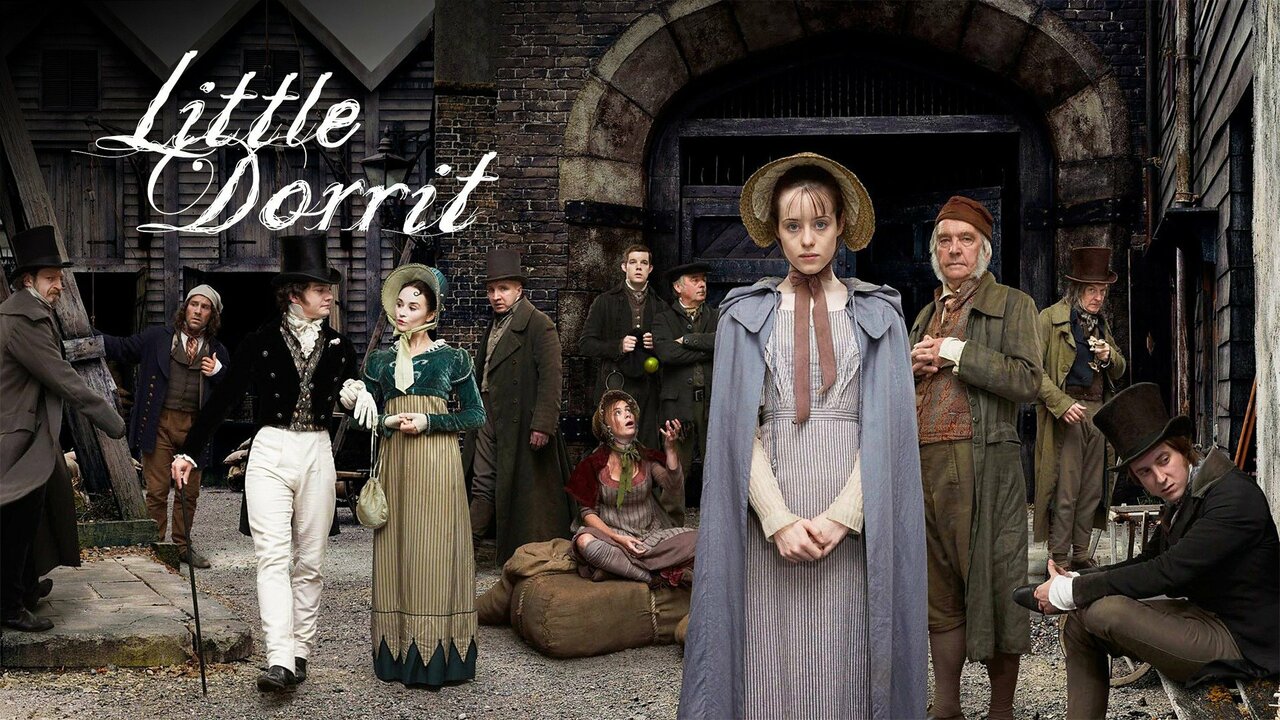
by The Adaptation Stationmaster
As with the recaps I did for the 2005 Bleak House miniseries, I’m going to go through each episode scene by scene and pretty much spoil everything, so I strongly advise everyone to not read a recap until you watch the episode. Of course, that brings up the question of why people who have seen the series would want to read these recaps since they already know what I’m going to describe.
I don’t really know. But the Bleak House recaps got a positive response here and I enjoyed writing them, so here we are.
Also as with Bleak House, I’m going to be using a less formal tone than usual for this site. There’ll be some LOLs, some BTWs, some FWIWs. Hope no one feels I’m lowering the tone. Now for a disclaimer I didn’t need for Bleak House. I actually watched the 2008 miniseries adaptation of Little Dorrit long before I read the original book by Charles Dickens. This may have made me biased in its favor in a way I wasn’t for the earlier miniseries, but hopefully not too much so. I am going to mention ways in which I think the adaptation improves on the book’s plot and characters but I’m also going to mention ways in which I think the original was better. There are also things about the miniseries that confused me on my first viewing. Only after reading the book did I understand what they were trying to convey. I think that experiencing this adaptation first enabled me to truly see how well it works as an introduction to its source material.
Let’s get started.
Episode 1
The first episode, which is twice as long as a normal one, begins with a prologue showing Little Dorrit’s birth. This establishes right away whom this story is going to be about unlike the book in which the heroine isn’t introduced until the third chapter as a mysterious figure. IMO, the miniseries is the better for this. Actually, we don’t see the birth itself or the mother. But we do see that it takes place in the Marshalsea Prison for Debtors. We also see Little Dorrit’s older brother and sister. (The actors who play them as kids are uncredited.) We don’t get a good look at her father, William Dorrit (Tom Courtenay who once played Daniel Quilp from The Old Curiosity Shop and Newman Noggs from Nicholas Nickleby), but we hear his voice as he names her “Little Amy” and we can already detect his shame at one of his children being born in a prison.
The next scene shows us Amy Dorrit (Claire Foy), twenty-one years later, leaving the Marshalsea and making her cheerful way to a job interview. (I typically refer to this character as Little Dorrit since that’s what Dickens calls her, but I think she’s called Amy more often in the miniseries, so that’s what I’ll do in these recaps. It’ll save typing.) We also briefly see John Chivery (wonderful Russell Tovey), the prison’s junior turnkey who lets her out. After some beautiful shots of London, we cut to the wheelchair bound Mrs. Clennam (Judy Parfitt) summoning Jeremiah Flintwinch (Alun Armstrong, another actor who’s played a lot of Dickens characters; you’ll remember him from Bleak House.) He looks just as Dickens describes with his head “awry” and “a one-sided, crablike way with him.” Actually, as with Bleak House, you can tell just by looking at all the actors what kind of characters they’re playing, a tribute both to the casting and to the hair and makeup people. It’s awesome! Anyway, Mrs. Clennam tells Flintwinch, “the girl comes this morning. Tell her nothing.” Thus, for better and for worse, the miniseries establishes right away that there’s some secret behind Mrs. Clennam’s interest in Little Dorrit. For better in that this hooks the viewer right away in a way the book arguably doesn’t and for worse in that it’s going to be a frustratingly long time before we learn anything about this secret.
Clennam and Co, Mrs. Clennam’s house/place of business also looks just as Dickens describes e.g. like it’s about to collapse at any moment. The sets for this miniseries in general are wonderful. You can tell things about the characters just by looking at their homes. They’re much better than the sets in Bleak House which were simply functional. My regards to the design team! Little Dorrit (maybe I’ll call her that after all) is greeted at the door by the terrified maid, Affery Flintwinch (excellent Sue Johnston.) She’s conducted up the creaking stairs to Mrs. Clennam’s room by her husband, Jeremiah. The way he shoves his wife around and growls at her like a dog is both funny in its over-the-top-ness and legitimately disturbing. (“You’re not afraid of me, are you now?” he asks Little Dorrit. “Well, you ought to be because I’m a terror when I’m roused.”) Amy looks like she’s already wondering what she’s getting herself into. After looking at some samples of her needle work, Mrs. Clennam hires her to come “three days a week from eight in the morning to seven in the evening.” Her stern voice falters and slightly saddens when she mentions that her husband and son are abroad.
We then cut to her son, Arthur Clennam (Matthew McFadyen), standing on a dock in Marseilles, lost in thought. Screenwriter Andrew Davies immediately shows us what’s preoccupying him as we get a quick flashback to Arthur’s father (Ian McElhinney) on his deathbed, handing him a pocket watch and telling him to “put it right.” McFadyen looks like he’s in his late 30s at the oldest rather than his 40s, but he brings a great air of brooding melancholy which serves the character well. (Also, FWIW, the book implies-all but states really-that Arthur Clennam’s insecurity about being too old for romance with a young woman is unwarranted.) Clennam is snapped out his flashback by his recently acquired friend, Mr. Meagles (Bill Paterson), his spoiled-sweet daughter, Pet (Georgia King), and her attendant, Tattycoram (Freema Agyeman.) The miniseries doesn’t have as much time to establish these characters as the book has, but the actors are all so great that we can tell everything we need to know about them right away. In particular, McFadyen’s smile instantly tells us that Arthur is attracted to Pet and, more importantly, that she’s one of the few pleasant things about his sad life. It might have been nice though if the episode had had time to explain the origin of Tattycoram’s nickname since it’s not exactly familiar to modern audiences. Still, this isn’t a huge problem. When Pet gives Tattycoram her shawl to carry, she walks off, grumbling about how she hates the Meagleses’ charity. At that moment, she bumps into Miss Wade (Maxine Peak), a mysterious woman who gives her an unnerving smile. She doesn’t smile at Pet as she passes but she does give her a different kind of unnerving look.
Miss Wade finds Tattycoram in an alley, crying about how the Meagleses treat her. The fact that she seems more sad than angry at this point suggests that we’re supposed to take her grievances more seriously than in the book. But if the adaptation wanted us to root for Miss Wade, Maxine Peak clearly did not get the memo. She’s awesomely creepy as she “grooms” Tattycoram, or Harriet as she calls her, first taunting her about her life of servitude and then dangling a promise of sympathy in front of her. “You see all my badness,” says Tattycoram. “You make me worse. You make me say things I don’t mean.” She maintains that the Meagles family are really good to her and she’s ungrateful to them but it’s clear that she’s really trying to convince herself. Miss Wade leaves her address, kisses her on the cheek and leaves. Just as creepy as Peak’s performance is the scene’s music by John Lunn. The soundtrack for this miniseries is another thing that’s better than its counterpart in Bleak House.
Speaking of addresses, back in England, after Little Dorrit leaves, Flintwinch cynically notes to Mrs. Clennam that she didn’t mention hers. “Nor would you, I daresay, if you lived in a debtors’ prison,” she says. This line represents a change from the book where Flintwinch taunts Mrs. Clennam with his knowledge of where Little Dorrit lives, and she doesn’t want to hear it. Don’t know why they changed that. “God has brought this child to my door,” says Mrs. Clennam as she stares at Amy’s needlework, “and I cannot avert my eyes.”
Arthur Clennam and the Meagleses are preparing to head back to England. Miss Wade returns Tattycoram to them. Mrs. Meagles (Janine Duvitski) is delighted at this since now Tattycoram can help them pack. Tattycoram’s resigned/annoyed reaction to this is hilarious. I’ve got to give a shoutout to Duvitski here as she plays the Meagles with the least to say and do but she still manages to make an impression. (Despite this unflattering introduction to the character, it’s not a bad impression either.) Mr. Meagles bids farewell to Miss Wade, saying they’ll probably never meet her again. She responds by giving an inexplicably creepy speech. (Inexplicable at this point, that is.) “In our course through life, we will meet the people who are coming to meet us. They may be coming from thousands of miles over the sea. They may be close at hand now. They may be coming, for all you know, from the vilest sweepings of this very town.”
With that handy transition, we cut to a jail cell in Marseilles, occupied by Rigaud (Andy Serkis who once played Bill Sikes), a hook-nosed Frenchman, and Cavalletto (Jason Thorpe), an Italian. (In the book, this is actually the very first scene.) Rigaud complains about being locked up with “a petty smuggler” when he’s “a distinguished murderer.” He acts a bit more overtly threatening here than he does in the book at this point, saying he could kill Cavalletto too. He also doesn’t even pretend that he’s not guilty. (“You think I killed my wife for her money? I would have killed her for nothing.”) But he’s confident that the bribes he says he’s laid out will free him. At one point, he drops some of the food he’s eating and Cavalletto is about to grab it, but Rigaud intimidates him with just a look and a clucking tongue. It’s an effectively creepy scene. It ends with the noise of what might be a head being chopped off and a crowd cheering coming from outside.
Amy Dorrit arrives back home at the Marshalsea. She tells John Chivery she got the job but not to tell her father. It’s clear to the viewer that John is in love with Amy or dealing with a massive crush anyway. It’s also clear to his father, Mr. Chivery Sr. (Ron Cook), the head turnkey, a character who doesn’t get much personality in the book but who Cook and Davies make a stoic foil to his emotional son.
At his shabby apartment, Amy tells her fretful father that she’s going to be “visiting” Mrs. Clennam regularly. This is a great scene for both actors that really establishes their characters and relationship. Amy obviously doesn’t like lying to her father, but she has to take this job and she knows he’d be devastated to know that his daughter, a gentlewoman, was working for her bread. It seems like he knows she’s lying on some level because he agrees despite being upset by her not being around to take care of him all the time. “It’s not as it was meant to be,” he laments, “If you’d known me as I was before I came here-” “I love you as you are,” she assures him. Props to Foy. She actually sells that line as an expression of fact, not a reassuring lie.
Arthur Clennam sits in a London inn, working up the courage to go to home of his traumatic childhood. (You can hear the church bells in the background in this scene, a nod to Dickens’s description.) There’s some good comedy from the waiter (Johnathan Slinger) who is annoyed at Clennam’s flipflopping as to whether he’ll stay the night at the inn or not. He ultimately decides not and goes to Clennam and Co. Affery is clearly delighted, even thrilled, to see him but is too scared to talk to him with Flintwinch present. Mrs. Clennam is not so delighted. When he tells her his father, her husband, has died, she says, “you needn’t have come halfway around the world to tell me that. You could have written.” In the book, he actually did write, and he mailed her the watch his father (apparently) left to her. Here we see him give it to her and her reaction-or rather her careful nonreaction. She quickly tells him it doesn’t mean anything and dismisses him. Once he’s gone, she takes out a piece of cloth from the watch with the words, “Do Not Forget,” embroidered on it. In the book, all it had were the initials, D. N. F. and we only learn what they stood for later.
The Meagles family returns to their cottage in Twickenham. It’s a much happier homecoming than Arthur’s though the conspicuous birdcages they unpack remind us that Tattycoram feels trapped there. We get an indication that she doesn’t completely hate her life though. When Mrs. Poyner (Amanda Lawrence) the housekeeper hugs her, she manages a more genuine smile than normal for her. (Mrs. Poyner’s name was Tickit in the book. Not sure why they changed that.) Mr. Meagles’s smile, on the other hand, becomes forced when Poyner informs him that a Mr. Gowan has been asking after Pet who, unlike her father, is delighted to hear that. While the miniseries emphasizes one of Mr. Meagles’s flaws from the book, his condescension toward Tattycoram, it also removes another. In Dickens, he reconciles himself to Henry Gowan as a son-in-law by remembering that “he certainly is well connected and of a very good family.” Here, when his wife tries to comfort him by saying that Gowan “isn’t a scoundrel; he’s a gentleman,” he replies, “same thing often enough.”
That night, Little Dorrit’s brother, Tip (Arthur Darvill), or Edward as his father prefers him to be called, unexpectedly shows up at her home. This scene is different from the version in the book but it’s equally emotional in its own way. Initially, Amy is delighted to see him since her brother and sister generally leave her to take care of Mr. Dorrit by herself. But when he says that he’ll be staying for a while, her smile collapses as she knows there’s only one possible reason for that. Tip has lost every job he ever had and is now in debt. Amy tells him not to let their father know since the knowledge that one of his children was going down his path would crush him. I really can’t imagine this miniseries without Claire Foy in the lead role. She does so much to sell us on this character with just her facial expressions.
We get some good creepy shots outside Clennam and Co at night. Inside, Arthur is troubled by a dream of his childhood. At the dinner table, his mother tells him that God is in the room and “knows every wicked thought you think you keep hidden in your heart.” She tells him that he will bring her “nothing but shame and disappointment” just like his father who is also at the dinner table. Yeah, she’s kind of intense. Mr. Clennam looks just as traumatized by his wife as his son does. (Young Arthur is played by Laurence Belcher who’s very good in this brief but important role.) In my Bleak House recaps, I mentioned that that adaptation pretty much omitted any religious references from the source material, both ones that depicted Christianity in a negative light and in a positive one. That’s less true here as Mrs. Clennam’s grim religious fanaticism is such a big part of her character though the miniseries is still less interested in that than is the book. As for positive religious references, Little Dorrit no longer alludes to Christ in her final confrontation with Mrs. Clennam but when her siblings start complaining about her acting like a servant, viewers familiar with the gospels will likely be reminded of this quote from them. “If anyone would be first, he must be the servant of all.”
Affery brings Arthur breakfast in the morning. He asks her about her marriage to Flintwinch and she tells him she had to marry him because he and Mrs. Clennam both commanded her to do so. “If it had been a smothering instead of a wedding, I don’t think I could have said anything against it,” she says, “Not against them two clever ones.” This is just as creepy as in the book. I wish the miniseries could have included her encouraging Arthur to stand up to his mother and Flintwinch even though she couldn’t imagine doing so herself.
Stand up to his mother though, he does, telling her that after devoting half his life to the family business, he’s quitting. He also tells her that he wants to “put right” whatever his father was talking about on his deathbed. (In the book, his father never said anything about putting anything right. I guess Andrew Davies just felt Arthur needed more motivation.) Instead of explaining what her husband might have been talking about, Mrs. Clennam throws a fit, hands Arthur’s role in the family business to Flintwinch, who’s amusingly calm during this stormy scene, and kicks him out of her room. As he leaves, Arthur notices his mother being unusually nice to Amy to whom he hasn’t been introduced. Her being nice to anyone is pretty weird.
He asks Affery about Little Dorrit. All she can tell him is that she’s a “whim” of Mrs. Clennam. “Do you take a fancy to her?” she asks. “You must have had your pick of girls out there across the China sea.” “Well, one or two,” replies Clennam. That line really doesn’t fit with his virginal character in the book. Did the miniseries think that viewers wouldn’t respect a male lead who was a virgin? I kind of feel like if that’s your perspective, you shouldn’t be making a Dickens adaptation, but I can’t say that because I’m really glad this was made. Affery also informs Arthur that his childhood sweetheart, from whom he was separated, is now a wealthy widow whom he could marry. As Little Dorrit passes through the kitchen in this scene, we see her pocket some cake to take home to her father.
Meanwhile, Tattycoram and Pet are enjoying some lawn bowling while Mr. and Mrs. Meagles look on. Well, Pet is enjoying it. Tattycoram not so much. (Note all the birdcages in the background.) Mr. Meagles says he knows Tattycoram is just as happy to be home as he is. “You think you do but, in truth, you know nothing at all,” she mutters. Rain starts to fall. Mrs. Meagles is sure Tattycoram would be happy to go get Pet’s forgotten umbrella for her. “I’ll fetch it if you wish,” she says, “but I don’t know why you think I’m happy to fetch and carry and look after you all when no one will fetch and carry and look after me!” Mr. Meagles placidly tells her to control her temper by counting to five-and-twenty like she’s a little kid. Tattycoram doesn’t try but runs off. In contrast to the Meagleses’ caged birds, we see a bunch of free ones whom she scatters. “What is the matter with me?” she rants. “Why am I such a wicked girl?” Whom should she bump into mid-rant but the creepy Miss Wade. It really does feel like she’s an evil spirit or a manifestation of Tattycoram’s bad side.
I have mixed feelings about this added Tattycoram scene. It’s very well written, Freema Agyeman is great in the role and the character’s inner conflict of knowing she should be grateful while being sick of everyone telling her she should be grateful feels like something Dickens could have written even though it’s not from the book, Little Dorrit. But it also kind of amplifies my problem with the book that Tattycoram’s character and situation are so interesting that it feels weird they’re not bigger. It’s also distracting that she’s the only example of color-blind casting in the miniseries. That is, I assume it’s an example of color-blind casting since no one mentions Tattycoram’s dark skin which they certainly would in this historical culture. But because she’s the only non-Caucasian in the cast it feels like a message to the viewers that they should see the Meagleses’ relationship with her as exploitive when the miniseries really needs to fight against that impulse if modern audiences are to be reconciled to the ending. (I admire the miniseries for not changing Tattycoram’s climactic decision even though it’s the part of the book that has aged the least well. That would be too easy.) Still, I can’t wish that Agyeman hadn’t been cast since, like I said, she’s awesome as this character and I can’t wish any of the Caucasian actors had been replaced either because they’re awesome in their roles too. So, I’m just going to pretend this really is an example of color-blind casting.
Remember Rigaud? Well, he’s released from prison though his jailer (Daniel Rovai) warns him that popular opinion is against him. Before leaving, he taunts poor Cavalletto that they’ll meet again and that he intends to eat him. (See what I mean about him being even more threatening at this point than in the book?) As he leaves prison, he sings the French nursery song, Who Passes by This Road So Late? “Rigaud is down for now but never mind,” he monologues before hitching a ride on a passing carriage. “Rigaud will rise again.”
Arthur Clennam follows Amy home from work and sees her enter the Marshalsea. He asks a spaced out, slovenly man, who’s also entering, about it. The man turns out to be Frederick Dorrit (James Fleet), Amy’s uncle and a musician at a low-class theater. Once he knows who Clennam is, he takes him inside and introduces him to his brother, taking care to refer to him as the son of “Amy’s…friend.” Amy herself gets a deer-in-the-headlights look at the sight of Arthur but her father immediately launches into a pompous spiel about how, as the oldest prisoner there, he’s “the Father of the Marshalsea.” Tom Courtenay is masterful in this scene, making Mr. Dorrit obviously pathetic but also charismatic enough that you can buy him fooling some people with this cultivated role. Claire Foy has the unenviable task of convincingly portraying her character as a quiet, modest person who fades into the background while also commanding our attention and she knocks it out of the ballpark! (Though, to be sure, the camera helps her out with closeups.) She winces as her father blatantly hints that Clennam is expected to donate money to him and tries to change the subject to no avail. Finally, she becomes so humiliated that she can’t bear to remain in the room. McFadyen also shines, conveying that Clennam sees through Mr. Dorrit’s pretensions but pities him too much to laugh or show any disrespect. The miniseries begins its trend of making Frederick a bit more self-aware and argumentative than he is in the book. When Dorrit says that he and Mr. Clennam understand each other after his blatant hint dropping, he pointedly says, “I should think so!”
Back at Clennam and Co, after staring at the words, Do Not Forget, Mrs. Clennam tells Flintwinch to fetch a specific box of legal documents from downstairs and destroy it before her eyes. He looks at the documents before bringing them up and seems to consider pocketing one but decides against it-or so it seems.
It’s almost time for visitors to leave the Marshalsea for the night and William Dorrit is still talking to Arthur Clennam about how everyone always leaves him money! Tip shows up with his sister, Fanny (Emma Pierson), who has come to pick up her clean laundry from Amy. Fanny wears an unusually high amount of makeup to the extent that when I first saw her, I wondered if she was supposed to be a prostitute. Perhaps the miniseries is implying that in this culture, being a dancer at Frederick’s theater, like Fanny, was seen as being a stripper. (If so, that’s probably a bit of an exaggeration. I don’t think Dickens would have had Little Dorrit help her sister get such a job if everyone saw it as being really immodest. There were probably some Victorians, like Mrs. Clennam, though who did see it that way.) That’s probably reading too much into it. It probably just symbolizes how Fanny, like her father and brother but unlike Amy, is obsessed with appearances and putting on a show for everyone. She, Tip and Frederick pick up their things before leaving as the bell has started to ring, announcing that the Marshalsea gates will soon be locked for the night. Before he goes, Arthur slips Mr. Dorrit some coins.
In the Marshalsea courtyard, Arthur asks an embarrassed Amy if he can talk to her later. She’s arguably a bit more irritated with him than in the book, asking how she could stop him, though she apologizes immediately afterwards. I love the character of Little Dorrit in the book but I actually really like having her show repressed anger in this adaptation. It emphasizes just how hard it is to be so patient and makes her seem even more heroic. That’s not to say every instance of her being visibly angry in the miniseries works for me but this one does. It’s also worth noting that she always tries to soften her angrier words after she says them, so I feel like the adaptation itself is wary of going too far in that direction. Little Dorrit runs off but it’s too late for Clennam who is now locked in for the night. (The way Mr. Chivery Sr., whose job it is to ring the warning bell, rolls his eyes at this is hilarious.) Tip ungraciously shows him how to get a room for the night, explaining his own situation. (“I belong to the shop only the governor isn’t supposed to know about it.”)
Another creepy night scene. Flintwinch burns some papers in front of a relieved Mrs. Clennam. Later, Affery awakes and spies him conferring with a man who looks exactly like himself! He gives him the box with the real papers, telling him to guard it with his life. Suddenly, Flintwinch grabs Affery by the throat, telling her she’s been sleepwalking and dreaming. “If you ever have such a dream again, it’s a sign you’re in want of physic,” he says, “and I’ll give you such a dose, old woman, such a dose!” Affery runs back up to bed. She can clearly see that she’s not dreaming as Flintwinch’s double is looking at her. It’s a great spooky cliffhanger for this first episode.
Episode 2

As Amy exits the Marshalsea in the morning, John Chivery tells her that Arthur Clennam was locked in last night. (She actually already knows this since we saw her watching him through her bedroom window at the end of the last episode, but she pretends not to have known.) He asks if she’d like to see him again. John clearly already senses Arthur as a romantic rival in this version, given how ecstatic he is when Amy says no. Once she’s out of sight, he all but dances a jig. To his great dismay, Arthur then appears, asks whether Little Dorrit has gone and heads in her direction.
Clennam catches up with Amy. She’s a bit freaked out about having a stalker. Once he explains himself though, she’s moved and maybe a little attracted to him. She thanks him for his kindness to her father and asks him not to judge him too harshly. To escape a sudden downpour, Arthur takes her into a coffee shop. Her innocent delight in the modest place is charming but also saddening in that it shows how few luxuries she’s ever had in her life. Charmed and saddened is certainly how she makes Arthur Clennam feel. He asks about her father’s affairs, saying if his family is one of the creditors, he’d love to release Mr. Dorrit from his debt, but Little Dorrit doesn’t know and suspects that by now her father himself has forgotten. “I think it is monstrous that a man should spend his days in prison simply because he owes money,” Arthur says. Amy quietly but firmly argues that her father is probably better off not being released at this point. “He might not be so gently dealt with outside as he is in there,” she says, “people might not think so well of him.” Clennam counters by bringing up her brother. Should he also stay in the Marshalsea forever? Amy hopes not. She mentions that Tip is in debt to a horse dealer in Bleeding Heart Yard and that she plans to repay the man once she’s saved up enough.
The conversation is interrupted by someone banging on a window. It turns out to be Little Dorrit’s friend, Maggy (Eve Myles), a poor young woman whose mind has stopped maturing when she got a fever at ten years of age. Despite Maggy’s disability, Amy is proud to say that she can read and support herself with a job. Eve Myles doesn’t really match Dickens’s physical description of this character having “large bones, large features, large feet and hands, large eyes and no hair.” But she’s great in the role, nonetheless. Anyway, Amy says goodbye to Clennam and leaves with Maggy.
At Clennam and Co, Flintwinch confronts Mrs. Clennam. “You never gave Arthur’s father a chance to redeem himself and you never gave Arthur a chance either,” he says. “I’m faithful to you and I’m attached to you, but I won’t be swallowed up by you!” Mrs. Clennam doesn’t bat an eyelash at his ranting but calmly looks over some papers. She even taunts him in a cold, not very humorous way, saying that he’s put up with her this long and he’s going to go on doing just that. “What I have done is between me and my maker,” she says. Mrs. Clennam is a tad more rattled by Flintwinch in this scene in the book. (Remember what I wrote about how she doesn’t know where Little Dorrit lives in that version, and she doesn’t want to know?) But we’ll see her be more rattled by Flintwinch in a similar scene later in the miniseries, so you could argue they’re not changing the character, just splitting one scene into two.
In the poor neighborhood of Bleeding Heart Yard, Pancks (Eddie Marsan), a scrappy and constantly snorting rent collector, tries to collect rent from a struggling plasterer, Mr. Plornish (Jason Watkins.) He accepts a shilling to tide the landlord over for the moment before moving on to the next house. Eddie Marsan doesn’t have Panks’s spiky hair (he and Maggy seem to have switched heads) or the grimy complexion Dickens describes but he’s loads of fun as this character. (Not in this scene so much but later.) Jason Watkins is also endearing as the Cratchit-eque Plornish and so is Rosie Cavaliero as his wife. Arthur arrives and asks about the horse dealer to whom Tip Dorrit is in debt. Plornish directs him to a Capt. Slingo and advises Clennam that he won’t need to pay much as Slingo is hard up for cash. Just then Mr. Casby (John Alderton), the landlord of Bleeding Heart Yard comes up the street. We immediately get the impression that everyone looks up to Casby as a benevolent grandfatherly figure, given the way children flock to him, adults smile at him, and Mrs. Plornish offers to introduce Arthur to him like he’s a celebrity. (“Such a kindly landlord! If only his rent collector was more like him.”)
Clennam demurs as he already knows Casby. Instead, he goes to Capt. Slingo (Angus Barnett) and offers him twenty pounds to release Tip. Slingo keeps asking for more, but Arthur refuses and he has no choice but to take what he can get, understandably so since as soon as he has the twenty-pound bill, Pancks comes to take it away from him. This is pretty different from Arthur Clennam’s negotiations with Capt. Maroon (don’t ask me why the name change) through Plornish in the book but it’s still a fun scene. Despite his initial dismissal of Casby, Arthur seems curious in spite of himself and asks Slingo if he still lives at his old address. He does.
Arthur goes to visit Casby at his home and questions him about what his father’s secret regret might be and how he knows Little Dorrit. John Alderton is perfect as Casby. He looks exactly like him with his long white hair and beard, he sounds like him with Davies replicating the speech patterns Dickens gave the character and he gives off the same self-satisfied, benignant air while not saying or doing anything remotely helpful. The house he shares with his daughter, who happens to be Arthur’s old sweetheart, is also a great example of how the sets for this miniseries reflect the characters. The emphasis on pink and flowers and curlicues looks cozy at a first glance but becomes oppressively cutesy if you pay attention to it for any length of time. Casby suggests Clennam try the Circumlocution Office which handles most public matters. (In the book, Clennam had already tried that at this point BTW.) He then invites him to dinner that night to see his daughter, Flora, again. In this scene’s equivalent in the book, Arthur isn’t quite sure whether to buy Casby’s air of benevolence or not. Here he’s seen through him a long time ago. I think that change works better for this medium. Otherwise, the viewer might have been fooled by Casby too.
In the Marshalsea courtyard, two prisoners are playing a homemade (prison made?) board game using a bench Mr. Dorrit regards as his own for a board. He coughs officiously and Mr. Chivery Sr. moves them along. The two men have a friendly chat about their children. Mr. Dorrit frets that Amy is always absent nowadays. Mr. Chivery boasts that John will never leave the Marshalsea. He makes a point of saying how “loving” his son is. Mr. Dorrit picks up on the hint and is intrigued by it.
Meanwhile, Arthur makes inquiries about Dorrit’s debts at the Circumlocution Office, but he keeps being redirected to different departments to no avail. For purposes of tighter pacing, the Barnacle family that runs the Circumlocution Office in the book has been reduced to Tite Barnacle (Robert Hardy) and Tite Barnacle Jr. (Darren Boyd.) Because of this the scene can’t be as long and complicated and therefore quite as hilarious as it is in the book. But it partially compensates with, again, set design. The floor of Tite Jr.’s office department is covered with documents and so is every step of a huge circular staircase. And props to the miniseries for including the way Tite Barnacle pauses before mentioning the Public as if they’re “his natural enemy” and for giving Clarence Barnacle’s shocking honesty to Tite Jr. He tells Clennam he can give him a bunch of forms to fill out but that nothing will come of it in the end. “You’d do much better to give it up,” he says, “most men do.”
As Arthur glumly exits the Circumlocution Office, he meets an indignant Mr. Meagles and his friend, Daniel Doyce (Zubin Varla.) Doyce is an inventor and he’s been trying to get his invention patented at the Circumlocution Office without success. Mr. Meagles invites Clennam over to dinner at his place. He has to decline since he’s already going to Casby’s, but he’d be happy to visit the Meagleses another time. Doyce mentions that he’d have to go abroad to have his invention taken up. “The trouble with abroad, Doyce,” says Mr. Meagles, “is that there are just as many villains there as there are here.”
By what I’m sure is a complete coincidence, we then cut to Rigaud anonymously entering a country inn. He overhears gossip about how he has been released from prison. Public opinion is not in his favor. In particular, the landlady (Danielle Urbas) thinks “they should have let the mob get at him.” Rigaud flirtatiously argues with her that the man might be innocent. In the book, this landlady has trouble making up her mind whether this new guest is handsome or ill-looking. Here, while he doesn’t change her opinion about Rigaud, she doesn’t have any such trouble but responds to his flirting in kind. It looks like they’re about to have a PDA, much to the annoyance of another guest (David Verrey.) “Might one know your name, monsieur?” he interrupts in a hilariously dry voice. “Lagnier,” hisses Rigaud. It’s in this scene that it really becomes apparent how outrageous and cartoony Andy Serkis’s performance is going to be. Not that cartoony performances are unexpected or unwelcome in a Dickens adaptation. But while Serkis’s Rigaud is hardly the only cartoony character in the miniseries, he’s so over-the-top that he it feels like he belongs in a different world from everyone else. You could argue that helps make him unnerving and since, as far as Dickens’s villains go, Rigaud is a pretty generic moustache twirler, making him as over-the-top as possible is the best way to make him memorable. Serkis certainly does that.
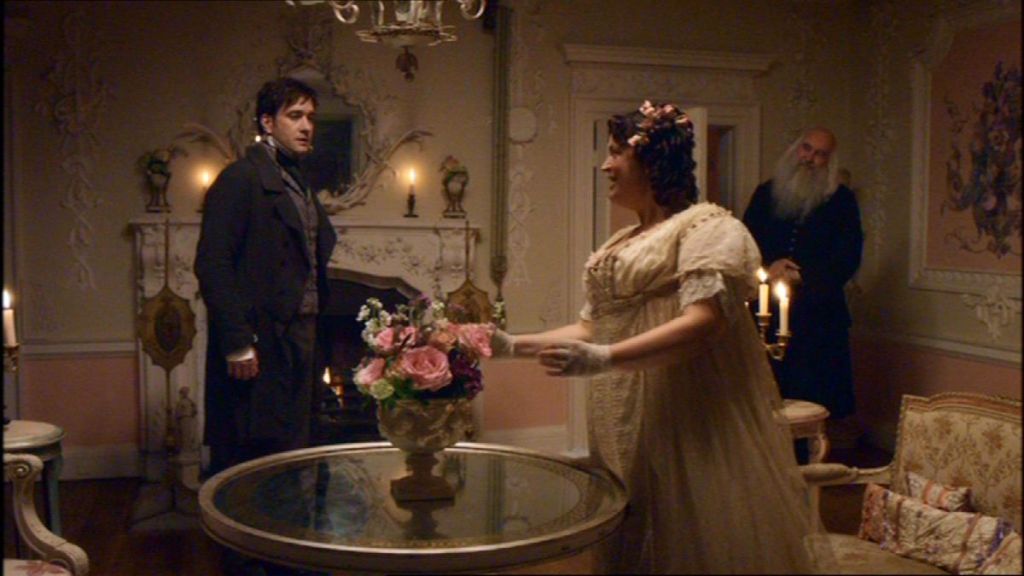
That evening, Arthur waits in the Casby drawing room, to see Flora again. We get a brief flashback to her in her youth. (Sadly, the actress who plays her in it is uncredited.) This romantic memory is hilariously shattered when the present-day Flora Finching (Ruth Jones) bursts into the room and we see that she hasn’t exactly aged gracefully into her middle age. You could argue that this scene does Arthur Clennam a disservice since it’s easy to assume he’s disenchanted by his old flame’s age when Dickens insists that what really kills his love is that “Flora, who had been spoiled and artless long ago, was determined to be spoiled and artless now.” But you could also argue that was just the character rationalizing his own lack of physical attraction to her now. As a counterargument to that counterargument, the character certainly is determined in her inappropriately girlish flirting in a way that most people would find a turnoff. The adaptation’s tight pacing means Flora’s silly speeches can’t be quite as long and full of rabbit trails as in the source material, but Ruth Jones delivers on the comedy while also bringing out the character’s tragedy. You want to give her a hug or a handkerchief as she realizes in this scene that Arthur is no longer besotted with her while she still very much is with him. She deludes herself later into thinking he’s going to renew his proposals at any time but that just makes the situation sadder.
“Tell me about the Chinese ladies,” she says to Arthur at one point. “My late husband, Mr. Finching, had a fancy they were made different down there, you know, but how would he know about that being a bachelor still?” Is that really supposed to be a reference to genitalia? I feel like a “well bred” Victorian woman would be unlikely to allude to such a thing to a member of the opposite sex. Maybe even to a member of her own sex if they weren’t close friends. I guess this is just to demonstrate Flora’s awkwardness. Here is as good a place as any to bring something up. I’ve described Andrew Davies in the past as having a “juvenile preoccupation with sexuality.” This isn’t as bad a thing when he’s adapting Leo Tolstoy or Victor Hugo since they’re more explicit about sex than Jane Austen or Charles Dickens but even with those adaptations, there’s the occasional nagging feeling that all the characters’ complex motivations are being reduced to “they want to have sex.” (I’m tempted to go on a rant about what Davies did to the character of Marius in his Les Misérables, but these recaps are ridiculously long as they are. I’ll just leave a link.) That really wasn’t a problem with his Bleak House, which was probably more explicit about sexuality than the book was but that just felt like making the story clear to viewers unfamiliar with the euphemisms of Dickens’s culture. With Little Dorrit, the sexual elements start to get a little more distracting but thankfully not too much.
Anyway, Arthur has an awkward dinner with Flora, Casby, Pancks and a senile old woman referred to as “Mr. F’s Aunt,” (Annette Crosbie) Mr. F being Flora’s late husband. Pancks complains about how hard it is to extract money from the residents of Bleeding Heart Yard. Mr. Casby expresses sadness at their poverty, but his “benevolent” smile belies this feigned compassion. It gets to be too much for Arthur who bursts out with indignation at the debtors’ prison system. This leads to an awkward pause in the conversation. Arthur’s not the only one to have an outburst though. Mr. F’s Aunt glares at him while growling that “When we lived at Henley, Barnes’s gander was stolen by tinkers!” Flora, seeing which way the wind is blowing, quickly ushers her out of the room. May I just say how grateful I am to this adaptation for doing justice to Mr. F’s Aunt and her angry non sequiturs and to her ridiculous blonde wig?
Back in France, Rigaud and the landlady are about to bed down in the inn’s barn when she casually mentions that there’s another guest sleeping there. It turns out to be Cavalletto who wakes up to find his terrifying old cellmate staring into his face. Rigaud clamps a hand over his mouth and whispers to him not to reveal his real name. He asks Cavalletto where he’s going. When he hears he’s headed for England, he “offers” to accompany him.
As they leave Casby’s, Pancks mentions to Arthur that he’s something of a detective in his spare time. Seeing an opportunity, Clennam hires him to investigate Mr. Dorrit’s affairs, seeing that Pancks is probably more useful than the Circumlocution Office. This is a change from the book where Pancks starts doing digging on the Dorrits of his own initiative and Clennam just asks him to tell him anything he finds out first. I actually think it’s an improvement on Dickens’s version as it makes the non-Amy Dorrits’ later ingratitude toward Arthur even more appalling.
Early the next morning, Cavalletto runs away from the barn before Rigaud awakens. We see that Rigaud has murdered the landlady. That detail isn’t from the book and I’m not sure of his motive. Maybe her harsh words about him, not knowing his identity, angered him more than he let on. Maybe she got too close to discovering that identity. (I don’t really have a problem with the motive being ambiguous BTW.) The real reason, of course, is give the episode a creepier ending.
Episode 3
Arthur tells his mother he’s taken a permanent lodging in Covent Garden. He leaves her his address on a slip of paper. She refuses to take it from him, but he leaves it on the table and awkwardly kisses her on the forehead. As soon as he’s gone, she tells Little Dorrit, who has been silently sewing in the room throughout this tense scene, to burn it. Amy obeys but not before memorizing that address for later.
Pancks calls on the Plornishes again. To Mr. Plornish’s relief, he’s not there to collect the rent again but to ask about Little Dorrit. (I haven’t mentioned it yet, but Plornish is the one who mentioned Amy to Casby who mentioned her to Mrs. Clennam. Man, I just used the word, mentioned, a lot in that sentence!) As with Davies’s Bleak House, we’re seeing a lot more of the “steps” of the detective work than we did in the book, though probably not as many as in that adaptation. After all, the miniseries still wants the revelation about the Dorrit family to be a surprise unlike Esther Summerson’s parentage which was always obvious.
That evening, Amy is about to take Maggy, who has been helping with dinner, home from the Marshalsea. Mr. Dorrit complains yet again about being left alone so often. “Tell me the truth now,” he demands of his daughter bitterly, “Do men and women look down on you when you go forth from this place? Do they sneer at you behind their hands?” She assures him everyone is kind and respectful to her. (Amusingly, before she leaves, Maggy swipes some of Mr. Dorrit’s meal.) As the Chiverys let the ladies out, they tell Amy someone has paid her brother’s debt and he’s been released. Realizing the truth, she rejoices at the news and clasps John’s hand in gratitude. This causes him to tremble and jangle the keys he always carries. But he’s disheartened to hear her say she must go and thank the man responsible for Tip’s liberty. His father encourages him in his romantic hopes however, cynically saying that the Dorrits aren’t the royalty they consider themselves to be.
Clennam is moving into his new apartment. He stops to buy a violet from a destitute young girl (Bel Powley.) She suggestively offers to come up to his room. He turns her down but then expresses concern whether she has a place to stay for the night. She assures him she does. I’m not sure why this scene exists except to show that Arthur Clennam is a nice guy, which we already know by now, and to allow Davies to bring up sexuality again. I guess it works on those counts. You really do feel sorry for this girl who only appears for this one scene. It’s nice to learn from IMDB that Bel Powley is still getting work all these years later.
Amy and Maggy’s journey to Arthur apartment is intercut with brief glimpses of Mr. Dorrit in his prison and Mrs. Clennam in her room, fingering the watch with the motto, Do Not Forget. I assume this is meant to imply that the latter is thinking about the former, as Arthur imagines in the book, and sees her imprisonment as making up for her keeping a secret that could release him from his.
Arthur offers refreshment to his unexpected guests. Amy lets him know that she knows he’s the one who paid Tip’s debt without actually saying so. “If I could meet him,” she says, “I would thank him and take his hand and kiss it and thank Heaven that he took pity on us!” Clennam disclaims that what this anonymous benefactor did was any great service, but she insists it was. She doesn’t ask him to ignore her father’s requests for money if he keeps making them, which is something of a pity since that was a great tearjerker in the book. I imagine the change was made because the miniseries wants Clennam to keep giving Dorrit money though I’m not sure why. In a detail original to this version, Amy notices that a button has come off his sleeve and wishes she could sew it back on for him, but he dismisses the idea. She says she’s going to drop Maggy off at her lodgings and then meet up with her sister. He expresses concern for her traversing the streets at night, but she assures him she’s used to it and would be more comfortable without his help.
When they get to Maggy’s shabby apartment building though, everyone’s asleep and Maggy is terrified of what the landlady will do if they wake her up, so Little Dorrit tells her they’ll both stay at Fanny’s. At the theater, they meet a character who’s not introduced until a bit later in the book, Edmund Sparkler (hilarious Sebastian Armesto), a ditzy, genteel suitor of Fanny’s who is waiting to take her on a date. Fanny is embarrassed by Amy and Maggy, referring to the latter as “that creature,” and sending them away. “What are we going to do now?” Maggy asks. Little Dorrit tries to smile confidently and reassuringly but she’s clearly worried. The scene of the two women wandering the hostile streets by night is much shorter than its literary counterpart but it’s still pretty disturbing. John opens the gates to Marshalsea the next day and is horrified to find that Amy and Maggy slept the night in the doorway across the street.
Mr. Meagles writes a letter to Arthur Clennam, which we hear through voiceover, inviting him for a visit. As he writes, he glances outside at his daughter who is happily talking to her questionable suitor, Henry Gowan (Alex Wyndham.) Clearly, he wants to turn Pet’s affections away from him and toward Arthur. Mr. Meagles isn’t the only one shipping his daughter with someone. Mr. Dorrit tells Amy to give a bouquet she got for him to Chivery Sr., stressing what a fine young man his son is growing to be. Little Dorrit can tell something is up, but she can’t quite figure out what yet.
The Meagleses warmly welcome Clennam to their (seemingly) idyllic home. When I say, “the Meagleses,” I include Pet who really does like Arthur, just not in a romantic way. Doyce is also visiting, and we see music box he made for Pet. It’s designed like a bird in a cage. We’re reaching the point where I feel that symbol for the Meagles home is getting overused, but I do like how this develops Doyce as a craftsman and a good friend. He says that it’s hard to excel at two things at once and he has no head for business. This is disappointing since Dickens portrays this as just a stereotype that people have of inventors and implies Doyce might have a decent head for business himself but needs a non-inventor partner to ease people’s fears. But I can see how that idea would be too complicated to convey in a short time. The conversation turns to Miss Wade. Despite Tattycoram’s earlier fear of the woman, when the others badmouth her, she protests that Miss Wade is actually “a good person” who is “very kind.” Everyone stares at her like she just farted. “Tatty, she’s not,” says Pet in a voice that implies she’s speaking to an imbecile. This makes Tattycoram so angry that she bursts out that Miss Wade offered her a home if she ever felt she were badly treated in her current one. Pet tells her not to talk to the strange woman as she doesn’t “think she’s very nice.” Unable to control herself further, Tattycoram leaves the room. “There’s a girl who might be lost and ruined were she not among practical people,” says Mr. Meagles. It’s too bad the miniseries never establishes what Mr. Meagles means by practicality which is actually more like generosity. That line doesn’t really make sense without that being established.
Outside, Tattycoram meets Miss Wade. Apparently, she’s been thinking of taking her up on her offer but, in spite of her anger, she can’t bring herself to leave the Meagles. Miss Wade scoffs at this, calling Pet “a spoiled girl who treats (Tattycoram) like a toy to be picked up and discarded at whim.” Harriet challenges her, asking how she’s supposed to know Miss Wade wouldn’t treat her the same way the Meagles family does. In the book, this is something she accuses her of doing after she’s been living with her for quite some time. I’m not sure what the point was of having her suspect it so early. Doesn’t it give her less of a character arc? Miss Wade assures her that she wouldn’t and tells Tattycoram that she’s not angry with her because she trusts her to come to her in her own time. This is the closest Miss Wade ever comes to acting nice and even it is pretty creepy as she strokes Tattycoram’s chin the same way Rigaud stroked the chin of the woman he murdered in the last episode. (Maybe that’s what the point of that was.) For a moment, it looks like Tattycoram will agree but then she runs off.
Amy is soaked from walking home from work in the rain and John Chivery invites her into his home to warm up. He shows her around and pointedly says “it could do with the little delicate touches a woman brings.” Props to Russell Tovey for making that line sound endearingly dorky and not predatory. “Perhaps it could, John, but I like it quite well as it is,” says Amy with equal pointedness. Ouch. Well, for viewers, it’s an “ouch” moment but John misinterprets it as a hopeful sign. He’s not even discouraged when Amy shuts down his reminisces about their shared childhood and hastily departs.
Affery wakes up in the middle of the night again and does some more eavesdropping. This time, she listens to Flintwinch and Mrs. Clennam as they argue about Little Dorrit. Remember what I said about that scene of him making her feel guilty about the young woman? This is it. “Let me suffer and let me have this little alleviation of my suffering,” she yells. “Is it so much that you torment me like an evil spirit?” Flintwinch turns to go fetch his wife. Not wanting to be caught, Affery runs back to her place in the kitchen and covers her head with her apron. “Do you know what I think?” says her husband when he finds her that way. “I think you’ve been dreaming again! You’ve got such a dose coming to you, you old woman!” Chillingly, if also somewhat amusingly, after scaring his poor battered wife off, Flintwinch sits down in her nice warm seat, smiles and picks up a newspaper.
In other news, John stands outside in the rain, staring up at Amy’s lighted bedroom window. Poor guy! If only he knew at that very moment, she’s looking at Arthur Clennam’s discarded button that she pocketed. There’s another little memento she looks at in this scene: a locket containing a portrait of a woman. I guess this is supposed to be her deceased mother because I really don’t know whom else it could be.
 All the (Dickensian) Year Round