
Wherein The Dickens Chronological Reading Club Wraps up Weeks 5-8 (Weeks 99-102 of the #DickensClub) of Little Dorrit; including a summary and discussion wrap-up; with a look-ahead to our break between reads, and our Next read, A Tale of Two Cities.
(Banner Image: by James Mahoney. Image scan by Philip V. Allingham for Victorian Web.)
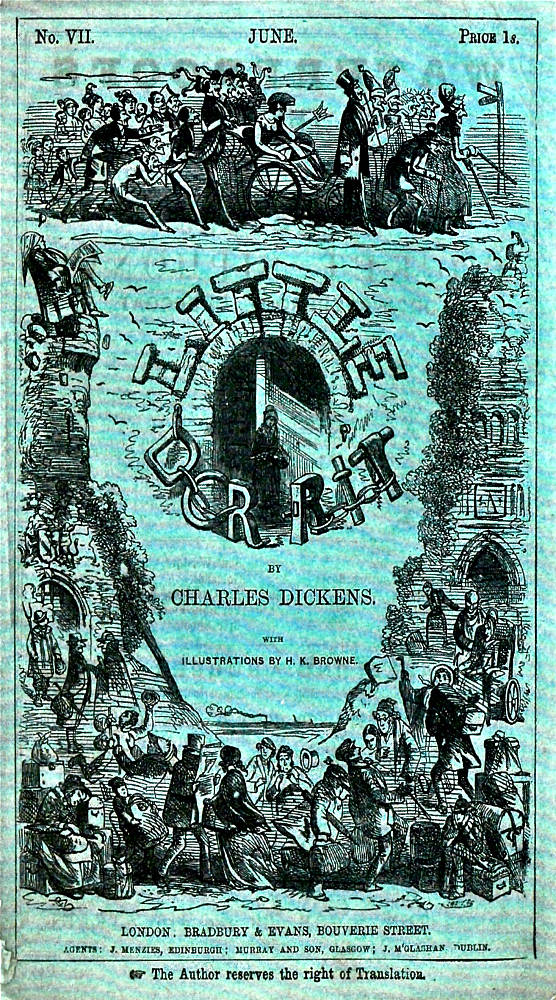
by the members of the #DickensClub, edited/compiled by Rach
Friends, can you believe that we have not only journeyed together for 2 months with Little Dorrit, but that our Club has been on this chronological Dickensian readathon for almost two years?
That is, in other words, 20 separate reads–one of which, Sketches by Boz, consisted of 56 sketches of London–of his novels, Christmas books, and essay collections. What a delight it has been, friends.
Thank you to all who have so graciously understood about the difficult time lately, and for suggesting the idea of one wrap-up–this final wrap-up–for covering the whole of Book II of Little Dorrit. Many, many thanks!
And before we move into the nitty-gritty, Boze and I just want to wish you all the happiest holiday season, and we so hope that you’ll join us in the New Year for our twenty-first read, that iconic story of love, sacrifice and revolution, A Tale of Two Cities.
A few quick links:
- General Mems
- Little Dorrit, Book II (Weeks 5-8): A Summary
- Discussion Wrap-Up (Weeks 5-8)
- Little Dorrit: A Final Thematic Wrap-Up
- A Look-Ahead to Our Break Between Reads (19 Dec, 2023 to 1 Jan, 2024)
General Mems

I want to lift a glass to our dear old cat, “Professor,” who passed away recently, and who would have been nineteen years old this Spring. She has been my companion on many a Dickensian journey–you can see her here accompanying me at the very outset of our Club, with Chapter Two of Sketches by Boz (oh, the curate, the old lady, and the half-pay captain!).
Upcoming: Friendly reminder that, for those interested, the Adaptation Stationmaster will be leading us through an episode recap of the 2008 Little Dorrit miniseries this week! For those who are going to be watching (self-paced), feel free to comment under his posts to discuss your thoughts.
Also, a reminder that we will not be having a Zoom meeting on Little Dorrit until next year, due to the holidays.
If you’re counting, today is Day 714 (and week 103) in our #DickensClub! Today we’re finishing up Little Dorrit, our twentieth read as a group. For the next two weeks, we’ll be taking a break between reads before beginning our twenty-first read in the New Year: A Tale of Two Cities!!! Join us on 2 January for this masterpiece. We wish you all a peaceful and joyful holiday season.
Meanwhile, please feel free to comment below this post for any final thoughts on Little Dorrit, or use the hashtag #DickensClub if you’re commenting on twitter.
No matter where you’re at in the reading process, a huge “thank you” for reading along with us. Heartfelt thanks to our dear Dickens Fellowship, The Dickens Society, and the Charles Dickens Letters Project for retweets, and to all those liking, sharing, and encouraging our Club, including Gina Dalfonzo, Dr. Christian Lehmann and Dr. Pete Orford. Huge “thank you” also to The Circumlocution Office (on twitter also!) for providing such a marvellous online resource for us.And for any more recent members or for those who might be interested in joining: the revised two-and-a-half year reading schedule can be found here. If you’ve been reading along with us but aren’t yet on the Member List, we would love to add you! Please feel free to message Rach here on the site, or on twitter.
And for any more recent members or for those who might be interested in joining: the revised two-and-a-half year reading schedule can be found here. Boze’s introduction to Little Dorrit can be found here, and Chris’s supplemental reading materials for this novel can be found here. If you’ve been reading along with us but aren’t yet on the Member List, we would love to add you! Please feel free to message Rach here on the site, or on twitter.
Little Dorrit, Book II (Weeks 5-8): A Summary
(Images below are from the Charles Dickens Illustrated Gallery.)
“It was vintage time in the valleys on the Swiss side of the Pass of the Great Saint Bernard, and along the banks of the Lake of Geneva. The air there was charged with the scent of gathered grapes.”

Amy and the Dorrits, along with their companion Mrs General (whose finances are strained due to her husband having been careless with her money while he was alive, and now she tutors young women who are trying to make their way in Society), have stopped at a monastery inn in the midst of their Alpine journey. They meet with the Gowans and their own less wholesome companion, Mr Blandois. Amy manages to get away from the group long enough to deliver a letter from Arthur Clennam to Pet, who has retired upstairs. Pet and Amy become fast friends; it is clear that Pet is homesick, and also worried enough about what Henry will think that she asks Amy not to speak of the letter.
Amy too is homesick, often to be seen as a solitary figure lingering on a balcony, reflecting on her past and present circumstances. She often writes to Arthur, giving him an update of the family, and how she herself feels ill-adapted to their change. She hopes he thinks of her as the same Little Dorrit that he always knew and cared for. She assures him that Pet is well.
The family has taken to berating Amy for reminding them—inadvertently, on her part—of their old life. Frederick, the uncle, however, seems to show her even more respect than before, while the rest of the family discuss their old friend and benefactor Arthur Clennam as though he were beneath them, and as though the very idea of him was an insult.
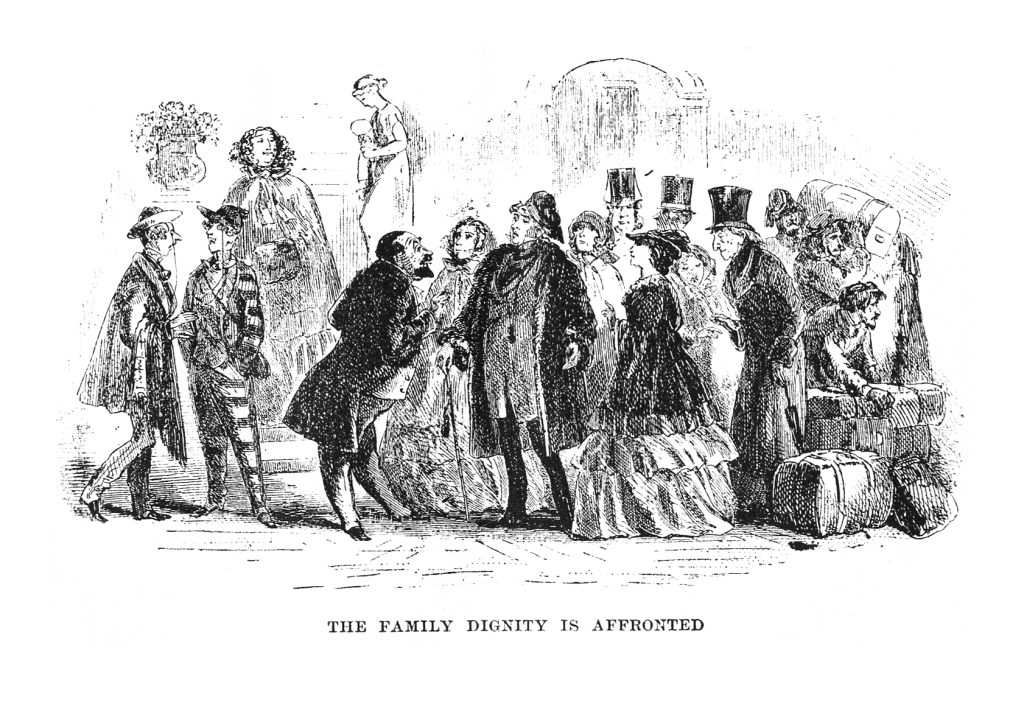
As they move to another inn, Mr Dorrit finds that one of their rooms has not yet been vacated by its former occupant, and Dorrit takes it as an insult to himself and his dignity—until the occupants (Mrs Merdle and Mr Sparkler) come to make their apologies in the most gracious manner, excusing the hotel staff entirely, and Mr Dorrit’s dignity is satisfied and he is eager to know the Merdles better.
The frustrations about Amy continue, as she continues to be uneasy in her new station. Mrs General and Mr Dorrit confer about this, and both make known their displeasure. Amy says that she will try to improve. Mrs General feels that she shouldn’t be taking note of vagrants and beggars as she does.
Finally, the uncle has had enough, and in a moment (when Amy is not by) of unusual strength of will and character, he chastises the whole family for their treatment of Amy, and their ingratitude and how much they have forgotten about what Amy has done for them. They all protest, but Fanny begins to take more notice of Amy and acts with more condescending affection towards her.
“‘To the winds with the family credit!’ cried the old man, with great scorn and indignation. ‘Brother, I protest against pride. I protest against ingratitude. I protest against any one of us here who have known what we have known, and have seen what we have seen, setting up any pretension that puts Amy at a moment’s disadvantage, or to the cost of a moment’s pain. We may know that it’s a base pretension by its having that effect. It ought to bring a judgment on us. Brother, I protest against it in the sight of God!’”

In Venice, Fanny and Amy visit the Gowans, and Henry Gowan’s dog shows a strong dislike to Blandois, which Henry beats him for—until Amy interferes to stop it. Fanny continues to accompany and tease Mr Sparkler, who is just as besotted by her as ever; both mother and son seem to be avoiding mentioning any previous knowledge of the Dorrits. Finally, Blandois informs them that Gowan’s dog has been poisoned.

Minnie/Pet is convinced that Blandois is responsible for poisoning the dog. She and Amy both dislike and distrust him. Both the Gowans and the Dorrits plan on going to Rome next, and Mr Dorrit expresses disappointment that Mr Merdle will not be joining them, as he wished to ask for financial advice. Fanny continues to tease Mr Sparkler cruelly. She also suggests to Amy the idea that their father has plans to marry Mrs General.
Back in England, Arthur misses Amy Dorrit, and the Meagles miss their daughter, who is now pregnant. Mrs Gowan—Henry’s mother—visits the Meagles, feigning her continued displeasure at the marriage, and that the Meagles had ensnared her son, but that there is nothing to be done about it now. Doyce’s business is now in good order thanks to Arthur, but several inventions of his are going nowhere because of the maddening inefficiency of the Circumlocution Office.


The Meagles leave to visit Pet abroad during her pregnancy. Meanwhile, Arthur sees Harriet and Miss Wade in the streets, the latter engaging in business dealings with a foreign gentleman. Once they part with the man, the women are seen going to Casby’s, and Arthur follows them there. Casby, however, declines any knowledge of Harriet’s current address. Arthur then sees the same mysterious gentleman going to his own mother’s house, and Clennam visits her and finds himself at odds with Blandois—yes, it is he—immediately. But Mrs Clennam won’t divulge anything about her dealings with Blandois, and dismisses her son. Clennam tries to get information from Affery, but she says she doesn’t know, though she is clearly scared of the man.

Back abroad, the Dorrits meet up with the Gowans again in Rome, and Pet and Henry now have a baby son.
Merdle’s name grows in greatness, and those in Bleeding Heart Yard—including the Plornishes, who now have a little store, where Nandy and Maggy help out—are eager to invest with him. Pancks visits the Plornish family often, and they all miss Amy Dorrit. Pancks too is sick with the Merdle fever, and has himself invested with him, and encourages Arthur to do the same, both for himself and for his partner, Daniel Doyce, who has left the business to Arthur while Doyce is abroad. Mr Sparkler, to everyone’s surprise and/or amusement, now has a position at the Circumlocution Office. (The Barnacles too want the connection with the Merdles.)
Fanny, who has long remained undecided about Sparkler, is now engaged to him. He acts very sweetly towards Amy, but Amy is distressed for her sister, knowing that Fanny doesn’t love him. Mr Dorrit, however, couldn’t be more thrilled, and only hopes that Amy, too, will marry well. Mr Dorrit returns to England with Fanny to see her settled with Mr Sparkler, but does not wish Amy to accompany them—the implication being that she is not yet accustomed enough to their new position to be seen in their old surroundings and do credit to the family.


Blandois, whose business with Mrs Clennam had barely begun, suddenly disappears, throwing suspicion on the house of Clennam. Flora pays an unexpected visit to Mr Dorrit, as Flora had employed Amy in times past—which Mr Dorrit said he would never have allowed if he had known of it—and asks whether Mr Dorrit knew anything of Blandois’s current whereabouts. Mr Dorrit, recognizing the man she describes, says that he will help keep a look-out for him. Mr Dorrit grows more and more agitated with his reengagement with England, and is completely thrown off when visited by the turnkey’s son, John Chivery, who brings Mr Dorrit cigars for old time’s sake. Mr Dorrit berates John, and John says that he is too proud, in his humble way, ever to have visited if he had known Mr Dorrit would take it ill. Mr Dorrit wishes John to forget his anger, and tries to make up for it.

After buying a gift for Mrs General and going into some business negotiations with Mr Merdle, Mr Dorrit returns to the Continent with relief. But it is a long and frenetically-paced journey, and he arrives unexpectedly early, and is peevish and jealous that Amy and Frederick are so close, and that he was unexpected by them. William thinks that his brother has declined since he left.
At a party with the Merdles, Mr Dorrit has a mental breakdown, and begins to address the company as the “Father of the Marshalsea,” as though he were still back in the prison. Amy comforts him and stays by him.
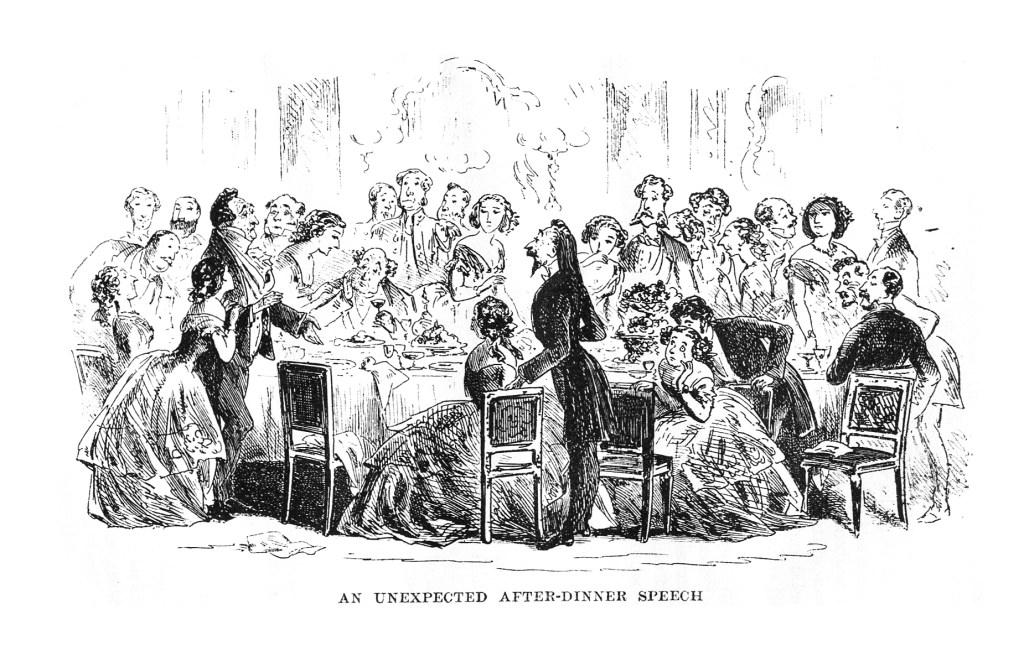

Amy nurses her father until his death. Her uncle, Frederick, dies shortly after the death of William.
Back in England, Clennam has found Miss Wade and Harriet, and the latter seems softened to him and to the Meagles, and asks after them, which Miss Wade sees as a weakness. Clennam affirms how welcome Harriet’s return would be to them, but she still refuses. Miss Wade doesn’t give much in the way of helpful information about Blandois, and no longer has a use for him. But she hates the Gowans, and gives a letter to Arthur which explains her history, which explains how she was an orphan, and how every kind action shown to her Miss Wade saw as a pitying condescension or as false. She was in love with Henry Gowan, whose own cynical view of the world was much in accord with her own. But he needed money, and pursued Minnie instead, leaving Miss Wade jealous and resentful.

Arthur must find Blandois at all costs, especially after he hears that Blandois was imprisoned along with his friend John Baptist at Marseilles—for murder. He wonders what his mother could have had to do with such a man. When he shares this knowledge with his mother, she still is not convinced enough to tell Arthur about her own business with the man.
Amy is expected to return to England shortly, while Fanny bemoans the long days and is bored to death. Mrs General has been paid off to leave them alone, to everyone’s relief. Suddenly, Mr Merdle pays a visit to Fanny and Edmund Sparkler, and, of all things, asks to borrow a pen knife.

The risky, empty foundations upon which the whole Merdle investment schemes were built are finally brought into the light, with a letter left by Mr Merdle, who has been found dead by suicide—with the pen knife he borrowed from the Sparklers—at the bath house.
Clennam is in agony, having invested with Merdle, at the prospect that he has ruined his friend and partner, Daniel Doyce. Pancks fetches the lawyer Rugg, but Rugg cannot persuade Arthur to any course except that which exonerates Doyce completely, taking the blame entirely upon himself and resigning his position. Arthur ends up at the Marshalsea, and the Chivery’s give Arthur the old familiar room which had belonged to the Dorrits.
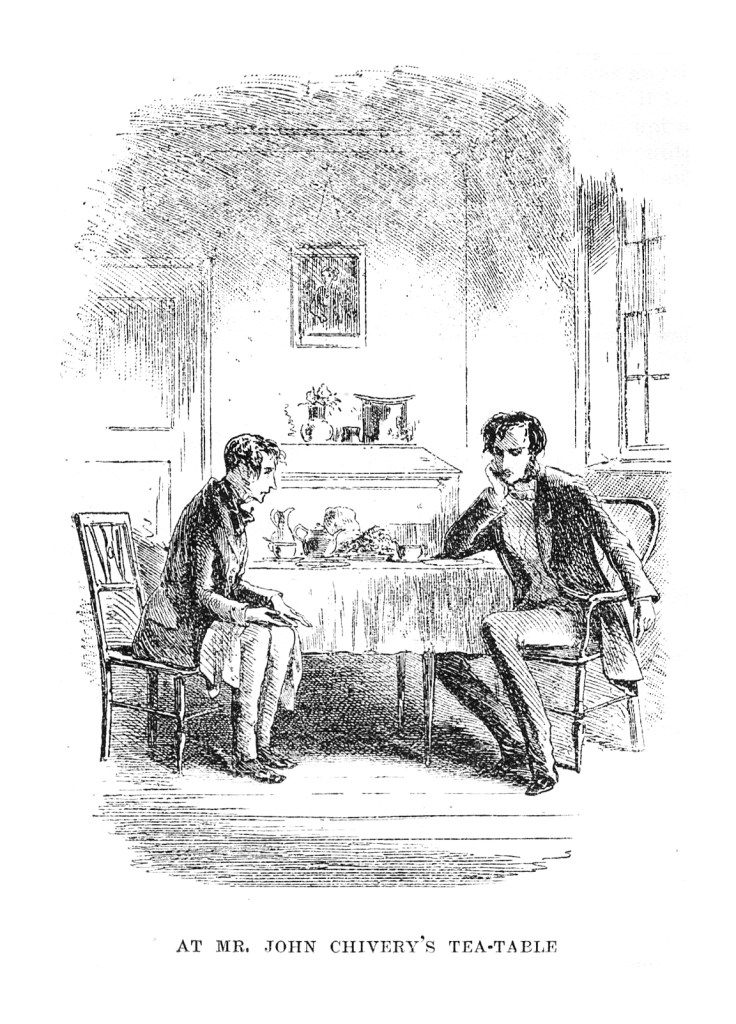
John Chivery is acting strangely: on one hand, he appears to have a resentful attitude towards Arthur, and yet he shows Arthur every possible kindness, encouraging him to eat—at least for another’s sake if not his own. Chivery fires up when Arthur claims that he can’t imagine to whom John is referring. John Chivery then reveals what he himself has known—what the very walls of the Marshalsea have long known—which staggers Clennam: Amy Dorrit loves him, and has always loved him.
“Had he ever whispered to himself that he must not think of such a thing as her loving him, that he must not take advantage of her gratitude, that he must keep his experience in remembrance as a warning and reproof; that he must regard such youthful hopes as having passed away, as his friend’s dead daughter had passed away; that he must be steady in saying to himself that the time had gone by him, and he was too saddened and old?”
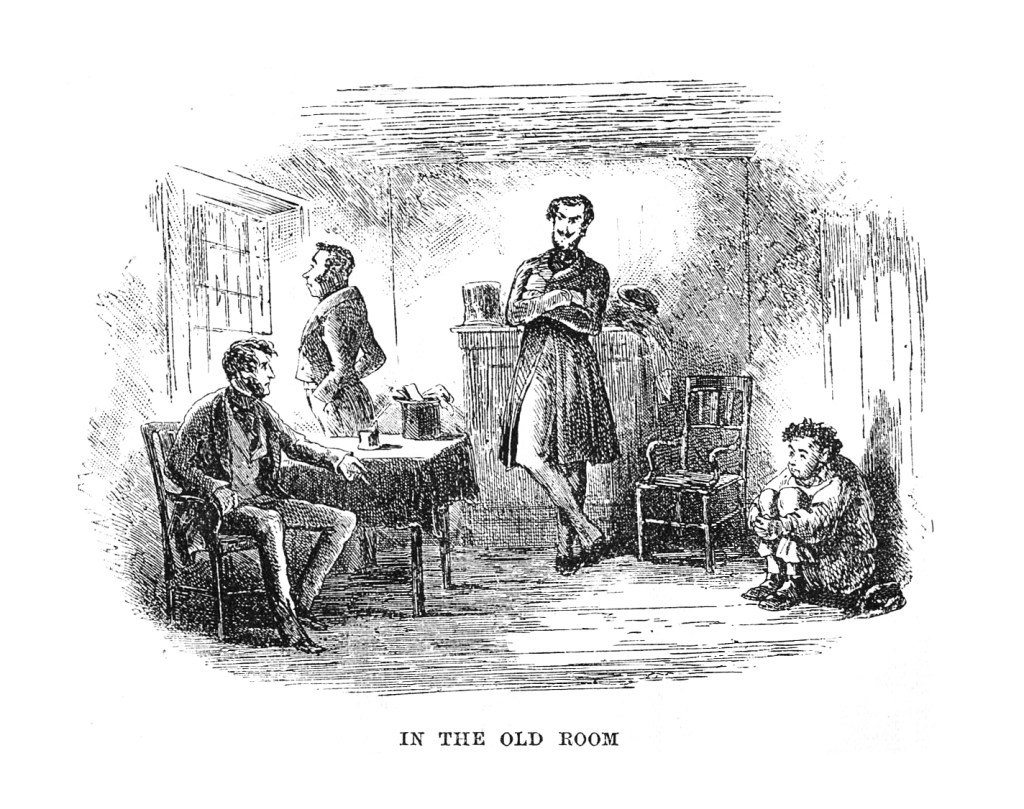
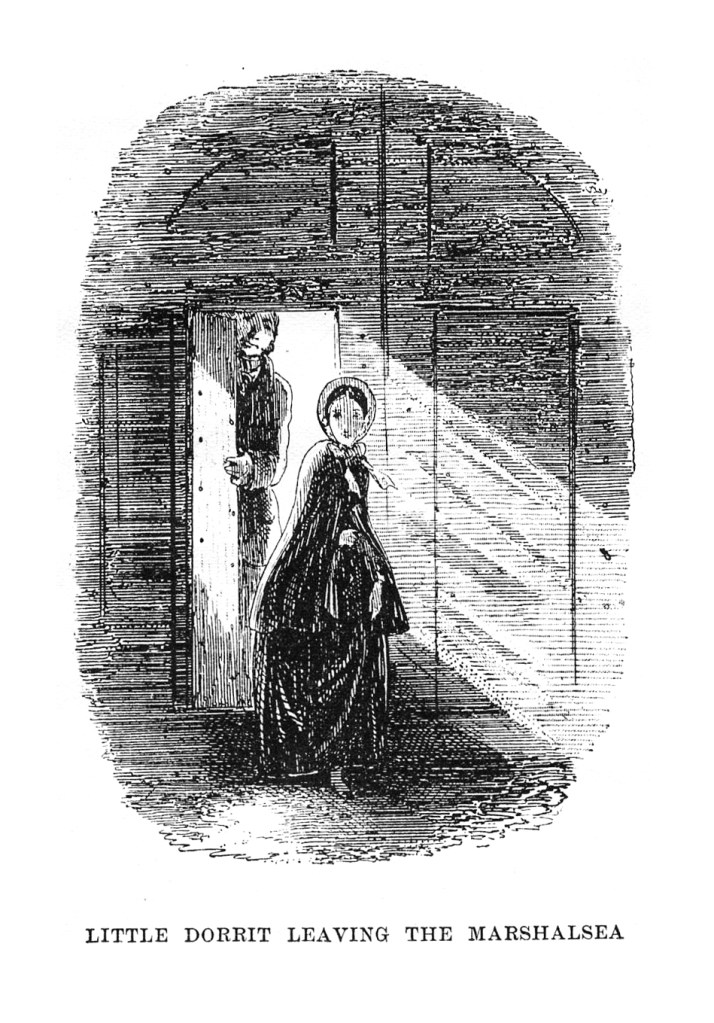
Arthur is visited by many: Rugg, the Plornishes, and even Blandois/Rigaud, who taunts him. Arthur’s health and spirits are declining fast, and he grows feverish. At one point, upon waking, he sees flowers on his table, and Little Dorrit is there—wearing her old dress—accompanied by Maggy. She cleans his room and unpacks food. She had only just returned to London, and heard of his imprisonment. Amy, who wishes to take care of him, is refused by Arthur, who feels that she must not be tainted by this place any longer.
Meanwhile, the history of the Clennam’s connection to the Dorrits has finally surfaced: Blandois has proof (from some documents that Flintwinch gave to his twin brother rather than burning—as Mrs Clennam had supposed) that money which was supposed to go to Amy Dorrit from Gilbert Clennam, has been taken by Mrs Clennam. Arthur is not her son, but was the son of a woman who was a pupil of Frederick Dorrit. Mrs Clennam shamed her into giving up her child, to be raised as Mrs Clennam’s own, with the same pride-filled fear of judgment with which she herself had grown up. All these documents Blandois will only give up to them for 2,000 pounds, which Mrs Clennam says that she cannot afford. Upon hearing that the documents were given to Amy Dorrit, who was to read them with Arthur if Blandois did not come to reclaim them at a certain time, Mrs Clennam almost miraculously stands from her chair, and rushes out into the streets. Blandois/Rigaud believes she is going to get his money.

Instead, Mrs Clennam goes to Amy, who readily returns the documents to her, unread. But Mrs Clennam asks that she read them. She does so, and is shocked and saddened by them. Mrs Clennam asks forgiveness, saying that she will restore what belongs to her, and Amy readily forgives her, not allowing Mrs Clennam to kneel to her. Mrs Clennam only asks that, if possible, the truth not be revealed to Arthur until after her death, unless it will do him some good. Amy assures her that she has no intention to reveal it. Amy accompanies Mrs Clennam back to her house to testify to Rigaud that she already knows the contents of the documents and so his blackmail is now worthless…but upon approaching the house, the house collapses, burying Rigaud. Affery had been out, and is safe. Flintwinch’s body is not found.
Casby doesn’t want either Pancks nor his daughter Flora to be visiting Arthur in the Marshalsea, and instructs Pancks to squeeze the inmates of Bleeding Heart Yard even harder. Pancks has finally had enough, and humiliates Casby—by knocking off his hat and cutting his flowing white hair—in front of the Yard’s residents, saying that they’ve all been taken in by this deceiver.
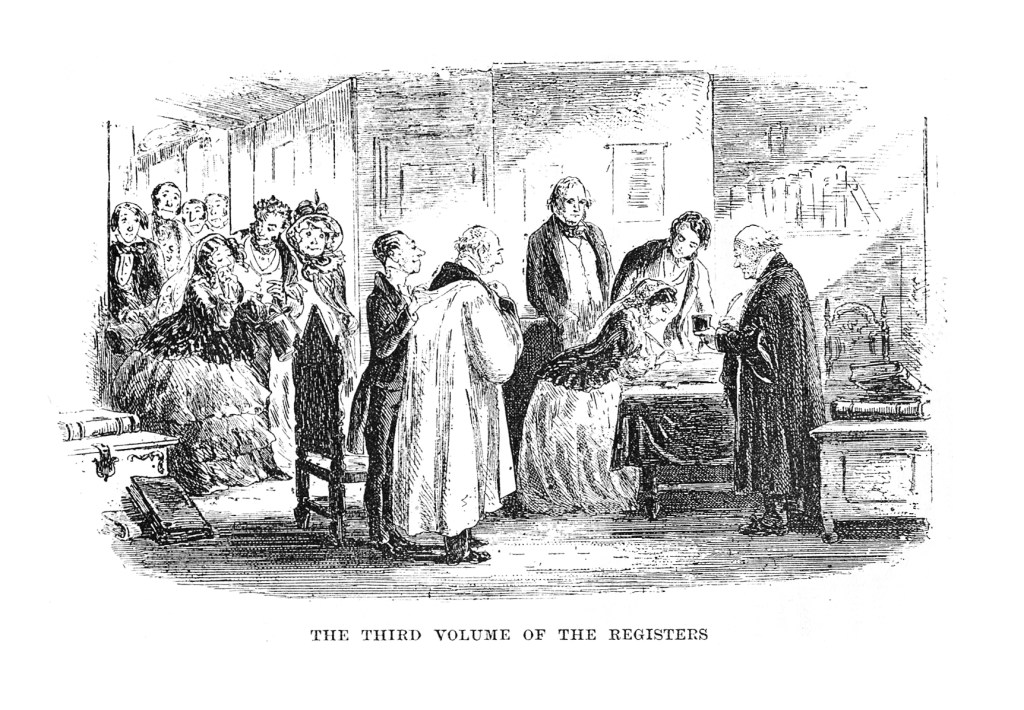
Arthur doesn’t want Amy to marry a pauper, and one in disgrace. Amy reveals to him that she herself is no richer than when she lived at the Marshalsea, as her whole family has lost money in the Merdle enterprise, and she loves him and cares nothing about being a “lady.” Daniel Doyce returns from his very successful trip abroad, and says that he regrets that Arthur has taken so much blame upon himself; he wishes Arthur to retain his old position, as they are doing better than ever thanks to the success of his ventures abroad. Pancks is to join them as a clerk. Amy and Arthur are quietly married at the same church where she and Maggy had slept on the registers during their night walk in London, and Amy and Arthur embark together on a life of quiet usefulness and happiness.
Discussion Wrap-Up (Weeks 5-8)
Miscellany; What We Loved
I think we all loved Frederick Dorrit’s outburst, standing up for Amy! The Stationmaster writes:
And three cheers for Edmund Sparkler:

Imprisonment
Daniel writes beautifully of the many forms of “imprisonment” in the novel: imprisoned by the Marshalsea, by selfishness, by false religion, etc:
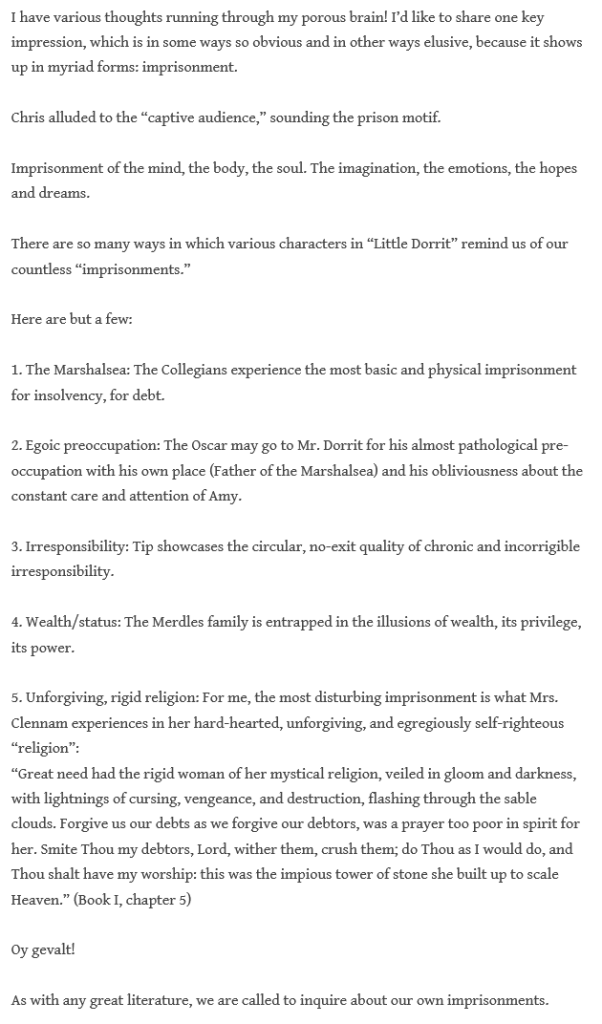
Chris reponds:
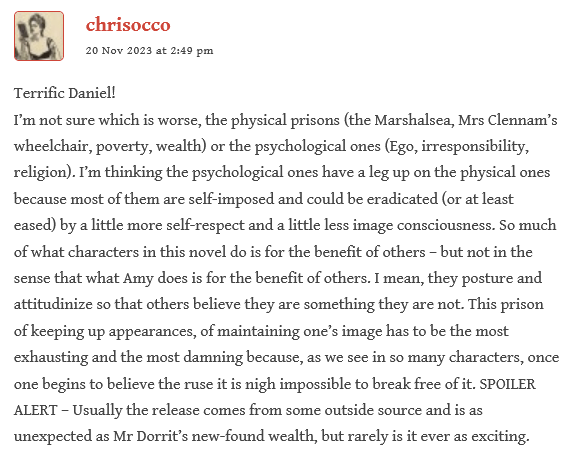
And Lenny agrees:
“…not only does your list get at the personalities who ‘highlight’ these kinds of ‘entrapments’ but it really allows the novel’s readers a set of terms which we can feed BACK into our readings of the first 4 segments of the novel (for more understanding), but also a terminology that we can apply GOING FORWARD into the next two segments of the novel–and probably beyond that to the novel’s finish!”
~Lenny H. comment
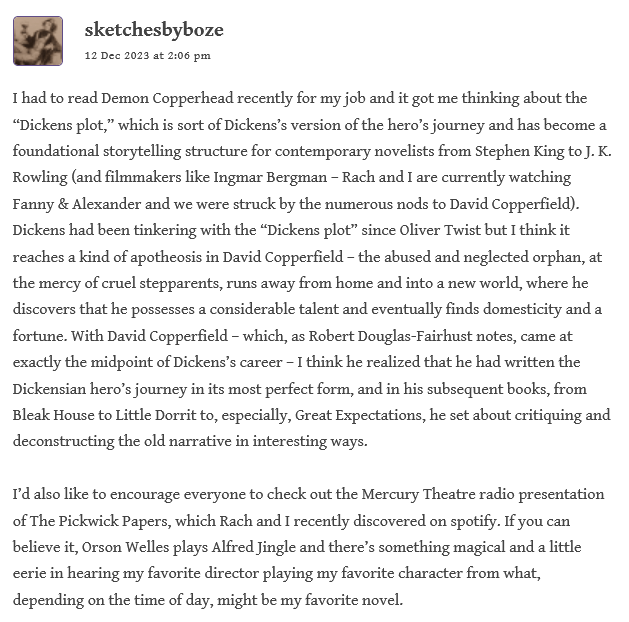
Dickens’s “Writing Lab”: Characterization; The “Dickens Plot”
The Stationmaster discusses the “cathartic” way in which many of the supporting characters “stand up to the people who have been pushing them around the whole story”:

Boze discusses his recent read of Demon Copperhead–a modern retelling of David Copperfield in the deep south by Barbara Kingsolver which we both enjoyed–and how Dickens’s plots keep popping up again in different forms, as though they are the secret of a successful novel:
Little Dorrit as a “Women’s Novel”
Lenny brings us back to “the ‘place’ of Women in this novel,” as “their roles far overshadow the roles of the men”:

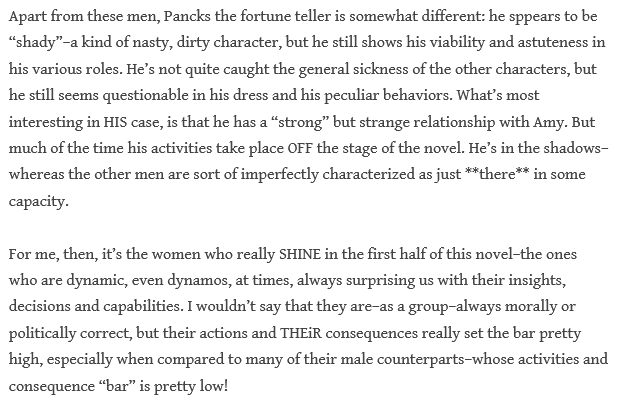
The Stationmaster discusses three of our women: Fanny, Mrs General, and Amy Dorrit:
Character Spotlight: The Gowans
“What on earth possesses Pet Meagles to be attracted to Henry Gowan”? Chris considers this:
Lucy feels that Mrs Gowan is “downright evil…a determined liar and twister of reality”:

Lenny responds:

And he concludes:
“I think, then, that LITTLE DORRIT is constantly, either directly or indirectly, asking the question–in its presentation of these various male/female relationships–’What makes a good and satisfying marriage?’ How is this nuptial fulfillment to be achieved in a world which is repeatedly challenging its fruition, its hopefulness!”
~Lenny H. comment
Amy Dorrit: Is there “Unhealthy” or “Selfish” In Her Attitude Towards Her Change in Circumstances?
The Stationmaster brought up some intriguing thoughts and questions regarding Amy Dorrit’s attitude about her sudden change of circumstances in Book II:
Chris responds about Amy’s “struggling” in her new position:
I add:


Chris adds:
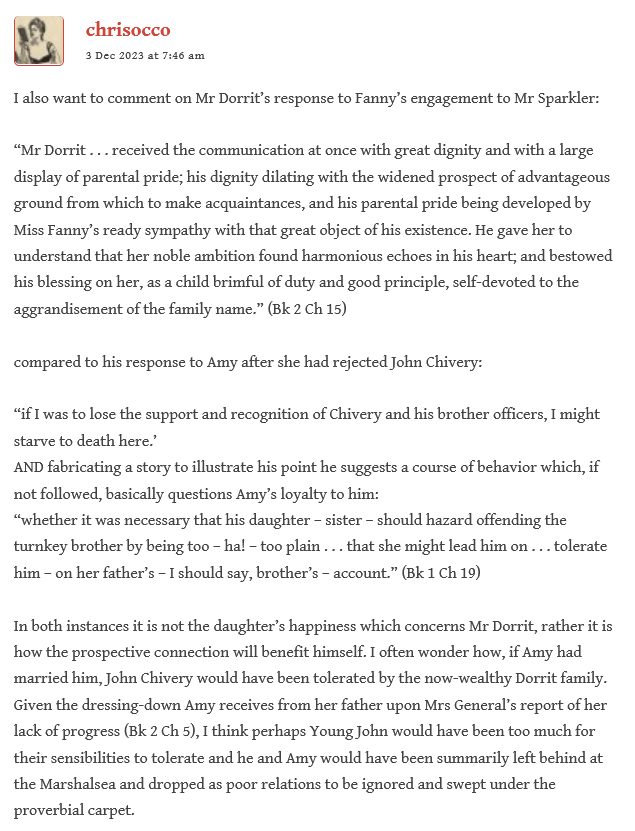
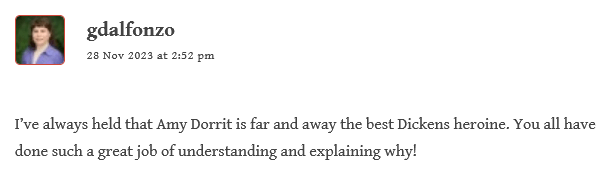
And I think we can all agree with Gina:
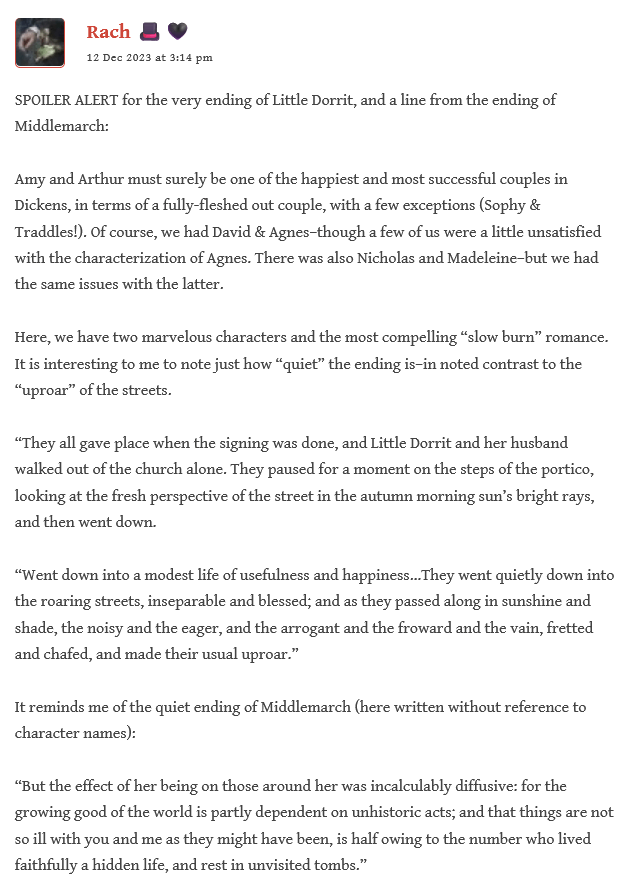
“They Went Quietly Down”: Quiet Heroism
I was pondering the very “quiet” ending of Little Dorrit, contrasting Arthur and Amy’s quiet life with the “uproar” of the streets, and thinking of George Eliot’s later conclusion of Middlemarch:

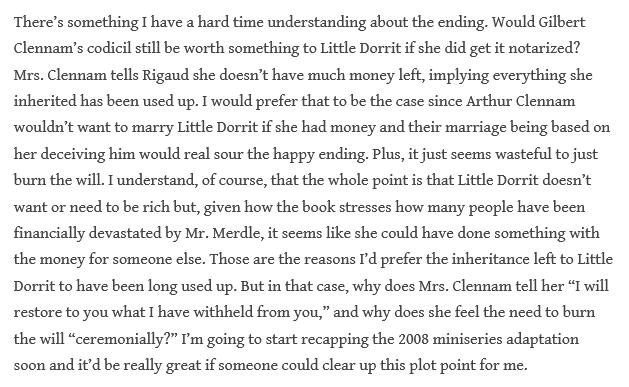
Curiosities & Questions…
But before we leave our friends and their Southwark haunts, the Stationmaster has some questions to ponder:
Little Dorrit: A Final Thematic Wrap-Up
- Contrasts: Light & Dark; Comedy & Tragedy; Life and Death (We have been considering this theme from the beginning of our Club, with Sketches by Boz. Here Dickens blends the pathos/imprisonment so inextricably with humor–Pancks, Flora, the Barnacles, etc.)
- Self-Definition Through Characterization; Dickens as the “Haunted Man” (Connections to Dickens’s own childhood; his father’s imprisonment for debt in the Marshalsea when Dickens was a boy, working and fending for himself; Dickens’s sister Fanny connected to Amy’s sister; Arthur Clennam’s melancholy/mid-life crisis like Dickens’s own? Dickens’s involvement at this time with Wilkie Collins’s play, The Frozen Deep.)
- Dickens, Shakespeare and the Stage (An ongoing theme. Fanny and Frederick’s theatrical connections; the connection between Miss Wade and Shylock. Dickens’s own connection to theater at this time, as mentioned in #2. Connection of Amy/William Dorrit to Cordelia & King Lear?)
- The Joys of Reading Dickens Aloud (Many of us have greatly been enjoying the experience of listening to Little Dorrit, read by such greats as Juliet Stevenson or Anton Lesser.)
- Little Dorrit as a “Women’s Novel”; Dickens’ Women: Amy Dorrit, Flora Finching, Mr F’s Aunt, Miss Wade & Tattycoram/Harriet, Maggy (A great deal of discussion has revolved around the women–far more than the men. “Angry women,” “soothsayers,” etc. Amy Dorrit Dickens’s best female lead?)
- Doubling (Lucy brought to our attention the real-life doubling of Daniel Doyce and Robert Whitehead, inventor. Also, the doubling of Mr Dorrit and Rigaud, both insisting on being “gentlemen.”)
- True and False Pride and Humility (The contrast of Amy’s pride–in not wanting her sister to be bribed–with Fanny’s false pride and willingness to take gifts from Mrs Merdle. The contrast of the false/insecure pride of Mr Dorrit in his treatment of John Chivery, with John Chivery’s true pride as one who would never have come to visit him in Book II, had he known Mr Dorrit’s true disposition towards him.)
- Responsibility and Debt; the Circumlocution Office; “Nobody’s Fault” (An ongoing theme throughout our Dickensian Chronological journey. The debt that brought Mr Dorrit to become the “Father of the Marshalsea” and Tip to become the consummate irresponsible young man. The lack of responsibility in figures such as Merdle, whose sham business dealings cause so much harm to so many who are taken in by him.)
- Dickens’ “Writing Lab”: Atmosphere (Southwark, the Iron Bridge, the Marshalsea) and Characterization; the “Dickens Plot”; the “Social Bitterness” in this Novel (Some of Dickens’s greatest creations here–including one of his best comic creations, Flora Finching–and one of his best atmospheric settings: the Marshalsea. A biting look at government and society, irresponsibility and debt.)
- Dickens & Parentless Children (Again, the children–e.g. Amy–must be the parents in the situation.)
- Forgiveness and Repentance; Justice and Mercy (The freedom of the forgiveness of Amy Dorrit–which takes only a moment–versus the lifetime imprisonment of Mrs Clennam, who imagines that she is making reparation over all the weary years.)
- Dickens, Romanticism, and the Imagination (Little Dorrit says that she could not have been of any use “if I had not pretended a little.” The story of the princess and the “tiny woman.” Imagination = interior freedom in the midst of imprisonment?)
- Imprisonment, Interior and Exterior (Is every character in Little Dorrit imprisoned in some way? Interiorly, exteriorly? Prisons physical, spiritual/religious, etc. From Mrs Clennam to Miss Wade to the Dorrits.)
- Dickens & Memory (See above, with Dickens as “Haunted Man.”)
- A “Pilgrim’s Progress” From One Novel to Another (An ongoing theme since the beginning. Here, everyone was smitten with Amy. Amy as “Nell Redux”? A more mature character from a maturer Dickens.)
A Look-Ahead to Our Break Between Reads (19 Dec, 2023 to 1 Jan, 2024)
For the next two weeks, the Dickens Club will be taking a break between reads. We hope you have a chance to check out the Stationmaster’s episode recaps for the 2008 Little Dorrit miniseries, and to join in the conversation!
Here, as we near the end of our second full year of the Dickens Chronological Reading Club–and what an accomplishment, friends!–Boze and I would like to wish all of our dear members, friends, and fellow Dickensians a very peaceful and joyful holiday season, filled with Pickwickian cheer! We hope to see you again on 2 January for Rach’s introduction to our next work, A Tale of Two Cities!
 All the (Dickensian) Year Round
Friends – I’ve been a little tied up recently because we finally moved back into our house after what I’ve been calling The Great Flood of Christmas 2022 wherein extreme cold temperatures caused water pipes in our home to burst, knocking out the electricity which caused more burstings, and thus it rained in our house for four days while we were away. The house was gutted and rebuilt – thankfully nothing of value (a.k.a. my Dickens library) was lost. I’ve missed being active in the group these last couple of weeks especially since “Little Dorrit” is my favorite Dickens novel and I can’t let us move on from it without saying just a few words on why it is so.
After all the struggles Amy and Arthur endure, after all the roadblocks that stood in the way of their endeavors to help those for whom they feel responsible or to right the wrongs for which they feel responsible, somehow they find each other and in each other a soulmate. That’s one thing – love will out. But with this story Dickens doesn’t simply end with the typical love story, he goes a step further. After all their struggles neither Amy nor Arthur has lost faith in their own purpose, their own reason for being. (Well, perhaps Arthur does for a time but Amy soon restores and revives it in him.) After their marriage they “Went down into a modest life of usefulness and happiness.” (Bk 2 Ch 34) What more can any of us strive for in our lives – especially at this holiday season – than to be useful and happy with those we love? (“Happiness” I define as being positive in the face of adversity – not becoming miserable, melancholy or despondent. These latter emotions so work against one’s ability to move forward or beyond whatever is troubling.) For me, this is the great message of “Little Dorrit” – of Dickens really – that in spite of the s**t life throws at us we must somehow find a way to be useful and happy. It sounds simplistic, but I think we often complicate life unnecessarily and that complication is what muddles us. Just look at the lives of most of the other characters in the novel to see how complication leads to muddle.
The final sentence of the novel – “They went quietly down into the roaring streets, inseparable and blessed; and as they passed along in sunshine and shade, the noisy and the eager, and the arrogant and the froward and the vain, fretted and chafed, and made their usual uproar.” – is often interpreted by critics as meaning Amy and Arthur will be swallowed up by all the commotion around them. They note how Amy and Arthur are quite while the rest of those in the “roaring streets” make “their usual uproar”, suggesting that Amy and Arthur will be ineffective against the roar. But I think – thanks to Dickens and his ambiguous commas – if we strip down the sentence to simplify it, it suggests just the opposite. Consider then – “They went quietly down into the roaring streets . . . and made their usual uproar”. To me, Amy and Arthur are the ones who speak the loudest via their “usual uproar” of quiet and unseen ministrations to their fellow beings.
Happy Holidays to you all and to your families! God bless us, everyone!
LikeLiked by 4 people
Glad you and yours are back in your house. I also prefer to interpret the somewhat melancholy last sentence of Little Dorrit as implying that the new Mr. and Mrs. Clennam represent an oasis of goodness in a corrupt world, all the more valuable because of their rarity, not that they’re doomed pebbles trying to dam a flood.
LikeLiked by 2 people
Chris, I think you hit the nail on the head. What a beautiful reflection on the quiet and somewhat unusual closing of the book. But as you say, it really is what Dickens is all about – “the story of our lives from year to year”, the quiet heroism, the striving to do the normal things with extraordinary fidelity. What a perfect way to end our Dorrit journey and move into the holidays 🎄❤️❤️❤️
LikeLiked by 1 person
Chris, you said: “For me, this is the great message of “Little Dorrit” – of Dickens really – that in spite of the s**t life throws at us we must somehow find a way to be useful and happy.” I completely agree. It’s the eternal question of how to live a good life. I don’t think there’s a more important one. As Amy & Arthur step down into the world, they may pass from our view, but nothing can swallow them up. They have found the greatest reality in each other.
LikeLike
Hello friends, I have managed to fall very behind with Little Dorrit due to general busyness at work (I work in the Theatre Royal in Nottingham and it is currently the very busy Pantomime season) and pressures of audio editing and the like and feel sorry not to have been active these last few weeks. I just wanted to wish you all happy holidays and all the best for the new year. Also to assure you that I will get through Little Dorrit. I am loving it very much and have not abandoned my desire to read it all (I did manage to read Dombey and Son in around 5 days, so I am hoping for a burst like that to come along) Once I have finished I look forward to going through the recent posts and catching up with discussion. 😀
LikeLiked by 3 people
I also finished LD up late, so please forgive me for sharing some closing thoughts now, when the rest of the Club is moving on!
Others have already mentioned Amy Dorrit as a kind of Little Nell “rediviva.” I detected a number of echoes of The Old Curiosity Shop in LD – the theme of ‘parentification’ in the young lives of Amy/Nell, and the need for each of them to save their father/grandfather from himself.
According to the Desert Fathers, the evil thoughts that arise spontaneously in our minds and are the source of our disordered desires and sinful actions tend to coalesce around nine major themes. Evagrius of Pontus associates these nine “logismoi” in turn with the three realms of the soul identified by Christian Platonism: there are three major temptations which beset the desirous part of the soul (epithymia or will), three besetting the emotional part (thymos or heart), and three besetting the intellectual part (nous or mind).
Without getting any further into the weeds on this, it seems to me that Nell’s grandfather was afflicted by the temptation to AVARICE — which the Patristic tradition places in the lower, desirous part of the soul — while Mr. Dorrit was consumed by the more insidious temptation of PRIDE, pertaining to the higher, intellectual part, the most advanced and dangerous of the vices. It follows that Nell is able to mitigate the effects of her grandfather’s greed by removing him to a place of security, free of temptations (epithymia is cooled finding no object to impel it). But when Mr. Dorrit succeeds to the family estate and his pride is let loose from the Marshalsea to bestride the wide world, his meteoric rise can only lead to a catastrophic fall.
The prison humbled him, to a degree, by keeping him reliant on Little Dorrit’s service — and she, for her part, she knew how delicately to work around his pride in all her acts of love for him. His sudden ascent to fame and fortune destroyed that delicate balance. Outside the salutary influence of the Marshalsea, his pride became a consuming, isolating passion that kept Amy and Frederick at arm’s length as embarrassing reminders of his past humiliation. He would not suffer himself to be softened by his “favorite child” (until the end?)
Both men were driven (or at any rate convinced themselves that they were driven) by a desire for their daughters’ good. Nell’s grandfather was compelled to gamble in order to win her a fortune, and Mr. Dorrit insisted that Amy adapt herself to the ways of high society so that she might have a comfortable future in it. But I think both were really driven by their own fears and woundedness: the grandfather was afraid of poverty and ruin after seeing his own daughter’s failure and determined that his granddaughter would not suffer the same; Mr. Dorrit was afraid of shame and rejection after the long degradation of the Marshalsea, and so attentive to the least affront to his dignity that it became a ruinous obsession. Ironically, as much as he refused to speak or hear one word about their “shameful” past, William Dorrit was utterly trapped in it — as evidenced when he humiliates himself in the eyes of polite society at last by lapsing into the old role of “Father of the Marshalsea” at Mrs. Merdle’s table.
In the end, Nell was more successful in protecting her grandfather from his own worst inclinations than Amy was in protecting William Dorrit from his — although Little Nell’s “success” in leading her grandfather to a place of repose and security came at the cost of her own young life and a happy future together! Nell’s story is a tragedy, whereas Amy’s is a comedy. Nell ends up in an early grave, Amy in a wedding dress. I wonder if this is why more readers seem to like Little Dorrit than Little Nell.
Other reactions: I loved Arthur Clennam, especially in “Nobody’s Fault” and the scene walking with Pet before her marriage to Mr. Gowan (what an awful man he turned out to be!) His integrity was tested and proven again and again, until finally his decision to exonerate Mr. Doyce and take all the blame for his bad investment. He underwent a kind of martyrdom in the Marshalsea! I also shared in the Club’s general affection for Flora Finching and Mr. F’s Aunt. Pancks came through as a surprisingly lovable character in the final act, too. (I loved Dickens’ characterization of him as the tugboat steaming here and there!) And Mrs. Clennam’s redemption in the end was a wonderful thing to behold. The collapse of the house just as they were running up seemed a bit of a stretch to get Rigaud off the board, but I can forgive Dickens a little “deus ex machina” to tie up the loose ends. 🙂
I was enchanted by this novel from beginning to end, and so looking forward to jumping in to A Tale of Two Cities! Just got my Penguin Classics edition in the mail. I haven’t read this since high school and am excited to come to it now with fresh eyes, as well as the context of Dickens’ life and earlier works.
Happy New Year!
LikeLiked by 2 people
Gosh, Fr Matthew, what a beautiful reflection! This could be its own essay/post entirely!! So much to comment on here…for now, I just wanted to wish you a Very Happy New Year as well, and to thank you for such a gorgeous reflection!!!
LikeLiked by 1 person