by The Adaptation Stationmaster
Episode 4

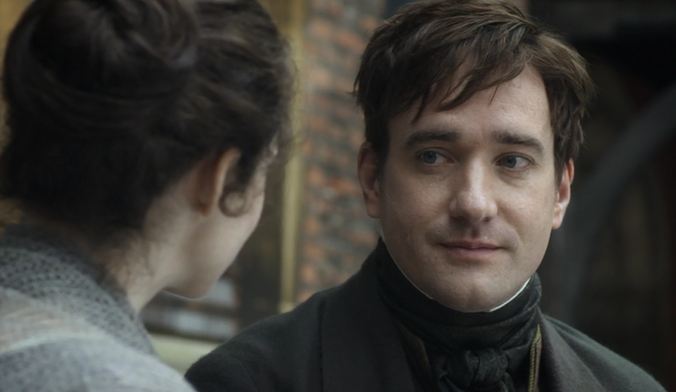
It’s morning and John Chivery is getting himself spruced up to propose. I love that this adaptation includes his habit of fantasizing about inscriptions for his tombstone (“Here lies John Chivery, sixty years turnkey, and his truly beloved wife, Amy”) which might easily have been cut for being too weird. I wish it could have also included his cane with the finger shaped tip. Anyway, he drops by Mr. Dorrit’s place with his regular gift of cigars. Mr. Dorrit can clearly guess John’s intentions and tells him without being asked that Amy is taking a walk down by the river. “You wouldn’t take her from me, John?” he asks all of a sudden. “I would never do that, Mr. Dorrit,” says John, oblivious that this question might reflect badly on the questioner, “Never! She would always be here.” The normally aloof and patronizing Mr. Dorrit is so happy to hear this that he actually hugs him.
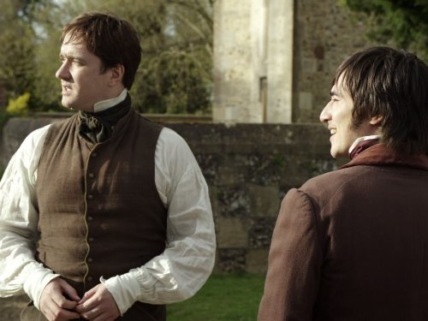
John Chivery isn’t the only one thinking about marriage. Arthur Clennam walks toward the Meagles abode with a big smile on his face. He can hear Pet singing not so far off. His good mood is shattered upon meeting Henry Gowan and his dog, Lion, at the gate. Actually, that’s not what makes him lose the smile. It’s seeing how happy Pet is to see Gowan when she greets them. Alex Wyndham is great as Gowan, being both cheerful and good looking enough that you can understand Pet being attracted to him and annoyingly flippant enough that you can understand why he drives Arthur and Mr. and Mrs. Meagles crazy. The writing could stand to be clearer about just what his moral failing is though. In an interesting touch, he addresses Pet as Minnie. While I’m pretty sure he wouldn’t be allowed to call a woman by her first name unless they were engaged in this culture, I really like the parallel this produces with the plotline of Miss Wade and Tattycoram. Pet may likely find it refreshing that Gowan uses her real name instead of the nickname her parents gave her just as Tattycoram finds it refreshing that Miss Wade calls her by her real name of Harriet. It’s a way of attributing independence and dignity to them though, of course, it’s questionable whether Gowan and Wade are actually going to give Pet and Tattycoram those things.
Amy is hanging out by the bridge and staring at Arthur Clennam’s discarded button when John interrupts her. He actually gets out a declaration of love and a marriage proposal, despite her attempts to change the subject, and she apologetically but firmly turns him down unlike in the book where he just asks if he may say something to her that’s been on his heart a long time and she says no, never. I don’t think the miniseries really needed to change that since both actors are so great that the viewers could easily understand the implications, but the scene is effective either way. As John leaves, weeping, he throws aside his fancy hat, not in anger but in sadness. Little Dorrit’s not happy either.
At the Meagles cottage, Pet sings and plays the piano while Arthur holds her music sheets for her. Tite Barnacle Jr. is visiting with Gowan, and he’s horrified to see Arthur again, whispering that he’s “a most ferocious radical, you know,” who came into the Circumlocution Office actually expecting to receive information. “Sent him packing, I hope,” says Gowan dryly. To prevent Pet getting a little too companionable with Arthur, Gowan asks to play a duet with her. As he does so, Arthur asks Doyce about Gowan. He learns that he’s an amateur painter distantly related to the Barnacle family. (Amusingly, as Doyce describes the Barnacles making “a botch of everything they put their hand to,” Tite Jr. can be seen fumbling with a knick-knack of the Meagleses in the background, dropping it and pretending it wasn’t his fault.) He also learns that the reason Mr. Meagles has been taking his daughter abroad so often lately is that he wants to separate her from Gowan. So far this hasn’t worked. I love the way Andrew Davies structures this scene with Gowan and Tite Jr. speaking during the first half while Arthur and Pet are at the piano and the Meagles parents smile and Arthur and Doyce speaking during the second half while Gowan and Pet are at the piano and the Meagles parents frown.
As Little Dorrit reenters the Marshalsea she hands Mr. Chivery Sr. his son’s hat. She can’t bear to look him in the face as she does so, and she doesn’t even try to look at John himself. “They always was a proud lot, the Dorrits was,” grumbles the elder Chivery. To his credit, John says, “I won’t hear a word said against her.” Once his father leaves, giving him some privacy, he composes a new, more depressing inscription for his tombstone. “Here lie the mortal remains of John Chivery, never anything worth mentioning, who died of a broken heart, requesting with his last breath that the word, Amy, be inscribed over his ashes which was accordingly done by his afflicted father.” Lots of credit to Russell Tovey for looking so goofy as this character while also being heartbreakingly earnest.
Mr. Dorrit and his brother are taking a stroll around the courtyard. Amy passes them without a word, looking unusually preoccupied and unfriendly. Instead of being concerned for her, Mr. Dorrit takes this as an opportunity to complain about young people. He brags about all the distinguished visitors he’s had and all the “testimonials” they’ve left him. He also tuts his brother about his appearance. Frederick protests that it’s easier for Mr. Dorrit to keep track of things like that when he’s the only one in the family not working. (Remember what I said about this version of Frederick being more clearheaded and argumentative than his literary counterpart?) Mr. Dorrit is furious at this, saying that no one can understand how he’s suffered all these years as a prisoner. At once, Frederick apologizes demurely, acting more like how he does in the book, and makes to depart. Mr. Chivery Sr. shows him out. “You know, Chivery,” says Mr. Dorrit condescendingly, “I worry about him out there in the world. Sometimes I think I’d be happier if he were safe within these walls. But, of course, it takes strength of character to endure confinement here year after year and still maintain one’s self-respect.” Mr. Chivery is unusually unfriendly. When Mr. Dorrit mentions John to him, he pointedly says that he wishes he hadn’t laid out so much money on his clothes, considering how little good it did him. Even the professionally delusional Dorrit can’t fail to get the message.
He returns home and tells Amy about Chivery’s coldness, though he claims he doesn’t understand it, stressing how very important it is for him to be in the good graces of the turnkeys. Then he tells her an obviously fake story about a young turnkey who was once in love with the daughter-sorry, the sister of a prisoner and how he told that prisoner his daughter-sorry, sister shouldn’t risk offending the man by outright rejection. Subtlety is not a strong suit of Mr. Dorrit’s. Afterwards, he seems to feel guilty or at least embarrassed and launches into a defensive rant about how he’s made a place of honor for himself in the prison. Finally, he breaks down in tears. Tom Courtenay is great, but this scene belongs to Claire Foy who conveys so much in a brief time. She goes from casual concern for her (character’s) father to being hurt and angered by him to feeling compassion for him without giving the impression she’s reconsidering John Chivery’s proposal and all with barely any dialogue!
Gowan says goodbye to the Meagles party. (Amusingly, his dog looks like he’s peeing on the Meagleses’ plants before his master calls him.) The miniseries makes it crystal clear what the book obliquely implies: that Mr. and Mrs. Meagles want their daughter to marry Arthur, not Gowan. When she runs after the latter to whisper a private farewell in his ear, they assure the former that she really likes him (Clennam) very much. When Arthur himself leaves, they call after him to come again soon. They called no such thing after Gowan. But Arthur’s romantic hopes have clearly been dashed if not completely obliterated.
Cavalletto has arrived in London and looks fairly happy-until he hears Rigaud somewhere in the crowd, whistling his signature tune. Terrified, he runs into Bleeding Heart Yard, where Doyce is about to show Clennam his factory, and gets his legs hurt in a traffic accident. Doyce and Clennam carry him into the Plornishes’ home. It’s weird that they would just leave the man to be taken care of by these financially struggling people who can’t even speak his language. (In the book, Arthur takes him to a hospital where someone speaks Italian.) But I understand the miniseries wanting to start developing the relationship between Cavalletto and Mrs. Plornish as soon as possible. Before Clennam leaves, Cavalletto begs him, “don’t let him find me,” though he won’t say whom he means. This detail isn’t from the book, and neither is Cavalletto getting in the accident because he was running from Rigaud, but I like both ideas.
BTW, while the Plornish kids are prominent in the Bleeding Heart Yard scenes, the character of Old Nandy, Mrs. Plornish’s elderly father, has been cut. He’s one of the few characters to completely get the axe in this adaptation, reasonably enough IMO. Not that I dislike Old Nandy in the book but if I were making my own adaptation, I’d consider cutting him too. The story is so full of memorable characters, it’s a lot to ask to include every last one.
Remember Flintwinch’s double to whom he entrusted the box with Mrs. Clennam’s big secret? Well, that was his brother, Ephraim. Rigaud notices him hanging out at an inn, waiting for a boat to come, presumably to take him and the box far away. I guess it’s pretty obvious from the way Ephraim keeps the box under his hand that it’s something valuable because the opportunistic Rigaud buys him a drink.
Meanwhile, Doyce shows Clennam his invention. The book isn’t super clear about just what Doyce’s supposedly awesome invention is. Looking at it in the miniseries…I still don’t know what is. LOL. Something to do with steam power. We don’t really need to understand it. Arthur mentions some overseas trading contacts of his who might be interested in the invention. After hesitating, he also asks to go into business with Doyce who happily accepts though he warns him it will be a while before the company makes either of them a lot of money.
Little Dorrit stops by the theater, and we get to see a little of Fanny’s dance routine. (She enters the stage in a gondola against a painted backdrop of Venice. It only just occurred to me that that was foreshadowing.) After the rehearsal, Amy confides in her about John’s proposal. Fanny is mystified by her refusal, asking if her sister thinks she’ll ever get a better one. This is a change from the book where Tip and Fanny look down on John as beneath their family. I wish that could have been kept since I like how it differentiates them both from their father, who wants to keep the Chiverys happy, and Amy, who doesn’t consider herself upper class but simply doesn’t love John Chivery romantically. (In the book, she actually tells him not to think of the Dorrits as anything special.) But maybe all that would have been too complex to develop. Other than that little change, Fanny’s personality is basically the same as in the book but as written by Davies and played by Emma Pierson, she’s a much more comedic character. I actually don’t mind that as I enjoy both versions of Fanny equally. Amy asks her sister if she loves Mr. Sparkler. Fanny reveals that she despises him but says she might marry him one day to spite his wealthy mother who has invited her to her house that day. She invites Amy to accompany her there. I feel like this scene would have made more sense at the beginning of the next episode, but I guess things just didn’t work out that way.
Of course, the episode doesn’t quite end there. Rigaud has gotten Ephraim Flintwinch very drunk. He takes him out behind the dock, stabs him repeatedly, tosses his corpse in the water (this is implied rather than shown) and collects the fateful box. In the book, Rigaud just says Ephraim was a friend of his who died of natural causes, and he found the box in his room after his death, but I think the change is quite reasonable. On reflection, since we only hear about that from Rigaud himself, he could very well be lying and the violent version of events in the miniseries actually be what Dickens meant to imply.
Episode 5
Fanny and Amy call on Sparkler’s mother, Mrs. Merdle (Amanda Redman), at her fancy house in Cavendish Square. (Sparkler is her son by her first husband.) She claims to them that she doesn’t have a problem with Fanny as a daughter-in-law herself, but Society would never accept the match, requiring her to disinherit him. Fanny says it doesn’t matter since she’s already refused her son but that she sees no honor in the connection. The air in the room crackles with tension between the two and Little Dorrit looks like she can’t wait to get away from this unfriendly lady. Mrs. Merdle and Fanny raise their voices to each other much more in this scene than Dickens describes them doing but, fortunately, it’s just for this one scene. All their other interactions are closer to the book’s depiction and this one is still riveting in its not-exactly-like-the-book way. (Perhaps the miniseries felt that since there were already two awesomely aloof and chilly female antagonists in Mrs. Clennam and Miss Wade, Mrs. Merdle would have to distinguish herself from them.) She ends the interview by giving Fanny a fancy bracelet and telling her there’s another “mark of her appreciation” waiting for her at the dressmaker’s. “And now I think it is time to part again and on the best of terms,” she says. The musical theme for Mrs. Merdle, which is equal parts comical and creepy, is one of my favorites in the series and I love the adaptation for including her pet parrot that interrupts her. Details like that are one of the things that make Dickens’s work so fun and memorable.
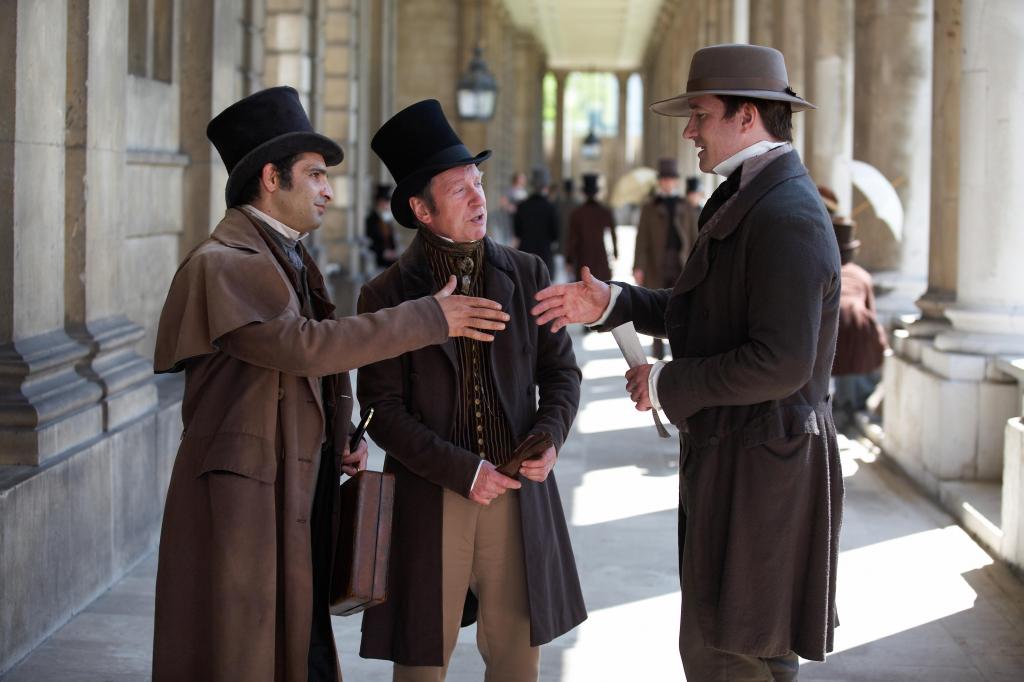
Meanwhile, Doyce’s factory has officially become Doyce and Clennam and Cavalletto has a job there. In more good news, Flora Finching and Mr. F’s Aunt stop by the workplace to visit Arthur. Well, that’s good news for us since those two are always fun. It’s kind of awkward for Arthur himself. But he’s glad to hear that Flora, inspired by his words, is hiring Little Dorrit as a seamstress. Mr. F’s Aunt is less glad. “You can’t make a head and brains out of a brass knob if there’s nothing in it,” she yells, pointing at Clennam. “You couldn’t do it with your Uncle George when he was living, much less when he’s dead!” I love her so much. Outside the factory, the Plornishes and other tenants of Mr. Casby are congregating around him. “They love him, you know,” Flora gabbles cheerily to Arthur, “They think he’s a saint. I don’t know why. They think it’s Pancks grinding their faces in the dust but it’s Papa all the time, you know. He loves money so very much. It’s quite a scandal, really.” Pancks, who has been collecting the rent, watches the scene with resigned disgust. Mr. F’s Aunt continues to glare at Arthur as Flora ushers her away.
John Chivery is moping in his father’s office when Pancks stops in to take a look at the books. (There’s a little in-joke where you can see John Dickens’s name in the registry above William Dorrit’s.) He’s intrigued to find that Mr. Dorrit was born in Dorset. We don’t know why yet. After he leaves, John sighs and says, “Oh, Amy!” It’s easy to infer that he’s been doing that a lot lately.
Mrs. Merdle is seen examining her hands. At first, I thought she was missing the bracelet she gave Fanny, but now I think this is a nod to her insecurity about her hands in the book, “the left being much the whiter and plumper of the two.” Her son arrives home, and she tells him that Fanny has broken up with him before sending him to get dressed for dinner. He’s devastated and for a moment, he starts to protest his mother’s interference but all she does is repeat her command in a slightly raised voice and he folds. This short scene isn’t in the book but it’s hilarious.
Backstage at the theater, Amy expresses disapproval of Fanny for taking Mrs. Merdle’s bribes when she doesn’t want to marry Sparkler in any case. Fanny yells at her for not wanting revenge on Mrs. Merdle for snubbing the family and even accuses her of her dragging them down. (“If you despise me for being a dancer, why did you put me it the way of being one?”) Immediately afterwards, she apologizes and hugs Amy though she still defends her attitude. Amy tells her that she has her own pride, implying that hers involves being honest and, you know, not accepting bribes.
Arthur drops off a note for Amy at the Marshalsea. Mr. Chivery Sr. takes the opportunity to tell him about his son’s pining. He tells him that Little Dorrit really wants to marry him and only rejected his proposal because her family would disapprove. He tells Arthur that Amy looks up to him and encourages him to reason with her. In the book, John’s mother, a character absent from this version, does this and it’s not clear that she knows Amy is really in love with Arthur though it’s possible she does. (Later, John speaks of her love for the man as if everyone in the Marshalsea could sense it.) Since Tip and Fanny really did look down on John Chivery in that version, it’s possible she really thought they were responsible for Little Dorrit’s refusal of him. Thus, Mr. Chivery is a more negative character here than in the book though we’ll see he’s not irredeemable. Arthur doesn’t seem to totally buy that John Chivery is Amy Dorrit’s type, but he considers the idea.
There’s a big dinner party at the Merdles’ house. Edmund Sparkler mopes through it, pining for Fanny, which arguably makes him more likeable than in the book where he’s already moved on to other “doosed fine girls with no biggod nonsense about them” at this point. Anton Lesser is perfectly cast as Mr. Merdle, a mild little man who’s terrified of company despite his high place in society. As his disapproving chief butler, Nicholas Jones isn’t quite as spine-tinglingly intimidating as Dickens depicts him as being, a rare case of it being possible to improve on this adaptation’s casting. Maybe the only case actually. A lawyer (Nicholas Blane) and a doctor (Geoffrey Whitehead) at the party act as a sort of Greek Chorus. (Dickens refers to them as Bar and Physican so I will too.) Their conversation reveals that Mr. Merdle has become one of the most powerful men in the country, solely because of his (apparently) awesome banking skills. Even Tite Barnacle, they note, is “dancing attendance” at the dinner. I know I accused Andrew Davies of being overly preoccupied with sex before, but I’d argue that Bar and Physician checking out Mrs. Merdle is true to the spirit of the book. Dickens emphasizes the magnificence of her “bosom” in the text though he mainly stresses what a great place it is for displaying jewels. After the dinner, Bar notes that Merdle looked quietly miserable throughout the night. Physician says he can’t find anything wrong with his health. He must be under some mental oppression. Whatever it is, it’s so palpable they agree they wouldn’t exchange places with him for all his millions.
Meanwhile, up in his room, Rigaud looks over the documents in the box he stole, the ones Mrs. Clennam can’t bear for her son to see. One of them is a last will and testament.
The next day, in his office, Casby tells Pancks he should be collecting much more money from Bleeding Heart Yard. Pancks objects that he can’t collect what the tenants don’t have but Casby dismisses this, saying his “mind is on higher things.” John Alderton does such a great job as this character, saying such obviously evil things while giving off such a benign, indulgent air. On his way out of the house, Pancks sees Little Dorrit waiting to be received by Flora. He stares at her an unnervingly long time yet doesn’t come across as creepy. Receive Little Dorrit, Flora does indeed. It’s unfortunate that the miniseries doesn’t include Amy voluntarily telling her about where she lives (which Flora already knows in this version) and Flora taking it in “with a natural tenderness that quite understood it, and in which there was no incoherence.” There’s much less of an impression of genuine friendship, or at least respect, between the two characters here. But at least when Flora tells her about her old romance with Arthur and how she believes it’s not quite dead yet, it doesn’t come across as her marking her territory-not much anyway. She’s just someone who loves talking about her love life. As with Arthur in his last scene, Amy doesn’t seem to quite know how much to believe here.
Later, Arthur finds Amy hanging out by the bridge. She’s much more pleased to see him than she was to see John. She confides in him that she sometimes feels guilty about enjoying “the river and the sky and so much change and motion” when her father’s trapped inside the Marshalsea. He assures her that she needn’t worry about that. He also tells her that if she loves John Chivery, she shouldn’t refuse him just because of her family. She clarifies that she doesn’t love John, though she wishes she could, and that it’s everyone else who’s trying to pressure her into accepting him. He apologizes and tells her to forget he said anything. I’m…not sure how I feel about this. On the one hand, it’s annoying to have a big misunderstanding between the lovebirds throughout the story, especially one that could be so easily cleared up. On the other hand, what was the point of introducing the misunderstanding if it was going to be cleared up right away? Well, McFadyen and Foy do give great performances here. There’s always that. Clennam also mentions that he’s been holding back romantic feelings of his own for someone. When Amy asks if it’s Flora, she’s excited to hear that it’s someone much younger but disappointed to be told it’s also someone she doesn’t know. Suddenly, Maggy interrupts the two with some letters for Arthur from Tip and Mr. Dorrit. She says she’s not supposed to let Amy know what they are, but she easily guesses that they’re begging him for money. Humiliated, she drags Maggy away. It’s disappointing the script doesn’t include some of Little Dorrit’s saddest lines from this scene in the book, about how her family perverts even innocent Maggy and about how she feels like the prison is where she belongs. Maybe the episode just didn’t have time for them.
Tip hangs out at his father’s place as Amy prepares dinner. Mr. Chivery Sr. drops off replies from Arthur Clennam to their letters, not without also dropping another caustic comment. Apparently, Clennam has granted Mr. Dorrit’s request but refused Tip’s. He throws a fit at this. Amy upbraids him for being so entitled. “It’s you who’s letting us down,” he tells her, “Going about like a little timid mouse and dressing like a skivvy. You could at least put on a bit of a show like the rest of us!” As I’ve described before, Amy gets visibly angrier at Tip than she does in the book, shouting that Arthur Clennam is worth ten of him (with which her father, to his credit, doesn’t disagree), but she still restrains herself in the end, clarifying that she loves her brother even if he does make her ashamed sometimes. She runs out to the bridge and throws Arthur’s button into the river. This recalls a scene in the book where, after relinquishing all hope of winning Pet’s hand, Arthur drops the roses she gave him into the river. I guess this was such a cinematic detail that the miniseries couldn’t bear to lose it but felt they couldn’t give it to the same character for some reason. (Pacing?) Suddenly, she’s confronted by Pancks who comforts her. He asks for her palm, calling himself a fortune teller, and “reads” it, revealing he knows lots of information about her and her family. Then he claims to find himself in her palm. What is his role in her life? “You shall live to see, Miss Dorrit, you shall live to see.” This is a rare cliffhanger for the series that’s really intriguing without being creepy. I don’t say that to disparage ominous cliffhangers at all. It’s just interesting to see one that’s different but makes you want to keep watching just as much.
Episode 6
This is first episode in the series to be directed by Adam Smith. The previous ones were by Dearbhla Walsh.
It’s Rent Day again in Bleeding Heart Yard. Amusingly, some of the residents scatter as soon as they hear Pancks’s voice. Mrs. Plornish tells him that Cavalletto is now making enough money that he wants to rent a place of his own. Pancks is cynical about him being able to pay but Arthur appears and announces that he’ll stand surety for him. Mrs. Plornish’s entertaining idea of speaking to Cavalletto in his native language is to speak bad English with a bad Italian accent. Apart from this, the miniseries doesn’t get into how condescending and initially hostile the people of Bleeding Heart Yard are to him in the book. You could argue that the series itself takes a condescending view of him. Cavalletto already embodied stereotypes about Italians being overly emotional and enthusiastic but Jason Thorpe plays him even broader than the text demands. (Not Andy Serkis level broad, mind you, but still cartoony.) It’s hard for me to object to that though when Thorpe is so much fun in the role. Anyway, Pancks privately tells Clennam, “I’ll get to the bottom of this Dorrit business or blow myself up in the attempt.”
Arthur tells Doyce he’s going to be gone for the day. He doesn’t say that he’s going to the Meagleses to propose to Pet but Doyce can tell that and wishes him luck.
Arriving at the house, Arthur is greeted by Pet who gives him the flowers this version won’t be dropping in the river. In the book, he realizes as soon as she says she has something to tell him that she’s engaged to Gowan. Here he says he has something to say to her first, never a good sign in a scene like this, and proposes to her. Even when she’s clearly pained, he doesn’t realize what’s going on and tells her she can take time to consider before answering. Regretfully, she tells him the truth. What is in the book is Pet showing some awareness she hasn’t before that she’s in the minority on Gowan, making her more sympathetic. “I know nobody likes him but me,” she says, “but I can’t help it. I do love him.” She asks Arthur to use his influence to reconcile Mr. Meagles to his future son-in-law. Arthur promises to do what they can with as much enthusiasm as he can muster. It’s not much. Inside, they find Gowan looking annoyingly self-satisfied (“Lord knows what the dear girl sees in me but that’s the way the world goes, I suppose”) and Tattycoram who isn’t shouting or anything but clearly resents waiting on Pet now more than ever.
The next morning, Arthur receives a surprise visit from Mrs. Gowan (Harriet Walker who once played Rachael from Hard Times), Henry’s mother, at his lodging. (I think Gowan introducing him to her at their home in the book made more sense, but I suppose this is more practical for filming purposes. Fewer sets and all that.) She asks about “the Miggles girl” and accuses her family of “straining every nerve to catch” her son. Arthur explains that Pet’s parents have actually been very much opposing the match, but Mrs. Gowan insists in her infuriatingly languid way that that’s all been reverse psychology on their part. Mrs. Gowan is regularly fanning herself and if you watch too many of her scenes, you’ll want to take that fan and hit her over the head with it.
John Chivery lets Amy Dorrit into the Marshalsea. (At least, he’s going outdoors again now.) She asks him how he’s doing and if they can still be friends. He says they can but he’s obviously just saying so for her sake. As soon as she’s gone, Pancks swoops down and offers him a chance to work off his pain by helping Little Dorrit. Of course, he agrees. (“She may never be mine, but I am always hers.”) The two of them plan to meet that evening. Meanwhile, Mr. Dorrit tells John’s father that he would have been happy to have his son for a son-in-law. This melts Mr. Chivery Sr., and he even offers to bend the rules and let Mr. Dorrit look out the gates at the world beyond. Mr. Dorrit is tempted but when he actually gets the chance, he panics and declines. That bit isn’t from the book but it’s great bit of foreshadowing that solving Dorrit’s problems won’t be as simple as clearing his debts and releasing him from prison.
As he gloomily heads home, Arthur meets Maggy who tells him she’s going to visit Amy and invites him to come along. After hesitating, he decides that’s just the thing to cheer him up and accepts. Maggy goes up to Little Dorrit’s room and tells her who’s waiting below. Hilariously, remembering the refreshment they received at his apartment, she refers to Arthur as “him with the cake.” But Amy refuses to come down, saying she has a headache, though we can tell that’s not the real reason. Maggy agrees to deliver the message if Amy tells her a story, so she tells her about a poor young woman who felt richer than a wealthy princess because of the shadow left by someone uncommonly good and kind who passed by her house. That story is from the book but Maggy’s reaction to it is more realistic here, complaining that it’s rather lacking in plot. Amy isn’t offended by her criticism, saying simply that it’s the best she can do for the moment. As she stares down out her window, we see the reason she believes she shouldn’t be friends with Clennam. Her father is schmoozing on him in his pretentious, bizarrely lordly fashion.
In Bleeding Heart Yard, Pancks introduces John to his lawyer friend, Mr. Rugg (Geoffrey McGivern) and Rugg’s daughter, Anastasia (Imogen Bain.) Rugg says his daughter can understand how John feels since she “was cruelly jilted by a fiend in human form.” When she was a plaintiff in a breach-of-promise suit, he says, “she wasn’t taking more than ten ounces of food a week.” Throughout this scene, Miss Rugg says nothing and eats whenever she can, so I guess she’s over it by now, though she maintains a sad facial expression. Pancks divides the places and people to investigate in the Dorrit case between himself, John and Rugg.
Frederick Dorrit spends the night with his brother and Amy, entertaining them with his flute playing. Again, he tries to point out the good things in Mr. Dorrit’s life and again he gets chastised by him for insensitivity. Dorrit also chastises Amy for not seeing Arthur Clennam, reminding her that he depends on the charity of people like him. He has the gall to tell her she needs to start thinking of others over herself. She just gives him a look. It’s a pained look, not an angry one, though you can easily interpret her vigorously cleaning his shoe as an outlet for repressed anger.
We get a brief glimpse of Pancks doing some work on the Dorrit investigation at night. His expression doesn’t change but the camera zooms in on his face, implying he’s had a breakthrough.
Tattycoram finally loses it one day, yelling at the Meagleses that she hates all of them. (“I am bursting with hate at the whole house!”) Mr. Meagles soothingly tells her to “count to five-and-twenty” again and she actually starts to do so, implying that on some level, she really does want to reconcile with the family or at least that she doesn’t want to live with Miss Wade if she can avoid it. But either she doesn’t try hard enough or it’s just not the great trick Mr. Meagles thinks it is for managing anger issues. While the adaptation does portray Tattycoram’s accusations against the Meagleses as more justified than the book does, it doesn’t completely throw them under the bus. When Tattycoram announces that she’s leaving and Mrs. Meagles asks where she’ll go, she sounds genuinely concerned for her. Tattycoram doesn’t answer the question. She just says she’s never coming back and storms out of the house, not before flinging a pillow at Mr. Meagles.
At Doyce and Clennam, Arthur tells Doyce about Pet’s impending marriage. Doyce condoles him about it and tells him that work is a good distraction for sorrow. (I should clarify that he’s not saying that for selfish purposes. He really is trying to help.) Mr. Meagles bursts in and tells Arthur about Tattycoram. He shows him Miss Wade’s address which he found in her room. That’s where she must have gone. Miss Wade’s apartment turns out to be a lot less cozy than the Meagles place but Tattycoram, or Harriet as she goes by now, refuses to accept Mr. Meagles’s forgiveness and return with him, saying she’d rather die. The miniseries has Arthur be more willing than Mr. Meagles, who keeps begging Tattycoram to count to five-and-twenty, to accept her decision than he is in the book though he doesn’t approve of it. Miss Wade is as cold and creepy as ever in this scene. “I pray Tattycoram comes to her senses and that she sees her for what she really is,” fumes Mr. Meagles.
A storm brews as Pancks pays a surprise visit to Clennam and Co. He claims he’s been sent by his employer to inquire after Mrs. Clennam’s health and refuses to be intimidated by her crabbiness. Clearly, he arrives at his true purposes when he asks Amy Dorrit about whether her uncle who was a sailor is still living. Bewildered, she replies that he died. “Well, well,” chortles Pancks, “Uncle Ned is dead!” This isn’t from the book and the miniseries never explicitly explains it, but I think we can safely infer that Uncle Ned would have been a rival claimant of the Dorrit fortune. After Pancks exits, leaving everyone confused, Mrs. Clennam asks Amy about her life with surprising tenderness and even kisses her on the forehead before dismissing her.
There’s a fierce wind blowing as Affery lets Little Dorrit out. No sooner is she gone than Rigaud appears like he’s been taking lessons in dramatic entrances from Pancks. He introduces himself to Affery by the name of Blandois. The aforementioned wind blows the door shut behind her, trapping her outside with him. That’s more like the cliffhangers I expect from this series.
 All the (Dickensian) Year Round