
by The Adaptation Stationmaster
Episode 7
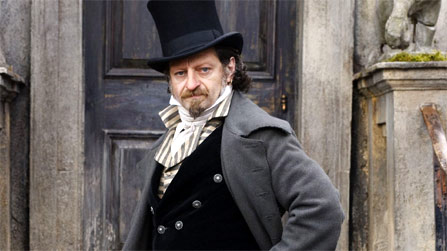
This episode picks up right where the last one left off with Affery being locked out of Clennam and Co. Rigaud assists her by climbing up the rickety building like a monkey, going through a top story window and opening the front door from within. (Remember what I said about him being as over-the-top as possible?) “He’ll kill her and then Jeremiah will kill me,” Affery moans. It’s Rigaud’s turn to be scared when he meets Flintwinch and thinks he’s seeing the ghost of his murder victim but quickly figures out what’s really going on. “Blandois” claims to be here on business and Flintwinch introduces him to Mrs. Clennam. But he doesn’t say much about business. Mostly, he acts creepily flirtatious. Affery looks like she’s going to have a nervous breakdown from his presence, or she would if she didn’t live in a perpetual state of nervous breakdown. (Amusingly, when she shows him out of the house, she asks him not to follow too close.) Mrs. Clennam, however, refuses to bat an eye, not even when he examines her watch and insinuatingly asks about the words, Do Not Forget, though her hand does spasm when he says, “there are the Devil’s own secrets in some families.” The tension between these two is great. They’re like the Tulkinghorn and Lady Dedlock of this series. Flintwinch is worried by this visit and goes to the inn to see if his brother has left yet. His fears are somewhat assuaged by the news that Ephraim has long gone and “Blandois” has recently gone. Up in her room though, Mrs. Clennam is haunted by her guilty secret.
Arthur Clennam walks with Frederick Dorrit to the Marshalsea. Arthur and the viewers learn a bit about Frederick’s backstory. He used to be rich and run a boardinghouse for theatrical ladies but then he stood surety for his brother and ended up losing everything. “Something called unlimited liability,” he says, “I think unlimited liability must be a terrible thing.” He also mentions out of the blue that he used to know Arthur’s father who was a regular visitor at the boardinghouse. It’s not a bad idea to foreshadow Frederick’s role in the Clennam family secret since that secret is so crazy and complex that people need to be prepped for it somehow. But after setting this up, the miniseries never mentions the connection between Frederick’s boardinghouse and the Clennam family again. Either we’re supposed to figure out the implication for ourselves or Andrew Davies forgot what he’d intended by the time he wrote the final episode with the big reveal.
Mr. Dorrit is happy to receive Arthur but Tip, to Amy’s horror, refuses to show him even basic politeness. Arthur, seeing the situation, leaves and Mr. Dorrit yells at his son, more for alienating a potential source of money than for being an immature jerk. Amy runs out after Clennam and apologizes for Tip’s behavior. “He feels that no one respects him, so he demands respect but in all the wrong ways,” she explains. Arthur isn’t bothered. He just wants to talk to her and make sure she’s all right after her supposed headache. It stills pains Amy to talk to him, but she instantly forgets her own discomfort when she sees that he’s unhappy himself. Arthur tells her about Pet. In the book, he only mentioned this failed romance to her at this point, after he’d lost all hope. I actually prefer the way it plays out in this miniseries. Little Dorrit not knowing about his feelings for Pet before she chooses someone else seems like a missed opportunity for drama. They’re interrupted by the arrival in the Marshalsea of an ecstatic Pancks and Rugg. Hilariously, as soon as she hears Pancks, Little Dorrit ducks back into the house, not wanting to deal with his craziness at the moment. Crazy, he certainly is. He’s drunk with joy over the big discovery he’s made. I love that the miniseries keeps the detail of him playing leapfrog with Rugg. Arthur takes him aside and, thinking of his family, asks if the discovery implicates anyone of any wrongdoing. Pancks says no but what is the big discovery then? “Just you wait and see, Mr. Clennam,” says Pancks, “just you wait and see.” Too bad the miniseries wasn’t able to use that as a cliffhanger.
Mrs. Gowan goes to visit her friend, Mrs. Merdle, and plead for sympathy regarding her son’s engagement. “It sounds mercenary to ask what the gentleman will get with this marriage,” says Mrs. Merdle, “but then Society is a little mercenary.” Mrs. Gowan admits that the bride’s parents will give Henry an allowance so that he can go to Italy and study “that dreadful art.” Mrs. Merdle can clearly see that Henry is the one who really stands to benefit from the match, but she goes along with her friend’s pretense, assuring her that “Society” will forgive her for allowing the marriage.
The groom-to-be pays a visit to Arthur. He knows about the one his mother made and doesn’t defend her but isn’t embarrassed at all by her either. “She knows very well I shall be dependent on Mr. Meagles’s wealth and generosity,” he says, “but she needs to make out that she’s doing the world a tremendous favor by condescending to have anything to do with it at all. It is a bore, and it is a sham but isn’t everything in this jolly old world a bit of a sham?” This is the one scene in the miniseries that really emphasizes Gowan’s main vice in the book, the “leveling” way he talks about everything, good and bad. He’s come to ask Clennam to be his best man at the wedding. Arthur apparently can’t bring himself to agree in words but he nods.
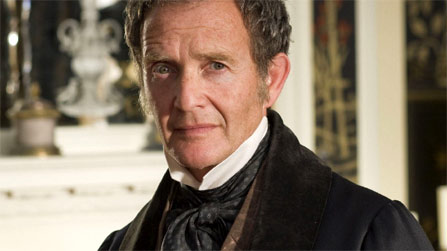
That night, Mr. Merdle quietly confides in his wife’s parrot. “It’s excruciating,” he whispers, “It’s just the same at the office. A lot of pompous fools.” In the book, the bird bites Mr. Merdle’s finger at one point, implying that it senses his true nature. Here it seems to be his only friend. His wife asks him whether they should attend Henry Gowan’s wedding when the Barnacles have cut him off financially, but he’s distracted. This annoys her and she upbraids him for going into society when he can’t make himself agreeable. Merdle is annoyed in his turn and has his only emotional outburst in the story, arguing that with all the money he spends on society, they’re the ones that owe him. Mrs. Merdle summons her nervous, apologetic son to back up her argument. Amanda Redman’s performance may make this character more demonstrative than I picture her as being from the book but she’s great fun to watch, nonetheless. I also love the interior of the Merdles’ home. It’s full of lavishly detailed items but there are so many of them that, combined with the heavy curtains in every window, the effect of the opulence is claustrophobic.
As Henry Gowan and Pet leave their wedding festivities, Gowan has his one moment of likeability from the book. When Mr. Meagles begs him to take care of his daughter, he first says, “don’t be so downhearted, sir” in a dismissive tone but then says, “by Heaven, I will” quite sincerely. (It sounds sincere in the moment anyway.) The camera pulls back to reveal Mrs. Gowan lamenting the union to the Barnacles then pulls back further to reveal Arthur looking depressed. This is another scene with great staging.
One day Pancks bursts into Doyce and Clennam with the news that Mr. Dorrit is the heir to “the Dorrit of Dorsetshire” and inherits enough wealth to clear him off all his debts and leave him with plenty left over. He thinks that Arthur should be the one to break the good news to the family. Clennam goes at once to Casby’s. Flora is delighted to see him, thinking he’s here for a clandestine romantic meeting. Naturally, she’s disappointed to hear that he’s just come to speak to Amy in private. It’s too bad we don’t see Flora’s overjoyed reaction to the good news about the Dorrits from the book, but this is still a great scene. We laugh at Flora’s delusions but also feel really sorry for her.
Amy and Arthur go to the Marshalsea to inform Mr. Dorrit of his fortune. John Chivery sees them, knows what they’re doing and experiences a rare moment of satisfaction. The ensuing scene is very close to the book as Clennam tells Mr. Dorrit to think of the best thing that could possibly happen to him. (“Do not be afraid to imagine it!”) After hesitating for a heartbreaking moment, Mr. Dorrit replies, “to be free.” Amy cries as Arthur assures him that all this and more shall come to pass. The normally talkative old man is so overwhelmed he can barely speak at first. Stuttering, he asks if he can go outside right now. Arthur tells him it’ll just take a few hours first. “How long do you think an hour is to a man who is choking for want of air?” Mr. Dorrit retorts bitterly. But with Amy’s help, he soon resigns himself to a short yet lengthy wait. This is a great ending to the episode. The main problem for the Dorrit family seems to have been solved but an unmistakably ominous air lingers. Clearly, we’re not done yet.
Episode 8

The Dorrits are getting outfitted for their grand exit when Arthur Clennam drops by. Mr. Dorrit wishes to pay him back the money he donated and asks for a receipt saying he makes no further claims on him. Clennam protests that the money was a gift, but Mr. Dorrit is terrified of falling back into debt. “Quite right, Pa,” says Tip cynically. “Can’t be too careful with some of these fellows!” Before Arthur leaves, Frederick tries to thank him for all his kindness, but his brother shuts him up. Amy gently chides her father for his ingratitude and starts to go after Clennam to apologize but Mr. Dorrit insists she stay. He tells her everyone in the family must avoid the people who have known them in their time of shame if they want to escape a bad reputation.
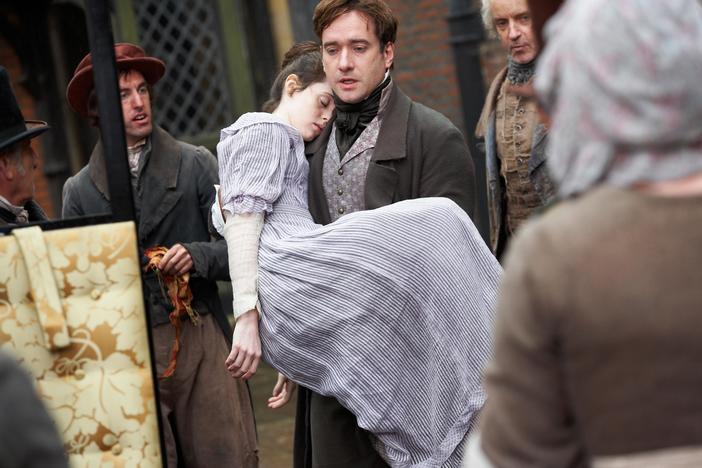
Everyone in the Marshalsea and a few people from outside of it (Pancks, Rugg and Maggy) gather to cheer “the Father of the Marshalsea” and his children and brother on as they leave for the last time. Arthur notices that Amy is absent and goes to look for her. She’s upstairs in her room, about to change into her fancy new dress but, overwhelmed by the prospect of leaving the only home she’s ever known, she passes out. Arthur carries her down to the carriage, much to her siblings’ embarrassment. I like how in the book, Amy isn’t even mentioned in this scene until right before Clennam appears with her, reflecting how little her family considers her compared to themselves. But the way the scene plays out here fits better with the overall style of the miniseries. (In his adaptations, Andrew Davies generally prefers to show things that readers are only told about second hand in the books. I don’t mean that as a criticism of him BTW. It often makes his adaptations more enjoyable and less claustrophobic than they would be if they stuck to the text like glue though, as we’ll see, it can have negative side effects too. The 1988 Little Dorrit movie does the opposite and only shows scenes from the points of view of the main characters. This led to some scenes being rather contrived and awkward IMO, but I know Rachel and Boze love that movie and they’re not the only ones who do.) Amy revives in time to look out the carriage window for a last look at Arthur Clennam. No sooner has she gotten one than Fanny pulls down the curtain in irritation, hiding him from view. The obvious symbolism is very enjoyable, and I really don’t mean that as sarcasm. Sometimes obvious symbolism annoys me but there are other times when it’s fun to instantly tell what’s being implied without having to ponder it. A lot of the visual symbols in Dickens are blatantly easy to decipher. That’s part of their power.
Up in her room, Mrs. Clennam stares wistfully at Little Dorrit’s needlework. “I wonder where she will go,” she says to Flintwinch, “and whether her riches will bring her happiness.” This moment is original to the adaptation, and I love it. The main message, arguably anyway, of this story is that riches don’t necessarily equate to happiness and there’s something appealingly counterintuitive about one of the main villains being the only one to realize that at this point. (Dickens does something similar in Great Expectations where Miss Havisham, the most prominent bad guy, is also one of the characters who is good at discerning which people are worth of respect and which aren’t.) And it’s nice to get another moment of vulnerability from the icy Mrs. Clennam.

Rigaud waits for someone in a shabby room. It’s Miss Wade. Great. They know each other. (I meant that last part sarcastically.) Miss Wade hires him to follow Henry Gowan to Italy and report back to her on what he observes of him. Rigaud asks if she wishes some harm to come to him. “I do,” says Miss Wade, “but not yet.” I’m not sure if this scene is such a good idea. It means there’s no mystery later as to why Rigaud is hanging out with Gowan and the whole “not yet” line sets up expectations that this subplot is going to be more exciting than it turns out to be. There’s still the mystery of why Miss Wade is so interested in Gowan though. Rigaud tells her he’s “conducting some reconnaissance” in London but there’s no hurry about that. We learn another surprising connection between Miss Wade and another character as she tells Rigaud he can draw on her account with Mr. Casby. Tattycoram stands silently in the background, looking uncomfortable. What has she gotten herself into with this woman?
Mr. Dorrit interviews a rather uptight woman called Mrs. General (Pan Ferris) whom he wants to teach his daughters how to be genteel. She recommends that the first thing family do (with her in tow) is go on a tour of Italy where “any little infelicities of speech and manner can be corrected well away from English eyes.” She makes a big show of being offended when Mr. Dorrit brings up the question of her salary, saying that she’s not some governess. (“You cannot therefore put a price on services which it is a pleasure for me to render.”) But she also makes a point of saying the last family she rendered these services too had only one daughter, so Mr. Dorrit should pay more than they did. I love Mrs. General. There are just so many great characters in this thing!
Somewhat abruptly, we cut to the Italian alps where the Dorrits’ tour begins. Mrs. General is making the whole party hike up the St. Bernard Pass. Fanny and Tip are not enjoying it. I’m with them, honestly. I’m not a fan of hiking. Well, that’s not totally true. Sometimes I enjoy hiking but only when I feel like doing it, not when someone like Mrs. General makes me do it. Frederick asks his youngest niece how she’s holding up. “Why’s everyone always fussing about Amy?” Fanny carps. “What about me?!”
Finally, the Dorrits reach the hospice at the top of the hike where they meet other tourists, Henry, Rigaud and Pet. Rigaud is highly amused to hear the name, Dorrit. In fact, he cracks up laughing which probably leads Mr. Dorrit to fear he knows about his long stay in the Marshalsea. Mrs. General hands out screens to the Dorrit ladies to protect their faces from the heat of the fire, but Fanny haughtily refuses the one for her. Henry offends Tip by making a joke about how he (Tip) stands too close to the fire. I wonder if Pet might look a little too obviously miserable in this scene. Her husband hasn’t really been established as enough of a jerk yet for it to seem warranted. (It’s too bad the miniseries never establishes that he’s giving every stranger the impression that he married down and that it was a huge sacrifice for him.) Then again, you could argue she needs to look obviously depressed and uncomfortable since she ends up fainting in this scene. Little Dorrit rushes to get her a glass of water. In the book, Fanny actually helps too-or rather, she offers to have her maid help. Thus, Amy’s family in that version doesn’t necessarily have the attitude of “rich people aren’t supposed to help others.” They’re more “rich people aren’t supposed to help others themselves; they’re supposed to hire people to do that.” The motive behind this change was probably less to make the characters worse than it was to save the expense of hiring actors to play all their servants.
Meanwhile, in Bleeding Heart Yard, the Plornishes and Arthur toast Little Dorrit’s good fortune but Maggy is miserable about her friend being so far away. I love the way the miniseries uses her childish character in this scene as a mouthpiece for what the more mature, less selfish Arthur Clennam is really feeling about Amy’s absence. Mr. and Mrs. Plornish are delighted when Mr. Casby drops by for a visit. They happily tell him all about “The Happy Cottage,” the shop they’re going to open with the money Little Dorrit gave them. (They’ll also be giving Maggy a job.) No sooner has he stepped outside Bleeding Heart Yard than Casby tells a seemingly stoic Pancks to “squeeze them harder” now that they’ll (theoretically) be making more money. This scene perfectly showcases the old man’s duplicitousness.
At dinner that night, while the guests at the hospice wait-some of them a tad impatiently-for the monks to finish their prayer before they eat, Rigaud chows down through the whole thing, ignoring everybody else. As you can imagine, the very proper Mrs. General does not approve. Amy notices that Pet isn’t at the table and asks her husband how she’s doing, much to Tip and Fanny’s irritation. Mr. Dorrit asks one of the monks (Philip Desmeules) how they stand their lives of limited and unchanging space. “We who have chosen it see it very differently,” the monk says casually. “Monsieur is not used to confinement.” Frederick actually gives a little laugh at that bit of irony before looking at his brother and realizing his insensitivity. The camera focuses on Mr. Dorrit’s face and we hear the echo of closing gates as he stares off into space and fumbles for words. This is one of the reasons I consider the directing for this miniseries better than that of Bleak House. Not that the directors for that one did a bad job or anything. But watching it, I just feel like I’m watching the characters from the outside, not feeling what they feel. This adaptation really captures the high emotion of Dickens’s writing.
Amy sneaks into the room of Pet, her onetime romantic rival, to check on her. Pet confides her homesickness in Little Dorrit. She claims that she’s happy with her husband and that she knows he loves her but it’s hard to believe her-or even think she believes herself. Amy gives Pet a letter from Arthur Clennam and confides her own problems in her, how her father insists she forget about him and everything she’s ever known. It’s a sweet scene but no sooner has Little Dorrit left the room than she finds the nightmarish Rigaud waiting to accompany her back to her father on the main floor. Mr. Dorrit expresses disapproval to Rigaud over Henry Gowan’s disrespectful attitude. Rigaud apologizes for him by explaining that “his family is very highly connected.” Mr. Dorrit fears that he’s implying that the Dorrits are not highly connected, but Rigaud assures him that wasn’t the case. He continues to behave in a very creepy, knowing way to Amy in particular.
As the Dorrits prepare to leave the hospice in the morning, Amy’s siblings berate for acting like a servant the other day. (“And all this for the wife of a man who had just insulted me!” says Tip.) Fanny guesses that Amy must know Pet through Arthur Clennam. (“Who also saw fit to insult me with his ungentlemanly conduct,” Tip interjects.) Mr. Dorrit, to his credit, likes Arthur better than they do but still insists that Amy have nothing more to do with him for the good of the family. An agreement is drawn from her but it’s clearly because they have her on the rack, poor girl! Poor woman, I should say. Before Little Dorrit actually seemed like the “mom” of the family, taking care of Mr. Dorrit and scolding Tip and Fanny for their misbehavior. Now they’re treating her like the baby. As the Dorrits’ carriage departs, Amy looks out the window and sees Rigaud staring after her just as Dickens describes. (“She felt as though she could yet see that smile of his, that high nose, and those eyes that were too near it.”) It’s a great cliffhanger but it was at this point in my first viewing of the miniseries, way back before I read the book, that I started to tire of the mystery plot.
Episode 9
The Dorrits have arrived in Venice. Arthur reads a letter from Amy describing the trip to the Plornishes in their new shop. (“She should have had me with her,” says Mrs. Plornish, “She don’t speak a word of Italian. I would have helped her out.”) We see that Pancks, despite being the Plornishes’ dreaded rent collector, is friendly enough with them at this point to be present for the reading of the letter. It may be significant though that he’s not actually in the building, just looking through the window. At one point he makes a joke in response to something Cavalletto says. The joke itself is predictable but the way Mrs. Plornish misunderstands it and thinks Pancks is the one who’s confused is very funny.
The Dorrits arrive at their fancy Venetian hotel. The majordomo (Vincent Riotta) apologetically explains that their rooms are still occupied by other English tourists who are just leaving. Mr. Dorrit, paranoid of any slight, throws a fit but the occupiers themselves are able to smooth things over. They turn out to be none other than Mrs. Merdle and Edmund Sparkler! Mrs. Merdle’s gracious smile freezes when she sees Fanny and Amy, but she recovers and drags her delighted son out of the room. “That’s her way out of a difficulty,” says Fanny smugly. “Well, we shall see if two can play at that game if we ever come across her again.”
We hear a letter from Arthur to Little Dorrit. In the book, she warns him not to write back to her as her family will object. That made more sense, but this letter is a handy way of proving exposition about what’s going on back in England. Arthur writes that he now considers his suspicions about the Clennams being responsible for the Dorrits’ problems “a foolish fancy.” As he writes this, we get a glimpse of Mrs. Clennam looking at her watch with its message of Do Not Forget. “From now on, Little Dorrit, I shall let the past lie in the past,” writes Arthur but the viewers are reminded that they shouldn’t do so.
In Venice, Mrs. General wants Amy to practice speaking Italian but chides her for speaking to lower class people. They practice small talk. If anyone should ask Little Dorrit what she thinks of Venice, Mrs. General instructs her to quote from A Classical Tour Through Italy by John Chetwode Eustace. “But if someone asks me what I think, shouldn’t I tell the truth if it offends no one?” Amy asks. “Conversation in Society is not about unburdening the soul,” says Mrs. General. “It is about the polite exchange of the correct opinions and sentiments.” I love that line. It’s not from the book but it perfectly sums up Mrs. General’s character in it. The end of this scene is framed through a window as creepy music plays, perhaps implying that Rigaud is spying on Little Dorrit. It could also just indicate her discomfort with her gilded cage.
At Doyce and Clennam, Arthur tells Doyce he’s going to “mount another assault on the Circumlocution Office” to get his (Doyce’s) invention patented. Doyce warns him it won’t do any good and Tite Barnacle Jr. says the same as he hands him some forms to fill out, but Clennam is determined. Amusingly, when he first reappears at the Circumlocution Office, Tite Sr. assumes he’s still asking about William Dorrit’s imprisonment. That just goes to show how useless and disconnected with everything the Barnacles are.
Amy enjoys reading Arthur’s letter. (BTW, he mentions that the Plornishes are thriving in their new shop, which is somewhat remote from what Dickens describes. I can’t blame the miniseries for wanting to give them a happier ending though since they’re so loveable.) She warns her uncle not to let anyone know about her communication with Clennam and, for his own sake, not to let Fanny hear him playing his old clarinet. “We do let them down, don’t we?” he says mischievously.
Amy comes downstairs with a shirt she’s mended for her father to find him and Mrs. General waiting to have a stern talk with her about her behavior. Mrs. General gets her iconic line here. (“Papa, potatoes, poultry, prunes and prisms are all very good words for the lips, especially prunes and prisms.”) Amy says she’ll try to act more like “a lady” but she can’t help but try to explain her feelings. As she does so, she kneels by her father’s-sorry, her papa‘s side the way she used to do in prison. Rather than softening Mr. Dorrit, this terrifies and enrages him. Once Mrs. General has left the two of them alone, he berates Amy for constantly reminding him of his years of imprisonment. “I say sweep that accursed experience off the face of the Earth and begin afresh,” he rants. “Why can’t you do it? You, my dearest? You, my favorite child? How can you expose your father to mockery?” In the end, he breaks down weeping. Little Dorrit weeps too but she holds it together enough to comfort him. It’s a really sad scene.
The young Gowans are also in Venice and Rigaud is staying with them. Henry is being a pill. First, he complains that Mr. Meagles doesn’t give him a big enough allowance though that doesn’t stop him from giving Rigaud money to buy more wine. Then when Pet offers to write to her father to ask for more money, he says, “I’m sure he would like it. It would give him an opportunity to reflect on what an idle splendthrift his son-in-law is.” Rigaud suggests he go out and do some original painting, but he gripes that there’s no way he could compete with Titian and Tintoretto. (So why has he come to Italy in the first place? I don’t mean that as a criticism of the writing. I believe we’re supposed to ask that question.) Rigaud also informs him that the Dorrits are in the neighborhood. Pet expresses a desire to see Amy again. “But you’d have to see her anxious, preening father,” Henry grouses, “and her clown of a brother and that walking corset of a companion!” (That line might be a little historically questionable. I’m not sure if corsets were associated with discomfort and restriction back then the way they are now. Calling someone a walking corset might have been like calling them a walking brassiere. Still, it is a fun line.) Rigaud argues that the Dorrits might be good for a meal if nothing else. Once she’s alone with her husband, Pet asks him if they can get rid of Rigaud who makes her uncomfortable. He refuses, saying Rigaud interests him (“He’s a scoundrel like most men but unlike most men he makes no bones about it.”) The two of them work out a deal. Pet will tolerate Rigaud if Henry lets her send the Dorrits their card.
At breakfast, Amy tells her family she’d like to visit Pet. Fanny makes a point of reminding everyone how her sister embarrassed them the last time they met the Gowans. (There’s a bit of meta humor here as Frederick recalls Rigaud as looking like “a villain in a play.”) Mr. Dorrit is jumpy at the idea of interacting with anyone who’s acquainted with Arthur Clennam. But once Mrs. General learns that the Gowans are connected to the Merdles, she totally approves of the visit and then Mr. Dorrit, who agrees with everything she says, does so too. Amy leaves the table shortly after Mrs. General does, looking weary and depressed. Suddenly, Frederick bursts with emotion and chastises the family for their treatment of Little Dorrit. (“I don’t give a fig for the family credit if it causes that girl one moment of unhappiness!”) Because Frederick is generally less demure in this adaptation than in the book, this moment doesn’t stand out as much and loses some of its power but it’s still pretty cathartic. Her uncle’s accusations seem to make Fanny feel genuinely guilty as she breaks down crying. We then cut to her accompanying her sister on her social call and even giving her a brooch. “I couldn’t possibly let you go to the Gowans on your own, darling Amy,” she says cheerfully. This is still rather condescending, implying Amy can’t be trusted to do anything by herself, but it’s as close to being nice as Fanny gets and Little Dorrit’s smile shows she appreciates it.
The sisters arrive at Henry Gowan’s art studio where Rigaud, with a drawn knife, is posing for a painting. “Don’t you think he makes an admirable brigand?” asks Henry. “It’s almost too real,” Fanny says pointedly. Lion, Gowan’s dog, barks and growls at Rigaud. Eventually, he jumps at him, ruining his pose. Henry grabs Lion and starts to beat him, only stopping when Amy intervenes. This is the only time we see how violent Henry’s temper can be and it’s effective. I feel like the script kills subtlety though with his line, “always obey your master. It’s a good rule for dogs and for wives too, eh?” I feel like the viewers could pick up on the subtext of the scene without having it explained to them. Fanny’s forced laugh in response is amusing though.
Later, when the others are elsewhere at the Gowans’, Amy looks over some paintings. Rigaud approaches her and starts doing his creepy insinuating schtick again. (“Perhaps you learned to appreciate fine things at Mrs. Clennam’s house.”) Little Dorrit assumes he’s mocking her past poverty and tells him she’s not ashamed of having once been a seamstress for Mrs. Clennam. Rigaud actually didn’t know what her job was and finds it amusing. Here’s the point where I’m really tired of the miniseries constantly reminding us that there’s this big secret connection between the Clennams and the Dorrits without dropping any clues. If I were adapting the book, I would probably reveal to the part of the secret about the Dorrits halfway through (to the viewers, I stress, not to any of the characters who aren’t supposed to know it yet) and wait to reveal the part about Arthur until the same point that Dickens does. The 1988 version actually does the opposite, revealing the part about Arthur long before it does the part about Little Dorrit. That was a mistake IMO since the part about Arthur is far juicier.
Fanny and Amy return to their hotel that night to find Sparkler waiting to see Fanny. A nice bit of depth is added to the sisters’ relationship here as we see they can laugh at the same thing together, mainly Sparkler’s clumsiness. But Amy is disturbed to hear Fanny say she intends to “make a slave of him.” She also says, “if I don’t make his mother subject to me too, it will not be my fault.” Mr. Dorrit is happy to have the opportunity to kiss up to someone so close to the famous Mr. Merdle. He asks Sparkler if he’d recommend having a portrait of himself painted by Henry Gowan. Fanny smiles sadistically upon hearing him reply that he’d rather have a painting of her.

Meanwhile, Rigaud unexpectedly announces to the Gowans that “business” calls him back to London. He’s barely left when Henry notices something wrong with Lion. Out of earshot, Rigaud turns back in the direction he came and barks mockingly. Then he saunters off, whistling that signature tune of his.
 All the (Dickensian) Year Round