
by The Adaptation Stationmaster
Episode 13

Mr. Dorrit is frightened to wake up and find that he’s slept through the whole morning. Happily, Little Dorrit is there to comfort him. She assures him that it’s only to be expected after his long trip. But clearly Mr. Dorrit’s mind is slipping as he needs to be reminded where they are and later seems to briefly forget about Fanny’s marriage. One of the first things he wants to do is see Mrs. General. His attempted proposal goes a little further than in the book as he grabs her hands, and she has to make him restrain himself. The scene ends the same as in the book though with her asking to defer the conversation until later while clearly planning to accept his proposal.
The Dorrits attend Mrs. Merdle’s farewell ball which she’s postponed just for Mr. Dorrit. (She greets him, Amy and Mrs. General when they arrive but not Frederick. Maybe she feels that ignoring him is the kindest thing she can do.) Suddenly, Mr. Dorrit thinks he’s back in the Marshalsea and starts worrying about all the guests being locked in for the night. He addresses them all in a big speech, reassuming his old role as “the Father of the Marshalsea.” Like Macbeth’s guests when he kept yelling at an empty chair, Mrs. Merdle’s guests “stand not on the order of their going but go at once.” What can I say about this scene besides that it’s really, really sad?
Little Dorrit and Frederick keep watch over the old man by night. Mrs. General says she unexpectedly has to leave right away (“There are two young ladies in Chelton who need my services.”) The quietly reproachful look Amy gives her is great. Whenever he’s conscious, Mr. Dorrit, still not remembering everything that’s happened to him, lists possessions of his that his daughter can pawn to take care of herself. Touchingly, his last words to her are “dear girl.” Amy, weeping herself, comforts Frederick. In the morning, she finds that he has died too. I’m not sure why in either the book or this miniseries. (It doesn’t seem to be a suicide.) There just wasn’t anything else for the character to do, I guess.
Amy returns to England and moves in with Fanny. In the book, she stays in Italy for a while to tend to her brother, Tip, who has contracted Malaria. Fanny is genuinely distraught to hear about her father, but she still sees everything in terms of what Society will think. (“If you’re not presentable then you’d much better die.”) And her thoughts soon turn to herself and her personal inconvenience. (“And now I shall have to go into mourning and not go out in society and just when I’d bought dozens of new dresses expressly for that purpose!”) I’m surprised Amy doesn’t throw a pillow at her. Sparkler is also great in this scene. Much of the comedy and poignancy comes from him clearly trying to be sensitive in this emotionally charged situation but not having any idea how to speak appropriately. He does earn a grateful smile from Amy though for saying something nice about her late uncle.

Arthur goes to Miss Wade’s lodging and procures an interview with her by having the (uncredited) landlady gives his name as Rigaud. He asks her about the man. “Why don’t you ask your dear friend, Mr. Gowan?” she snaps in what is for her an unusually fiery tone. Maxine Peak’s performance comes as close as it ever does to being vulnerable (which isn’t very close) as Miss Wade tells Arthur her history and about her past relationship with Gowan. She always resented her life as “the object of other people’s charity” and fell in love with Henry Gowan because he was the only one who really understood the way she felt. (Not that he empathized with her, but he could follow her thought processes.) After a fling, he dumped her. “I think perhaps he never knew how much I loved him,” she says, “nor how I hate him now!” This is severely truncated from Miss Wade’s backstory in the book, understandably so since it was quite detailed there. But the result feels really anticlimactic. The first time I watched the episode, not having read the source material, I kept thinking, “seriously? That’s it? That’s why she’s so creepy?” Unlike in the book, there’s no indication that the people whose kindness she found so offensive were genuinely trying to be kind and not just trying to feel good about themselves as she accuses them of doing. (Or if that was part of their motive, it wasn’t the whole part.) Neither is there any indication that she hurt any of them. Because of that, it’s really not clear what the message of Miss Wade’s subplot is supposed to be besides that Henry Gowan is a jerk and that’s been established already. Tattycoram just stands in the background during this scene. She doesn’t get into a fight with Miss Wade about the Meagleses as she does in the book. This seems like a bad thing to omit since it sets up her returning to them in the end. Freema Agyeman’s performance does indicate though that Tattycoram regrets going with Miss Wade but feels like she can’t leave her now. Anyway, Miss Wade explains that she doesn’t know where Rigaud is now. She just hired him to spy on Henry and Pet for her. “He would have killed Gowan too if I had paid him enough,” she says. “I don’t know what your family’s business is with Rigaud, Mr. Clennam, but if it’s crossed his path, I don’t envy you. You say you wish to find him. Have a care what you wish for.”
As Arthur returns to Clennam and Co, he’s haunted again by his father’s dying words. What was it he wanted “put right?” He finds Flora and Mr. F’s Aunt enjoying some cheese and anchovy paste on toast with his mother. (Well, they’re enjoying it. Mrs. Clennam probably never enjoys anything except being self-righteous.) In the book, Mr. Casby is present for this scene and Mr. F’s Aunt is absent. Not that I’m complaining. It’s hilarious how when Affery offers Arthur a slice of toast, Mr. F’s Aunt grabs it for herself. Actually, in the book this scene and the scene in the last episode between Arthur and his mother were one and the same. I guess the miniseries split their final direct confrontation into two scenes because if they didn’t, Mrs. Clennam wouldn’t be in this episode. That’s the only reason I can think of anyway. Something that stood out to me for the first time on this viewing was that as Flora herds Mr. F’s Aunt out the door to give the Clennams some privacy, she tells her “you don’t know what you’re talking about.” I can’t think of any other instance of her saying that to the woman in either this series or the book. She doesn’t say it in angry way or anything though. Anyway, Arthur pleads with his mother to explain Rigaud’s hold over her so he can help her, promising not to judge her or his father. She finally cracks just a little. “If there is a secret and I do not say that there is,” she says, “has it not occurred to you that it might be much better for you if you never knew it?” But that’s as low as Mrs. Clennam will let down her guard with Arthur. In the book, this was followed by a scene of him desperately pleading with Affery to tell all she knew and her finally agreeing to do so if he ever got the better of “them two clever ones” as she calls Mrs. Clennam and Flintwinch. Disappointingly, it’s been cut here.
A despondent Arthur goes back to Bleeding Heart Yard and crosses paths with an even more despondent Little Dorrit who’s taking in her old stomping grounds. She’s angry with him for ruining her life by making her a grand lady and says they can’t be friends as they were before. This scene isn’t from the book. I imagine it was created to make it seem as though Amy and Arthur weren’t going to get together after all. (To the characters themselves anyway. I doubt anyone had delusions of fooling the viewers.) It’s also likely the idea behind it was that every great fictional couple needs to go through a breakup at some point. Amy’s behavior doesn’t really make a lot of sense. Why would she be so openly resentful of Arthur and so amazingly patient with her father, Tip, Fanny and (in the next episode) Mrs. Clennam, all of whom she has, let’s face it, far better reasons to be angry with? I guess that’s not totally unrealistic though. Human emotions can be hard to predict sometimes and there probably are people in real life who have an easier time forgiving people who have really treated them badly than others who haven’t really done anything bad to them at all. I don’t blame any fans for finding this scene arbitrary and out of character for Little Dorrit though.

That evening at the Merdles’, Sparkler is trying to navigate a bad mood of Fanny’s when Mr. Merdle shows up looking more cheerful and relaxed than we’ve ever seen him. Fanny asks him about her father’s property, the distribution of which has been delayed. She’s not impatient but wants to make sure he didn’t leave any of it to Mrs. General. “She won’t get anything,” Mr. Merdle assures her with a big smile. I think viewers can guess from that line alone what the big twist with his character is going to be. (That’s not necessarily a bad thing since we won’t have to wait long for the reveal.) He asks to borrow Fanny’s mother-of-pearl penknife. He’d prefer one with a darker handle but says that’s not important.
Later, Physician is woken up in the middle of the night by a bathhouse attendant (Stephen Marcus) who says that a gentleman at the baths left a note for him. He brings him to see Mr. Merdle’s corpse lying in a bloody tub. He’s slit his own throat with a penknife.
Episode 14
Like the first episode, this finale is twice the length of a normal one.
Bar is summoned. Physician explains to him that, according to Merdle’s suicide note, he was operating a massive Ponzi scheme that just fell through. The two of them go to his house to convey the bad news to his wife. The chief butler tells them that Mrs. Merdle is still not back from Italy (in this version, that is, not in the book.) When he hears the news himself, he gives only the most perfunctory expression of dismay and then quits his job. “Mr. Merdle never was quite the gentleman,” he says, “and no ungentlemanly act on his part can surprise me.” As the sun rises over the city, we hear, in Bar’s words, “a fearful cry against one miserable soul” from many voices. Then we see a crowd banging on the doors of the bank, trying to get in, but with a very different attitude from the last time they did so.
We go to the Merdle drawing room where Sparkler and Fanny sit, looking not so much horrified as confused by this totally unexpected calamity. “With our mother-of-pearl penknife too,” says Fanny. “If I’d known what he wanted it for, I might not have leant it to him. And now I suppose the coroner’s got it and Heaven knows when I shall get it back!” My heartiest congratulations to Andrew Davies for writing that line. It’s not from the book but it sounds exactly like Dickens wrote it. Fanny has a brief moment of kindness and asks her husband if he’s grieved for his stepfather. It’s not long though before she asks for clarification about their financial situation. Dumb as he is, Sparkler knows she’s not going to like the answer. In the book, Dickens gives only a broad description of what happens to Fanny, Sparkler and Mrs. Merdle after the suicide. It’s not really dramatized. The scenes with them in this episode are some of the greatest things in any Charles Dickens adaptation not to have come from Charles Dickens himself. While I’m not sure if Davies’s habit of depicting scenes in his adaptations that were only implied in the books works as consistently well in Little Dorrit as it does in Bleak House (or in his Pride and Prejudice), this is one of the best examples of when it does work.
Pancks runs to Doyce and Clennam’s empty factory-empty except for a forlorn Arthur Clennam, that is. Pancks begs him to yell at him for telling him to invest with Merdle. Arthur finally does so, mostly to make him feel better, but he clearly blames himself. He says has no choice now but to declare Doyce and Clennam insolvent. Pancks advises him to flee the country until the scandal blows over but Arthur refuses to do that to Doyce. He does agree to speak to a lawyer though and Pancks runs off to get Rugg. This scene sticks very close to the book and it’s the better for it.
Back at the Merdles’-or Mrs. Merdle’s now-Amy and Fanny look out the windows at all the tradesmen demanding to be paid. Little Dorrit sympathizes with them, which isn’t from the book but fits with her unselfish character. Fanny by contrast just cares about her own problems. Mrs. Merdle finally returns home, making her way through the crowd. Fanny taunts her that she’ll now have to depend on her and Sparkler’s generosity as she’s going to have money from her father (or so she thinks) and he still has a job at the Circumlocution Office. (“And who knows? Perhaps you could go back to doing whatever it is that you did before Mr. Sparkler and Mr. Merdle. But I don’t think we’ve come to that just yet.”) Sparkler is hilariously oblivious to the animosity between his wife and his mother. (Our first sight of him in this scene is of him looking at the parrot. Could this be meant to imply he’s going to be the next Mr. Merdle? That seems a bit dark for the character.) Fanny announces her plan to run away in the night rather than face the consequences of Mr. Merdle’s actions and invites Mrs. Merdle to come along with her, Sparkler and Amy. “My dear Fanny, I am entirely in your hands,” Mrs. Merdle says grimly. “That’s nice,” Fanny replies.
Mr. Rugg, Mrs. Plornish and Cavalletto come running into the factory to warn Arthur that a mob of creditors is coming for him. They try to spirit him away, but he won’t have it. Arthur says he wouldn’t mind so much if it were only his only money he’d lost, not Doyce’s. Props to the miniseries for keeping Rugg’s response from the book. “That’s singular, sir. Generally, it’s their own money people are particular about. Most people can lose other people’s money and bear it very well indeed.” Ruggs tells him if he tries to pay off the debts himself, he’ll have to go to the Marshalsea. Clennam replies that if he has to go to prison, that’s the one he’d choose.
An uncharacteristically resentful looking John Chivery shows Arthur to his room in the Marshalsea. It’s Mr. Dorrit’s old room, which he thought Clennam would prefer. Arthur thanks him for this kindness and offers to shake his hand but John refuses. As time passes, he keeps doing nice things for Clennam but in a really angry manner and asking him concerned questions but in a threatening tone. “Did you ever think that even if it’s not worth taking care of yourself for your own sake, it’s worth doing for somebody else’s?” he demands. When Arthur can’t imagine whose, John really explodes. He reveals that he’d been getting over his feelings for Amy Dorrit, but that Clennam’s presence has revived them. The whole reason he’s trying to be nice to him is because he knows she’s in love with him. Arthur takes John’s hand despite the man’s earlier refusal to shake, and it actually does seem to comfort him. John pulls himself together and manages a polite goodbye.
Arthur is left alone with memories of Little Dorrit which he sees in a new light now that he knows she loves him…and that he loves her. His thoughts are interrupted by the visiting Mr. and Mrs. Plornish and Cavalletto. They’ve brought him some food, but he says he’s lost his appetite. At his wife’s urging, Mr. Plornish tries to cheer Arthur with some philosophy. “You’re down now,” he says, “there’s no doubt about it, but you’ll be up when your turn comes round again.” The way Mrs. Plornish nods and grins at this is great. She tells Arthur that at least he can be grateful Little Dorrit isn’t there to see this. In the book, it’s implied that she suspects Little Dorrit’s feelings for Clennam and is trying to turn his thoughts to her. Here she just comes across as oblivious. Actually, it just occurred to me that Mrs. Plornish’s line doesn’t make sense in this miniseries since Little Dorrit is back in London now and we even saw her in Bleeding Heart Yard, Mrs. Plornish’s own neighborhood. In the book, reconnecting with the Plornishes was one of the first things she did upon her return. To be fair though, I only noticed that gap in the adaptation’s logic on this viewing. On her way out of the Marshalsea, Mrs. Plornish warns Mr. Chivery Sr. that Arthur’s health looks like it’s on the decline and he should see a doctor.
That night, who should appear in Arthur’s lodging but…Rigaud! (I think we’re supposed to wonder if this scene is a nightmare. It’s not.) Clennam tells him he knows he’s a murderer. Rigaud just smirks. “And I know you are a… well, I am too delicate to say the word,” he says. He taunts Arthur, telling him that he knows a shameful secret about him, his parents and Little Dorrit, that he’s considered telling it to him for a thousand pounds, but he thinks his mother will pay more for him never to learn it. (Plus, you know, Arthur’s in major debt right now and doesn’t have much money.) Arthur tries to force him to tell but Rigaud easily overpowers him in his weakened state and leaves. This is very different from the confrontation in the Marshalsea between these two characters in the book. There Rigaud still wanted to avoid revealing himself, hoping that Mrs. Clennam would crack under the pressure and put a coded message in the newspaper promising to pay him his asking price for his silence if he clears her of suspicion. It’s Cavalletto who, acting on Arthur’s instruction, tracks down Rigaud and brings him to the Marshalsea and who, along with Pancks, brings him to Mrs. Clennam’s. I consider this a really disappointing change. Since Cavalletto is portrayed as even more terrified by Rigaud in the miniseries than in the book, seeing him get the upper hand of him would have been even more satisfying. It would have also made Arthur a more heroic character. (I don’t mind about Pancks as much since he still has a number of awesome moments in the miniseries.) I’m not even sure what Rigaud’s motivation for breaking into prison just so he can taunt Arthur and then leave is supposed to be. Just sadism, I guess. As with Davies’s Bleak House, the climax of Little Dorrit is the part of the story that gets changed the most from the book. I don’t necessarily mind the idea of making the climaxes more exciting and suspenseful since Dickens was always an author who wrote “for the people.” But the changes made to Little Dorrit‘s climax strike me as making it less crowd pleasing than following the book’s version would have been.
The remaining members of the Merdle family are preparing to sneak out of the house. Little Dorrit argues that they should stay and face their problems. She doesn’t say such a thing in the book, but it makes sense since she admires Arthur Clennam who has made just that decision. (Amy is reading a letter at the beginning of this scene and the implication seems to be that it’s about Arthur’s situation.) “They’re not our problems,” Fanny argues, “they’re Mr. Merdle’s problems!” Her plan is to hide out at a hotel until she comes into her inheritance. “You can stay for weeks in a hotel without having to pay for anything,” she says.

Time passes and Arthur Clennam becomes increasingly feverish. Mr. Chivery brings him a doctor (Stuart Nurse) but not one who offers much hope. Arthur imagines Amy, Henry Gowan, Miss Wade, Tattycoram, Rigaud and his mother are in the room. Amy seems to be taking care of him. Eventually, he comes to his senses and all the hallucinations fade except for Little Dorrit who has always been real and really has been his nurse. (This isn’t from the book but it’s almost exactly how Dickens describes Pip’s experience of fever at the climax of Great Expectations and it’s a great scene.) Amy asks to give all the property she’s about to come into to Arthur and to stay with him the rest of her life. He admits, nay, insists he loves her but for that very reason says he can’t drag her down with him. She protests that being stuck with a Marshalsea debtor is kind of her thing. (I paraphrase somewhat.) He says he’s going to tell the Chiverys not to let her back in if she tries to visit him again, but she says they’ll obey her, not him. This makes both characters more forceful than they are in the book where Clennam can’t bear to forbid Little Dorrit from visiting him though he believes that’s what he should do, choosing instead to tell her not to return too soon or too often. Another change is that Maggy is present in the book’s version of this scene. I kind of miss that, especially given how this adaptation has dramatized Maggy missing her “Little Mother,” but I can definitely understand why Davies thought a more private moment between the two lovers would work better.
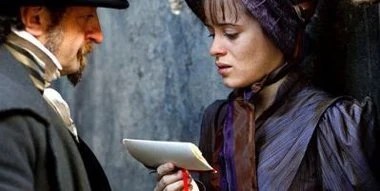
As John Chivery lets Little Dorrit out of the Marshalsea, she tells him to keep an eye on Clennam and tell him she sends her undying love. That seems uncharacteristically insensitive of her but it’s from the book. Seconds later, Rigaud grabs her and clamps a hand over her mouth! He gives her an envelope, calling it his “insurance.” He tells her to meet him outside the Marshalsea gate before the bell rings. If he doesn’t come to reclaim the envelope, she is to open it and read the contents. “There is a letter for you,” he says, “and a letter for your dear friend, Arthur Clennam.”
Rigaud returns to Clennam and Co. When Flintwinch says Mrs. Clennam hasn’t changed her mind about giving him money and never will, he pushes past him and goes up to her room. (The steps creak more than usual, foreshadowing…well, we’ll get to that.) Flintwinch and Affery follow him and Affery insists on staying to hear this big secret of Mrs. Clennam’s. This moment sadly isn’t as awesome for her as its equivalent in the book but at least the adaptation treats her better than Cavalletto when it comes to the climax. Mrs. Clennam asks Rigaud just what it is he knows about her. In the book, she insists on telling it herself rather than hearing it “with the taint of (Rigaud’s) wickedness upon it.” He’d attribute her actions to greed, she says, when really, they were all about enforcing justice. It was a mistake to change this in the miniseries IMO, partly because it’s a defining moment for Mrs. Clennam and partly because Rigaud’s thick, cartoony accent can make it hard to understand what he’s saying. And, boy, is what he has to say complicated! Long ago, Arthur’s father had an affair and a child with a woman at a boarding house for theatrical ladies. As punishment, Mrs. Clennam took the child from her and sent the mother to the poorhouse where “she died in poverty and pain.” Before she died however, she wrote to Arthur’s grandfather, Gilbert Clennam, who was moved by her story. It was too late to do anything for her by then, but he changed his will, leaving some money to Amy Dorrit who had been born the day the poor woman died. In the book, this was because Frederick Dorrit had been her protector and patron. This was already rather contrived on Dickens’s part. Why leave the money to Frederick’s youngest niece and not directly to him? (Dickens’s reason, of course, was Little Dorrit needed to be the specific one from whom Mrs. Clennam must beg forgiveness. There’s no way anyone else in her family, except maybe Frederick himself who wasn’t in his right mind, would ever grant it to her.) But without mentioning Frederick, this plot point seems even more random. Gilbert Clennam really just randomly decided to leave it to an unfortunate girl who was born that day? Really? Not helping is that when Rigaud speaks of “the other child,” it almost sounds like he’s going to reveal that Amy was also a lovechild of Mr. Clennam and she and Arthur had the same father. (They don’t.) What he’s really doing is threatening to tell Arthur that Mrs. Clennam isn’t really his mother and that she forcibly took him from the real one whom she persecuted ever afterwards. If she doesn’t give Rigaud two thousand pounds before the Marshalsea bell rings, he says, Amy and Arthur will find out the truth. This apparently gives Mrs. Clennam such an adrenaline rush that she’s able to rise from her wheelchair and run out of the building. (Affery also takes the opportunity to flee that house of horrors.) Judy Parfitt does a great job of conveying Mrs. Clennam’s feelings as she sees daylight for the first time in years and has to fumble her way through the unfamiliar streets full of strangers.
Intercut with all this, we see Tattycoram, alone in Miss Wade’s room. The fact that she has her hair down and she’s initially on the bed could imply that she and Miss Wade are lovers but, then again, it might not. After all, Tattycoram isn’t in her underwear or anything and, given Miss Wade’s semi spartan living conditions, she probably only has one bed in her apartment. I’d say this ambiguity is pretty true to the book’s depiction of their relationship. Bored, she picks up the box Rigaud left with Miss Wade and finds a letter to Arthur from his mother inside. “These things are nothing to do with you,” yells Miss Wade when she finds her reading the letter. “They’re nothing to do with you either,” sobs Tattycoram. Intercutting this scene with the reveal of the big mystery might have sounded like a good idea in theory but in practice, I feel, it’s confusing, setting up the expectation that the mystery will have something to do with Miss Wade or Tattycoram, especially since they’ve barely interacted with the main story so far.
BTW, after this miniseries was aired in the USA, Gina Dalfonzo’s did an FAQ page about the Clennam Family Secret on her excellent Dickens-related blog. It’s kind of hilarious how many grateful comments there are from confused viewers and readers.
Mrs. Clennam reaches Amy before the bell rings and asks for the envelope. Without hesitating a second, Amy gives it to her, unopened. The adaptation adds a great beat here as Mrs. Clennam realizes she could just take it and Little Dorrit would never ask questions or be the wiser, but she can’t do that to her. Little Dorrit deserves to know the truth. Mrs. Clennam tells her to open the envelope and read the contents. To her amazement, Amy forgives her. In the book, the idea behind this is that Mrs. Clennam represents the Old Testament and Little Dorrit represents the New Testament or four particular books in it anyway. On the one hand, I’m good with this aspect being absent from the miniseries since I disagree with the idea, and I don’t like seeing ideas promoted I believe are wrong. On the other hand, without that philosophical/religious backdrop, the version of the scene in the miniseries is rather shallow by comparison. There’s no worldview behind it. Amy Dorrit just forgives Mrs. Clennam for suppressing the will and ruining her life and those of her family members because, well, because that’s just in her character. Then again, you could argue that this act of forgiveness is so powerful, one of the most powerful Dickens ever wrote really, that it doesn’t need a philosophy behind it. Indeed, the power of this scene goes a long time toward redeeming the finale from its storytelling problems. Judy Parfitt is really great in it.
Clennam and Co creaks more than usual as Rigaud and Flintwinch wait for Mrs. Clennam to return. Suddenly the whole thing collapses, crushing them. This, along with Mrs. Clennam suddenly regaining the ability to walk, is one of the craziest plot points in Dickens and I applaud the miniseries for leaning into the melodrama rather than toning it down. Rigaud gets even more comeuppance than in the book. Right before the roof caves in on him, he looks down out the window, sees Amy with Mrs. Clennam and the open envelope, and realizes he’s lost his power over her. (Well, he doesn’t know that Tattycoram has taken the letter from Arthur’s real mother, so if he remembers that, he shouldn’t be feeling too disappointed but let’s assume he doesn’t remember for the sake of a satisfying defeat.) As Mrs. Clennam stares up at the ruin of her house, she seems to have a stroke and dies in the street. In the book, she lived for another three years, mute and immobile. On the one hand, I dislike changing that since I love the idea that Mrs. Clennam, who had been secluded in her house for so long, got out of it just in the nick of time. Her dying immediately afterward really undermines that. On the other hand, I understand the reasoning behind it. In the book, Amy promises not to tell Arthur about his real mother until after Mrs. Clennam’s death, meaning we never actually see his reaction. That would have been annoying since his search for the truth is what sets the story in motion in many ways and Amy breaking her promise to Mrs. Clennam would be totally out of character.
Pancks runs into Casby’s office and tells him the bad news about the Clennams. Casby calmly dismisses it as none of their business and chides Pancks for not doing more to “squeeze” the rent out of his tenants. “I wonder what the people would say if they heard how you go on in here,” says Pancks. Mr. Casby just laughs. “They love me, Mr. Pancks,” he says, “they love me. In fact, I’m just going out for a little walk to give them my blessing, you know, to give them my blessing. They appreciate it, Mr. Pancks, they appreciate it.” OK, remember what I said about Pancks retaining more of his awesome moments from the book than some other characters do? Well, in the middle of Casby’s blessing, he goes up to him, knocks his hat off and gives a big speech about how he’s “a driver in disguise, a screwer by deputy, a wringer, a squeezer and a shaver by substitute!” In a nice touch, someone in the crowd (I think it’s Mr. Plornish) warns Pancks to stop or he’ll lose his job, but Pancks won’t heed the warning and he actually manages to turn public opinion in Bleeding Heart Yard about him and Casby right around. For a climax, he whips out a pair of scissors and cuts off Mr. Casby’s long flowing hair. You could argue this scene doesn’t have the power it does in the book since John Alderton doesn’t look particularly ugly without the long hair and beard and in modern times, we don’t associate virtue in old men with hair length. (Or do we? I haven’t taken a poll or anything.) But I’m not going to argue that because I still love this scene. When he’s finished, Pancks hands the scissors to Casby and asks him to return them to Mrs. Finching. What a way to quit your job! It would have been nice if the miniseries had time to clarify Pancks would get a new job at Doyce and Clennam.
Speaking of things that it would have been nice to clarify, as a fan of the book, I appreciate that this adaptation shows Flintwinch was able to escape from the ruin of Clennam and Co but since it doesn’t have time to show that he then fled overseas, it comes across as something of a pointless flourish.
At the Dorrits’ hotel, Tip and Fanny are devastated to discover that their father invested all his money with Mr. Merdle and so it’s been lost. “It’s all very well for you,” Tip whines to Fanny. “(Sparkler’s) still got his job at the…whatever it is. It’s all very well for Amy. She likes being as poor as a beggar. But what I say is what about me?! It suited me being rich!” Fortunately, Sparkler has a solution and offers Tip a job at the Circumlocution Office, the perfect place for a useless guy like him. In the book BTW, Tip would occasionally show some regard for Amy which the miniseries totally omits. Trying to keep that might have made him a more interesting character but dropping it wasn’t a huge stretch. (According to Dickens, Tip “was never vexed by the great exactions he made of (Little Dorrit) in return for the riches he might have given her if he had ever had them.”) Throughout this scene, Amy sits quietly with Gilbert Clennam’s will in her lap. If she got it notarized, could she help her family? Is she deciding they don’t deserve that? That doesn’t seem in character for her at all. I prefer to think that Mrs. Clennam had used up all the money that would have gone to Little Dorrit by then, but both the miniseries and the book are frustratingly opaque about that.
We see Tattycoram leaving the Marshalsea and Arthur Clennam inside opening the box with the letter from his real mother inside. I wonder if there was a scene written of Tattycoram giving it to him and explaining why she was leaving Miss Wade and returning to the Meagleses. It’s understandable this was for cut for time, but the story could really have used it. The scene of Tattycoram apologizing to Mr. and Mrs. Meagles is probably the part of the book that’s aged the least well but it’s weird for her decision to go back to them to be dramatized so little, especially when she was more prominent in the first part of the miniseries than she was in the book. An acceptable compromise for modern audiences might have been Tattycoram and Mr. Meagles apologizing to each other instead of the apologies being all on her part. It actually wouldn’t have been that much of a stretch since Mr. Meagles does ask Miss Wade in the book to pass on the message to Tattycoram that he never meant to insult her with the nickname. An added moment of Miss Wade realizing that her evilness had alienated Tattycoram, her closest equivalent to a friend, might have been cool too though it would be out of character for her to be too vulnerable.
On her way back to the Marshalsea, Little Dorrit meets Flora who is also going to visit Arthur. Realizing what’s going on between him and Amy however, she decides she’d better bow out gracefully. “Far be it from me to play the gooseberry,” she says, “though why do they say gooseberry, I wonder, and not greengage or pomegranate.” I’m not sure if the expression actually existed back in that time period but props to the miniseries, if it was, that sounds exactly like something Dickens’s Flora would say. Amy assures her that Clennam would be happy to see them both in his confinement but Flora declines. Instead, she gives Little Dorrit her gift to give to Arthur and asks that he be told she didn’t desert him. (“And I don’t know after all if it wasn’t just nonsense between us.”) Mr. F’s Aunt was present in the book’s version of this moment. As with Maggy, I’m sad not to see such a great character but I understand why the miniseries didn’t want to undercut the surprising dignity Flora displays here with comedy. Another surprisingly dignified character is John Chivery who tells Amy that he’s informed Arthur about his (supposed) mother’s death as gently as possible. Once alone, he gives his final hypothetical tombstone inscription. “Here lie the mortal remains of John Chivery, assistant turnkey and later chief turnkey of the Marshalsea Prison for Debt. He was unlucky in love and endured a great deal of sorrow, but he rose above it and performed many acts of kindness even to his rival and always engraved, not on stone but deep into his very heart was the name of Amy Dorrit.”
Amy finds Arthur tearfully reading the letter from the mother he never knew. She tells him about her last meeting with Mrs. Clennam and how she begged for forgiveness which she granted. “Do you think you can forgive her, Arthur?” she asks gently. He’s not as naturally forgiving as she is but he’s getting there. He says he pities the woman for never knowing love. “But she did,” insists Little Dorrit. “When she spoke to me, it was clear that she loved you and knew that you loved her, and your real mother loved you too just as my mother loved me though I never knew her.” I’m not sure why we’re suddenly bringing up the long deceased Mrs. Dorrit who’s never been mentioned before but this is still a nice scene.
Meanwhile, Doyce has returned from St. Petersburg. As he stares at the empty interior of his factory, we hear again Arthur’s optimistic words about investing in Merdle’s bank but it’s unclear from Doyce’s expression what he’s thinking or feeling.
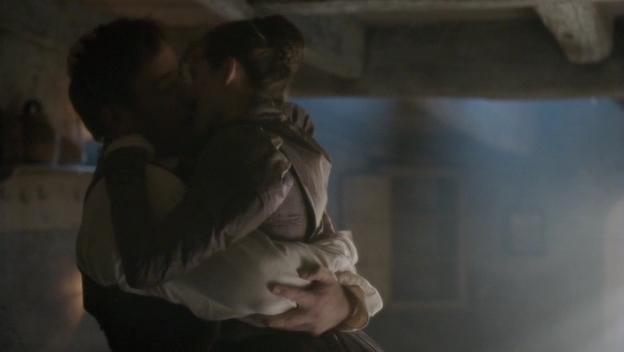
Amy reveals that her father lost all his money so Arthur really wouldn’t be dragging her down by marrying her. In response, the ordinarily somber and withdrawn Clennam smiles, picks her up, swings her around and kisses her. But wait a minute. In the book, the fortune that Gilbert Clennam left to Little Dorrit was the one secret she never told her husband about even after Mrs. Clennam’s death. Moments ago in this adaptation, he implied that he knew about it, telling her he now knew “how your fate is bound up in mine.” So… does that confirm that the will was useless now? Or did Andrew Davies forget what he’d just written? This episode just keeps being confusing, sometimes through the book’s fault, sometimes through its own. But, hey, the theme of this part is forgiveness, so let’s pretend we’re not confused. Speaking of forgiveness, Cavalletto brings Doyce to the prison. Arthur starts to apologize to him, but he says there’s no need. (“There was an error in your calculations. I know what that is.”) His invention is making so much money in Russia that he can pay off all of the company’s debts. Arthur still thinks he doesn’t deserve to be a partner anymore, but Doyce says if it weren’t for all his help and encouragement, he would never have come so far.
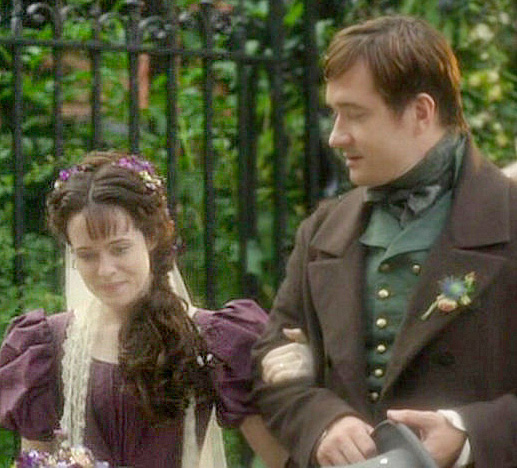
Like the 2005 Bleak House, this miniseries ends with the wedding of the romantic leads with all of the supporting characters present. Unlike the scene at the end of Bleak House however, the one in Little Dorrit is actually from the book though the guest list there was considerably shorter. Absent from both versions are Pet and Henry Gowan. Pet is one of the rare characters in Dickens whose story doesn’t really have an ending. That’s not necessarily a bad thing but I wish the miniseries could make it clear that that was intentional, and they didn’t just forget about her. A character present at this scene in both the book and the miniseries is Maggy so hurray for that! For me, this wedding scene works better than the one in Bleak House which isn’t faint praise because that ending was fine. Part of what I like better about the scene in Little Dorrit is the music and the other part is that not only do we get to see all these great characters one last time, but we also get to hear some of their catchphrases again. (Flora, like John Chivery, is too overcome with emotion to say hers but Pancks helpfully says it for her.) You could argue the book’s last scene had an undercurrent of wistfulness about it that this one doesn’t but, hey, it’s not like Dickens meant it to be a tragedy or anything.
So that was the 2008 Little Dorrit. Not surprisingly, it shares a lot of strengths with the 2005 Bleak House. While I regard Andrew Davies’ adaptations of classic literature as a mixed bag and I think some of the credit for the better ones goes as much to their casts and directors as to him, I find myself wishing he’d try his hand at some more Dickens stories. (I hear at one point he was going to adapt Dombey and Son and at another point, David Copperfield, but they both fell through. The latter seems like a weird choice for him anyway since the whole point is that it’s told entirely from the title character’s point of view and Davies’ tendency is to add scenes without the main characters. Still, I’d have been interested in seeing it.) Susannah Phelps’s miniseries adaptations of Oliver Twist and Great Expectations aren’t the worst things ever but they’re too revisionist for my taste with seemingly every character reimagined in some way. The less said about Stephen Knight’s recent “Dickens-sploitations” the better. Bleak House and Little Dorrit, on the other hand, feel modern and accessible to general audiences (assuming they’re OK with stories from different cultures) while also making Dickens fans feel like the beloved books are coming to life before their eyes. Watching them, I feel like I’m seeing a world we will never see again, and I don’t mean their historical settings. Of the two, I prefer Little Dorrit. It’s true that it has more problems with its story than Bleak House has but IMO it also has greater virtues. Maybe that’s appropriate since I’d say much the same thing about their corresponding books.
 All the (Dickensian) Year Round
I’d like to thank Rachel for doing the tags and images for these recaps for me. She really went above and beyond the call of duty with them!
LikeLiked by 2 people
Dear Adaptation Stationmaster,
I thoroughly delight in your recapitulation of the 2008 “Little Dorrit” miniseries, doing comparisons between it and Dickens’ novel as well as the 2005 “Bleak House.”
Thanks much for the time and energy you expended on this! I particularly relish your commentary—at times appreciative, at times confused, at times stunned (“Really?”)!
Several insights stood out to me.
1. Profound sadness of the scene in which Mr. Dorrit addresses the group as “Father of the Marshalsea”: You can take the man out of the Marshalsea, but not the Marshalsea out of the man.
2. I’m surprised Amy doesn’t throw a pillow at her (Fanny). Hear, hear!!!
3. “It’s really not clear what the message of Miss Wade’s subplot is supposed to be besides that Henry Gowan is a jerk.” I had very much the same reaction to the Miss Wade character.
4. “Mrs. Clennam probably never enjoys anything except being self-righteous.” Amen. What an iron-clad, Puritanical GRUMP!
5. “And now I suppose the coroner’s got it and Heaven knows when I shall get it back!”—Davies imitating Dickens. You pointed out when Davies did this imitation of the Inimitable effectively, and when not. Very insightful.
6. “The steps creak more than usual, foreshadowing . . . “: Yes, love when Dickens uses dwellings to characterize the moral stance of the inhabitants.
7. “But, hey, the theme of this part is forgiveness, so let’s pretend we’re not confused.” Love this!
8. “Watching them, I feel like I’m seeing a world we will never see again, and I don’t mean their historical settings. Of the two, I prefer Little Dorrit. It’s true that it has more problems with its story than Bleak House has but IMO it also has greater virtues. Maybe that’s appropriate since I’d say much the same thing about their corresponding books.” Great summary.
Thanks again for your thorough and insight-inducing work here!
Daniel
LikeLiked by 3 people
Glad you enjoyed it and that you didn’t seem to feel like I was overdoing saying that I like this miniseries better than the Bleak House one. I really do enjoy that miniseries a lot, but I get the impression that it’s more well known than the Little Dorrit one which I personally gravitate toward more, so I might come across as a little defensive.
LikeLiked by 2 people
Very good reflections and analysis. Thanks!
LikeLiked by 1 person
As I told you elsewhere, I was unable to comment for a while, but I enjoyed these. The Clennam family secret is a mess, isn’t it? After the miniseries first aired, I wrote out an explanation on my blog, and I got SO MANY thank-yous from people who had been confused. 🙂 To this day it’s one of my most popular posts ever.
LikeLiked by 2 people
Stationmaster, I just want to echo what other folks have said here: a HUGE “THANK YOU” for these absolutely marvelous episode recaps! I too loved reading the detailed insights here. I had hoped to be more or less in sync with the rewatch of it while you were posting, but that week Boze & I were still finishing our delayed annual re-watch of the 8 1/2 hr stage Nicholas Nickleby. On my next rewatch of LD, however, I want to comment under these, however belatedly! 🙂 Thank you!!!
LikeLiked by 1 person
I’m actually more of a fan of Nicholas Nickleby’s story than Little Dorrit’s (though I hope these recaps show I think the latter is great too) so I can’t criticize anyone for choosing to watch an adaptation of that one first. LOL.
LikeLiked by 1 person