Wherein your co-hosts of The Dickens Chronological Reading Club 2022-24 (#DickensClub) wrap up the final two “books” of Our Mutual Friend (our twenty-fourth read as a group); with a chapter summary, discussion wrap-up, and a final thematic wrap-up.

By the members of the #DickensClub, edited/compiled by Rach
“But the river had an awful look, the buildings on the banks were muffled in black shrouds, and the reflected lights seemed to originate deep in the water, as if the spectres of suicides were holding them to show where they went down. The wild moon and clouds were as restless as an evil conscience in a tumbled bed, and the very shadow of the immensity of London seemed to lie oppressively upon the river.”
~ Dickens, “Night Walks”
Friends, it is hard to believe that we have arguably read our final “The End” on our Dickensian chronological journey! And what a river journey this one has been.
Due to wrapping up both of our final books together, this will be a longer read, though I attempted to edit and summarize the discussion a little more than usual. If you have time for nothing else, I hope you can check out the final thematic wrap-up here, where I try to condense and consolidate the themes in our eight-week journey with Our Mutual Friend.
- General Mems
- Our Mutual Friend, “Book the Third” and “Book the Fourth”: A Summary
- Discussion Wrap-Up (Weeks 5-8)
- Our Mutual Friend: A Final Thematic Wrap-Up
- A Look-Ahead to Our Break, and to The Mystery of Edwin Drood
General Mems
SAVE THE DATE: Based on our recent poll, we have set the Zoom chat date for Our Mutual Friend! Saturday, 17 August, 2024, 11am Pacific (US)/2pm Eastern (US)/7pm GMT (London). We’d love to have you join us! Email Rach if you aren’t on the Zoom mailing list and would like a link.
Please see below for our proposed schedule for our final read in the #DickensClub, and whether or not you’ve joined us in the past, we would LOVE to have you here to help solve The Mystery of Edwin Drood!
If you’re counting, today is Day 931 (and week 134) in our #DickensClub! Today we are wrapping up our eight-week journey with Our Mutual Friend, our twenty-fourth read as a group. Please feel free to comment below this post with any final comments or questions for the group. What did you think of this final, completed novel? Or, you can use the hashtag #DickensClub if you’re commenting on twitter/X.
For our introduction to this marvelous novel, and our eight-week reading schedule, please click here. For Chris’ supplementary materials for Our Mutual Friend, please click here.
No matter where you’re at in the reading process, a huge “thank you” for reading along with us. Heartfelt thanks to our dear Dickens Fellowship, The Dickens Society, and the Charles Dickens Letters Project for retweets, and to all those liking, sharing, and encouraging our Club, including Gina Dalfonzo, Dr. Christian Lehmann and Dr. Pete Orford. Huge “thank you” also to The Circumlocution Office (on twitter also!) for providing such a marvellous online resource for us. And for any more recent members or for those who might be interested in joining: the revised two-and-a-half year reading schedule can be found here. If you’ve been reading along with us but aren’t yet on the Member List, we would love to add you! Please feel free to message Rach here on the site, or on twitter.
Our Mutual Friend, “Book the Third” and “Book the Fourth”: A Summary
(Illustrated by Marcus Stone. Images below are from the Charles Dickens Illustrated Gallery.)
“It was a foggy day in London, and the fog was heavy and dark. Animate London, with smarting eyes and irritated lungs, was blinking, wheezing, and choking; inanimate London was a sooty spectre, divided in purpose between being visible and invisible, and so being wholly neither…”
The Lammles’ plans for Miss Podsnap and Fledgeby have come to nothing, as a note from the Podsnaps—requesting the Lammles to stay away from their daughter—shows. Mr Lammle shows this note to Fledgeby, and the latter warns Lammle to stay away from Pubsey & Co, where Riah works (for Fledgeby).
Lizzie, meanwhile, has fled London, with the assistance of Mr Riah, due to the fear of Wrayburn’s and Headstone’s attentions towards her, and the danger that Eugene may be in because of Headstone. Riah will not divulge where she has gone.
Jenny misses her friend, and she and Mr Riah visit Miss Abbey at the Six Jolly Fellowship Porters in order to clear Gaffer Hexam’s name of any involvement in Harmon’s death, with a note signed by Riderhood—presumably procured thanks to the secret mutual friend, Harmon/Rokesmith himself. Then, the very subject of the conversation—Rogue Riderhood—is brought in, clinically dead after having been run down by a steamer. He appears to hover between life and death, and everyone shows pity for him and even roots for him to be resuscitated.
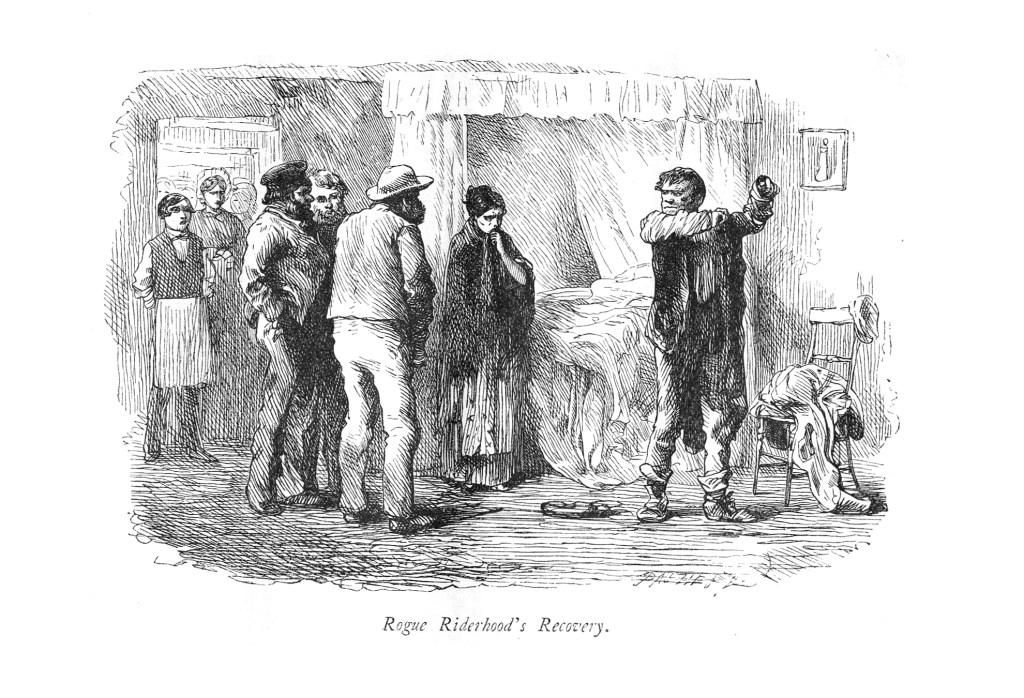
“If you are not gone for good, Mr Riderhood, it would be something to know where you are hiding at present. This flabby lump of mortality that we work so hard at with such patient perseverance, yields no sign of you. If you are gone for good, Rogue, it is very solemn, and if you are coming back, it is hardly less so. Nay, in the suspense and mystery of the latter question, involving that of where you may be now, there is a solemnity even added to that of death, making us who are in attendance alike afraid to look on you and to look off you, and making those below start at the least sound of a creaking plank in the floor.”
They root for him, that is, until he finally starts reviving, and his old wickedness—and others’ old dislike—resurfaces.
Bella is beginning to think that fortune is spoiling the goodness of Mr Boffin, as she reluctantly confesses to her father.

“I am so sorry for it, I am so unwilling to believe it, I have tried so earnestly not to see it, that it is very hard to tell, even to you. But Mr Boffin is being spoilt by prosperity, and is changing every day.”
This appears even more evident when he discusses wages with his clerk, John Rokesmith, and Boffin shows himself to be not only condescending towards John, but micromanaging and distrustful.
“‘I’ll have a bell,’ said Mr Boffin, ‘hung from this room to yours, and when I want you, I’ll touch it. I don’t call to mind that I have anything more to say at the present moment.’”
Boffin begins to purchase biographies of misers, and encourages Bella in her love of money. Meanwhile, in a moment of confidence with Mrs Lammle, Bella confesses about Rokesmith’s proposal to her.

Wegg, growing ever more resentful of Boffin’s wealth, watches Boffin suspiciously as the latter inspects the dust mounds, finding something (a bottle – the “Dutch bottle”) one night which he doesn’t reveal to Wegg. Boffin tells Wegg that he intends to sell off the mounds. Feeling proprietary about the mounds and the loaner home, Wegg grows angrier still. Wegg has just discovered a new will of old Harmon’s, buried in the mounds, and which is dated later than the will previously acknowledged, giving Boffin only the small mound and the rest to the Crown. Wegg intends to blackmail Boffin with this new discovery.

“Old Betty Higden fared upon her pilgrimage as many ruggedly honest creatures, women and men, fare on their toiling way along the roads of life. Patiently to earn a spare bare living, and quietly to die, untouched by workhouse hands—this was her highest sublunary hope.”
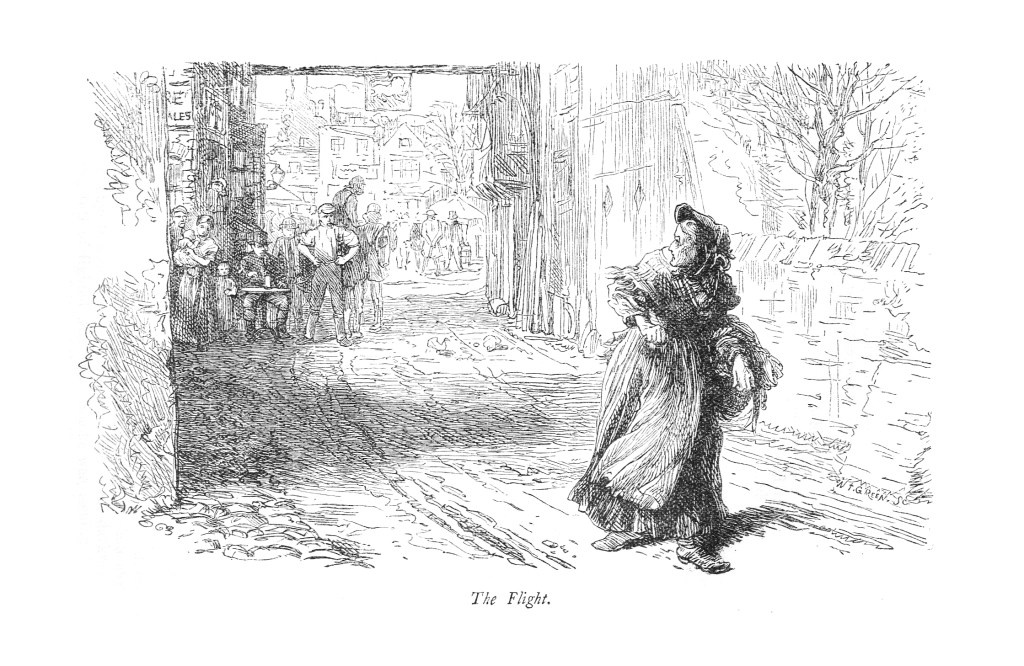
Lizzie, on her way home from work one evening, finds Betty Higden under a tree, near death. She had avoided all help from strangers, in the fear that they would take her to the workhouse. Lizzie stays with Betty as she dies, and contacts Rokesmith and the Boffins, as Betty had carried a note from them on her person. Lizzie, together with Bella, John, Sloppy, and the Reverend Frank Milvey—and having had the help of Riah in the funeral arrangements—attend Betty’s funeral together. This gives several friendships a chance to blossom: one, between Bella and John; the other, between Bella and Lizzie. In Bella’s honest openness with Lizzie, Lizzie reciprocates by confessing her reasons for leaving London: the two men who admire her, one of whom she loves, though she has no hope.
“‘I have no more dreamed of the possibility of my being his wife, than he ever has—and words could not be stronger than that. And yet I love him. I love him so much, and so dearly, that when I sometimes think my life may be but a weary one, I am proud of it and glad of it. I am proud and glad to suffer something for him, even though it is of no service to him, and he will never know of it or care for it.’”
Lizzie also confesses her fear of reading about some violence done to Wrayburn, because of Headstone. After, Bella confesses to John that she feels changed after her conversation with Lizzie. She also discusses with him her anxiety about his treatment at Boffin’s hands, and that wealth is spoiling Mr Boffin. John is comforted that Bella herself is not spoiled by her good fortune. Bella wishes to be useful in the world but feels helpless.
“‘No one is useless in this world,’ retorted the Secretary, ‘who lightens the burden of it for any one else.’”
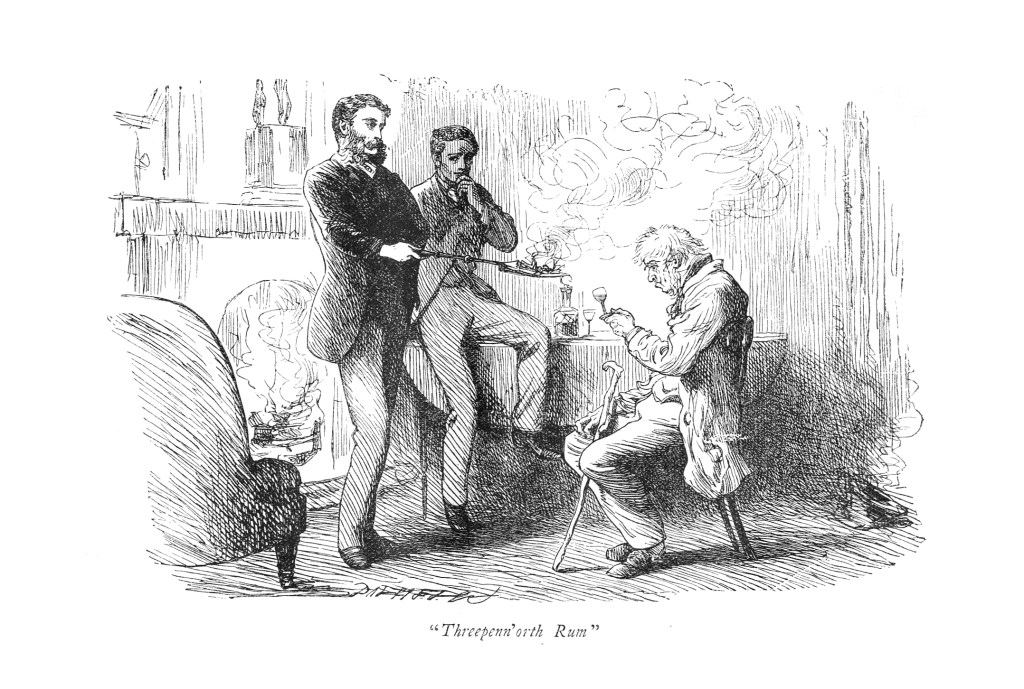
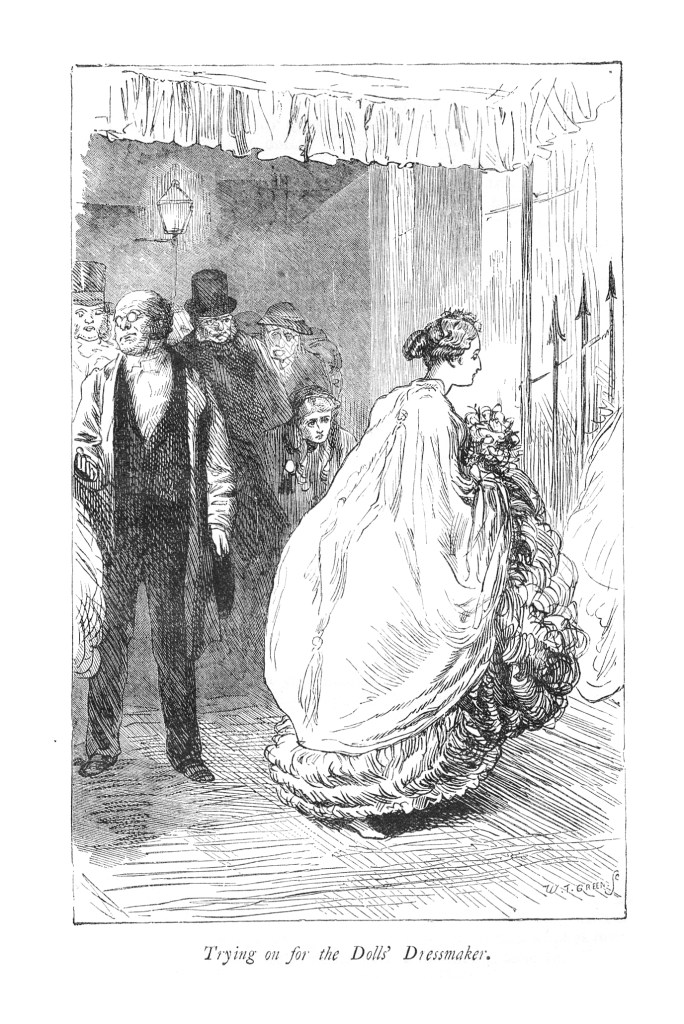
Eugene, meanwhile, tries to get an address for Lizzie from Jenny, by feigning interest in buying a doll’s dress for his goddaughter. When this fails, Eugene hires Jenny’s father to find it out, giving him drink money. Lightwood is disgusted by the bargain, and haunted by the face of Bradley Headstone, who has been following Eugene in his nightly walks all across London, while Eugene taunts Headstone by taking meandering paths, leading to nowhere.
“There was no sleep for Bradley Headstone on that night when Eugene Wrayburn turned so easily in his bed… Bradley consumed the lonely hours, and consumed himself in haunting the spot where his careless rival lay a dreaming… the state of the man was murderous.”

In his sleepless haunting of the city, Headstone meets Riderhood, who has just gotten a job upriver, at the Plashwater Weir Mill Lock. Headstone asks about Lizzie and Eugene, and whether they have been seen together, suggesting that Riderhood might to him—Headstone—some service for payment in future.
There is a misunderstanding between Jenny and Riah, when Jenny is coming with Twemlow to Pubsey & Co, and witnesses Riah unwilling to be merciful with Twemlow’s requests for delays in payments. Lammle’s property must be put up for auction in order to pay Lammle’s debts. She doesn’t know that Riah has just been instructed to do this by his boss, Fledgeby, who pretends to be interceding for Twemlow with Riah. Fledgeby plays the innocent, and lets Riah take the heat for the business.

Venus meets with Boffin, and reveals Wegg’s blackmail plans to him, apologizing and regretting his own part in the business. Boffin asks him to throw the new will in the fire, or to give it to Boffin, but he feels that he must now take a straight path, and refuses. Boffin sees Wegg’s treachery firsthand, as Venus arranges for Boffin to listen in on their conversation in hiding.
“‘Let him alone this time, and what’ll he do with our property next? I tell you what, Mr Venus; it comes to this; I must be overbearing with Boffin, or I shall fly into several pieces. I can’t contain myself when I look at him. Every time I see him putting his hand in his pocket, I see him putting it into my pocket. Every time I hear him jingling his money, I hear him taking liberties with my money. Flesh and blood can’t bear it. No,’ said Mr Wegg, greatly exasperated, ‘and I’ll go further. A wooden leg can’t bear it!’”
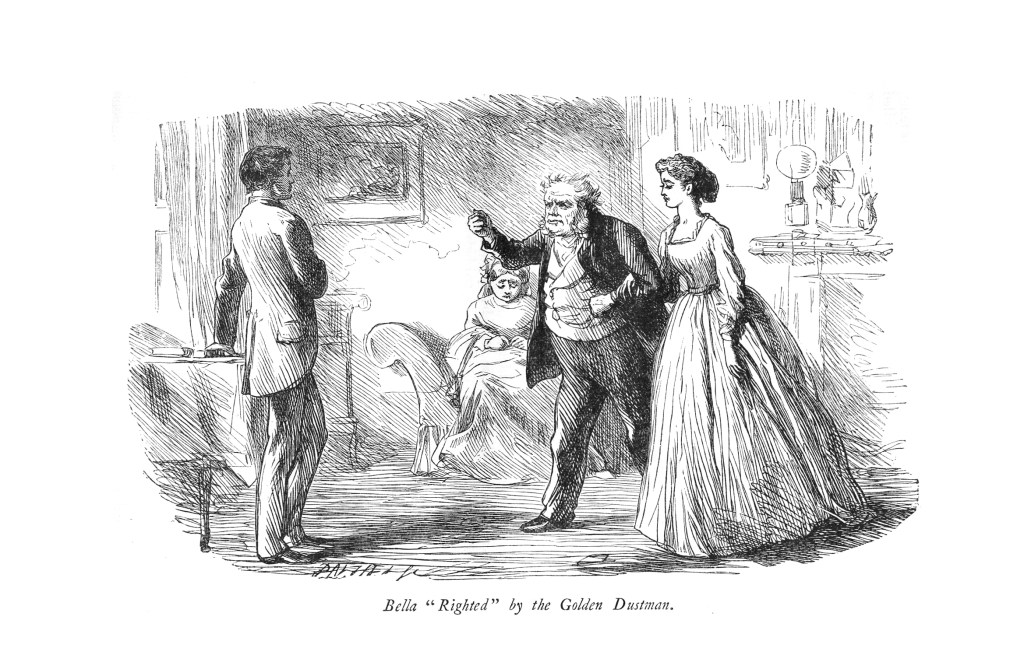
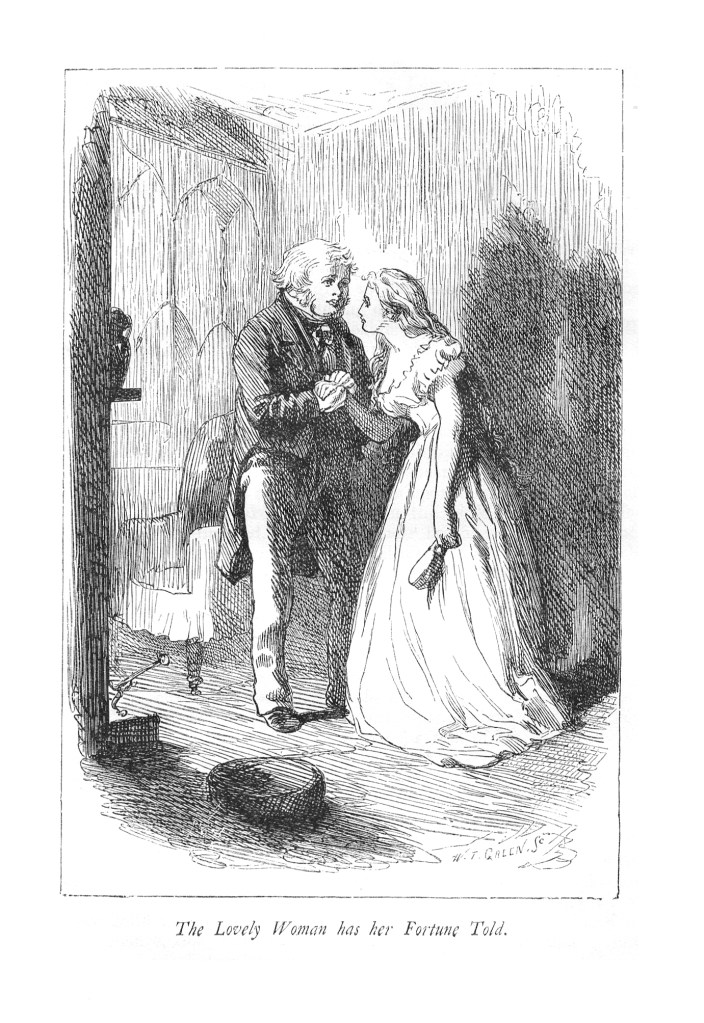
The Lammles then wish to speak to Boffin, using Bella’s confidence about Rokesmith’s proposal to Bella as a means to make Boffin fire Rokesmith, and to trust them instead, thinking that Mr Lammle might replace Rokesmith as the Boffins’ secretary. Boffin immediately causes a scene, firing Rokesmith on the spot in order to “right” Bella; Bella, instead, knowing that she can never return, renounces Mr Boffin and his money, defends Rokesmith and his goodness, apologizing for her role in the whole thing, and goes home.
Rokesmith meets her at her father’s work, where she has gone first. There, they declare their love and intention to marry.
Mrs Lammle confesses to Twemlow that her husband is behind the plot to unite Fledgeby and Miss Podsnap, and also that it is Fledgeby rather than Riah who is to blame for their financial ruin. Society is now turning its back on the Lammles, whose ruin is made public.
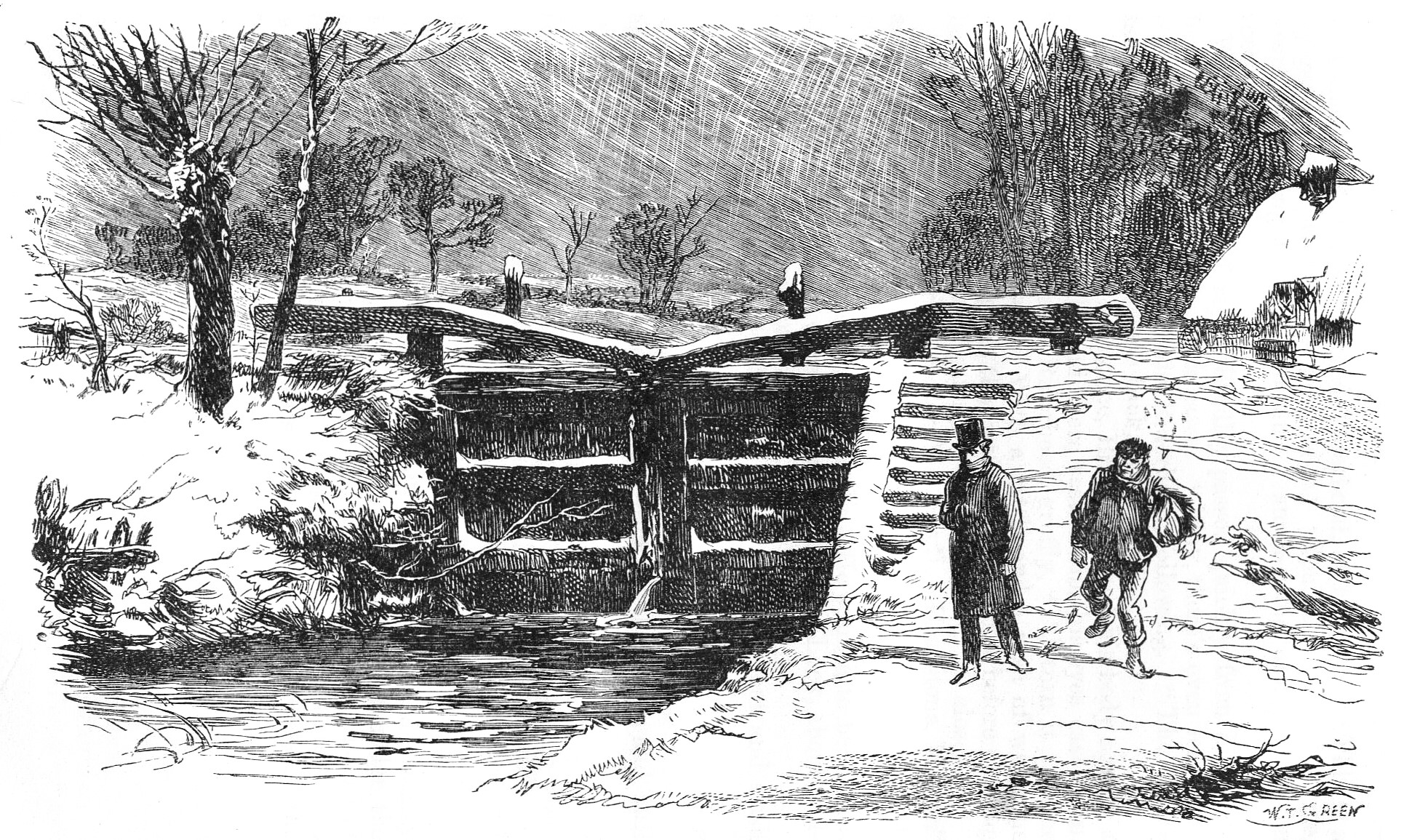
“Plashwater Weir Mill Lock looked tranquil and pretty on an evening in the summer time. A soft air stirred the leaves of the fresh green trees, and passed like a smooth shadow over the river, and like a smoother shadow over the yielding grass. The voice of the falling water, like the voices of the sea and the wind, were as an outer memory to a contemplative listener; but not particularly so to Mr Riderhood, who sat on one of the blunt wooden levers of his lock-gates, dozing.”

Riderhood, who now keeps a lock upriver (near to the factory where Lizzie works), lets Eugene through as he rows his boat. Eugene has just had a visit from Jenny’s father, and now knows Lizzie’s location. Bradley Headstone, Riderhood finds out shortly after, is following Eugene, suspecting that Eugene will be meeting Lizzie. Riderhood then notices that Bradley has copied the red neckerchief that he himself wears, and decides to keep observing the schoolmaster.
Meanwhile, Wegg is proposing to extract a heavy fee from Boffin in order to give over this new will, which will make Boffin all the poorer.
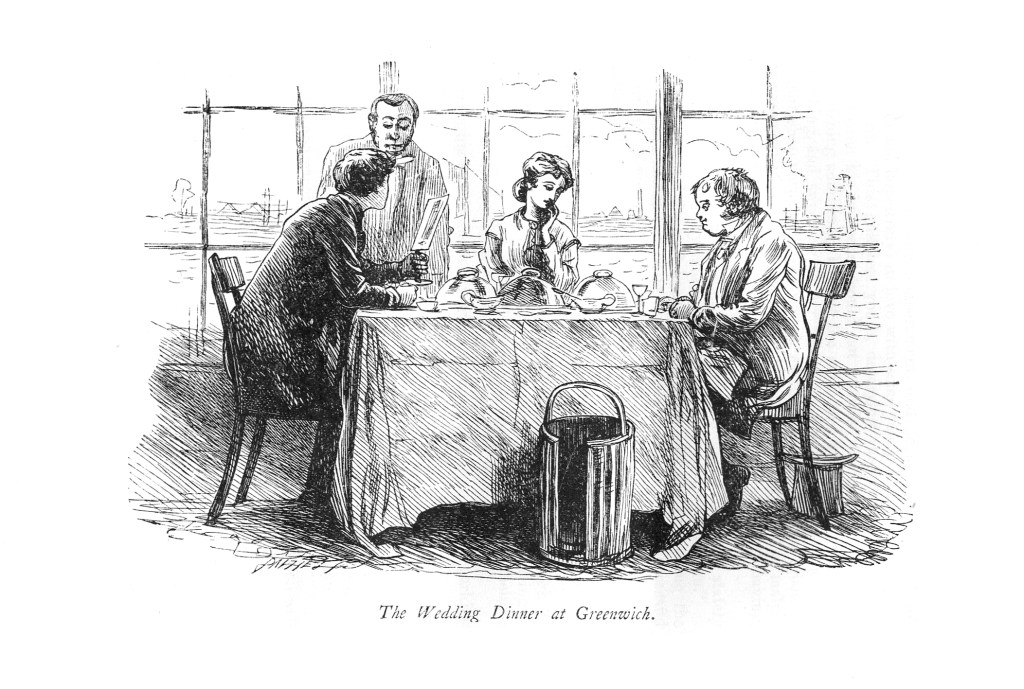
Though Mr Wilfer attends his daughter’s wedding, he must feign ignorance about it for the sake of familial peace, and Mrs Wilfer finds out about it from a letter from Bella. She is disappointed at what appears to be a bad match. When John and Bella visit, the latter tries to diffuse the uncomfortable situation with her cheerfulness, but John wonders whether Bella would prefer to be rich—which she denies. Not long after, they find out that Bella is expecting a child.

Lizzie meets secretly with Eugene after her work day at the paper mill, asking him to stop following her for the sake of her reputation; after she leaves, he considers the request, and knows that he cannot leave her. Eugene is then attacked violently by a man in passing, and ends up falling in the river.
“Was he struck by lightning? With some incoherent half-formed thought to that effect, he turned under the blows that were blinding him and mashing his life, and closed with a murderer, whom he caught by a red neckerchief—unless the raining down of his own blood gave it that hue.
Eugene was light, active, and expert; but his arms were broken, or he was paralysed, and could do no more than hang on to the man, with his head swung back, so that he could see nothing but the heaving sky. After dragging at the assailant, he fell on the bank with him, and then there was another great crash, and then a splash, and all was done.”
From a distance, Lizzie hears the splash of water and a cry.
“A sure touch of her old practised hand, a sure step of her old practised foot, a sure light balance of her body, and she was in the boat. A quick glance of her practised eye showed her, even through the deep dark shadow, the sculls in a rack against the red-brick garden-wall. Another moment, and she had cast off (taking the line with her), and the boat had shot out into the moonlight, and she was rowing down the stream as never other woman rowed on English water.”
Using all of her old skills that she learned on the river, she rows out to assist whoever is in danger, and pulls Eugene from the water, bloodied and nearly unrecognizable. She brings him home and the doctor doesn’t hold out much hope for him.
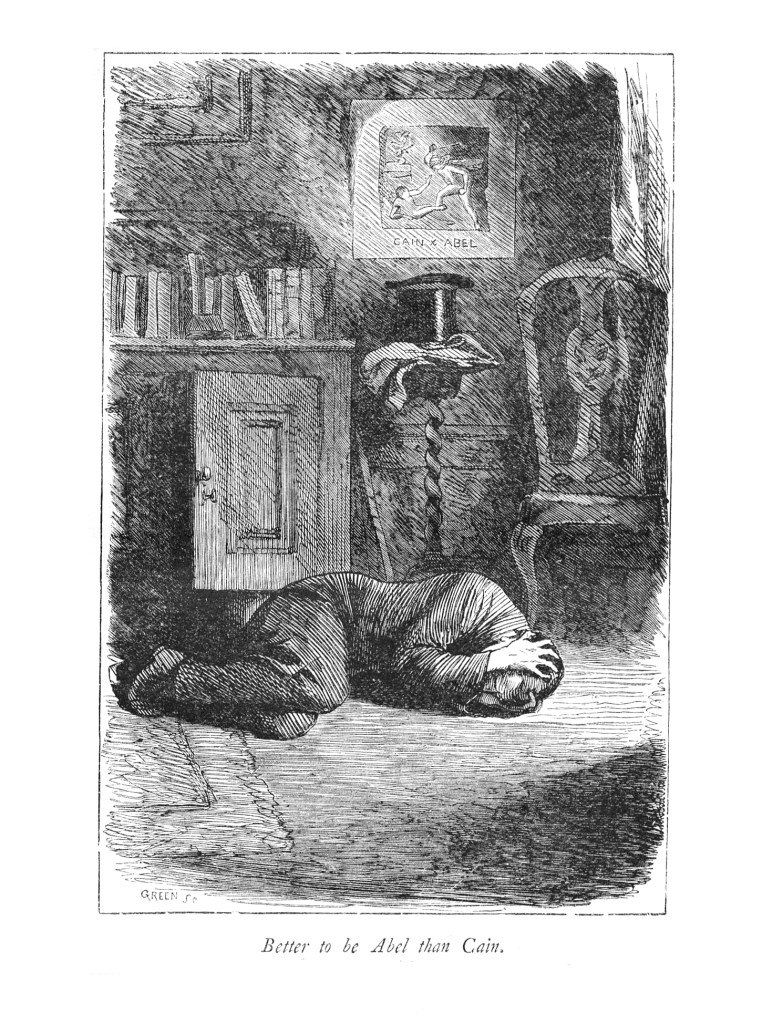
“‘Poor girl, poor girl! She must be amazingly strong of heart, but it is much to be feared that she has set her heart upon the dead.’”
When Headstone, who had attacked Eugene, comes back to Riderhood’s, he makes a feint of having accidentally cut himself in order to splatter blood onto Riderhood. Riderhood, deeply suspicious, follows Headstone when he sneaks away, and sees the schoolmaster changing into new clothes and throwing his old ones—the ones looking like Riderhood’s—in the river. Bradley resumes his teaching and finds himself cast off by Charley Hexam, who has been suspecting him of “murdering” Eugene.
Jenny, who has been disappointed in thinking that Riah is the cause of unmerciful loans, has avoided him; then, however, after a conversation between Lammle and Fledgeby—the former physically attacking the latter—she talks to Riah and comes to realize her mistake. She reconciles with him–he is no longer working for Pubsey & Co–and offers to him the room that Lizzie used to occupy, as Riah is now thrown out upon the world.

Jenny’s father dies, having been beaten in the streets, and she feels that she could have been kinder to him, but Riah becomes like a second father—or, like she later tells Sloppy, like a first father.
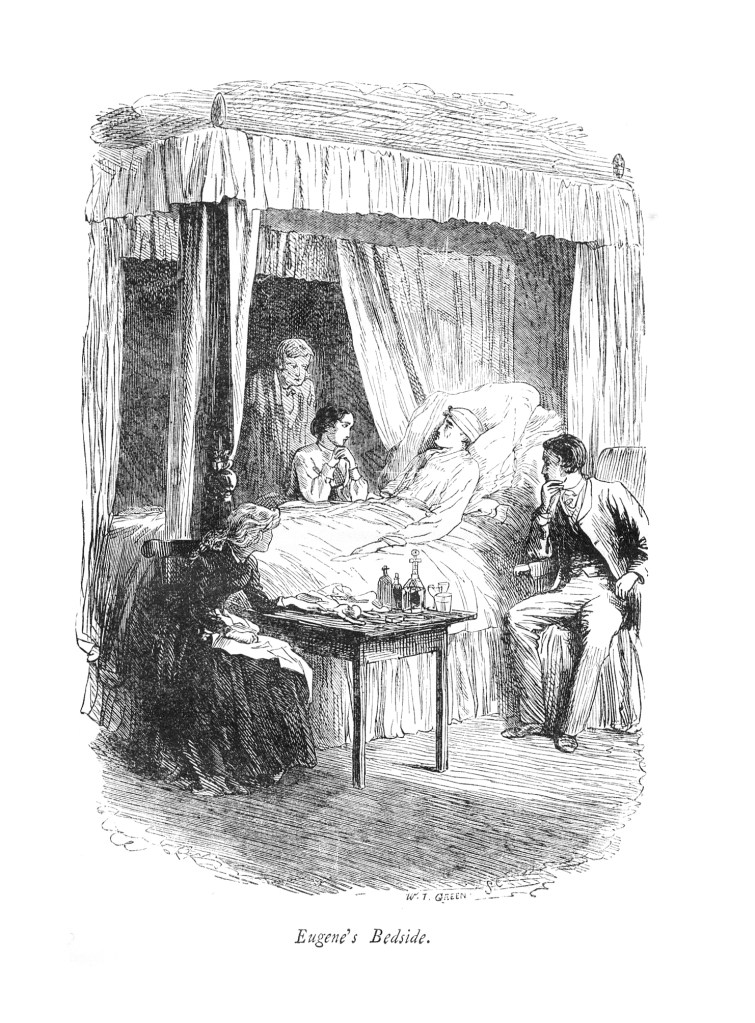
Mortimer arrives to beg her to accompany with him to see his dying friend, Eugene, who is requesting her presence, as he wants to hear her speak of the “children” that she used to see, who comforted her in her pain; Jenny here seems to be a kind of intermediary between heaven and earth.
Jenny stays by him as Eugene requests first that Bradley Headstone not be pursued for his actions, as it might bring harm to Lizzie; secondly, that he wishes Lizzie to marry him. The latter, even if he dies, will preserve her reputation from harm, and perhaps help her forward. Lizzie and Eugene marry, witnessed by Mortimer, Jenny, and Bella (without John, who is still unwilling to meet Mortimer).
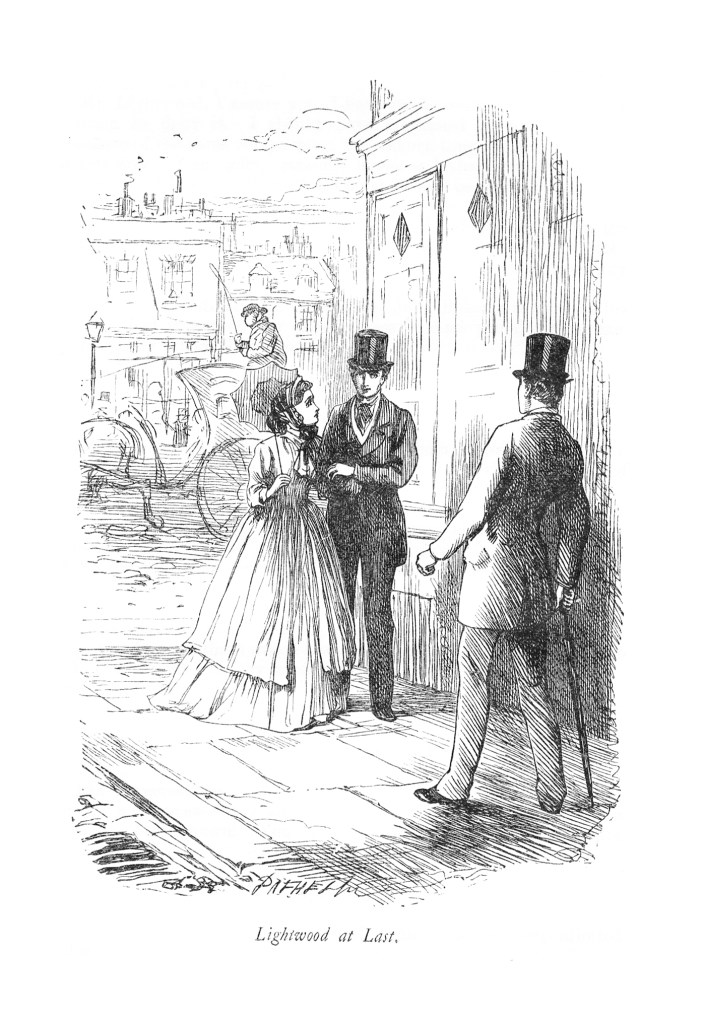
With the birth of their little girl, Bella and John finally come to the moment of revelation. Mortimer sees John and recognizes him as the Julius Handford that he had been looking for so long ago, and who was suspected of the murder of John Harmon. John goes with them, with Bella’s full faith in him. Then, John takes Bella to, of all places, the Boffins’ home. Mr and Mrs Boffin welcome her in, revealing all: Mrs Boffin had recognized John as their own dear John Harmon, and they also had faith in the goodness of Bella to love John for himself and not for his money, and decided to test her by Mr Boffin playing the miserly monster that he became.
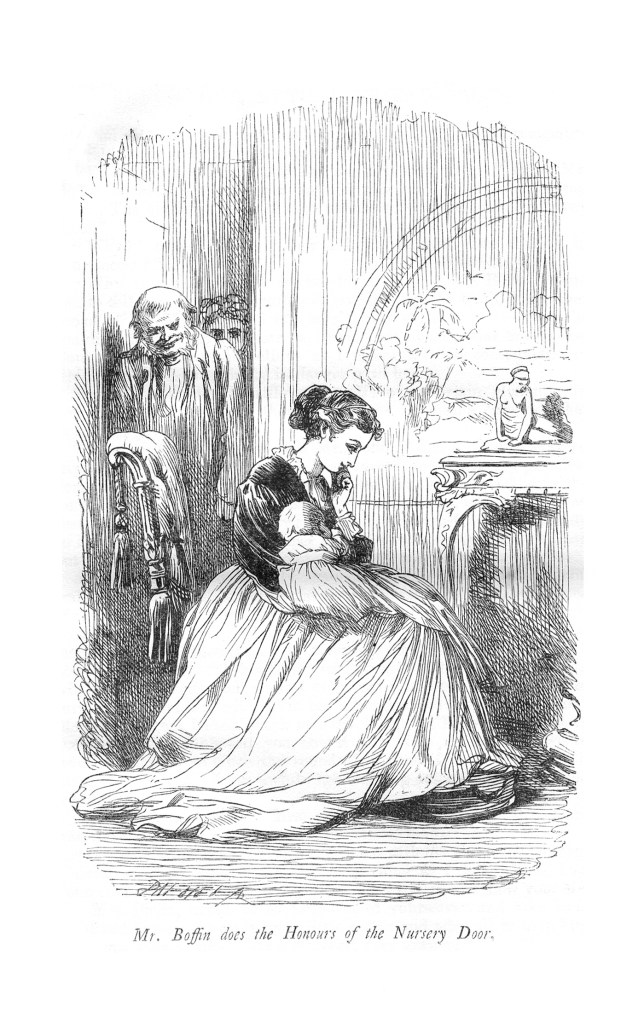
Wegg gets his comeuppance as, when he comes with Venus to the Boffins’, he sees John there, and finds out that all of his scheming was for nothing: the will he found was not the most recent, and John himself owes everything to the generosity of the Boffins, who would have gladly pretended that the newest will—Mr Boffin went to search for in the “Dutch bottle” buried in the dust mounds—which actually gave most of the wealth to themselves and not to John, didn’t exist. Harmon tells Wegg off royally.
“‘Now, scoundrel,’ he pursued, ‘I am going to finish. You supposed me just now, to be the possessor of my father’s property.—So I am. But through any act of my father’s, or by any right I have? No. Through the munificence of Mr Boffin. The conditions that he made with me, before parting with the secret of the Dutch bottle, were, that I should take the fortune, and that he should take his Mound and no more. I owe everything I possess, solely to the disinterestedness, uprightness, tenderness, goodness (there are no words to satisfy me) of Mr and Mrs Boffin. And when, knowing what I knew, I saw such a mud-worm as you presume to rise in this house against this noble soul, the wonder is,’ added John Harmon through his clenched teeth, and with a very ugly turn indeed on Wegg’s cravat, ‘that I didn’t try to twist your head off, and fling that out of window!’”
Riderhood has followed Headstone back to his school, and makes it evident that he has found the incriminating clothes—meant to look like Riderhood’s in order to cast suspicion of the bloody deed onto him—in the river. The two men meet up at the lock, Riderhood saying that he will be squeezing the schoolmaster dry for the rest of his days in order to pay him back, and that the schoolmaster will never be rid of him. Instead, looking suicidal, Headstone grabs Riderhood, ready to plunge both himself and Riderhood into the dangerous part of the lock’s icy water below.
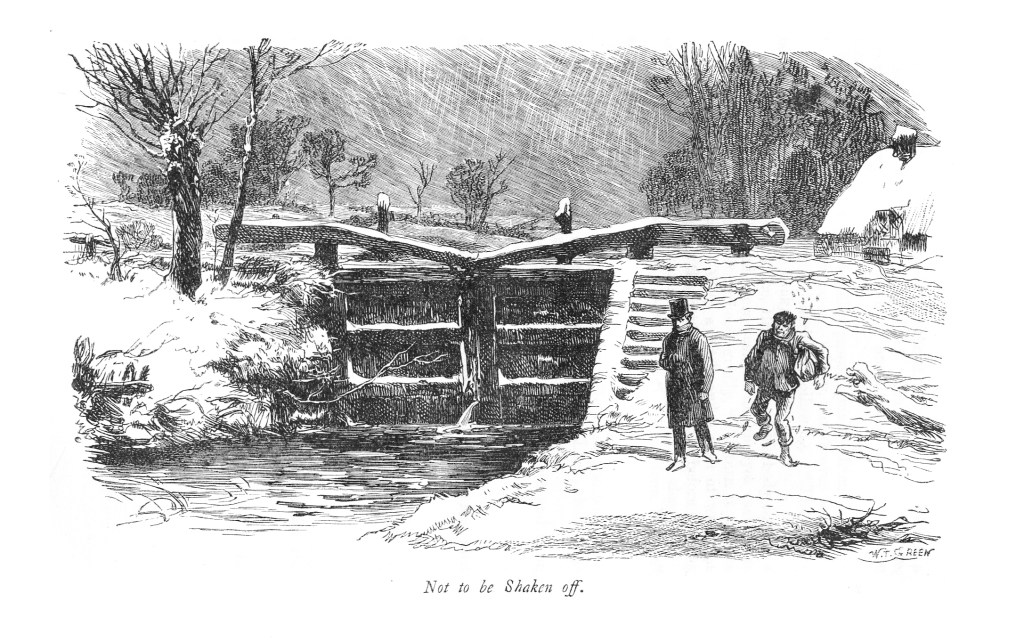
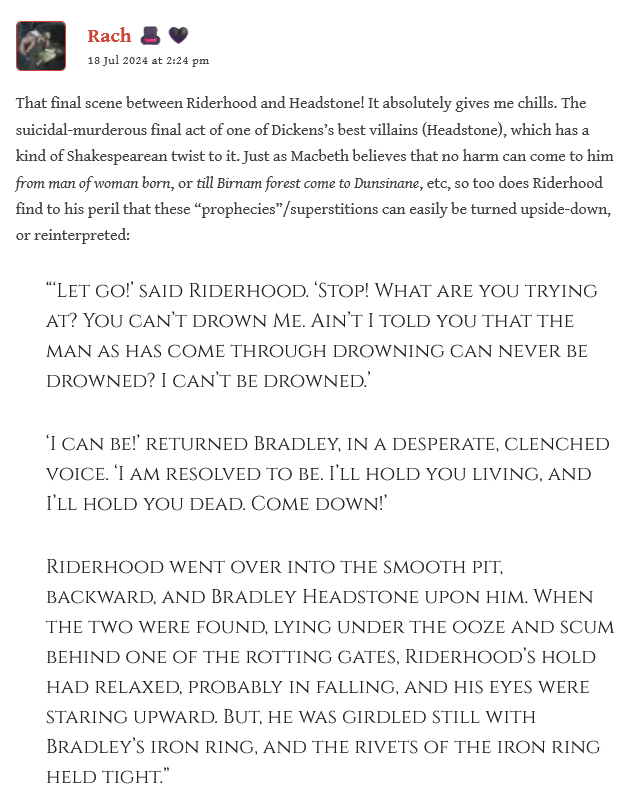
“‘Let go!’ said Riderhood. ‘Stop! What are you trying at? You can’t drown Me. Ain’t I told you that the man as has come through drowning can never be drowned? I can’t be drowned.’
‘I can be!’ returned Bradley, in a desperate, clenched voice. ‘I am resolved to be. I’ll hold you living, and I’ll hold you dead. Come down!’
Riderhood went over into the smooth pit, backward, and Bradley Headstone upon him. When the two were found, lying under the ooze and scum behind one of the rotting gates, Riderhood’s hold had relaxed, probably in falling, and his eyes were staring upward. But, he was girdled still with Bradley’s iron ring, and the rivets of the iron ring held tight.”
Many of our characters begin to connect: Mortimer helps Bella and John with the legal issues involved related to his sudden restoration to life; Eugene recovers by the strength of Lizzie’s care and love; Jenny and Sloppy form a connection, as he wishes to make a cabinet for her dolls. The Lammles and the Veneerings must both use their wits and cunning to scrape by, as they are running out of funds.
We end with Mortimer in that same Society that Eugene has rejected, defending Eugene’s choice in the face of everyone’s opposition and contempt. Everyone, that is, except the quiet Twemlow, who finally speaks up.
“‘I say,’ resumes Twemlow, ‘if such feelings on the part of this gentleman, induced this gentleman to marry this lady, I think he is the greater gentleman for the action, and makes her the greater lady.’”
Discussion Wrap-Up (Weeks 5-8)
Miscellany & What We Loved–and Didn’t
The Stationmaster started the discussion off after Weeks Three & Four with a number of insights about character:
- Bella is not, perhaps, so different from other Dickensian angelic heroines, in that she spreads cheer and good humor, though there is more nuance and distinctness. After Weeks 5 & 6, he writes: “In Chapter 5, she’s just as tolerant of and forgiving toward her terrible family members as Little Dorrit or Lizzie Hexam but she is so with her own style. In the book’s words, ‘her old coquettish ways (were) a little sobered down but not much.'”
- “It sounds ridiculous but I find Pleasant Riderhood’s wish for her father to remain comatose so people wouldn’t hate him to be really poignant.”
- Loves the relationship that builds between Jenny and Riah.
- The painfulness of the “Jewish moneylender” stereotype as evinced in the discussion between Lammle & Fledgeby. Milvey’s discomfort with his wife’s comment later echoes this theme.
- “I love the counterintuitive name for the heart of the city: Saint Mary Axe! The contrast between the soft, gentle associations of the first two words and hard, sharp associations of the last one is great.”
- “Earlier, I described Our Mutual Friend as having, for Dickens, an unusually high number of characters whom we’re not sure are good or bad until the end. I wasn’t just thinking of Eugene Wrayburn and John Rokesmith. I was also thinking of Ned Boffin who was introduced as a positive character but who now seems like he might very well be a negative one…”
- He wasn’t so sure about Bella and John at first, but by Chapter 9 he is definitely “shipping them”! 🙂
- “Man, I hate Fledgeby! Someone needs to go all Nicholas Nickleby on his posterior. The way he cools Riah’s friends and heats his enemies is so infuriating. It’s especially depressing to see the generally savvy Jenny Wren fall for his propaganda.”
- “Hurrah for Twemlow standing up to everybody else in Chapter 17! That was satisfying to read.”
- As to the comparison between A Tale of Two Cities and Our Mutual Friend: “I think I like both of them better than Bleak House and Hard Times, but I might like Little Dorrit better than either. I’ll have to read them all again to say for sure.”
- “I’m delighted Dickens gave Mr. Venus and Pleasant Riderhood a happy ending!”
The Stationmaster loves the scenery described in Chapter Nine:

And I just had to add my love for the whole scene where Lizzie saves Eugene:

Daniel responds to the above thoughts, and the Stationmaster’s wonderful appreciations:
And why not conclude with a Bellaism/Wellerism?

The Enigmatic Book Titles in Our Mutual Friend
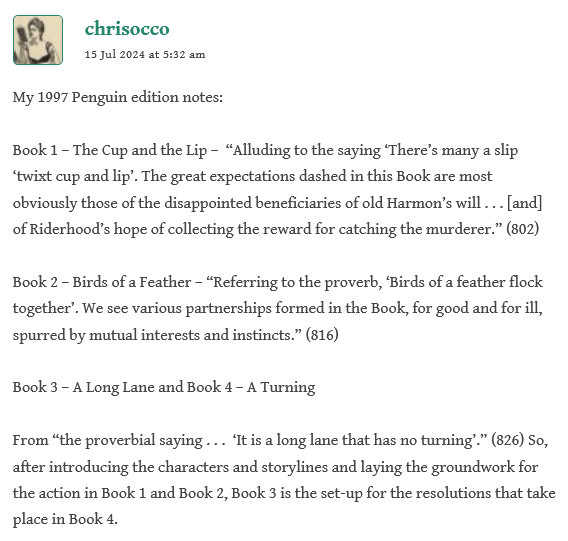
The Stationmaster asks a great question:

And Chris responds with very helpful notes from the Penguin Edition:
Dickens’s “Writing Lab”: Atmosphere; Setup & Payoff; “We Travel in the Circle”; Opening and Closing Lines
After Weeks Three and Four, Chris drew our attention to the parallels in Our Mutual Friend‘s description of the London fog, with that of a passage in The Old Curiosity Shop and of the famous opening in Bleak House. Finally, she quotes and comments on Christine L. Corton’s passage from London Fog: The Biography:

Lucy responds:

On “Society”; On Our Characters as “Readers” of One Another
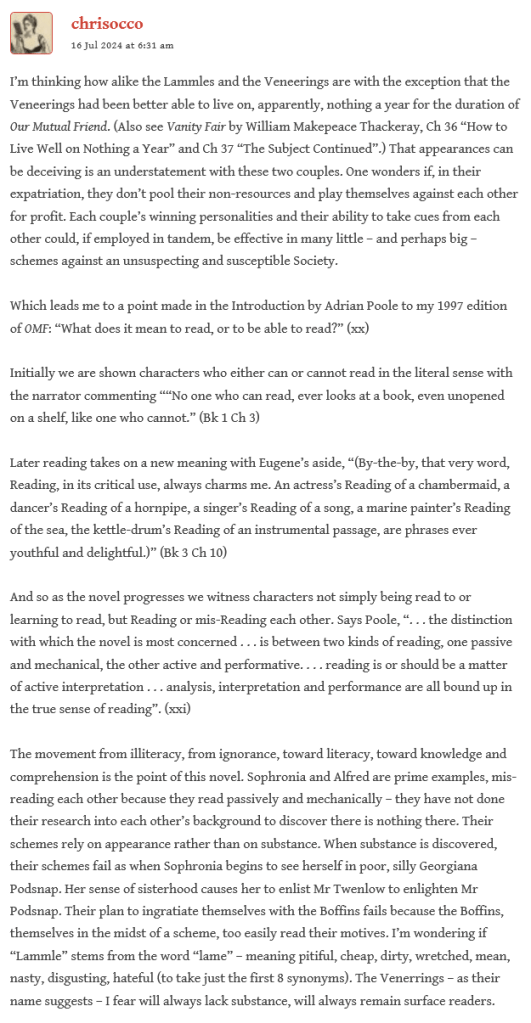
Chris’s marvelous insight about the meaning of “reading” in Our Mutual Friend, as our characters all read–or don’t read, or misread–one another and their situation:
Dickens, Crime, and the Criminal Mindset
Crime and the criminal mindset have been recurring sources of interest and drama throughout Dicken’s writing career, and I place them in a separate category here, as we will be delving more deeply into this with The Mystery of Edwin Drood.
On this, Chris writes:

And on Bradley Headstone in relation to other Dickensian villains:

Daniel responds:

And I respond, as to another possible cause of Bradley’s illness:

Doubling, Foils, & Parallels
The Stationmaster writes:

He argues that we might also see some doubling in the pursuit (of Lizzie) of Bradley, to that of Eugene:

In response, Chris writes:

It does, as Chris says, take Eugene’s near-death to get him to do the honorable thing, as he had clearly been “grooming her” and was reckless of the consequences.
And though this could equally be put under the category of “Crime and the Criminal Mindset,” I will post it here under the “Doubling”:
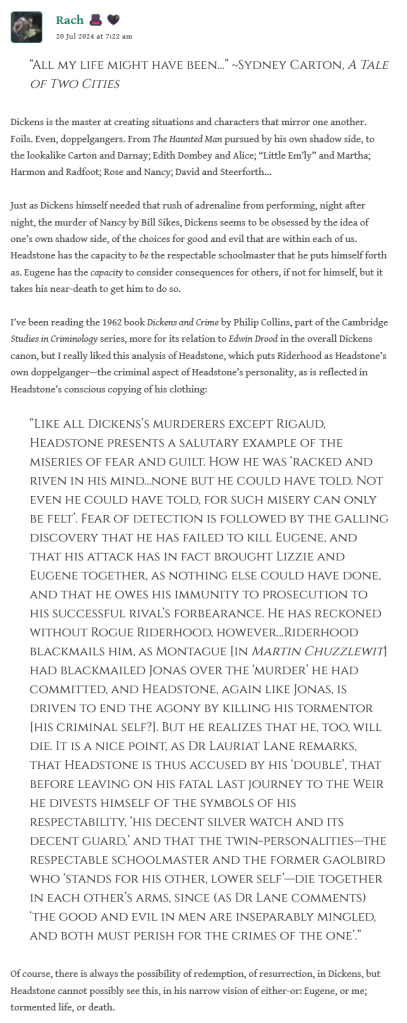
Chris responds:
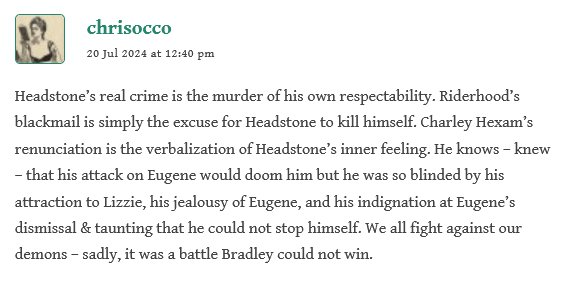
Connecting Our Mutual Friend with The Mill on the Floss
Lucy writes:

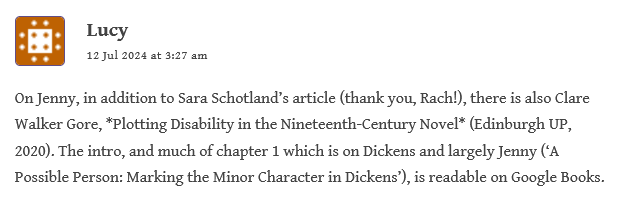
Dickens and Disability: Jenny Wren
In keeping with this ongoing theme which we touched on especially in David Copperfield and in our intro to Our Mutual Friend, Lucy has a great resource to share:
The “Problem Play” Aspect: The Testing of Bella
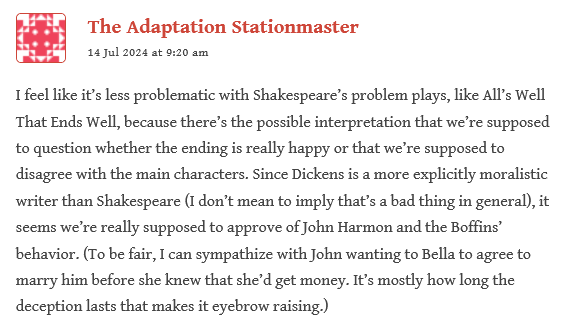
Of course, there is that “most controversial plot point,” and the Stationmaster tackles it. He is less disturbed by the initial testing, than by the length of time that it is allowed to go on:
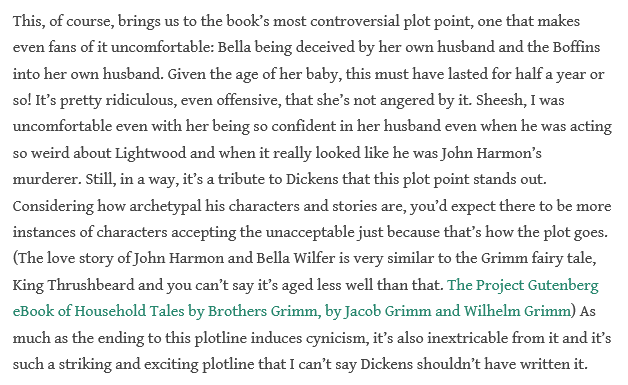
I agreed with Lucy and the Stationmaster here in my comments, feeling that the testing is a kind of Shakespearean Problem Play echoing The Taming of the Shrew; Dickens somehow pulls it off, but it remains a bit problematic because of the length of time that the testing lasts–well beyond marriage, and past the birth of Bella and John’s child.
In response, Stationmaster feels it is perhaps less problematic in Shakespeare than here:
For Lucy, the whole section with Bella post-marriage diminishes Bella as a character, and she analyzes why some of Dickens’s women are so satisfying and others are a tough go for her:

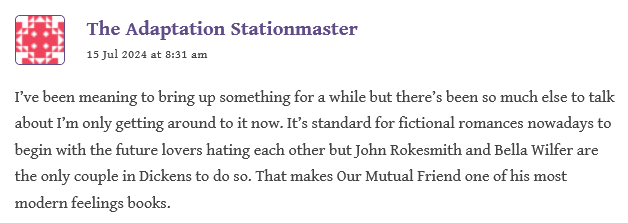
For another perspective on John and Bella, and why theirs might perhaps feel like a more “modern” fictional relationship:
Bella and Her Father: OMF’s “Shining Love Relationship”?
Daniel writes:
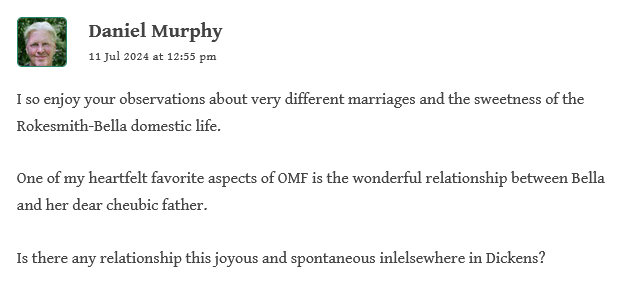
Lucy sums it up in calling Bella and R.W. “the shining love relationship” in the novel:

I agreed with this wholeheartedly, wondering whether this was modeled on his relationship to Katey Dickens–though we know there was a real strain there after his separation with Catherine.
Dickens, Shakespeare, & the Stage
Keeping this theme ongoing from the beginning of our chronological reading journey. Here, Daniel is commenting on the introductory material (provided by Chris) from Peter Ackroyd:

And I comment on the Shakespearean twist on superstitions or prophecies here:
Dickens’s Postscript, & a Final “The End”
The Stationmaster gave us a wonderful listing of Dickens’s opening and closing lines, which I would love to put in a separate post, perhaps in a table format. At the end, he comments on how he feels about the closing line in Our Mutual Friend:

And Chris responds, with Dicken’s final postscript:
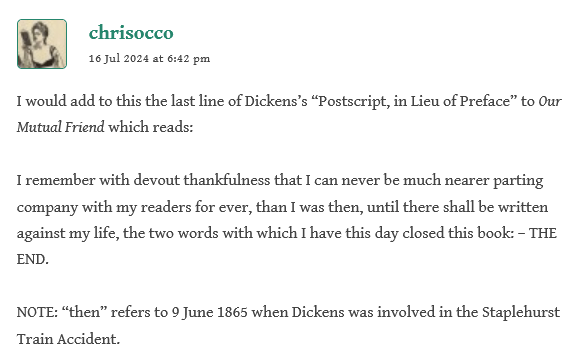
And I respond:

“No one is useless in this world…who lightens the burden of it for anyone else.”
Though we have just discussed Dickens’s final “The End” in a novel, perhaps the last word here is best expressed about what the Stationmaster feels might sum up Dickens’s whole oeuvre:

Our Mutual Friend: A final Thematic Wrap-Up
- The River: Life, Death, Resurrection (Characters live by the means of the river, and die by it. They also rise from the dead–Harmon, Riderhood, Eugene.)
- Dickens & Disability (Dickens’s representation and positive portrayals, echoing Mr Dick in David Copperfield. Physical disability in Miss Jenny Wren; I/DD in Sloppy.)
- Contrasts: Light & Dark; Comedy & Tragedy; Life and Death (Keeping this at the forefront, thematically, since the beginning. There is a darker, more somber tone to this novel in spite of its comedic social satire; its lighter aspects seem to revolve around the cynicism and shallowness of “Society.” The lighter is less light; the dark is darker.)
- Self-Definition Through Characterization; Dickens as the “Haunted Man” (The best relationship is between Bella and her father, arguably; Dickens’s own familial troubles and marital troubles seem to be reflected here. Eugene as a Sydney gone to seed.)
- Dickens, Shakespeare, and Theatricality: OMF’s “Problem Play” Aspect (The Bella testing aspect lends a kind of Taming of the Shrew element to the story, and is close to being a “problem play,” though Dickens pulls it off due to his portrayal of Bella and her relationship to John and the Boffins. Ackroyd’s comparison to The Tempest, as referenced by Daniel. The comparison of the problematic Macbethian prophecies to the superstition of Riderhood about his inability to be drowned a second time.)
- The Joys of Reading Dickens Aloud (Boze, Rach, and Dana greatly enjoyed the beautiful audiobook narration by David Troughton.)
- Dickensian Parents; The Relationship of Bella and R.W. (Possibly the best love relationship in the book, according to Lucy, and several of us agreed. Pure delight.)
- Class & Social Commentary: “Money–Money, money…” (The extreme spoof on Society and its hollowness, as embodied in the bankrupt and scheming Veneerings and Lammles. Chris’s reference to “How to live on nothing a year”…)
- The Women in Dickens: Lizzie Hexam, Bella Wilfer, Jenny Wren (Dickens portrays three of his most shining, distinctive female heroines in this novel. This might be called a “women’s novel.”)
- Doubling, Foils, Dickensian Parallels (Possible doubling in the Headstone/Lizzie with Eugene/Lizzie, as referenced by Stationmaster? Also, parallels to other Dickensian novels/characters, from the Fledgeby/Riah with Casby/Pancks, to the similarities between Lavinia and the Pecksniff girls or Fanny Squeers. Headstone doubling with Riderhood as the “respectable schoolmaster” versus his criminal shadow side.)
- Dickens and Antisemitism (Dickens has come a long way since the disturbingly antisemitism portrayed in Oliver Twist. Here, partially in response to a Jewish woman’s letters to him, Dickens created one of his most truly good and honorable characters in the Jewish friend of Jenny Wren’s, Mr Riah. Simultaneously, like the Pancks/Casby relationship, Riah is the scapegoat for the “Christian” moneylender’s harshness, as Riah’s boss “Fledgeby” uses and abuses him.)
- Responsibility and Debt (Here, moral irresponsibility is most fully embodied in Eugene, who cannot think of the consequences of his actions, either for himself nor for the woman he loves.)
- Dickens’ “Writing Lab”: Atmosphere, Characterization; Theme/Imagery (The River. The Lock. London, from the glittering home of the Veneerings, to the foul reek of the River. Fog.)
- Dickens & Parentless Children (This theme is continued through little Johnny, and Lizzie/Charley. In Bella’s, we find a truly wonderful parental figure, however, in R.W.)
- Forgiveness and Repentance (Leaving this theme here for ongoing consideration, as it has been a recurring one. Eugene’s need for forgiveness.)
- Dickens, Romanticism, and the Imagination (This, too, has been a recurring theme throughout our journey.)
- Dickens and Fairy Tales (Jenny and Riah/Cinderella & “Godmother.”)
- Imprisonment, Interior and Exterior (Continuing this theme from earlier in our journey; not as explicitly discussed here.)
- Time, Memory, Circularity, Legacy (The river as beginning and end. The river as life, death, and resurrection.)
- A “Pilgrim’s Progress” From One Novel to Another (From sunshine to shadow; Pickwick to the river which is both life, and death.)
- Psychology, Mental Illness, and Trauma (Bradley Headstone’s mysterious illness–epilepsy, or ulcer?–which causes him to spit up blood through his nose and mouth. To see it, taste it, everywhere. Bradley murdering his own respectability and allowing his criminal side to dominate.)
- Dickens and the Great Ormond Street Children’s Hospital (Dickens illustrated the beauty of this work–which he was actively involved in–with little Johnny’s death.)
- Dickens, Crime, and the Criminal Mindset (Connected sometimes to #21. We’ve discussed this in relation to Headstone, Riderhood, Wegg, & Venus; this will lead us into The Mystery of Edwin Drood.)
A Look-Ahead to Our Break, and to The Mystery of Edwin Drood
Due to Boze and Rach’s wedding and honeymoon, we have a longer break between reads–four weeks!–which will hopefully give everyone a chance to catch up, or to read ahead, if helpful.
We will begin a six-week journey with Dickens’s final, unfinished novel, The Mystery of Edwin Drood on Tuesday, 20 August, reading one installment per week, which will be 3-4 chapters each week. Our final wrap-up for Edwin Drood will fall on 30 September. For this final read, Rach will return to the original schedule of posting one wrap-up per week, as we did with Sketches by Boz and some of our early reading, as there will be so many aspects to this detective story–including its tantalizingly unfinished state–that we want to keep the momentum strong!
After Drood, we will have our final Zoom chat in our chronological readalong (SAVE THE DATE: Sat, 5 October, 2024!) with additional opportunities to either share final theories about Drood, or to post final retrospectives on our whole nearly-three-year reading journey together. We will also consider the question of where the #DickensClub will go from here, and whether we wish to continue reading Dickens (or another author) together in another, more gradual format, or whether simply to write a final “THE END” to this Inimitable journey.
 All the (Dickensian) Year Round
Greetings, Fellow Inimitables,
It is hard to believe that we have completed the last full novel that Dickens wrote and are facing “The End” of this remarkable journey–with another stretch ahead, “Drood.”
This journey has been filled with delight, insight, and continual enrichment of understanding about the genius and mastery of Dickens. What a remarkable capacity for crafting worlds–characters, plots, places . . . with a profound sense of the arc of the moral universe.
There are so many themes, which Rach and Boze summarized wonderfully. Our “communion” of fellowship in reading and “processing” Dickens reminds me of how much better we are together!
Here are a few themes that continue to reverberate for me.
One final thought: I love this image and wording, which Rach and Boze cited from “Night Walks”: “The wild moon and clouds were as restless as an evil conscience in a tumbled bed.” That captures an essential capacity of The Inimitable: to plumb the depths of the human psyche and to find amazing images and words to describe “the abyss” of the troubled mind and spirit.
Thank you, All. I look forward to the Drood stretch of our journey!
Daniel
LikeLiked by 1 person