
Wherein your co-hosts of The Dickens Chronological Reading Club 2022-24 (#DickensClub) wrap up Week 2 (Installment 2) of our twenty-fifth read, The Mystery of Edwin Drood; with a chapter summary and discussion wrap-up.
By the members of the #DickensClub, edited/compiled by Rach
Friends, things are heating up between Neville and Edwin, and Jasper seems to be encouraging it. Or is he only watching them closely, as so many characters have been watching one another in these last two novels?
OR, did Jasper go so far as to drug the wine in Chapter Eight…?
This week, we’ve talked about the marvelous atmosphere that Dickens creates. We’ve also discussed the unique and intriguing Landless twins, the “hero” Minor Canon Crisparkle, and of course the “villain protagonist” John Jasper.
More to come this week. But first, a few quick links:
- General Mems
- The Mystery of Edwin Drood, Chapters 5-9 (Installment 2): A Summary
- Discussion Wrap-Up (Week 2)
- Questions, Theories, & Polls…
- A Look-Ahead to Week 3 of The Mystery of Edwin Drood (3-9 Sept, 2024)
General Mems
SAVE THE DATE: Our final Zoom chat of The Dickens Chronological Reading Club (#DickensClub) will focus on The Mystery of Edwin Drood. Join us on Saturday, 5 October, 2024! 11am Pacific (US) / 2pm Eastern (US) / 7pm GMT (London)! Email Rach if you’d like the link; she will send out the link via email the week of the Zoom chat.
If you’re counting, today is Day 973 (and week 140) in our #DickensClub! This week, we’ll be reading the third installment, or Chapters 10-12, of The Mystery of Edwin Drood, our twenty-fifth read as a group. Please feel free to comment below this post for the third week’s chapters or use the hashtag #DickensClub if you’re commenting on twitter.
For Boze & Rach’s “introduction” to Drood, including our reading schedule, please click here. For Chris’s supplement with additional resources for consideration, please click here.
No matter where you’re at in the reading process, a huge “thank you” for reading along with us. Heartfelt thanks to our dear Dickens Fellowship, The Dickens Society, and the Charles Dickens Letters Project for retweets, and to all those liking, sharing, and encouraging our Club, including Gina Dalfonzo, Dr. Christian Lehmann and Dr. Pete Orford. Huge “thank you” also to The Circumlocution Office (on twitter also!) for providing such a marvellous online resource for us. And for any more recent members or for those who might be interested in joining: the revised two-and-a-half year reading schedule can be found here. If you’ve been reading along with us but aren’t yet on the Member List, we would love to add you! Please feel free to message Rach here on the site, or on twitter.
The Mystery of Edwin Drood, Chapters 5-9 (Installment 2): A Summary
(Illustrated by Luke Fildes. Images below are from the Charles Dickens Illustrated Gallery.)
Jasper and Durdles talk, harassed by the stone-throwing of the “Baby-Devil,” the boy called “Deputy,” who hangs around the cathedral and teases Durdles. Jasper expresses such a “romantic interest” in Durdles’s mysterious trade among the tombs that he wants Durdles to allow Jasper to shadow him in his work.
“I am beginning to have some idea of asking you to take me on as a sort of student, or free ‘prentice, under you, and to let me go about with you sometimes, and see some of these odd nooks in which you pass your days.”
Durdles then demonstrates, with his hammer, his skill at discovering the location of bodies by the sounds emitted from his tapping on the stone. Jasper then returns to his own home at the Gate House, where he readies his pipe for smoking—“but not with tobacco”—and watches his sleeping nephew Edwin Drood “with a fixed and deep attention.”
We begin our new scene at Minor Canon Corner with the athletic, cheery Mr Crisparkle and his long-widowed mother.
“Minor Canon Corner was a quiet place in the shadow of the Cathedral, which the cawing of the rooks, the echoing footsteps of rare passers, the sound of the Cathedral bel, or the roll of the Cathedral organ, seemed to render more quiet than absolute silence.”
They read a letter from Mr Honeythunder, an eminent philanthropist who has put the living and education of his wards—the twin brother and sister from Ceylon named Neville and Helena Landless—into the care of the Crisparkles. Mr Crisparkle is to tutor Neville and give him lodgings in his own home, and Helena is to take up residence and schooling at the Nuns’ House. Crisparkle and his mother plan on having a welcome dinner for the siblings, with Edwin, Jasper, Rosa, Miss Twinkleton, and themselves.
When Crisparkle is introduced to the handsome siblings, he feels that they have an air about them of wariness, or of two who are used to escaping from a hunt. And they are all glad to be escaping Mr Honeythunder and his boisterous philanthropy.
As Crisparkle and the siblings walk together after parting with Honeythunder, Neville tells him that they know almost nothing of the man. We then learn that their mother died when the siblings were very young, leaving them in the care of a cruel stepfather “who grudged us food to eat, and clothes to wear.” Crisparkle is shocked to hear Neville rejoice in the man’s death, as he would have been tempted to kill him himself, but Neville says, “You never saw him beat your sister.” Helena, he reports, would have rather died than shed a tear; Neville finds himself lacking in many virtues, and is very hard on himself. Helena is clearly the strong personality of the two and has huge influence over her brother, even from their youngest days. They had run away from their cruel stepfather four times in the course of six years.
“…the flight was always of her [Helena’s] planning and leading. Each time she dressed as a boy, and showed the daring of a man.”
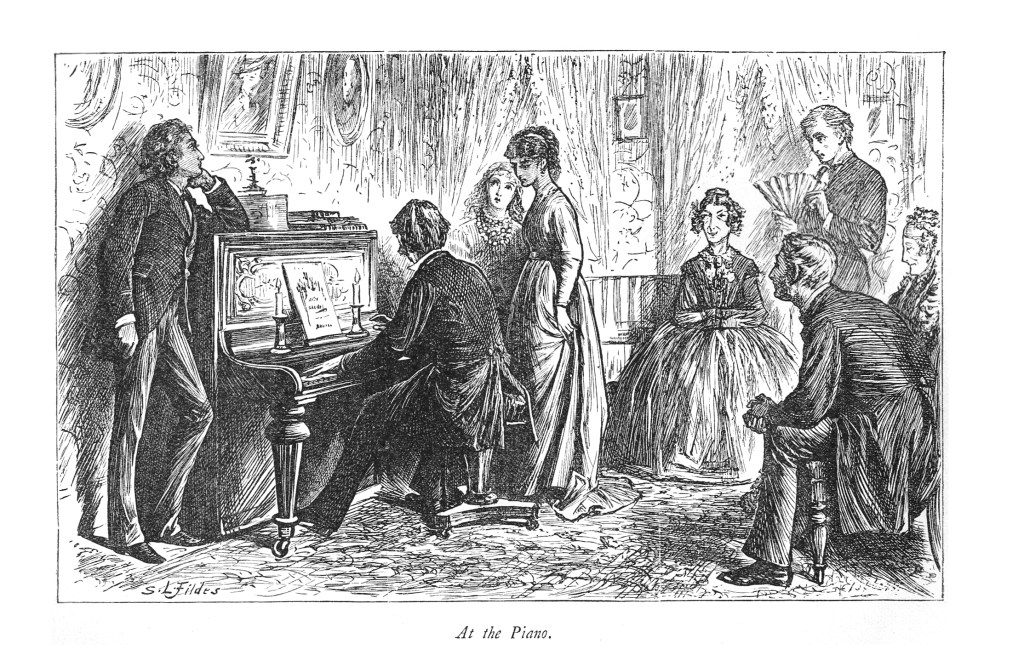
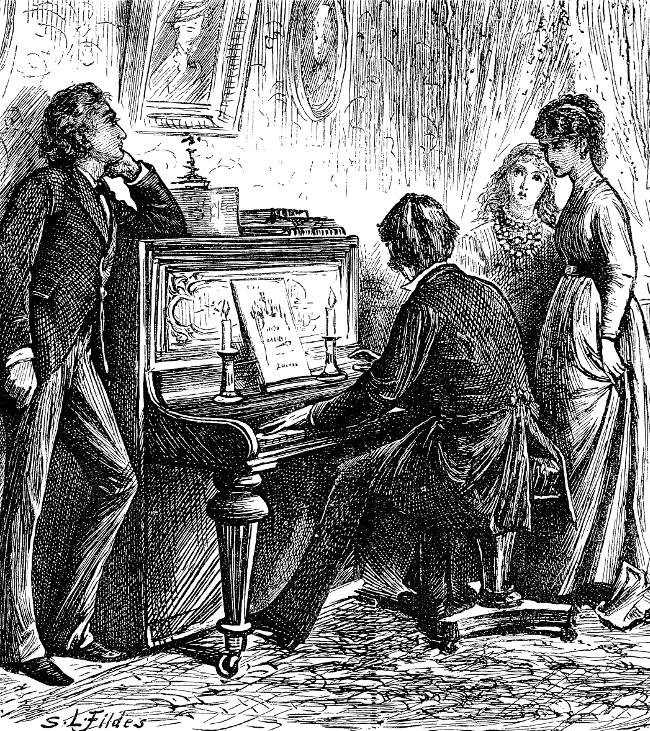
Both Helena and Neville had been disposed not to like Crisparkle, but find that they do, very much. We also learn that there is such a close connection between Helena and Neville as to be almost telepathic; one such instance of unspoken communication passed between them at the dinner that night, when Helena—who takes to Rosa immediately, and has her arm around Rosa while she sings to Jasper’s accompaniment on piano—looks at Neville with a suggestion of the discomfort that Rosa feels about Jasper. Rosa can finally handle Jasper’s close presence and attention no longer, and breaks away from the song. Helena takes charge and draws Rosa away to recover herself.
Later that night in their private room, Rosa confesses to Helena—with whom she has become fast friends—that she fears Jasper, that he has an almost mesmeric influence over her, as though in his looks he were forcing Rosa to an understanding between them. She desperately doesn’t want her fears to be known to Drood, who so looks up to him. Helena, at that moment, takes on the role of Rosa’s protector.
That evening, Neville and Drood have a chance to converse alone, with Neville asking polite questions and Drood half-rebuffing them with an annoyed, insolent, and condescending manner. The two appear to dislike each other from the first; Neville’s temper is open, and Edwin’s hides under a mask of smoothness and carelessness, which grates on Neville even more, as does Edwin’s careless, proprietary attitude towards Rosa. Jasper, who had been lurking about in the shadows, comes between them, ostensibly as a peacemaker. He invites them over to the Gate House.
“Jasper looks observantly from the one to the other, slightly smiles, and turns his back to mix a jug of mulled wine at the fire. It seems to require much mixing and compounding.”
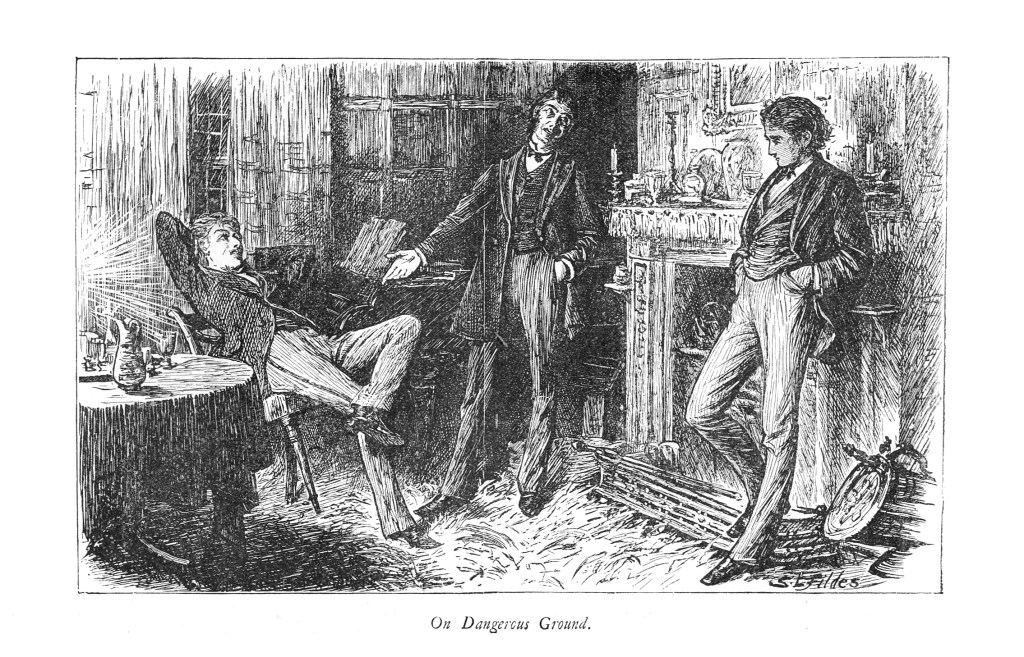
Jasper mixes them a drink, which seems to go immediately to their heads, causing their tempers to boil over as Drood makes a racist comment.
“This insulting allusion to his dark skin infuriates Neville to that violent degree, that he flings the dregs of his wine at Edwin Drood, and is in the act of flinging the goblet after it, when his arm is caught in the nick of time by Jasper.”
Jasper intervenes, and Neville breaks the glass and leaves the house. Pondering on his situation, and on the kindness of Crisparkle, Neville regrets his violent action and goes to Crisparkle to confess what happened, and that, although he and Drood had had very little to drink, it had gone to their heads in the strangest manner. Crisparkle acts as an understanding mentor. Later, Jasper himself comes to Crisparkle, relating his exaggerated fears about Neville’s “murderous” behaviour.
“I shall never know peace of mind when there is danger of those two coming together with no one else to interfere. It was horrible. There is something of the tiger in his dark blood.”
Crisparkle gently reasserts his confidence in Neville.
Rumors of the altercation make their way to the Nuns’ House, and Helena is determined to find out more. Mr Grewgious, a barrister who is now overseeing several properties and who is the guardian of Rosa, comes to visit his ward for some practical matters related to her inheritance and what she is to receive for wedding costs, and to see how she is. She delicately asks that Jasper not be involved in any of the arrangements. Furthermore, she wonders whether there would be any forfeiture if she and Drood were not to marry. Though Grewgious doesn’t appear to follow her real reluctance, he reassures her that there will be no forfeiture of their inheritance if they do not marry; it was simply the wish of two old friends, their fathers.
Grewgious then pays an uncomfortable visit to Jasper, noticing his pale attentiveness about whether it appears that the marriage is still to move forward, and Grewgious gives him assurance of it.
“‘God save them both!’ cried Jasper.”
Discussion Wrap-Up (Week 2)
Miscellany & What We Loved (e.g. Grewgious)
First of all, our dear member Rob Goll popped in to say hello, and to let us know that he is reading along with us and following the comments, and he will be commenting when he is able!
Lucy shared with us a “completion” of the novel by Leon Garfield, made for a BBC radio drama in 1990:
And here is the link that Lucy shares above.
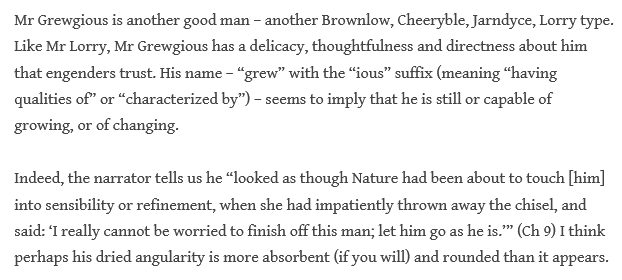
And here, Chris writes of one of our benevolent benefactors, Mr Grewgious, of the Mr Lorry variety:
Dickens’s “Writing Lab”: Place & Atmosphere; The Cathedral as “A Character in the Mystery”; The Use of Present Tense
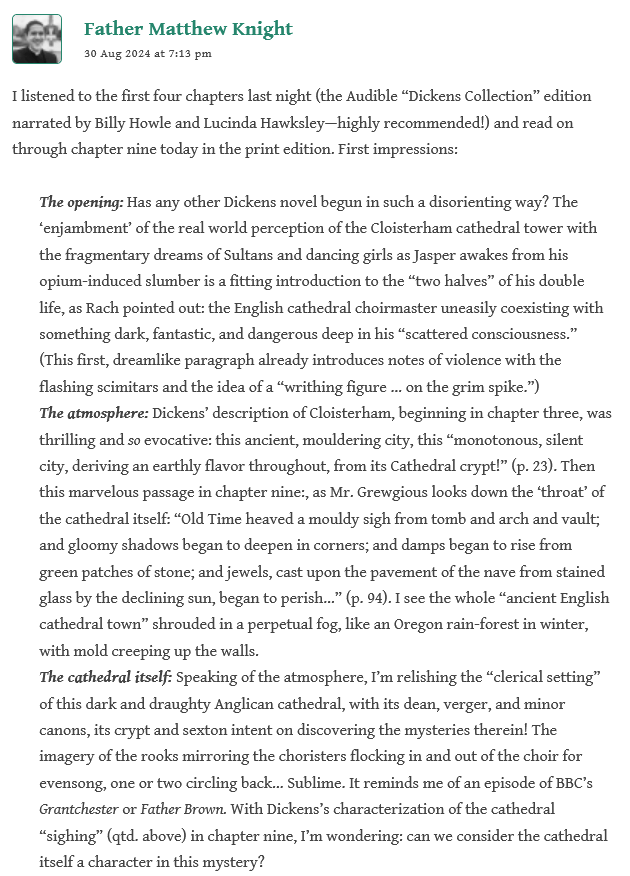
Father Matthew discusses the “disorienting” opening, “the ‘enjambment’ of the real world perception of the Cloisterham cathedral tower with the fragmentary dreams of Sultans and dancing girls,” and the marvelous atmosphere in this novel so far. He asks whether the Cathedral itself will prove to be a character in the drama:
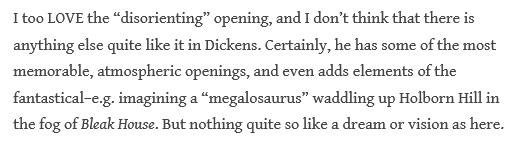
I respond:
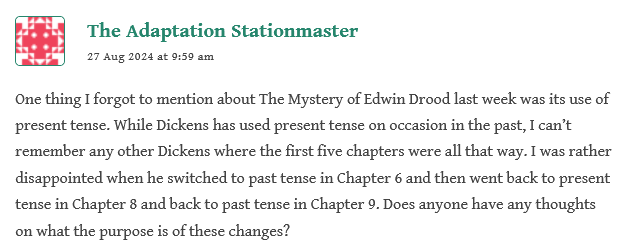
The Stationmaster is struck by the use of the present tense, and wonders about the “purpose” of the changes in tense:
Dana responds, and follows up with a question:
Boze shared this link, suggesting that Dickens was the first to use the present tense in a systematic/sustained way.
Chris shared this link, more focused on the use of the present tense by Dickens and Wilkie Collins.
Character Spotlight on Jasper: Enigmatic, Disturbing, Mesmerically Powerful; Like Claggart in Billy Budd
Dana is “good and hooked,” particularly by John Jasper. What exactly is his murky disposition about Edwin, the mysterious pain/agony that he suffers, his intentions? His “love-hate” attitude about Edwin is reminding her of Claggart’s towards Billy Budd in the Herman Melville novella. Budd’s/Edwin’s disposition is one that certain personalities cannot at all comprehend, but are perhaps envious of:

Chris comments, bringing in Jasper’s powerful gaze/eyes/look and relating it to Dickens’s own practice of mesmerism:

I comment on the violence of Jasper’s personality, as shown in his threats to Deputy…and whether his anger about Deputy’s presence suggests something else, too:

Father Matthew, like Dana, is “firmly in the ‘villain protagonist’ camp,” re: Jasper. He is haunting, enigmatic, violent. He also writes of the introduction by David Paroissien in the Penguin edition:

Further Speculations about Jasper: “When the Wicked Man…”
And here is another fascinating note from Father Matthew, in regards to the source of the hymn about “the wicked man,” which might(?) suggest where Dickens intended to take Jasper’s character:

I responded, agreeing that this makes complete sense that there would at least be a powerful moment of regret and opportunity for change/repentance. But would Jasper choose ultimate despair, or take the opportunity? Anyway, here is an image of the portion of the chant that Father Matthew found:

Spotlight on Chapter Eight, “Daggers Drawn”
The climactic chapter in this section of our reading is certainly Chapter Eight. Chris comments:

I strongly express my dislike of Edwin (and my sympathy with Neville) in this scene, and wonder whether Jasper has drugged the wine, to heighten their emotions & dampen their restraint:

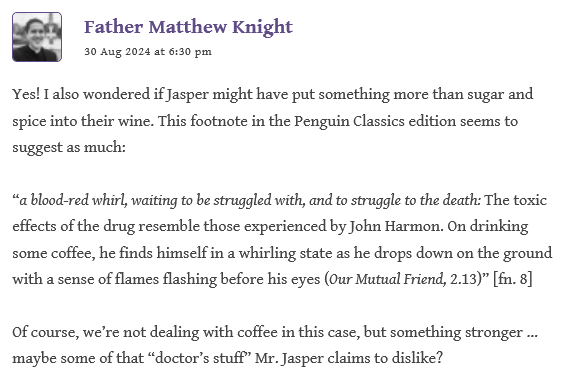
Father Matthew wondered the same, and refers to the footnote in the Penguin Classics edition, which references Our Mutual Friend as another possible reason to believe that the drink is indeed drugged:
Character Spotlight on Helena & Neville Landless: Strength, Scapegoating, Racism and “Unrelenting Englishness”
The Stationmaster finds the Landless twins “intriguing,” and comments on Dickens’s interest here in going beyond his usual “unrelenting Englishness”:

Chris comments on the unique “duo,” and also on the telepathic connection between them:

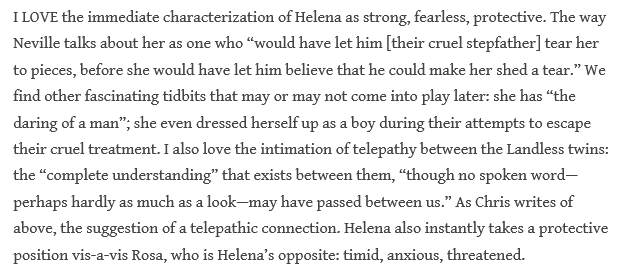
I comment on my love of Helena’s characterization:
Character Spotlight on Minor Canon Crisparkle: “The Hero of this book”?
Perhaps the Stationmaster speaks for us all in wondering whether Minor Canon Crisparkle will prove to be “the hero of this book”:

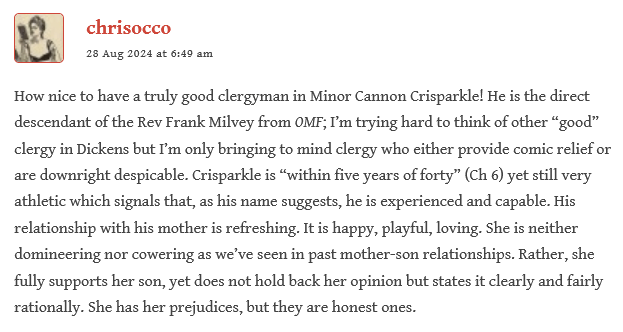
Chris is delighted that we have “a truly good clergyman in Minor Canon Crisparkle,” and a delightful mother-son duo:
I comment, referencing the Landless twins’s confidence in him as testament to his goodness:

Father Matthew comments on his “favorite character so far,” and his “real kindness,” and compares the delightful mother-son relationship to that of Kit Nubbles and his mother:

I reply, also referencing George Bernard Shaw’s comment about Kit & the Minor Canon:

Questions, Theories, & Polls…
Last week, we asked our readers–and especially first-time readers–what they thought of Jasper. It was fairly split between the baddie/villain-protagonist, and a stance of unknowing. Now, let’s look at a few more questions left open by this week’s installment…
“Jasper looks observantly from the one to the other, slightly smiles, and turns his back to mix a jug of mulled wine at the fire. It seems to require much mixing and compounding.” –Chapter Eight, “Daggers Drawn”
A Look-Ahead to Week 3 of The Mystery of Edwin Drood (3-9 Sept, 2024)
This week, we’ll be reading the third installment, Chapters 10-12, of The Mystery of Edwin Drood. This section was published in All the Year Round in June of 1870. It was the final installment published in Dickens’s lifetime.
Please share your thoughts on this section in the comments below, or use the hashtag #DickensClub if commenting on Twitter/X.
If you’d like to read it online, it can be found at sites like Gutenberg.
 All the (Dickensian) Year Round
He has made me a slave with his looks.–Rosa Bud (Chapter 7)
Greetings, Fellow Inimitables,
Thanks much to Rach and Boze for the excellent and comprehensive summaries and distillations of input. As usual, I feel as though I am experiencing a graduate seminar on Drood!
Likely for all of us, Jasper is a captivating, if terribly disturbing and “enslaving,” character.
I am wondering if his “heart of darkness” may give way to a “heart of light,” but all of the evidence points away from a conversion of heart. Crisparkle is, as though, the light to Jasper’s darkness–one can imagine a Caravaggio chiaroscuro rendering of the two!
There are times that it appears that Jasper has a true affection for his nephew; other times, he seems cold-hearted and calculating.
Is there any struggle in his heart–between light and darkness, between life and death (cf. Deuteronomy 30:19)?
Ah, Dickens. I recall the tragic moment when one of his sons (Charles?) was in his presence and Dickens was so “possessed” by the writing of “Drood” that he couldn’t really SEE his son.
Well, let’s keep traveling together on this road that will come to an abrupt end soon!
Daniel
LikeLiked by 1 person
I wonder the same thing. I can’t help but wonder whether whatever Jasper proves to be guilty of (ie, whether an attempt at or a completion of a crime), he has a true opportunity for repentance and a turning. But will he choose the ultimate despair? Hmmm….
LikeLike
In Chapter 12, we have Jasper sharing wine again in his nightly rounds with Durdles through the mysteries of Cloisterham Cathedral…her crypt, her tower. This time the wine is in a “wicker-cased bottle”, and it seems once again to be powerful stuff, as Durdles is all but knocked out cold. It is also interesting to note that Jasper only sips it and spits it out.
“Durdles is asleep at once; and in his sleep he dreams a dream.” For those of us who read Little Dorrit, this particular kind of “dreaming” is familiar: Affery “dreamed” similar dreams…which always meant that she actually witnessed these things that felt so dream-like, and Flintwinch insisted that she was “dreaming again,” and beat her for it. So, it would seem that here too, though Durdles was extremely groggy, he saw/heard in his restless state:
When Durdles finally awakes and asks why Jasper didn’t wake him, Jasper claims that he had tried to wake him, unsuccessfully.
Then, Deputy appears again, after the nightly haunting of the Cathedral & crypt.
“‘What! Is that baby-devil on the watch there!’ cries Jasper in a fury: so quickly roused, and so violent, that he seems an older devil himself. ‘I shall shed the blood of that Impish wretch! I know I shall do it!’”
Durdles has to plead with Japser not to strangle the boy. What was Jasper up to—or intending to be up to in future—that he was so furious at the idea of being detected here at such a time?
LikeLiked by 1 person
Just a quick note: With Grewgious entrusting the ring to Edwin in Ch 11, Edwin seems to become serious, truly serious perhaps for the first time, feeling the weight of this charge.
Somehow, in some way, THE RING IS KEY to the mystery.
LikeLike
Ch 10 – Smoothing the Way
Before we judge Mrs Crisparkle too harshly for being “absolutely incapable of self-revision” in terms of her opinion of young Neville (which I think will prove a fallacy), let us understand that in her eyes Mr Neville’s sin is not so much that he lost his temper with Edwin as that “he came home intoxicated, and did great discredit to this house, and showed great disrespect to this family.” (Ch 10) Mrs Crisparkle’s loyalty lies squarely with her son and with the position he holds. When this is understood then Mrs Crisparkle is understood and one cannot really grudge her her inflexibility toward Mr Neville. And should he redeem himself I believe she will revise her opinion, though she may still, from time to time, remind him of his slip.
That said, this chapter highlights Mr Crisparkle, the peacemaker, though it also sheds light on Jasper, the troublemaker. What Mrs Crisparkle sees as Jasper’s “well-bred consideration” for her feelings is, in reality, Jasper’s continued effort to both spread the story and to spin it to suit his purposes. Mr Crisparkle’s first impulse to hush up the altercation would have given the young men time to apologize and re-establish their relationship before public opinion became a factor. Jasper seems intent on making the altercation “the town talk” and he seems intent on the talk being squarely against Neville.
The degree of his success is painfully obvious to Neville and Helena who, in their short time in Cloisterham, have daily felt the sting of the town’s “suppressed hints and [prejudicial] references”. Cloisterham’s prejudice against Neville may stems from his altercation with Edwin but it is rooted in Cloisterham’s fear of Neville’s ethnicity. Had Neville not been from Ceylon, had he been just another British lad, I don’t think Cloisterham would have been so quick to demonize him. And it speaks to Mr Crisparkle’s character that he stands as Neville’s friend, listens to Neville’s side of the story and point of view, counsels Neville on how to rectify the situation, and mediates with Jasper on Neville’s behalf.
SPOILER ALERT RE THE FOLLOWING
During Crisparkle’s mediation with Jasper we see Jasper’s premeditation in action. The “perplexed expression” which is so “very perplexing” to Crisparkle is one not “unable to grasp something clearly” but rather one that is “intricate or involved” (dictionary.com), or, as Mr Crisparkle correctly, if incredulously, understands to “denote . . . some close internal calculation” (Ch 10) The calculation Jasper is making is how to pin the murder of Edwin on Neville. Crisparkle’s reconciliation proposal provides him the opportunity of bringing the two young men together again. He firms up the foundation for Neville’s guilt by showing Crisparkle his diary in which he further spins the original altercation to Neville’s detriment. No doubt in the letter he writes to Edwin proposing the reconciliation – a letter we never see – Jasper himself suggests both the dinner and that only “we three” (Neville, Edwin, Jasper) be present. This last stipulation is important because with only “we three” at dinner there will be no witness to confirm either Neville’s or Jasper’s account of what took place after Edwin is dead. And who will be believed – a hot tempered Ceylonese or the local choir master?
LikeLiked by 1 person
Ch 11 – A Picture and a Ring
I think Mr Grewgious would be sympathetic with those of us who don’t particularly care for Edwin. He clearly shares Dana’s concern over Edwin’s “seeming inability to imagine Rosa’s value beyond a reference to himself” (quoting Dana’s August 30th post). In his “fidelity to a trust” – that is, his loyalty to his client and his fulfillment of his duty to that client (i.e., Rosa’s father) – he draws the picture “of a true lover’s state of mind” because he “had observant eyes for Edwin” which showed him the lineaments of Dana’s complaint on Edwin’s face and in Edwin’s behavior. The abstract he draws is pointed directly at the shortcomings in Edwin’s attitude toward Rosa – his flippant and flagrant use of his pet name for her, his interest not solely concerned with or centered upon Rosa (i.e., his first question is not about Rosa but rather if Rosa had mentioned Helena, whom he describes as “a strikingly handsome girl”). To Edwin’s credit, he immediately, rightly, and discomfitedly feels the sting of Mr Grewgious’s picture. He is hesitant when Mr Grewgious hands him the ring and his anxiety “to get away and be alone” suggests his awareness that he has much to think about – perhaps to reimagine himself in reference to Rosa’s value.
The backstory of Mr Grewgious having been in love with Rosa’s mother harkens back all the way to Nicholas Nickleby and Mr Charles Cheeryble in love with Madeline’s mother (Ch 46); The Old Curiosity Shop and the Single Gentleman in love with Nell’s grandmother (Ch 69); Barnaby Rudge and Gabriel Varden having courted Mary Rudge (Ch 6) and Mr Haredale love with Edward Chester’s mother (Ch 29). Mr Grewgious’s love for Rosa’s mother, like that of the gentlemen in the other novels, gives him an added incentive to look after Rosa and her interests. She is at once the daughter he never had, might have had, could have had, if circumstances been different, if he had been a different man, if he had acted more quickly. But then, of course, we would have had another story and not this one.
LikeLiked by 2 people
Ch12 – A Night with Durdles
The plot thickens! Jasper watches – and is watched in return. But where Jasper’s watching is laser focused – he watches Sapsea with the eye of flattery to maintain Sapsea’s partisanship; he watches Crisparkle and Neville with the eye of a spy intent on intrigue; he watches Durdles with the eye of a manipulator waiting for his plan to unfold and his moment of opportunity to present itself – those who watch Jasper aren’t quite sure why they are watching him or what they are seeing. Sapsea doesn’t know what the Dean, Mr Tope, and Jasper are talking about until Jasper flatteringly clues him in. Durdles watches Jasper watching Crisparkle and Neville and instinctively feels the “sense of destructive power . . . so expressed in [Jasper’s] face, that even [he] pauses in his munching”. Durdles continues to “stare” at Jasper as Jasper “bursts into a fit of laughter” for no reason that Durdles can imagine. During their ascent of the cathedral tower Durdles becomes increasingly drunk (drugged?) and increasingly aware, in a sodden sort of way, of Jasper’s “watchful eyes”. Even in his drunken (drugged?) dream Durdles is aware of Jasper and his unaccountable movements. And when reawakened by Jasper and on the way out of the cathedral Durdles is “again” and “once more conscious that he is very narrowly observed” by Jasper – so much so that he confronts Jasper, “What do you suspect me of, Mister Jarsper?”. Jasper, of course, glosses over the watching, blames it on the drink, and they exit the cathedral apparently as cordially as they entered. They are met by Deputy who Jasper immediately attacks and suspects of having spied on them. Neither Durdles nor Deputy can understand the vehemence of Jasper’s reaction. How much, if anything, Deputy has seen is, at this point in the story, a question important only to Jasper.
Fred Kaplan, in Dickens and Mesmerism), suggests it is “no wonder Jasper despises Deputy . . . [because] Deputy pursues him with the threat, ‘I’ll blind yer, s’elp me! I’ll stone yer eyes out, s’elp me! If I don’t have yer eyesight, bellows me!’ . . . [by which, if it became literal] Jasper would lose the key image, focus, and vehicle of his power” – his mesmeric eye. (133) Should he lose his mesmeric power he would lose the one thing he craves most – his power over Rosa. By the way, Jasper’s mesmeric eye reminds me of Simon Tappertit’s less effective optical power: “He also had some majestic, shadowy ideas, which had never been quite fathomed by his intimate friends, concerning the power of his eye. Indeed he had been known to go so far as to boast that he could utterly quell and subdue the haughtiest beauty by a simple process, which he termed ‘eyeing her over;’ but it must be added, that neither of this faculty, nor of the power he claimed to have, through the same gift, of vanquishing and heaving down dumb animals, even in a rabid state, had he ever furnished evidence which could be deemed quite satisfactory and conclusive.” (BR Ch 4)
One last comment, according to The Companion to The Mystery of Edwin Drood by Wendy S. Jacobson, “A rough estimate gives Jasper four or five hours on his own” in the crypt between the time when Durdles passes out and Jasper reawakens him. Four or five hours to do what, exactly???
LikeLiked by 2 people
I wonder if we’re supposed to agree more with Crisparkle or with his mother in Chapter 10. The opening paragraph of the chapter all but states that she’s being irrational. But her son seems like he’s just as naively oblivious to Jasper’s manipulations.
Having called the characters naively oblivious, I hasten to add that I admire what a good job Dickens does of making us believe that all the characters would be fooled by Jasper while clearly showing him to be duplicitous. Keep in mind that we readers are privy to every scene with Jasper but no individual character is so they can’t put together all the clues. He’s rather like Shakespeare’s Iago in that regard.
Both Chapter 9 and Chapter 10 end with ominous lines from Jasper.
I love how Grewgious guilt trips Edwin over his attitude towards Rosa without ever actually reprimanding him and I’m intrigued by the reveal of his past relationship with her mother.
Hurray for another scene with Sapsea!
The scene with Durdles in Chapter 12 is awesomely creepy. I wonder why Jasper reacts so violently to the story about the echo of a scream and I wonder what he did with the key to the crypt door that he didn’t want anyone to see, and I wonder whether “the Deputy” really saw nothing. It’s so aggravating that Dickens didn’t finish this book!
LikeLiked by 1 person
Chris alludes to the possible 4-5 hours of time when Durdles was asleep in Ch 12 – what was Jasper doing this whole time?
Several possibilities:
1.) Making a copy of the key to the Sapsea tomb – hence the clinking that Durdles hears.
2.) Perhaps (pure conjecture) killing a smaller animal to test the potency of the quicklime and how quickly it destroys evidence of a body.
3.) Checking how long it takes to get from one place (e.g. Cloisterham Weir) to another (e.g. the Cathedral).
LikeLike