
by The Adaptation Stationmaster
“‘Well, well!’ said my aunt. ‘I only ask. I don’t depreciate her. Poor little couple! And so you think you were formed for one another, and are to go through a party-supper-table kind of life, like two pretty pieces of confectionery, do you, Trot?'”
~David Copperfield
Reading Our Mutual Friend, the last novel Charles Dickens completed, it occurred to me that it’s driven by the love story to an unusual extent for him. This made me think it might be interesting to look back on all of his major works of fiction and see in which of them romance plays a central part and in which of them it’s just included out of obligation. Dickens has a reputation for creating idealized portraits of marriage and family life while his own was a disaster. You might expect him to have written more glowing portrayals of marriage when he was young and in love and to have done more negative portrayals as his relationship with his wife soured. But this is not the case. Right away, Dickens showed a concern with dysfunctional marriages. Radhika Jones once wrote that his books don’t follow the “marriage plot” of 18th and 19th century novels so much as they do the divorce plot. I wouldn’t go that far but she has a point. You’d also expect Dickens to depict wives more sympathetically early in his career and have them be more shrewish in later books, reflecting his (by all accounts unjust) animosity towards his own wife. This is…closer to the case but still an oversimplification. In truth, stereotypically shrewish, domineering wives appear in Dickens starting with The Pickwick Papers. (If I were an expert on Sketches by Boz, I might be able to tell you they appear even earlier.) But in his early books, domineering wives were just as likely to reform by the end and in some cases, their husbands would be so bad that reading about the wives’ shrewishness could be downright cathartic. In later books, however, such wives were more often simply unpleasant and contemptible and their husbands more simply pitiable. (In Dickens’s defense, abusive and predatory male lovers would also always be part of his stories, and their behavior was less likely to be played for laughs.)
With each book, I’ll try to answer three questions: How much does romance drive the story? What’s the ratio of good marriages and to bad marriages? And how big a role does unrequited love play? Before we begin, here are a few caveats. This article assumes readers are familiar with every book mentioned. I’m not going to explain who any of the characters are, except maybe to mention which ones are villains and which heroes, and neither will I hold back any plot spoilers. This analysis is also going to sadly be somewhat incomplete since I’ve reread some Dickens books many more times than I’ve reread others and I’m sure I’ll forget about some couples. Most notably and sadly, I’m not going to include any of the “travelers’ tales” from The Pickwick Papers since I just don’t remember enough of them and I’m too busy to comb through the book to reread each one. I’m more familiar with the two from Chapter 6 of Nicholas Nickleby but I feel like it’d be wrong to include those but not the ones from Pickwick. (If any Pickwick fans in the comments section want to write about the roles romance, marriage and sexuality play in those stories, that’d be wonderful.) Now let’s get started.
The Pickwick Papers
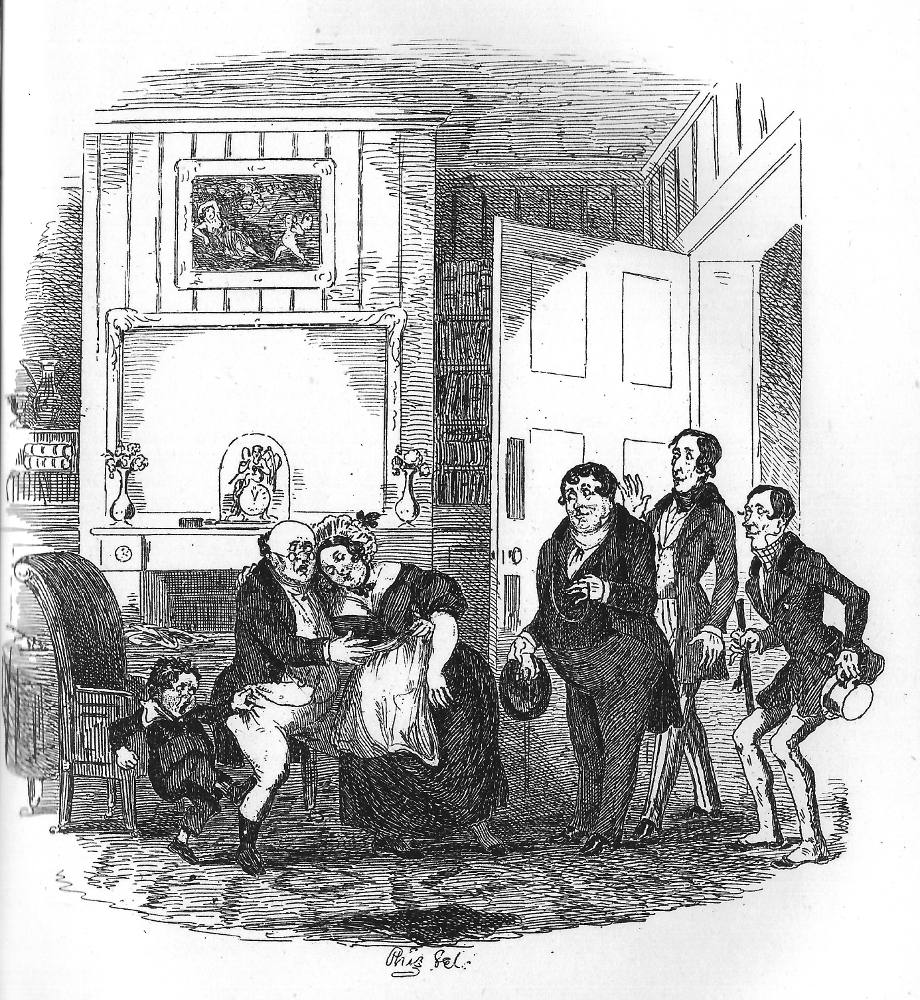
How Much Does Romance Drive the Story? Samuel Pickwick is one of the few Dickensian protagonists to have no love interest, presumably because Dickens felt he was too old. But, true to the conventions of the Victorian novel, there are still some successful marriages in the end. Sam Weller marries his beloved Mary; Augustus Snodgrass marries Emily Wardle and Nathaniel Winkle marries Arabella Allen. That last match is a crucial plot point as reconciling Arabella’s brother, Ben, and her spurned suitor, Bob Sawyer, to the lovers partially motivates Mr. Pickwick to lower his pride and pay his undeserved fines to get out of debtors’ prison.
Ratio of Good Marriages to Bad Marriages The novel ends with happy marriages but the marriage depicted in the most detail is Tony Weller’s unhappy one to his second wife, Susan, which leads him to take a dim view of his son’s relationship with Mary. However, we’re told that Mrs. Weller nee Clarke repents of her henpecking ways on her deathbed and Mr. Weller is surprised to find himself grieving for her.
Unrequited Love Mrs. Bardell suffers unrequited love for Pickwick which gets them both in trouble. As mentioned above, Bob Sawyer’s hopes with Arabella Allen are also dashed though I feel like his motives were too mercenary for that to count. Tracey Tupman’s feelings for Rachael Wardle are initially requited but she is seduced by Alfred Jingle the conman with whom she elopes and has to be rescued from by her family. Devastated, Tupman swears off romance. It’s interesting to read Dickens playing these kinds of plots for laughs when later he’d play them for melodrama. (The Tupman-Rachael-Jingle love triangle almost plays like a parody in advance of the Ham-Emily-Steerforth one in David Copperfield.)
Oliver Twist
How Much Does Romance Drive the Story? If Samuel Pickwick was too old for romance, Oliver Twist was too young. The only love story in the book (unless we count the relationship between Bill Sikes and Nancy) is that of Rose Maylie and her adopted cousin, Harry. It’s easily the least interesting part of the story and Dickens seems to have only included it for commercial purposes.
Ratio of Good Marriages to Bad Marriages Except for Rose and Harry, all the marriages in Oliver Twist are bad. Mrs. Sowerberry is another self-righteous shrew, a nastier one than Mrs. Weller. She never repents and her follies can’t be blamed on the influence of a no-good “shepherd” like Reverend Stiggins. Mrs. Bumble nee Corney is a more violent version of this character type but, for all her villainy, since she’s married to the odious Mr. Bumble, the scenes of her dominating him may give readers the perverse desire to cheer. After all, if she didn’t bully him, he was going to bully her. More seriously, we’re told in the backstory of a horrible marriage between Oliver’s father and Monks’s mother. (It’s something of a pity Dickens couldn’t have depicted it in more detail. It sounds like quite the story.) And if we count the cohabitation of Sikes and Nancy as a marriage, it’s one of the most disastrous in Dickens if not the most disastrous.
Unrequited Love Does Nancy’s devotion to Bill Sikes count as unrequited? He didn’t love her enough to give her the benefit of the doubt when she appears to have betrayed him and not enough to refrain from murdering her. But the guilt he feels afterwards can be interpreted as implying he did love her some level. Other than that, there’s not much unrequited love in this book. Mr. Brownlow’s backstory does involve an unconsummated love though.
Nicholas Nickleby
How Much Does Romance Drive the Story? Technically speaking, romance doesn’t take up too much space in this book. Nicholas only starts to get to know his love interest, Madeline Bray, very late in the book and his sister, Kate, doesn’t even meet Frank Cheeryble until two thirds of the way through. Yet somehow romance feels like a much more important part of Nicholas Nickleby than it does of Dickens’s previous novels. The climax is largely devoted to Nicholas rescuing his beloved from a villain and the book is largely concerned with contrasting good love interests (Nicholas, Frank, Madeline) with evil ones (Arthur Gride, Sir Mulberry Hawk, Fanny Squeers.)
Ratio of Good Marriages to Bad Marriages Another reason this book feels more romantic than Dickens’s previous is the surprisingly high number of happy marriages it features. It ends with not one, not two, but three weddings. The last one is between Tim Linkinwater and Miss La Creevy and surprisingly, it’s arguably the most moving romantic finale of the three. While we witness Nicholas’s initial declaration of love to Madeline (“You have but to hint a wish and I would hazard my life to gratify it”) it verges on ridiculousness in its youthful enthusiasm, which Dickens may have intended since Madeline herself seems to find it so. (“You speak hastily, sir.”) He never actually proposes to her that we read. Most of his wooing is done by proxy and Frank Cheeryble’s romance with Kate is practically offstage. We do get Tim Linkinwater’s proposal to Miss La Creevy (“Why shouldn’t we both be married, instead of sitting through the long winter evenings by our solitary firesides? Why shouldn’t we make one fireside of it and marry each other?”) and it’s strangely beautiful in its commonplace way. I suggested above that Dickens didn’t give Pickwick a love interest because of his advanced age but Tim Linkinwater stoutly declares that love is for the old as well as the young. Of course, those three marriages all take technically take place after the story is ended but there are many healthy marriages in the main body of the novel. For all their foibles and outright vices, Mr. and Mrs. Kenwigs, Mr. and Mrs. Crummles, Mr. and Mrs. Curdle, Mr. and Mrs. Wititterly and Mr. and Mrs. Browdie are all happy couples. Even the reprehensible Mr. and Mrs. Squeers have a good marriage. It’s arguably a redeeming point in Wackford Squeers that when he’s finally arrested, he grieves for what this means for his family. Nicholas and Kate’s mother may be a self-absorbed garrulous fool, but it’s implied she really loved her late husband, and he loved her.

Bad marriages are still very much a part of Dickens’s vision in Nicholas Nickleby though. Ralph Nickleby’s backstory involves a terrible one that ended in adultery. Mr. Lillyvick’s alliance with Henrietta Petowker ends badly too though that’s played more for comedy. The Mantalinis have one of the most unique bad marriages in Dickens. At first, Madame Mantalini seems like one of Dickens’s shrews, berating her husband and forbidding him from laying eyes on her young female employees. It becomes clear though that she’s the victim in their relationship. Her husband wastes her money, cheats on her and uses blatant emotional manipulation to keep her under his thumb. In the end, she demands a separation and when we last see Mr. Mantalini, he’s been reduced to leeching off a more genuinely formidable woman. On a related note, the evils of sexual harassment are a big theme of Nicholas Nickleby, one that Dickens would explore further in other novels.
Unrequited Love The tragic Smike suffers unrequited love for Kate. This is basically tacked on to make him even more pitiable, but some adaptations have made it genuinely tearjerking. Less seriously, nothing comes of Miss Snevellici’s flirtation with Nicholas but it’s unclear how deep her feelings went and eventually we learn she’s “happily married to an affluent young wax-chandler.” Miss Petowker ends up turning on Mr. Lillyvick but his pain is softened (for the readers anyway) by the fact that his attraction to her was always partly mercenary. Fanny Squeers’s unsuccessful pursuit of Nicholas is portrayed even less sympathetically and is even more effectively humorous. Slimy predators Sir Mulberry Hawk and Arthur Gride have unrequited “feelings” for Kate and Madeline respectively, but you wouldn’t call them love.
The Old Curiosity Shop
How Much Does Romance Drive the Story? Not much at all or not for the main characters at least. Kit Nubbles has a comedic romantic subplot with Barbara. (His devotion to Little Nell is really more like a Catholic’s devotion to the Virgin Mary.) Dick Swiveller has a more serious but still fun romance with “the Marchioness.” Little Nell gets nothing though.
Ratio of Good Marriages to Bad Marriages Apart from the marriages mentioned above, which take place outside the main body of the story, the only one of note is the abusive one between the monstrous Daniel Quilp and his wife.
Unrequited Love In the backstory, Nell’s great-uncle suffered unrequited love for her grandmother, leading to his estrangement from his brother. Other than that, there’s just Quilp’s lust for Nell.
After making such inroads in Nicholas Nickleby, romantic love seems to have retreated from Dickens’s imagination.
Barnaby Rudge
How Much Does Romance Drive the Story? Arguably, all of the subplots in this book carry equal weight, making it hard to consider any of them central. But two of them are romantic plotlines. There’s the more serious love story between Edward Chester and Emma Haredale and the livelier one between Joe Willet and Dolly Varden, both of which end successfully. Like Nicholas Nickleby, the climax of the story involves the heroines being rescued by their love interests. While Emma admittedly amounts to little more than a figurehead, in this fan’s opinion, Joe and Dolly have better chemistry than any young couple Dickens had created so far.
Ratio of Good Marriages to Bad Marriages We get another nagging wife in Mrs. Gabriel Varden but she’s also another one who mends her ways, and, unlike Mrs. Weller, she doesn’t wait until she’s dying to do so. Her growing disillusionment with the No-Popery movement gives her an air of tragedy none of the previous bad wives in Dickens had. In Barnaby Rudge’s mother we get another recurring Dickensian archetype, the wife tragically devoted to a husband who doesn’t deserve her. Like Mrs. Quilp, she’s freed by her spouse’s death in the end. The positive marriages described above further balance out the negative ones.
Unrequited Love The villainous Miggs carries a torch for the equally villainous Simon Tappertit. On an even darker note, this is the Dickens book in which the threat of rape, embodied in Tappertit and Hugh Maypole, looms the largest. There’s an entire Society of “‘prentice knights” who feel entitled to take their masters’ daughters as booty. This palpable sexual threat, even more palpable than the one in Nicholas Nickleby, is in keeping with Barnaby Rudge‘s atmosphere. It has a more rugged and less genteel feel to it than most Dickens books. More characteristically of the author, we eventually learn the sad story of Hugh’s mother who was used and abandoned by his father. This left her so bitter that he dying wish was that her son would never know his father’s identity lest that knowledge prevent him from killing him.
Martin Chuzzlewit
How Much Does Romance Drive the Story? The whole plot is set in motion by the theoretical protagonist Martin Chuzzlewit Jr.’s forbidden love for his grandfather’s attendant, Mary Graham. As he seeks his fortune, his character development and the theoretical heart of the novel is his growing from an initially selfish, entitled lover to one worthy of the noble Mary. This character arc isn’t as well paced or satisfying as one would wish though. Practically speaking, the heart of the novel is Tom Pinch’s character development. Romantic love also plays a big part in that though as his regard for Mary opens his eyes to the villainy of Seth Pecksniff, his idol.
Ratio of Good Marriages to Bad Marriages Not only does Martin the younger end up happily married to Mary but supporting characters Mark Tapley and John Westlock end up with Mrs. Lupin and Ruth Pinch respectively. The former defies expectations of widows by proving to be a good love interest rather than a bossy shrew. These healthy unions are more than balanced out by the marriage of Jonas Chuzzlewit and Mercy Pecksniff, surely one of Dickens’s creepiest depictions of an abusive relationship. (Jonas never kills Mercy but, apart from that, their “romance” may be even more horrifying than Sikes and Nancy’s.)
Unrequited Love Tom Pinch’s love for Mary Graham is hopeless. Unlike Smike though, he doesn’t die. Neither does he get a backup love interest as Toots, another hopeless Dickensian lover, would later get. The book simply ends with him resigned to a single life. Charity Pecksniff is also unlucky in love, first with Jonas and later with Augustus Moddle but those emotional blows are to her pride, not her heart. This novel also gives us another disturbing portrayal of sexual harassment/predation in Pecksniff’s pursuit of Mary.
The Christmas Books
To save space, I’ll treat these five novellas as one.

How Much Does Romance Drive the Story? Only The Cricket on the Hearth and The Battle of Life can really be said to be driven by romance. (You could argue The Chimes is too but it’s a stretch.) Both are largely concerned with love triangles or apparent love triangles anyway. At the heart of The Cricket on the Hearth is the relationship between John Peerybingle and his wife Dot. At first, they seem perfectly in love and perfectly happy with each other. But John’s confidence is shattered by evidence that Dot is cheating on him. After a long night of reflection, he blames himself for pressuring her into an unsuitable marriage. But in the end, the misunderstanding is cleared up and the Peerybingles are more in love than ever. In The Battle of Life, one of the heroines, Marion Jeddler seemingly elopes with Michael Warden, a man of questionable character, leaving her intended, Alfred Heathfield, devastated. Eventually, he marries her sister, Grace, and it’s revealed that Marion did love Alfred but could see that Grace also loved him and ran away to give him a chance to fall in love with her. She never actually eloped with Warden but in the end, we’re told they eventually married. While romance isn’t as much at the center of A Christmas Carol in Prose, The Chimes and The Haunted Man and the Ghost’s Bargain, romantic and marital relationships do feature prominently as we’ll see.
Ratio of Good Marriages to Bad Marriages A Christmas Carol is Dickens’s most pro-marriage story. The supporting cast is full of happy couples. The Fezziwigs. The Cratchits. Fred and his wife. Less famously, there are Belle and her husband in the visions of Christmas Past and Caroline and hers in Christmas Yet to Come. The fact that Ebenezer Scrooge never married is a point against him. As far as the eye can see, there’s not a single bad marriage. With The Chimes, Dickens does a 180 and shows us a horrific one. In a nightmarish vision of the future, Trotty Veck sees that his daughter, Meg, and her sweetheart, Richard, initially refrain from getting married in response to the finger wagging of Alderman Cute. Richard becomes an alcoholic, and Meg eventually marries him in an effort to save him. Their marriage proves to be so bad that she kills herself and her baby (or nearly does so) rather than see him grow up like his father. But if it sounds like Dickens is warning against wedlock, that’s the opposite of The Chimes‘s message. In the end, when Trotty is restored to reality, he finds that Richard and Meg are getting married right away despite Alderman Cute’s warnings about the economics of it all. This early marriage, we assume, will work out much better than the later one in the vision. John and Dot’s marriage in Cricket on the Hearth is happy (initially anyway) to the point of being cloying. In the end, Dot’s friend, May Fielding, also gets to marry her long lost love and we get a glimpse of another happy couple in Dot’s parents. But the book also admits the darker possibilities of marriage. May Fielding narrowly escapes a dreadful “marriage of convenience” to the miserable Tackleton and when he believes his wife has betrayed him, John Peerybingle momentarily considers murdering his supposed rival. Besides the Jeddler sisters’ marriages, servants Clemency Newcombe and Ben Britain end up happily wed in The Battle of Life and The Haunted Man features the healthy marriages of William and Milly Swidger and Mr. and Mrs. Tetterby. It also alludes to a less healthy one. In the background of the story, lurks a husband by the name of Longford who “abandoned and deserted what he should have held most dear.”
Unrequited Love In his youth, Ebenezer Scrooge of Christmas Carol fame was engaged to be married to a woman called Belle, but she regretfully broke up with him when he ceased to love her as she loved him. Later, the shoe is on the other foot, when Scrooge has a vision of her as a happy wife and mother, surrounded by her family, while the closest thing he had to a friend (Jacob Marley) lay dying. Blind Bertha Plummer in The Cricket on the Hearth loves the aforementioned Tackleton or rather the imaginary Tackleton her father has created for her in her head by telling her that the man’s gruff words are really jokes and that he’s truly kind and generous. When he finally confesses the truth, she gets over her heartbreak with ridiculous speed. Tackleton’s own marriage plans are wrecked but he proves to be a surprisingly gracious loser. In the backstory of The Haunted Man and the Ghost’s Bargain, the protagonist Redlaw’s sister was betrayed by the man she loved, his best friend, Longford, who won the heart of the woman Redlaw himself hoped to wed. Forgiving this betrayal forms the book’s emotional climax.
Dombey and Son
How Much Does Romance Drive the Story? Well, there’s a romance between Florence Dombey the heroine and the dashing Walter Gay that forms a big part of the plot. It’s not very interesting though. Of course, the love stories of Nicholas Nickleby and Madeline Bray and Joe Willet and Dolly Varden aren’t, strictly speaking, interesting either but at least they’re fun. The romance in Dombey and Son isn’t terrible but it’s the exploration of parent-child relationships that give the book its appeal. Or to the extent that relationships between men and women are part of its appeal, let’s just say they’re not what you’d describe as romantic.
Ratio of Good Marriages to Bad Marriages Besides Walter and Florence in the end, we see another happily married couple in Polly Toodle and her husband. Eventually, Susan Nipper and Toots make a third. But Dombey and Son largely occupies itself with the poisonous marriage of Paul Dombey Sr. and Edith Granger. Dombey initially sees Edith, his second wife, as a trophy and she sees him as a meal ticket whom she resents. As Dombey comes to realize Edith isn’t going to accept him as her superior, he seeks to break her pride through increasingly cruel means. Eventually, she demands a separation. While Dickens generally advocated wifely submission, it’s hard not to feel his sympathies lay with Edith so far. When Dombey refuses to give her the separation though, she humiliates him by (apparently) running away with his business manager, James Carker. (Another slimy Dickensian predator.) Dombey evidently considered his first marriage to Florence’s mother, who dies in the book’s first chapter, to be healthier, likely because she always deferred to him. Dickens doesn’t seem to have meant his original readers to see that as a good thing though and modern readers are even less likely to consider it so.
Unrequited Love Well, as mentioned above, Edith never loves Dombey but it’s debatable whether he actually loved her in the first place. The minor tragic character of Lucretia Tox loves Dombey and would probably be the perfectly demure wife he’d want but the vengeful Major Bagstock steers him away from her and it’s unclear if he’d ever consider her even if he hadn’t. On a more comedic note, the pathetic bumbler Toots always carries a torch for Florence. As I mentioned, unlike Miss Tox, he gets a backup love interest in Susan Nipper, not a very convincing one. If we view lust as love (I don’t but I feel like I need to include this plot point somewhere in the discussion), though Edith leads Carker on, she never lets him satisfy his desire for her. Carker once abandoned his mistress, Alice Marwood, and she turns out to be the first of many spurned, vengeful women in Dickens. (Technically, Fanny Squeers was the first or maybe Mrs. Bardell. But nothing much came of Fanny’s vengefulness and Mrs. Bardell’s was due to the malign influence of her lawyers.)
David Copperfield

How Much Does Romance Drive the Story? You could argue that, as with Barnaby Rudge, every subplot in David Copperfield is given equal weight, making it hard to say how much is romance-driven. Still, the book is written like an autobiography and the titular autobiographer is a character very much driven by romance. It’s been suggested that we all experience three great infatuations in our lifetimes and David Copperfield fits this thesis remarkably well. First, there’s David’s childhood love for Little Emily. Then there’s his difficult but educational relationship with Dora Spenlow, his first wife. Finally, he finds lasting love with Agnes Wickfield. Those aren’t the only loves he experiences though. There are also his teenage crushes on Miss Shepherd and the eldest Miss Larkins, both of them played for laughs. Like his father, David “was always running after wax dolls from his cradle.” And his plotline isn’t the only one in the book concerned with romantic love. So are the stories of Tommy Traddles, Wilkins Micawber, Ham Peggotty and Dr. Strong. David Copperfield is a book very much driven by romance though not exclusively by it.
Ratio of Good Marriages to Bad Marriages One of the first things we learn about Betsey Trotwood was that her ex-husband may have beaten her and tried to throw her out of “a two pair of stairs’ window.” Years later, as admirably formidable as she is, the man still has the power to scare her. The experience has left her with a negative view of marriage. While the book certainly doesn’t endorse that view, it showcases enough abusive marriages (and abusive nonmarital relationships) to make it understandable. The one between David’s mother and Edward Murdstone goes without saying. The villainous schoolmaster Mr. Creakle is implied to mistreat his wife, and we’re told Mr. Dick’s favorite sister was “made wretched” by her husband. (Of course, it’s Betsey Trotwood who tells us that and, as I’ve mentioned, she’s not unbiased when it comes to the subject of marriage. Still, from the impact this had on Mr. Dick, she seems to have been right in this case.) From a realistic standpoint, the Micawbers’ marriage is also dysfunctional with Mr. Micawber having “kept (his wife) in the dark as to his resources and his liabilities” but they’re both so lovable that it’s impossible to root for them to break up and they don’t. Many characters suspect that Dr. Strong’s much younger wife, Annie, will betray him but these fears prove unfounded, and they have a perfectly happy union. So do Tommy Traddles and Sophie Crewler and while the union of Clara Peggotty and Mr. Barkis is based on pragmatism more than romance, it likewise works out very well.
David’s marriage to Dora Spenlow is one of the most unique bad marriages in Dickens. What makes it unique (in fiction, not in real life) is that neither the husband nor the wife is really vilified. They’re both the victims of each other. At first glance, it might seem that Dora is the stupid one and David the smart one but even a slightly closer reading reveals that she actually sees potential problems in their relationship long before he does. What she lacks is the maturity to break off their engagement when she sees them or to make herself the more mature woman David wants in a spouse after the wedding. Still, both David and Dora remain loyal to each other even as they grow to realize they’re not cut out to be husband and wife. Some readers, though not all of them, may feel a dramatic problem with the book is that David’s eventual idyllic marriage to Agnes Wickfield is just not as interesting as his bad marriage to Dora.
Unrequited Love David is initially crushed by the rejection of the aforementioned Miss Shepherd and Miss Larkins, but this is the result of his immaturity and is played for humor. More serious are Ham Peggotty’s feelings for Little Emily who runs off with James Steerforth. While she and Steerforth do consummate their relationship, he also abandons her, leaving her devastated. (You could argue though that she never really loved Steerforth himself, just the glamor and security that being his wife would bring her and that her hysteria at his leaving her was more about guilt over betraying Ham and her family for nothing.) The bitter and fanatical Rosa Dartle also suffers unrequited love for Steerforth, but this doesn’t lead her to sympathize with Emily. Instead, she takes out her terrible anger on her. The noble Ham also struggles with anger over the Emily-Steerforth affair, but he deals with it in a healthier way, eventually admitting that Emily didn’t owe him her love and he shouldn’t have pressured her into an engagement whereas Rosa Dartle insists that she should have been Steerforth’s wife even as she denounces him. Like Rosa, when his beloved runs off with someone else, Ham blames that person more than them, but this seems justified in his case as Steerforth really did instigate the affair. Ironically, Ham dies trying to save Steerforth’s life though it’s ambiguous as to whether he knew his identity at the time.
Bleak House
How Much Does Romance Drive the Story? Bleak House is packed with subplots even by Dickens’s standards, but there are really two main plotlines: the story of Richard Carstone and the case of Jarndyce and Jarndyce and the story of Esther Summerson and Lady Dedlock, her long lost mother. Both of these involve romance as we’ll see below but neither can really be said to be driven by it.
Ratio of Good Marriages to Bad Marriages Remember what I wrote about David Copperfield’s first marriage being among the most unique bad marriages in Dickens? Well, Sir Leicester Dedlock’s marriage to his lady is arguably even more unique. On the one hand, it’s based on a lie. Sir Leicester married Honoria Barbary on the clear understanding that she was a virgin when she wasn’t. On the other hand, Lady Dedlock appreciates her husband’s love, though she doesn’t necessarily return it, and is haunted by guilt and fear over her secret. Her motive for keeping the secret is just as much to protect him from public disgrace as it is to protect herself. When she learns the secret is about to be revealed, she runs away and effectively kills herself. Surprisingly, given his proud character, Sir Leicester declares that his regard for his lady is as high as ever and that he regrets nothing. But even if Lady Dedlock knew of this, it’s doubtful that she’d ever feel for Sir Leicester what she’d felt for her old lover. In a best-case scenario, she’d have ended up bound to her husband by obligation, not love.
More familiar bad marriages in Bleak House (familiar to Dickens fans anyway) are those of the Jellybys and the Pardiggles. The charity-minded (but not necessarily charitable) wives in those relationships neglect their husbands in favor of their “causes” and drive them to distraction. Another shrewish wife is the paranoid Mrs. Snagsby who insists on believing that her timid (and perfectly faithful) husband is cheating on her. This leads to her inadvertently helping to expose Lady Dedlock’s secret. In the end, Inspector Bucket scolds her for her attitude and she shows contrition, but the effect is less to humanize her, as Mrs. Weller and Mrs. Varden were eventually humanized, than it is to give her a humiliating comeuppance. There are also examples of marriages in which the wife is the victim, most notably those of the abusive brickmakers’ wives, Jenny and Liz, the latter of whom says, like Meg in The Chimes, she’d rather see her child die than grow up under his father’s influence. While not on the same level, we’re also told that Mr. Turveydrop “worked (his wife) to death, or had, at the best, suffered her to work herself to death, to maintain him in those expenses which were indispensable to his position.” Harold Skimpole likewise ruins his wife’s life with his hedonistic, irresponsible lifestyle. While Richard Carstone is a more genuinely loving husband, the effect of his marriage to the devoted Ada Clare is also to ruin her. They end up being more tragic and not at all funny versions of the Micawbers. With the Smallweeds, we see a marriage where both husband and wife are evil and neither is a victim-well, not originally anyway. By the time we meet her, senility has made Mrs. Smallweed more pleasant and something of a punching bag for her husband.
Bizarrely, this, the most antifeminist of Dickens books, also features his most positive portrayal of a woman who holds the reins in her marriage. Matthew Bagnet never admits it to his wife (“Discipline must be maintained”) but he lets her make all the decisions and he’s perfectly fine with that. Other happy marriages in the book are those of Caddy Jellyby and Prince Turveydrop, despite them both having bad role models in their parents, and of Watt Rouncewell and Lady Dedlock’s attendant, Rosa. Mr. Bucket also has a good wife. Though she never appears in the book, she plays a vital role in resolving the plot. In the end, Esther Summerson is happily married to Allan Woodcourt but…well, keep reading.
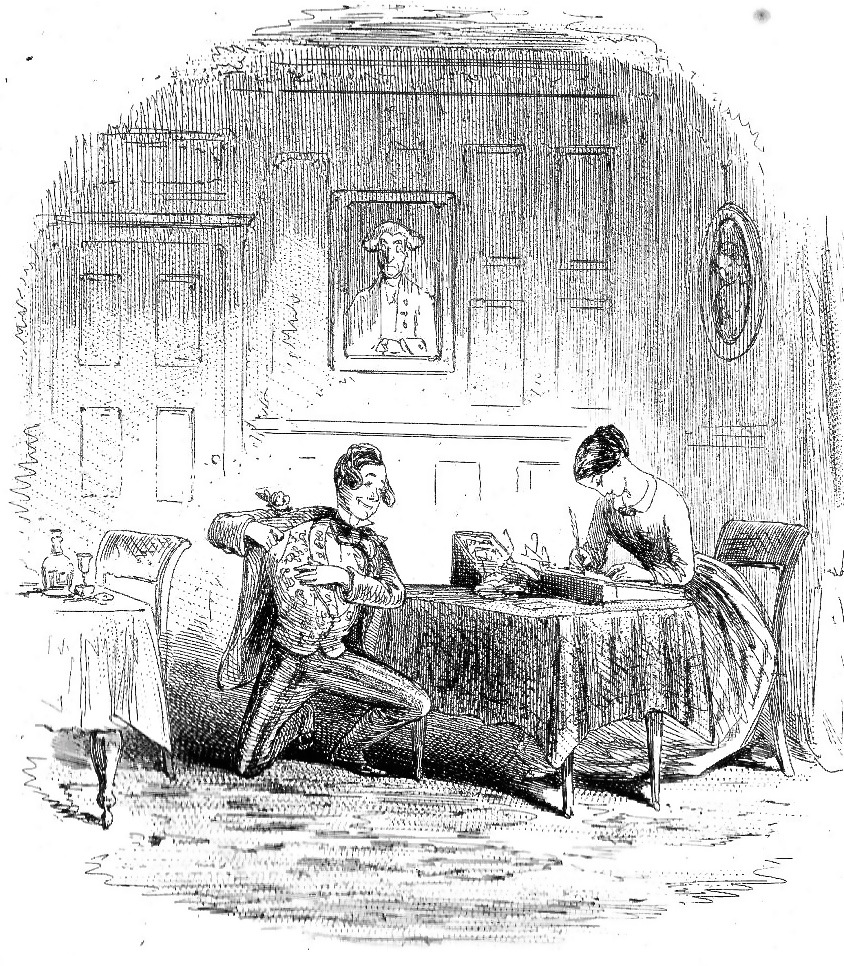
Unrequited Love Allan Woodcourt is little better than a figurehead in the story which is disappointing since the outlines of his relationship with Esther are highly romantic. It’s not nearly as developed as her relationship with John Jarndyce who loves her yet is also ashamed of his feelings for a woman young enough to be his daughter and who certainly sees herself that way. At one point when Esther is particularly vulnerable, Jarndyce awkwardly proposes to her, and she accepts out of a sense of duty. He repents of this though and arranges for her union with Woodcourt instead. Jarndyce and Woodcourt have a humorous foil in Edward Guppy, Esther’s unwanted suitor/stalker who won’t take “no” for an answer. Unlike either of them, he loses all attraction to Esther once smallpox destroys her beauty. He does however renew his proposal towards the end of the book. Most readers interpret this as an indication that she has already regained her looks though the text doesn’t explicitly say so. We see a variation on unrequited love in the backstory. Esther’s godmother loved Lawrence Boythorn but broke off their engagement so she could raise her, a sacrifice that doubtless played a part in her bitter, vindictive attitude towards her goddaughter.
Hard Times
How Much Does Romance Drive the Story? While the first third climaxes in a wedding and the second third largely concerns an attempted seduction, Hard Times really cannot be said to be driven by romance at all.
Ratio of Good Marriages to Bad Marriages If A Christmas Carol was Dickens’s most pro-marriage story, Hard Times is his most anti-marriage story. The marriage of convenience between Louisa Gradgrind and the obnoxious Josiah Bounderby almost ends in adultery and does end in an unamiable separation. Louisa’s father, Thomas Gradgrind Sr. sees his marriage as a good one, much as Mr. Dombey did with his first marriage, but the reader sees it as otherwise. Then there’s Stephen Blackpool’s marriage to a woman he once loved but who has since become a thieving, promiscuous, alcoholic disaster. Through him, Dickens explicitly makes the case for No Fault Divorce. There’s not a good marriage in sight-though are a few suggestions of such unions offstage. There are families among the positively portrayed circus troupe. When Sissy Jupe reunites with them, she’s informed that E. W. B. Childers has married Josephine Sleary and young Master Kidderminster has married an older widow. The last chapter alludes to Sissy Jupe’s future children, implying she’ll be married one day. But for once, Dickens leaves this a suggestion and doesn’t bother to create even the thinnest of characters to be his heroine’s obligatory love interest.
Unrequited Love In all likelihood, Louisa, inexperienced in matters of the heart, doesn’t really love James Harthouse, her would-be seducer, but in any case, he just sees her as an object in a game and a pastime. Mrs. Sparsit fails in winning Bounderby’s love, but her goal was always social advancement and security anyway. (When she finally speaks honestly to him, she calls him a noodle.) Rachael does return Stephen Blackpool’s love but since he’s married, they can never be together. It’s briefly implied that Kidderminster “harbored matrimonial views” regarding Sissy but as I mentioned, he gets over them.
Little Dorrit

How Much Does Romance Drive the Story? Arguably, more than it did in any novel Dickens has written prior to this one. I wouldn’t say the central love story is more important than the social commentary or the parent-child drama but it’s at least as important. The leads, Little (Amy) Dorrit and Arthur Clennam, meet early in the book rather than being introduced to each other halfway or a third of the way through. I haven’t counted but it also feels like there are more scenes of them interacting than there were for most previous Dickensian couples. Little Dorrit’s feelings for Clennam are at the back of her mind throughout the story-that is, when they’re not at the front of it. The book’s emotional climax is him recognizing those feelings on her part and realizing that he requites them. The last chapter closes with a detailed description of their wedding as if to say that was the thing up to which the book had been building.
Ratio of Good Marriages to Bad Marriages This is another novel featuring many unhappy spouses. In the first chapter, we learn that one of the antagonists, Rigaud, has murdered his wife. The couple who raised Arthur Clennam had a nightmarish marriage reminiscent of the one between Oliver Twist’s father and Monks’s mother. Little Dorrit’s deceased mother remains a shadowy figure but it’s hard to imagine her marriage to William Dorrit brought her much happiness. Henry Gowan neglects his wife’s happiness, letting society think he made a huge sacrifice in marrying Pet Meagles when really, he was the one who needed her family’s money. But she’s still better off than poor Affery Flintwinch whose husband Jeremiah’s abuse has reduced to a pathetic ghost of herself. The first interactions we witness between Mr. and Mrs. Merdle, on the other hand, may lead us to think of him as another henpecked husband like Mr. Snagsby. But in the end, it’s his wife who is the victim in their relationship. Then there’s the union of the ditzy Edmund Sparkler and Little Dorrit’s sister, Fanny. If we could say that David Copperfield and Dora Spenlow were the victims of each other, Sparkler is Fanny’s victim, and she is her own victim, marrying a man she can barely tolerate out of a mixture of spite, social ambition and pragmatism. All these bad marriages are somewhat balanced out by the good ones between Mr. and Mrs. Meagles, Mr. and Mrs. Plornish and in the end, Mr. and Mrs. Arthur Clennam. While Flora Finching apparently never had the love for her late husband, “Mr. F,” which she had for Clennam, it’s implied they also had a basically good marriage. The book’s last sentence suggests that such relationships are rare in a fallen world but all the more valuable for that.
Unrequited Love Little Dorrit is arguably the point when unrequited love graduated from being a minor motif in Dickens to a major theme. For most of the book, Amy Dorrit’s romantic desire for Arthur Clennam is unreciprocated. So is his for Pet Meagles. Arthur and Amy each also have an ardent admirer whose feelings they can’t return. John Chivery, Little Dorrit’s moony suitor, is reminiscent of Toots from Dombey and Son but either by a failure on Dickens’s part or by design, it’s harder to laugh at him and, like Tom Pinch, he gets no consolation prize. Laughing at Arthur Clennam’s old sweetheart, Flora Finching, who still carries a torch for him, is much easier. But, for all her ridiculous run-on sentences, she also emerges as a tragic figure. By the end of the story, John and Flora equal the leads in heroism and nobility as they graciously witness their wedding. Pet Meagles, on the other hand, gets to marry Henry Gowan as was her wish but, as described above, his treatment of her hardly suggests he loves her as she loves him. Another woman, Miss Wade, once loved Gowan-or almost loved him. That is as much as she will admit. But after he ended their affair, she hated him and his chosen wife with an unspeakable hatred. (Some readers also interpret Miss Wade’s possessive attachments to certain young women, whom she resents for not loving her as much as maintains she deserves, as homoerotic. Ordinarily, I roll my eyes at interpretations that assume any strong attachment to another person must be sexual or romantic in nature. But Miss Wade is such a strange character, even by the standards of creepy Dickensian villains, that I kind of buy it in her case.) Miss Wade herself was once loved by a young man above her station and she admits she loved him too, but her perverse pride led her to drive him away by preferring Gowan.
A Tale of Two Cities
How Much Does Romance Drive the Story? I hesitate to call A Tale of Two Cities primarily a love story, but romance cannot be removed from its plot. If Charles Darnay had no loving and beloved wife, we would not be as invested in his safety and the climax, nay, the entire ending hinges on another character’s unrequited love for her.
Ratio of Good Marriages to Bad Marriages This might be that rarity, a novel from the later part of Dickens’s career with more positive depictions of matrimony than negative ones. Not only do Charles Darnay and Lucie Mannette have a good marriage but surprisingly, so do the Ernest and Therese Defarge. Unless I’m mistaken, which is a definite possibility, this is the first time Dickens has given a villain a functional marriage since the Squeerses in Nicholas Nickleby. Although a man’s cruelty to a woman played a part in her tragic backstory, Madame Defarge is a rare vengeful Dickensian villainess who is not motivated by any romantic betrayal. (Hortense from Bleak House was another. Did Dickens have something against French women?) The arrogant C. J. Stryver eventually marries “a florid widow with property and three boys,” a ridiculous match perhaps but not an unhappy one. From what we hear about them, Lucie Mannette’s deceased mother was happily married to her father though she was tragically and involuntarily separated from him and Charles Darnay’s deceased mother was unhappily married to his or at least she was after she learned of his wickedness. It’s mentioned that the Marquis St. Evremonde has given his sister in marriage to a farmer-general (tax collector) for financial reasons, which reflects ominously on his character. The worst marriage we see is between Jerry Cruncher and his wife at whom he throws boots to punish her for praying for him. (He sees it as praying against him.) In his last appearance though, Cruncher repents and gains a new appreciation for his wife’s “flopping,” making him something of a male counterpart to the domineering wives who eventually reformed in Dickens’s earlier books.

Unrequited Love The darkest example of unrequited “love” in A Tale of Two Cities is in the backstory in which the Marquis St. Evremonde, after Madame Defarge’s sister rejected his advances, raped her. That crime is arguably what sets the whole plot in the motion. C. J. Stryver is unsuccessful in his pursuit of Lucie Mannette but, as mentioned above, he recovers from the disappointment and finds happiness with someone else. The most famous example of unrequited love in the book, of course, is Sydney Carton’s for Lucie. He doesn’t even bother to propose to her as he sees she doesn’t return his feelings and believes (realizes?) he is unworthy of her. This isn’t enough to keep him from revealing those feelings to her, however. But Sydney’s nobility ends up going far beyond coming to terms with her love for another. In fact, it goes further than that of any other rejected suitor in Dickens. In the end, he takes her husband’s place at the guillotine, ensuring her happiness. In doing so, he resolves the plot and goes from being one character among many to the book’s biggest hero. Interestingly, after playing such a positive role in A Tale of Two Cities, unrequited love would play a mostly negative one in every novel Dickens would write afterwards.
Great Expectations
How Much Does Romance Drive the Story? Romance of the unrequited love variety is very much a driver of the plot and, as I’ve implied above, not in a positive way. The protagonist Pip’s discontentment with his lot in life as a lowly blacksmith’s apprentice is fueled by his longing for the unattainable Estella. Unlike other “dream girls” in Dickens though, such as Madeline Bray, Florence Dombey or even the childish Dora Spenlow, Estella has seemingly nothing but beauty and glamour to recommend her. She’s heartless and cruel to Pip when they’re growing up and while she’s kinder to him in adulthood, she still torments every other man in her life. Even her friendship with Pip serves her as a weapon to wound others. Pip’s adoration of her has a negative effect on his character, leading him to put class above all else and snub his oldest friends. The final third of the story is largely about Pip coming to terms with the fact that Estella is out of his reach and seeking to make amends for the sins he’s committed for her sake.
Ratio of Good Marriages to Bad Marriages Great Expectations begins, more or less, with the portrayal of a bad marriage between Pip’s abusive sister, “Mrs. Joe” and the gentle Joe Gargery. As monstrous as she may be, Mrs. Joe has more psychological texture than other shrewish wives in Dickens, even the ones to whom he gave or sought to give redemptive endings. Reading between the lines, we get the impression her desperation for control over her husband and brother and demand for their gratitude seem to stem from some deep feelings of personal inadequacy. We also get more of a psychological basis for her husband letting her rule the roost, something we didn’t get with, say, Mr. Snagsby of Bleak House. Growing up seeing his beloved mother be physically (and probably emotionally) abused by his father has made him “dead afeerd” of doing the same to his wife. Joe’s insistence that his cruel father’s refusal to let his wife and son leave him proved “he were that good in his heart” seems to be wishful thinking on his part but given the novel’s nuanced characterizations, it could be that he really had some twisted form of love for his victims. One of the last words Mrs. Joe says on her deathbed is “Pardon” which could indicate she repents of her abuse but the fact that she’s unable to form clear sentences during the latter part of her life makes it hard to say.
Matthew and Belinda Pocket have a marriage similar to that of the Jellybys in Bleak House with the difference that whereas Mrs. Jellyby threw herself into charity work while neglecting her husband and numerous children, the lazy Mrs. Pocket takes interest in nothing her pedigree. Arguably, another difference is that Matthew Pocket, while generally an admirable character, is implied to be no great husband and father himself rather than all the family’s problems being blamed on the wife/mother. (I admit that impression of Mr. Pocket may have been unintentional on Dickens’s part, but I can’t shake it.) Speaking of bad marriages, Abel Magwitch had a barely legal one in his backstory. (He refers to the woman as his “missus” but any references to her being his wife are obscure.) It ended in her telling him she had killed their child out of spite. Grieved though he was by this, he refrained from incriminating her with it. Magwitch also tells us that the villainous Compeyson once had a wife, Sally, “a good creetur” whom “Compeyson kicked mostly.” Estella eventually marries Bentley Drummle who likewise abuses her. While bad marriages are common in Great Expectations, it ends with three positive unions, that of Herbert Pocket and Clara Barley, that of John Wemmick and Miss Skiffins and that of Joe Gargery and Biddy. (It’s also worth noting that while they’re negative characters, Mr. and Mrs. Hubble and Raymond and Camilla Pocket seem like well-matched couples.) What about Pip’s marital prospects in the end? Well…
Unrequited Love As described above, Pip is very much defined by his longing for Estella. The villainous Miss Havisham is also motivated by unrequited love or, more accurately, her love for a man whom the con artist in her past pretended to be and who never really existed. She defines her whole life by this tragedy, and it leads her to “wreak revenge on all the male sex.” In the end, despite the terrible impact that unrequited love has had on them, both Pip and Miss Havisham take the position that Estella would be better off if she were capable of love even if it hurt her. In the book’s final chapter, Pip reencounters Estella after she’s been freed by the death of her abusive husband. The broken, humbled woman has come to appreciate the value of love and regrets her former cruelty. Originally, Dickens intended for Estella’s second husband to be a doctor who had stood up for her against her spouse. Pip would have been glad that she’d found love even if it wasn’t with him. (I’d argue that idea was still maintained in the final text. When Pip first hears of Estella’s engagement to Bentley Drummle, he begs her to marry someone more worthy even as he insists that someone can no longer be him.) Dickens was persuaded to keep Estella single in the final version, leaving open the possibility that she and Pip will be a couple after all. But he still refrained from ending with explicit wedding bells. The most Pip says aloud is that he and Estella are now friends. In her last line of dialogue, she replies that they will continue to be friends apart but, in the novel’s last sentence, Pip the narrator tells us he “saw no shadow of another parting from her.” In the words of Nicholas Nickleby, this denouement leaves readers “in a state of pleasing uncertainty” as to whose assessment of their relationship’s future will prove correct.
Our Mutual Friend
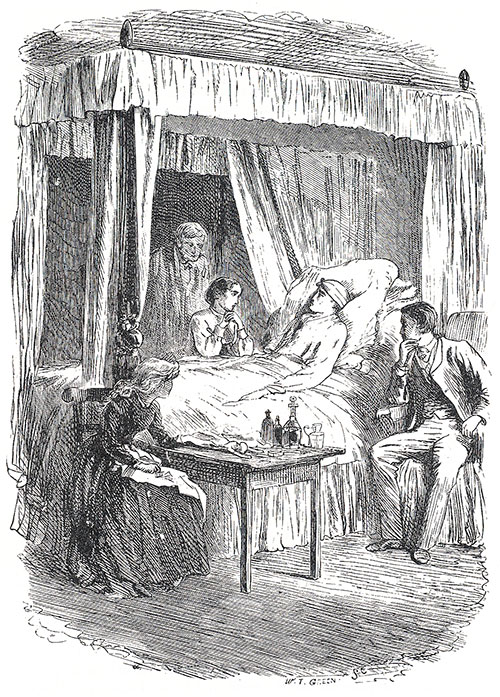
How Much Does Romance Drive the Story? The first sentence of this article, which you’ve doubtless forgotten by now, described Our Mutual Friend as driven by romance to an unusual extent for Dickens. The two main plotlines are love stories and, unlike in Great Expectations, the romance in them plays a positive part in the characters’ development. (Well, the main characters anyway. The villain is another story.) Through her love for John Rokesmith, the initially hedonistic and mercenary Bella Wilfer becomes noble and self-sacrificing. So does the initially callous and selfish Eugene Wrayburn through his love for Lizzie Hexam. In the end, not only does he brave society’s disapproval by marrying her but he prefers to let the man who tried to murder him go free rather than risk damaging her reputation. These two love stories are unusual for Dickens in their emphasis on sexual tension. Both couples spend a lot of time fighting their attraction to each other. In particular, the romance between John and Bella is unusual in that the two start out as resenting each other and fall in love gradually. This has become the basic modus operandi for anyone writing a love story these days though that isn’t to say it’s particularly modern. (Much Ado About Nothing and Pride and Prejudice are pre-Victorian examples of the trope.) But Our Mutual Friend is the only instance of Dickens using it that I recall. His romances tended to consist of either love-at-first sight or friendship blossoming into love.
Ratio of Good Marriages to Bad Marriages Just as Dickens followed up A Tale of Two Cities, which portrayed a number of healthy marriages, with Great Expectations, which portrayed a number of unhealthy ones, he followed up Great Expectations with Our Mutual Friend, which-you guessed it-also portrays many healthy marriages. Not only are the two main couples married by the end, but Dickens follows Bella and John past the altar, all the way up to their first child and beyond. It must be admitted though that this rather backfires. The story involves John deceiving Bella so far into their relationship that it’s hard to see it as a healthy marriage the way Dickens intends us to see it. In other news, a loving older couple, Mr. and Mrs. Boffin, serve as mentors of sorts to John and Bella and the humorous side characters of Mr. Venus the taxidermist and Pleasant Riderhood are happily united in the end. Reverend Frank Milvey and his wife, whatever their shortcomings, also seem well suited to each other. In the backstory, we hear that John Harmon’s sister had a short and not particularly happy marriage, but this was the fault of her cruel father, not of her husband or herself. Mr. and Mrs. Veneering and Mr. and Mrs. Podsnap have shallow but not necessarily bad marriages (though I hesitate to call anything involving Mr. Podsnap “good.”)
On the flipside, the novel gives us Reginald Wilfer and his wife, a rather tired reiteration of Dickens’s previous shrewish wife characters, one without the psychological texture of Mrs. Joe or the entertainment value of Mrs. Snagsby. Still, there’s a difference between not being as entertaining as Mrs. Snagsby and not being entertaining at all and Mrs. Wilfer has her fun moments, such as her wedding anniversary on which she treats her husband with particular passive-aggressive hostility. (“Within a-month, I first saw R. W. my husband. Within a year, I married him. It is natural for the mind to recall these dark coincidences on the present day.”) Her younger daughter, Lavinia, starts a relationship with Bella’s old beau, George Sampson, which looks like it’s shaping up to be as bad as her parents’. Con artists Alfred and Sophronia Lammle have a more interesting bad marriage. Each married the other under the mistaken impression that they had money. When they learn the truth, they’re furious but ultimately agree to “work together in furtherance of (their) own schemes.” At first, these two seem equally vile but when they try to arrange a marriage between the innocent Georgiana Podsnap and the despicable Fascination Fledgeby for their own purposes, Mrs. Lammle reveals a conscience and secretly sabotages it. If her husband were to learn of this, we’re told, she would be in danger.
Unrequited Love While reciprocated love redeems the protagonists of Our Mutual Friend, Bradley Headstone’s dark obsession with Lizzie Hexam and his anger at her rejection fuel his villainy. Not content with emotionally tormenting people, like Miss Havisham or Rosa Dartle, he outright tries to murder his romantic rival. This is as dark as unrequited love gets in Dickens. On a lighter note, his fellow teacher, Miss Peecher, carries a torch for him. If only she knew what lay beneath his respectable surface! Mr. Venus also suffers unrequited love for Pleasant Riderhood but as mentioned above, she eventually gets over her reservations about his unromantic profession.
The Mystery of Edwin Drood
How Much Does Romance Drive the Story? That is a hard question to answer due to Dickens dying before this novel’s completion. If we define dark passion of the Bradley Headstone variety as romance, then it very much drives the story. The title character starts out betrothed to beautiful young Rosa Bud by their parents’ dying wishes. His seemingly devoted uncle, John Jasper, secretly desires Rosa for himself and feels Edwin takes his luck in this engagement far too glibly. He murders his nephew-or he has if we take Dickens at his word. Some fans have speculated that Edwin is still alive and in hiding. Jasper certainly seems to believe he’s murdered him though. In either case, Jasper blames Edwin’s disappearance on Neville Landless, another young man who, like Jasper in secret, longs for Rosa and has publicly taken issue with Edwin for not treating her with due respect. Positive romances are notably lacking in what Dickens managed to complete of this book though in the final chapters he wrote, he set up one between Rosa and Lt. Tartar.
Ratio of Good Marriages to Bad Marriages Are there any marriages at all in The Mystery of Edwin Drood? The only one we see is that of Mr. and Mrs. Tove and I can’t think of anything to say about them. (After I’ve written all this, can you blame me?) Another minor character, Thomas Sapsea, is a widower and has written a hilariously vain epitaph for his late wife that is really all about himself. Rosa and Edwin begin as a couple, but they decide they make better siblings than spouses and amicably end their engagement. (Ironically, if Edwin had only told his uncle this, he would have saved himself.) Of course, we only have half the book. According to Dickens’s friend, John Forster, he planned to end the story with a marriage between Tartar and Rosa and another between Septimus Crisparkle and Neville’s sister, Helena. I find it difficult to imagine those last two as a couple, Crisparkle being so wholesome and down to earth and Helena being so brooding and exotic, but they express enough respect for each other in what Dickens wrote that I believe Forster. We’ll never know if Dickens would have been able to sell that relationship though. Neither will we know if those successful romances would have balanced out of the darkness of John Jasper’s obsession, with which Dickens seems to have been mainly interested.
Unrequited Love Jasper is an even more disturbing villain than Bradley Headstone. Not only is he respectable, but he manages to come across as genuinely open and friendly. It seems he genuinely loves Edwin but not enough to forgive him for being engaged to the object of his desire and simply refrain from killing him. This might be the darkest portrayal of unrequited love in Dickens. In the scene of Jasper trying to blackmail Rosa into accepting him, Dickens seems to be trying to outdo in creepiness every scene of sexual harassment and predation he’d written prior to this, no small task. Of course, Jasper isn’t the only character in love with Rosa whom she doesn’t love back. According to Forster, Neville Landless was going to perish helping Tartar bring Jasper to justice but he prefaced that with the words “I think.” (For what it’s worth, there were instances of Dickens changing his plans for characters’ fates before he’d finished writing their books.) If Neville hadn’t died, presumably he would have reconciled himself to Rosa and Tartar’s marriage (just as Mr. Grewgious had to reconcile himself to the marriage of Rosa’s parents in the backstory.) Personally, I prefer the prospect of him heroically dying as Dickens had already written enough books that ended with (mostly) male supporting characters nobly giving their blessing to their beloved’s marriages to others. Then again, if Dickens had gone that route with Neville, it would have made him a good foil to Jasper who would never have gotten over his obsession with Rosa.
Final Thoughts
Composing conclusions has always been my least favorite part of essay writing. Why should I bother to summarize what I just explained to the reader in detail? It’s not like they’ve forgotten it. Writing a conclusion to this piece poses a particular challenge. You see, this is the part where I’m supposed to summarize how Dickens’s views evolved over the course of his literary career, but I’m not convinced they really did or at least not regarding what makes a good marriage. When I described A Christmas Carol as his most pro-marriage story and Hard Times as his most anti-marriage story, I was being somewhat facetious. I don’t seriously believe Dickens forgot about the existence of bad marriages when writing the former or the existence of good ones when writing the latter. Like Jane Austen, another classic author with seemingly limited range, each time he reused setups or themes he’d done before, he would give them a different emphasis. And while certain character types recur throughout his works, he managed to put new spins on them. (The dandiacal Mantalini and the grim Murdstone are both abusive, manipulative husbands but they’re hardly interchangeable.) If Dickens did undergo an evolution in how he handled romance, it seems to me it consisted in three things. First, in his earliest novels, romances tended to be more perfunctory, something he included because Victorian novels typically ended with happy weddings, whereas in later books, they seem like something he was genuinely interested in exploring. Second, unrequited love plays an increasingly large role. Third, towards the tail end of his career, that role became increasingly negative. If Dickens was suffering from unrequited love himself, his treatment of the subject became less self-pitying and more self-recriminating. His final three books feature fewer romantic sufferers like Tom Pinch or Sydney Carton who accept their beloved’s autonomy and wish her to find happiness with another man and more crazed villains who seek to kill their rivals and force themselves on their beloved. But, again, this wasn’t necessarily a radical change. Such villains appear in Dickens’s earlier books even if they’re not as developed. And while it’s not the main focus, characters like Pip, Eugene Wrayburn, Neville Landless and Mr. Grewgious do represent-or at least hint at-the spurned lover’s capacity for nobility.
Note: I’d like to thank Rachel for providing tags and images for this post and the epigraph that gave it its title.
 All the (Dickensian) Year Round
This is a topic I’ve spent a lot of time thinking about – what is Dickens’s purpose for including so many different types of “romantic” love (as opposed to familial or platonic). I think it goes beyond a simple plot device and moves into the territory of exploring a topic such as he did with various aspects of the social condition of his time, poverty, religion, the law, etc. I also think his exploration has a personal dimension summed up quite nicely by John Kucich: “In [his novels], Dickens is clearly working out his own troubled attitudes toward marriage, divorce, and adultery, and exploring the circumstances that may or may not permit the enlarging of one’s sexual experience” (Repression in Victorian Fiction: Charlotte Brontë, George, Eliot, and Charles Dickens, p. 229).
Romantic love – Love – in Dickens’s novels is fraught with complication. It comes in various shapes and sizes, which have shapes and sizes of their own. Love forms quickly or slowly, arrives early or late in life or in a relationship, is strong or weak, is one-sided or triangular, is arranged or suspended, is healthy or malignant, ethereal or carnal, selfless or self-serving, patient or insistent, is real or imaginary, is clear-sighted or completely confused.
By showing it often and often in contradiction with itself I think Dickens ultimately captures its essence, laying out for us a roadmap of sorts pointing to what it means to Love and what Love is meant to do. In the end, it is likely he did not come to a satisfying resolution of what Love means or looks like for himself, but I believe he has illustrated for us, as he so often has done, what Scripture so beautifully tells us:
If I speak in the tongues of men or of angels, but do not have love, I am only a resounding gong or a clanging cymbal. If I have the gift of prophecy and can fathom all mysteries and all knowledge, and if I have a faith that can move mountains, but do not have love, I am nothing. If I give all I possess to the poor and give over my body to hardship that I may boast, but do not have love, I gain nothing. Love is patient, love is kind. It does not envy, it does not boast, it is not proud. It does not dishonor others, it is not self-seeking, it is not easily angered, it keeps no record of wrongs. Love does not delight in evil but rejoices with the truth. It always protects, always trusts, always hopes, always perseveres. Love never fails. But where there are prophecies, they will cease; where there are tongues, they will be stilled; where there is knowledge, it will pass away. For we know in part and we prophesy in part, but when completeness comes, what is in part disappears. When I was a child, I talked like a child, I thought like a child, I reasoned like a child. When I became a man, I put the ways of childhood behind me.For now we see only a reflection as in a mirror; then we shall see face to face. Now I know in part; then I shall know fully, even as I am fully known. And now these three remain: faith, hope and love. But the greatest of these is love. (Corinthians 1:13)
LikeLiked by 2 people
Dear Friends,
I am really eager to delve into your review of the novels, Adaptation Stationmaster, with the three questions guiding your reflection: How much does romance drive the story? What’s the ratio of good marriages and to bad marriages? And how big a role does unrequited love play?
Chris, thank you, as always, for your astute and informed thoughts, including the incomparable passage from Corinthians.
It will be really interesting to re-experience the novels through this lens.
With much appreciation and additional thoughts to come!
Daniel
LikeLiked by 2 people
You know, it’s kind of weird that I chose this topic. In college, for one of my literature courses, the professor kept having us study plays about bad marriages. I found it a tad repetitive after a while I started to get the impression she did this to warn us against getting married. This irritated me because
(I really shouldn’t bash that professor though. I know she meant well and was a very generous grader to me.) Still, once I got out of college, I was thrilled about getting to write about the aspects of art that I wanted to tackle, not just stuff about dysfunctional marriages, so you’d think for the end of Dickens Club, I would have wanted to write about, say, different Dickensian siblings (the Nicklebys, the Cheerybles, the Brasses, the Murdstones, etc.) or maybe, given the theme of my own blog, my favorite adaptation of each Dickens book. But, no, this was really what I felt like writing. LOL. It’s not like it’s a bad topic as long as you’re exploring it because you want to explore it and not because that’s what you keep getting assigned in college.
LikeLike
This is a topic hugely close to my heart, and I spent a lot of time looking at it in both my Masters degree and in my PhD (which, fingers crossed, is looking like it might just get published). I think in a consideration of this topic, much of Dickens’s work, especially from David Copperfield onwards, needs to be placed in the temporal context in which it was written, particularly the law governing marriage and divorce. Dickens was writing that novel just as the Royal Commission was appointed to examine the laws of divorce, triggering a societal existential examination of what made a marriage, together with when the state could – or even if they should – legislate to bring a marriage to an end.
In my view, Dickens, in that inimitable way of his, danced around the issue somewhat, but does, as you point out, finally make the case for no-fault divorce through Stephen Blackpool in Hard Times. The imagery he uses is particularly potent, and it draws on aspects of the campaign for no-fault divorce that had first been used in the 1600s. He runs with this theme even after 1857, when the new Divorce Act came into force, because although it made divorce a legal judicial remedy for the first time, it really did very little to change the existing reasons for which a divorce would be granted (and certainly would not have assisted Dickens in achieving a divorce from Catherine). And while the number of divorces did go up after the enactment of the Act, it was still statistically insignificant as a whole because divorce itself was still considered unrespectable in a society that was driven by social norms of respectability. This is important because Dickens himself was driven both by a desire to appear respectable, and court his respectable readership (I’m using the word respectable here in the sense that Thackeray did. Thackeray defined ‘Respectables’ as ‘the class of lawyers and merchants and scholars, of men who are striving on in the world, of men of the educated middle classes of the country).
I think much of Dickens’s frustration, even anger, at how the law had been reformed can be evidenced in his later novels, particularly in Great Expectations and Our Mutual Friend (I have an article appearing in the Dickensian shortly which examines Our Mutual Friend in the context of the reformed law of divorce). It is the little things he does, and the use of symbolism and imagery as he sculpts the relationships throughout the novels where his true thoughts are betrayed. As ever, as you turn your mind to these issues, and how Dickens approached them, you can only admire the depth of his genius. It is one of the reasons we keep going back to Dickens, over and over again. There is always so much to see and devour from his works.
LikeLiked by 2 people
“Carker once abandoned his mistress, Alice Marwood, and she turns out to be the first of many spurned, vengeful women in Dickens”.
But did Alice Marwood love Carker? It seemed to me that she had always detested him. Her greedy mother sold her and forced her to become his mistress.
LikeLiked by 1 person
That’s probably a good point. Dombey and Son isn’t one of the Dickens books that I’ve reread the most.
LikeLike
Although there are differing opinions on the matter. The author of this scholarly article believes that Alice may have loved Karker.
https://www.jstor.org/stable/2933534
LikeLiked by 1 person
I doubt she “loved” him but she certainly blames him for the part he played – or didn’t play – in her transportation. Her mother asked Carker for “not so many pounds” to set Alice free but he refused “well satisfied that [she] should be sent abroad, beyond the reach of further trouble to him” (Ch 53).
LikeLiked by 1 person