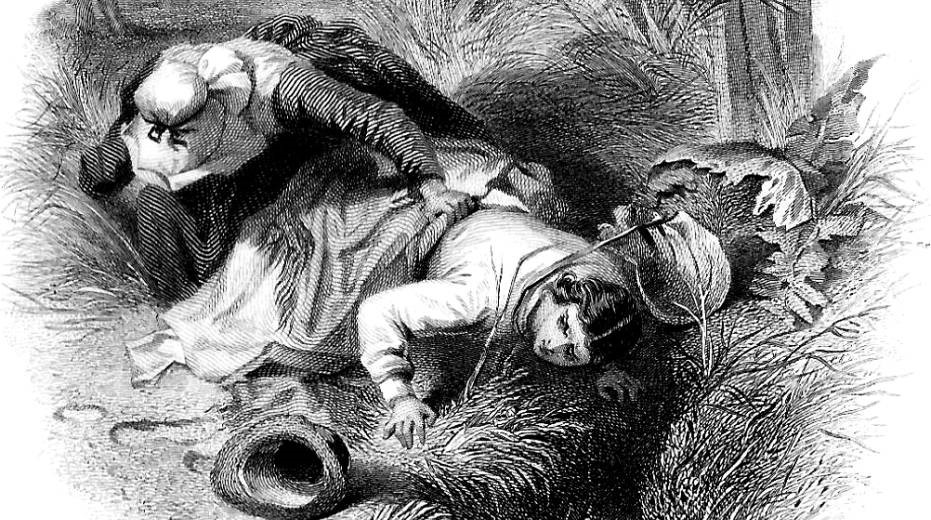
WHEREIN WE REVISIT OUR final weeks’ READING OF Hard Times (WEEKS 91-92 OF THE DICKENS CHRONOLOGICAL READING CLUB 2022-24); WITH A CHAPTER SUMMARY AND DISCUSSION WRAP-UP; CONTAINING A Thematic wrap-up and a look-ahead to our break between reads, and our next read: Little Dorrit.
(Banner Image by Felix O.C. Darley. Scanned image by Philip V. Allingham for Victorian Web.)
By the members of the Dickens Club, edited/compiled by Rach
“Dickens was not interested in writing a political or social tract; he was writing a fairy story of the industrial age.”
-Peter Ackroyd
First of all, thanks to Rob for that marvelous Peter Ackroyd quote! And a huge “thank you” to all of our friends for reading along with us, whether you’ve joined in the discussion or not!
We are at the end of our journey with Hard Times, and we are very much looking forward to discussing it in our online chat this Saturday. (The Zoom link should be coming in your inbox today!)
How would we rank it among Dickens’s canon so far? And among your personal favorites?
If you have time to read nothing else right now, friends, I’d highly recommend the final thematic wrap-up, where we try and pull it together. Here are a few quick links:
- General Mems
- Hard Times, Book III, “Garnering,” Chs 1-9 (Weeks 5 & 6): A Summary
- Discussion Wrap-Up (Weeks 5 & 6)
- Hard Times: A Final Thematic Wrap-Up
- A Look-Ahead to Our Break Between Reads (10-23 Oct, 2023), and Our Next Read
General Mems
If you’re counting, today is Day 644 (and week 93) in our #DickensClub! Today we’re wrapping up Hard Times, our nineteenth read of the group. Please feel free to comment below this post for any final thoughts, or use the hashtag #DickensClub if you’re commenting on twitter. We will be on a 2-week break between reads. See our look-ahead below for more info, and join us for our next read beginning 24 October: Little Dorrit!
Join us this Saturday, 14 October for our Zoom discussion of Hard Times at 11am Pacific (US)/2pm Eastern (US)/7pm GMT (London)! Very informal chat–tell us what you loved (and didn’t!) about Hard Times. We’ll also discuss options for the Zoom meeting on Little Dorrit, as it is such an important work, but its end falls near the holidays.
No matter where you’re at in the reading process, a huge “thank you” for reading along with us. Heartfelt thanks to our dear Dickens Fellowship, The Dickens Society, and the Charles Dickens Letters Project for retweets, and to all those liking, sharing, and encouraging our Club, including Gina Dalfonzo, Dr. Christian Lehmann and Dr. Pete Orford. Huge “thank you” also to The Circumlocution Office (on twitter also!) for providing such a marvellous online resource for us. And for any more recent members or for those who might be interested in joining: the revised two-and-a-half year reading schedule can be found here. If you’ve been reading along with us but aren’t yet on the Member List, we would love to add you! Please feel free to message Rach here on the site, or on twitter.
And for any more recent members or for those who might be interested in joining: the revised two-and-a-half year reading schedule can be found here. Boze’s wonderful introduction to our current read, Hard Times, can be found here. For other marvelous supplementary resources shared by Chris, please click here. And a friendly reminder that our marvelously gifted member, Rob Goll, has an audiobook version available, for the audiophiles among us!
If you’ve been reading along with us but aren’t yet on the Member List, we would love to add you! Please feel free to message Rach here on the site, or on twitter.
Hard Times, Book III, “Garnering,” Chs 1-9 (Weeks 5 & 6): A Summary
“Some persons hold that there is a wisdom of the Head, and that there is a wisdom of the Heart.”
Louisa is supported in her healing by both her humbled father—who feels now that there is much he has misunderstood about life, and about her—and by Sissy.
On her own inspiration, Sissy pays a visit to Harthouse, and, in her quiet but forceful way, tells him off royally. She insists that not only will he never see Louisa, but he must leave town immediately and for good. He is so disarmed by her honest goodness and conviction that he can do nothing but comply.
Mrs Sparsit then tells Bounderby of the scene she’d witnessed between Harthouse and Louisa, and Bounderby goes to Stone Lodge in a blustering huff, saying that Louisa must be back by midday the next day, or he will effectively assume that she has abandoned her place as his wife. Gradgrind tries to awaken a little compassion in Louisa by suggesting that they both had never truly understood her, but to no avail. Louisa remains where she is, and is estranged from Bounderby.
Bounderby then pursues Stephen, and sets the factory Hands against him, by accusing Stephen of the bank robbery. Everyone begins to come to Louisa, including a distraught Rachael, who fears that Louisa had a hand in blackmailing Stephen—that that was the real intent behind her kindness to him. Rachael has sent Stephen letters about the accusation, confident that he will return to defend himself, but time passes and there is no sign of him. Sissy visits Rachael faithfully to comfort her as she waits.
Mrs Sparsit’s meddling continues—and finally backfires. She brings Mrs Pegler to Bounderby, having seen her with Stephen, and figuring that the old woman knows something or was an accomplice. Bounderby is far from pleased, however. Turns out, Mrs Pegler is his mother, and all along Bounderby had been lying about her upbringing of him to make his own story look more attention-worthy. She is distraught and wonders who could have been telling Bounderby’s friends such lies about her—about his being neglected, abandoned in the gutter, etc—not at first realizing that such lies came from her own son.
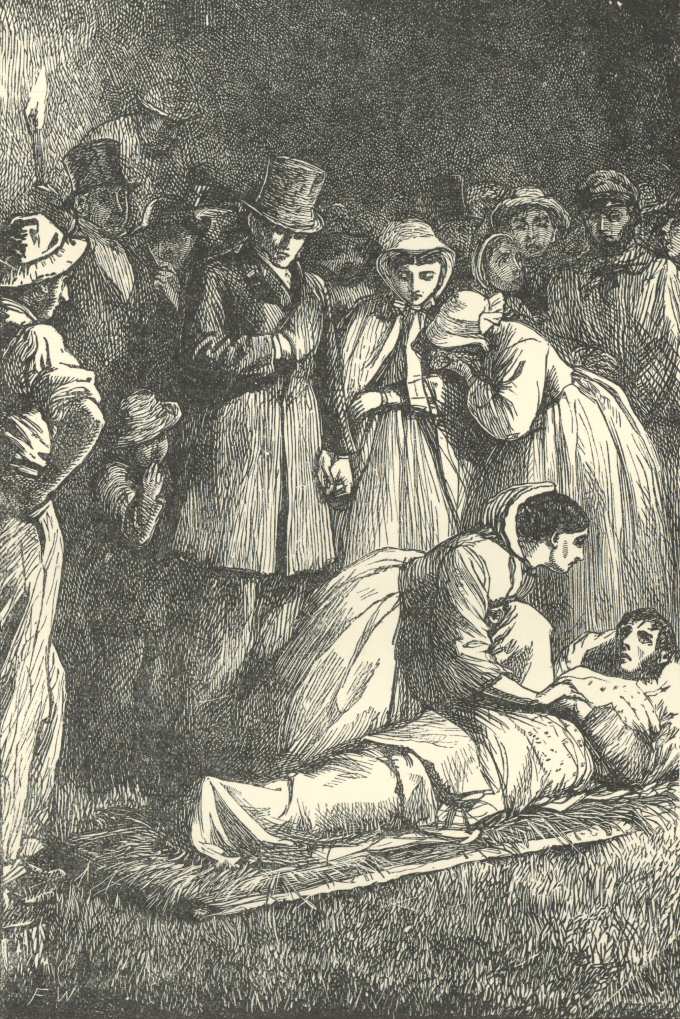
Stephen still hasn’t arrived in town. As Sissy walks with Rachael, however, they find his hat close to a deep mining shaft no longer in use, which wouldn’t have been visible in the darkness. (Rachael nearly falls into it herself in the daylight.) It is known as the “Old Hell Shaft.” They call his name but with no response. Each of the women runs in a separate direction to get help, in case Stephen is down there alive. He is brought up with help from some of the local men—still alive, but only just. After a tender goodbye to Rachael, he hints that Louisa might ask her brother about the robbery. He dies.
Sure enough, Tom is fled, and Gradgrind and Louisa now are certain of his guilt. They then find out that Sissy had arranged for Tom to hide with Sleary’s circus near Liverpool. Gradgrind and Louisa find him there, disguised in blackface and still unrepentant, blaming others for his misfortunes. They intend to get him out of the country, but Bitzer, true to his Gradgrindian education, cannot find the compassion to turn a blind eye about the matter, but is ready to hand him in to the authorities. But Sleary, with a pretense of agreeing with Bitzer, double-crosses him, and manages to get Tom aboard ship and away from England.
Merrylegs, Sissy learns, has returned to the circus without his owner, which she takes as a sign that her father has died.
Our narrator ends with a foreshadowing of many doings to come: Bounderby’s death in only a matter of five years; Mrs Sparsit’s living with an annoying relative after being fired; Gradgrind’s publication of Stephen’s innocence, and Gradgrind’s own change in philosophy-in-action from fact to the virtues of faith, hope, and charity; Tom’s ultimate repentance and lonely death abroad; Sissy’s happy family, and Louisa taking delight in Sissy’s family, too, where she can reclaim and support the kind of happy, wonder-filled childhood that she had never known.
Discussion Wrap-Up (Weeks 5 & 6)
Miscellany; What We Loved–and Didn’t
Though the Stationmaster is definitely a fan of Hard Times, he also addresses some of the things that become irksome for him:
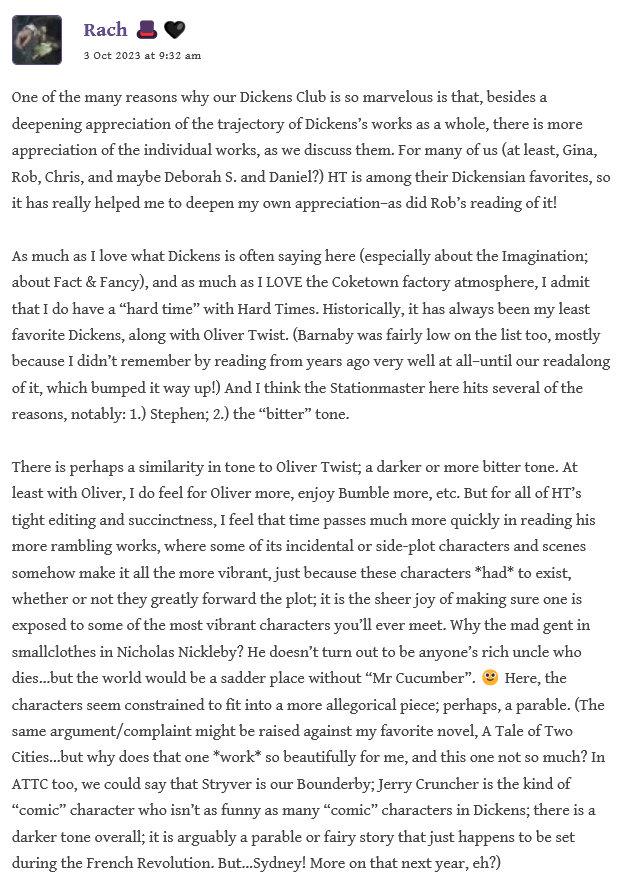
I have been so enriched by the group, and have really enjoyed this read much more than I had anticipated, as Hard Times has been always one of my least favorite Dickens novels:
On Stephen Blackpool
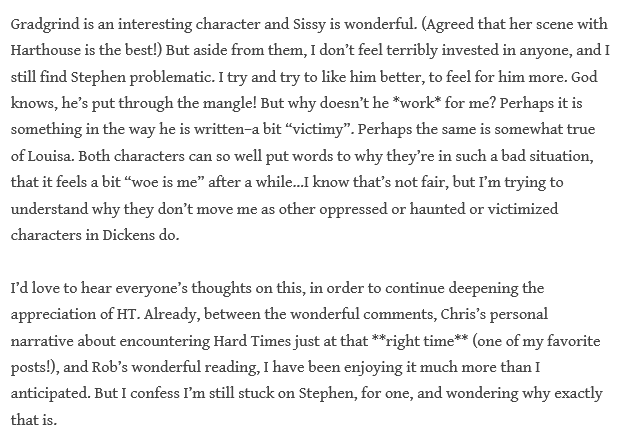
I’m continuing my comment under a separate heading, to spotlight one of Hard Times‘s most important characters, but one which I have a “hard time” with:
Our “Villains”: Bounderby’s Narcissism; Tom’s Escape
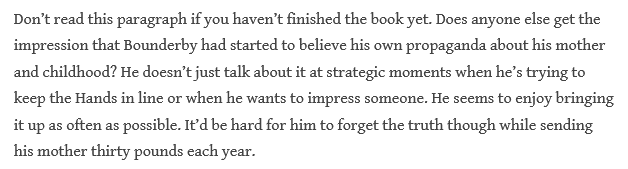
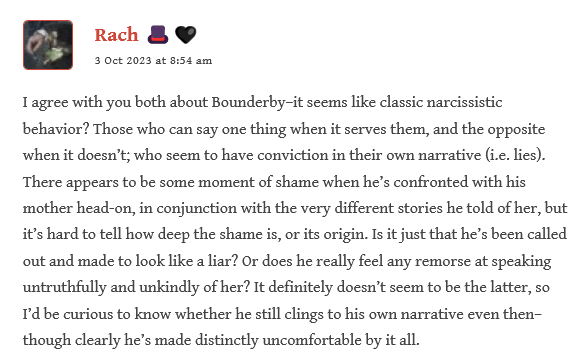
Does Bounderby believe his own lies? The Stationmaster asks:
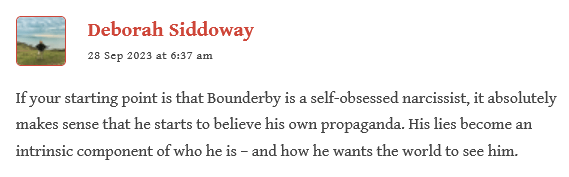
Deborah adds that this is accurate characterization for a narcissistic personality:
I agree:
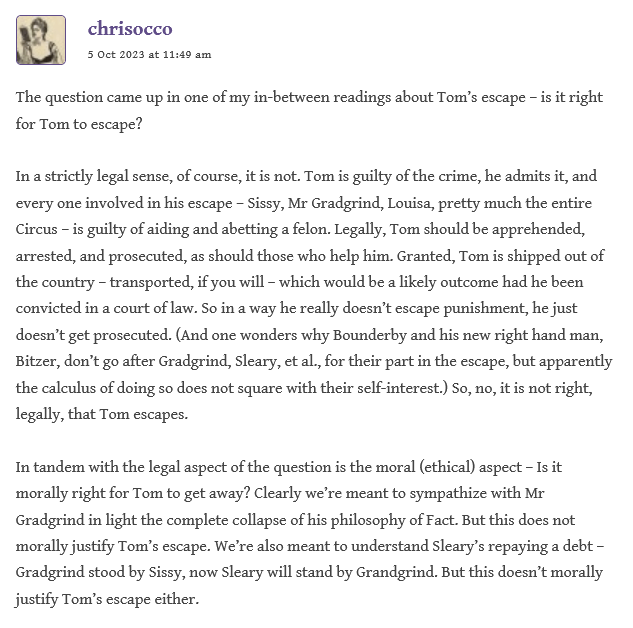
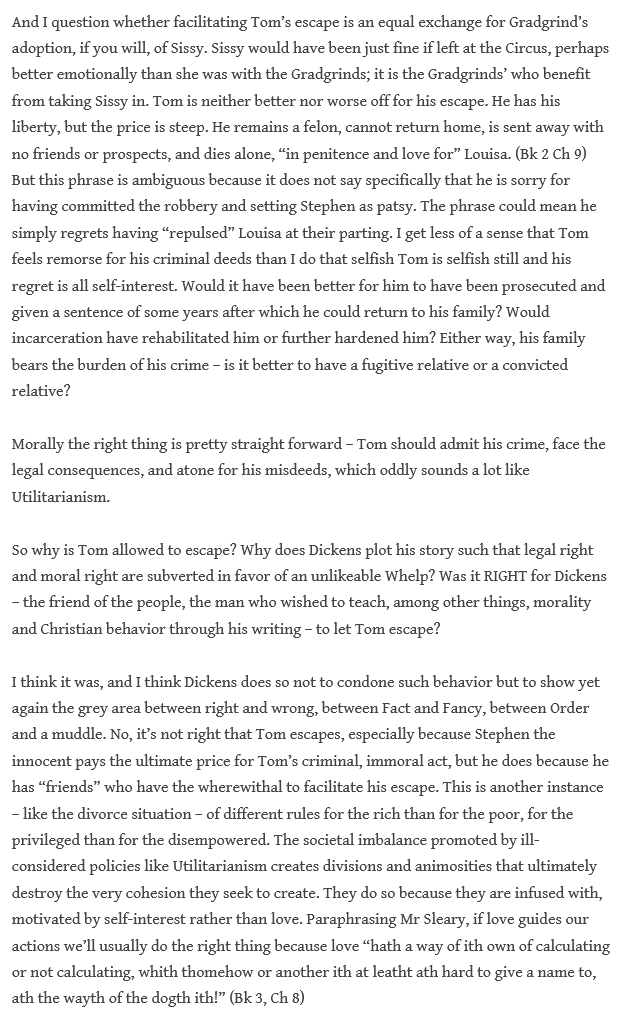
And what of Tom? It is hard to feel for him, even though we feel for Gradgrind at the end. Was his escape justified ethically, even if unjustified in law?
Sissy: Her Strength, & “The One Thing Needful”
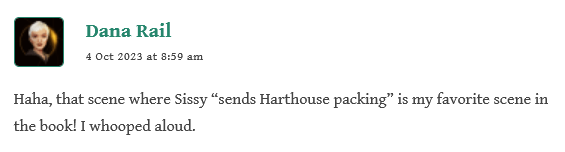
Dana expresses all of our thoughts about that fabulous scene between Sissy and Harthouse:
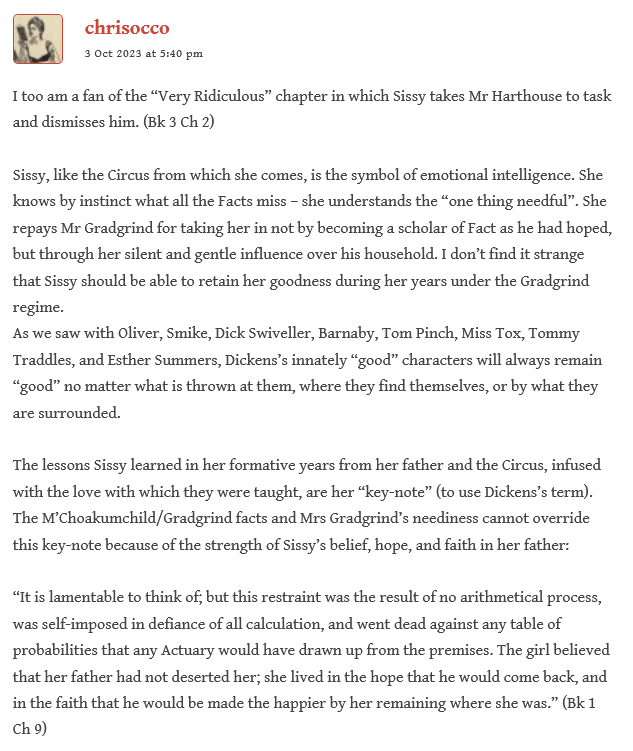
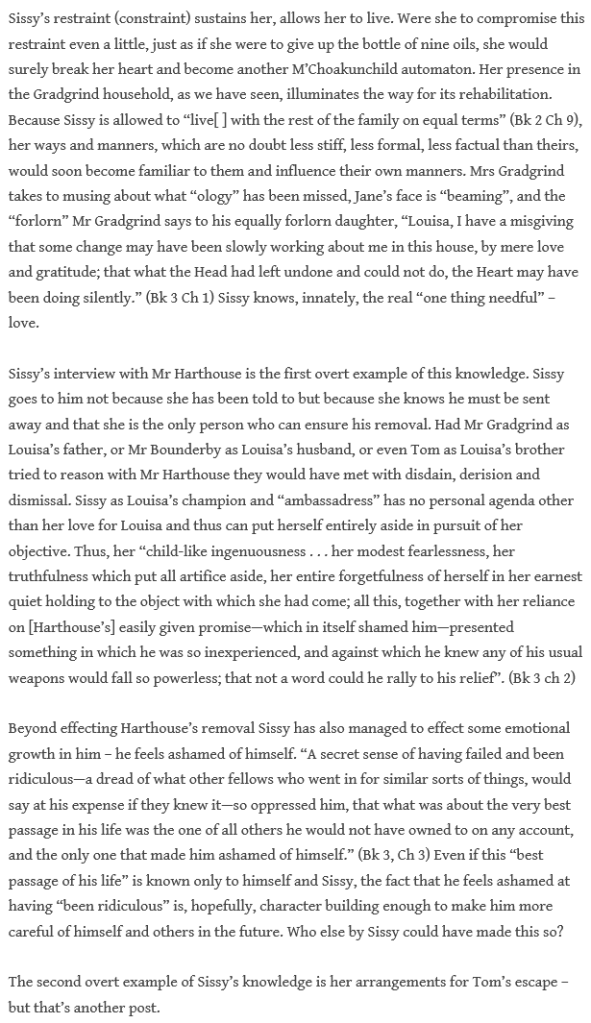
Chris agrees, and goes on to discuss this particularly wonderful character:
Rob discusses the touching relationship between Sissy and Louisa, especially at the end:
https://platform.twitter.com/widgets.jsIn the innocence of her brave affection, and the brimming up of her old devoted spirit, the once deserted girl shone like a beautiful light upon the darkness of the other.#HardTimes #Dickens #SissyJupe #LouisaGradgrind pic.twitter.com/ipYlkNmE0G
— Rob Goll (@Llogtrebor) April 1, 2020
Dickens’s “Writing Lab”: Hard Times as Parable; the Necessity of Constraint
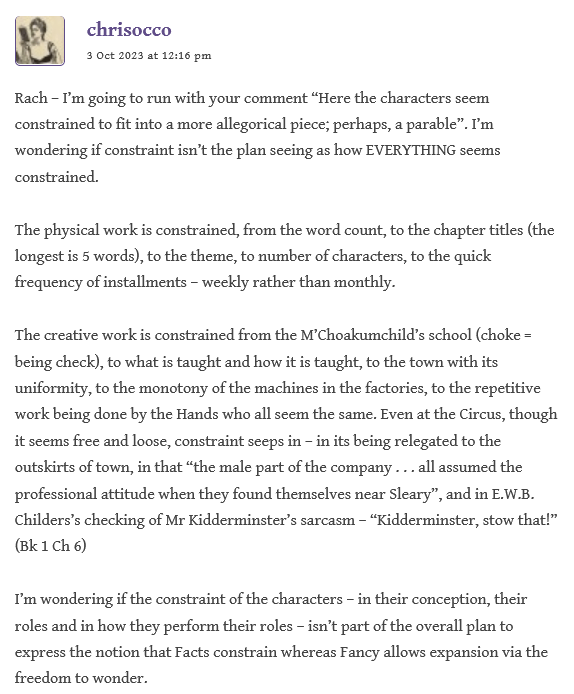
Both Hard Times and A Tale of Two Cities are almost parables or fairy tales–to allude to our Ackroyd quote–and I wrote of this above. Chris responds beautifully as to why the characters feel “constrained” in this shorter form:
On Film Adaptations of Hard Times
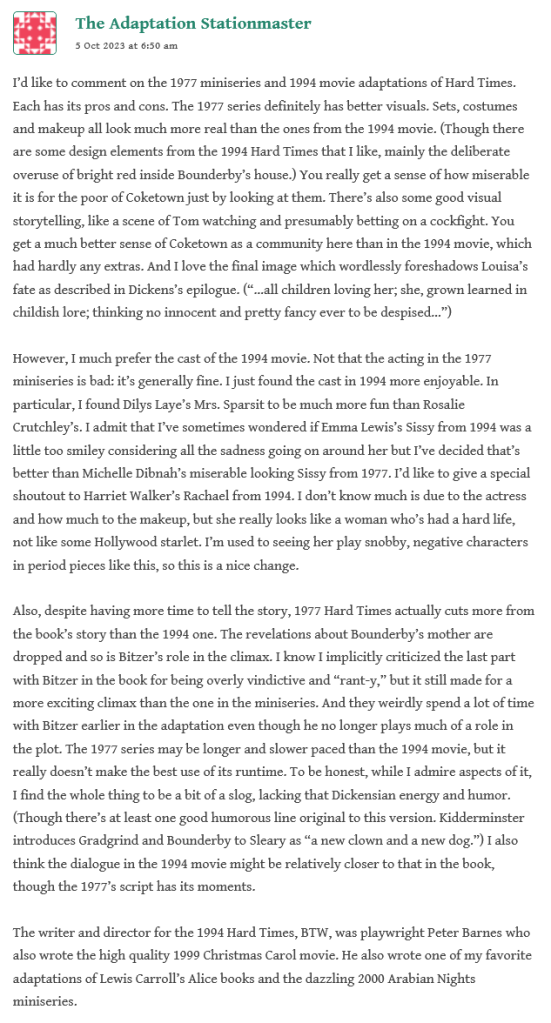
Who better than the “Adaptation Stationmaster” to analyze the film adaptations for us?
AND the Club has inspired him to try his own hand at writing a screenplay! Fantastic!
Hard Times as “Condition of England” Novel
On the site formerly known as Twitter, Deborah posted some wonderful videos of a power loom in action:
https://platform.twitter.com/widgets.jsThis was one of the power looms in operation. Just one and the noise was intense and the floor was shaking. I can only imagine the racket if all the machines were working at the same time. #dickens #hardtimes pic.twitter.com/K3HvNVHhl1
— Deborah Siddoway (@debsiddoway) October 6, 2023
https://platform.twitter.com/widgets.jsAnd a steam engine that would have been powered by coal to operate the machinery when the river was too low to provide enough power. Incredibly warm standing next to it. You get a real feel for what a Coketown mill might have looked like. #hardtimes #dickens pic.twitter.com/y2gmhJGCRd
— Deborah Siddoway (@debsiddoway) October 6, 2023
From the Critics…
Rob collected some phenomenal quotes about Hard Times, from Ruskin to Ackroyd to G.K. Chesterton:
Rob also shared a passage from Dickens’s essay, “On Strike,” and a link to it in full.
Hard Times: A Final Thematic Wrap-Up
- Contrasts: Light & Dark; Comedy & Tragedy; Life and Death (Continuing this theme from the very beginning of our Club. Also, this has been compared in tone by the Stationmaster and Rach to Oliver Twist; the humor is less humorous, and the tone over all darker and more bitter. Also, Sissy = light as Rob/Rach have brought up.)
- Self-Definition Through Characterization; Dickens & the Marriage Laws (Carrying on this theme from previous reads. Dickens as Blackpool in his marriage/divorce arguments? In his center/understanding-based position vis-a-vis Management and Hands in the strike? In particular, Chris, the Stationmaster, Deborah have discussed this. Rob and Deborah have discussed HT in relation to Jane Eyre.)
- The Joys of Reading Dickens Aloud (Several of us have been listening to one–or more–audiobook versions! Notably: Anton Lesser and our very own ROB GOLL!)
- Dickens’ Women: Louisa, Sissy, Mrs Sparsit, Rachael; the “Gaslighting” of Mrs Gradgrind (We have all alluded to the complex women in this novel, particularly Sissy and Louisa. Sissy is a universal favorite. Chris wrote of Mrs Gradgrind as one of the best examples of the result of gaslighting in literature.)
- Doubling (The Stationmaster & Chris compared Harthouse’s manipulations to Mrs Sparsit’s; both trying to undermine the Bounderby marriage.)
- Responsibility and Debt. (Is Tom, or Harthouse, another Richard Carstone, but less likeable? Dickens again and again presents us with “adult children”.)
- Dickens’ “Writing Lab”: Hard Times as Parable or “Fairy Tale”; Childhood & Wonder, Biblical Allusions & Onomastics; Constraint in Narrative and Characterization (The Stationmaster, Rob, Rach, Daniel, and Chris have discussed this; Chris wrote beautifully in our final week of the “necessity of constraint.” Names are important–variations on “Child” and “Kid”. Coketown as also “choke” town–choking children, stifling them. Several members count HT among their favorites: Chris, Gina, Rob.)
- Dickens & Parentless Children (Continuing the theme. Sissy Jupe. Almost…Tom and Louisa?)
- Forgiveness and Repentance; Justice and Mercy (This ongoing theme continues in Gradgrind particularly. Chris brings up whether Tom’s escape is just or right; perhaps his “escape,” however, is the worst punishment. There is a poetic justice in the ends of Sparsit and Bounderby.)
- Dickens and Romanticism: Wonder (A continued theme from early on in our readings; here, is is primarily in Sissy, and the triumph of love, empathy, imagination. The Sleary circus versus Gradgrind’s school.)
- Dickens and Mobs, Strikes, Rebellion (We saw Dickens’s concern about mob violence in Barnaby Rudge; we’ll see it again in A Tale of Two Cities. his ambivalence about the Preston strike is illustrated in this tale, and in Stephen Blackpool’s position.)
- The “One Thing Needful” (Martha & Mary–although we love Martha too; Fact vs Fancy; Utility vs. Love.)
- Hard Times as a “Condition of England” Novel (Boze, Chris, Rach, the Stationmaster, and all of us have alluded to it as being in the tradition of North and South, Mary Barton, and other novels dealing with contemporary topics such as industrialization. Deborah shared wonderful videos to looms in action–the sort that Stephen would have used in his work.)
A Look-Ahead to Our Break Between Reads (10-23 Oct, 2023), and Our Next Read
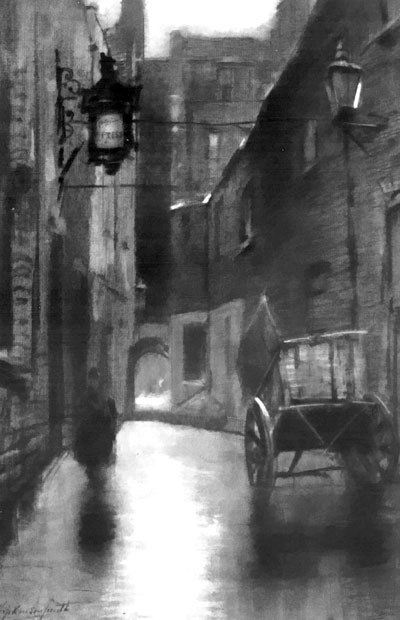
Please feel free to comment below this post for any final thoughts on Hard Times, or use the hashtag #DickensClub if you’re commenting on twitter. Please feel free to message Rach here on the site, or on twitter if you’d like a link to our Zoom meeting on Hard Times this Saturday, 14 October! The links will be coming to our members today. At that time, we’ll also discuss alternative meeting options for Little Dorrit, due to the holidays.
This week and next, we’ll be on our 2-week break between reads. We’d love to hear what you’re reading during the break, whether catching up or getting ahead on Dickens, or something else entirely!
We’ll see you again on Tues, 24 October for Boze’s introduction to one of the great novels, Little Dorrit!
 All the (Dickensian) Year Round
A wonderful wrap up, Rach! Thank you so much for all your dedicated work in pulling everything together so well. 😀 And what a great future resource these threads will be to any enthusiast who stumbles across them! 😀
I don’t know if anyone else clocked the rare error in Book III Chapter 7 ‘Whelp-hunting’… we could always blame it on the proof-readers (Forster?)
LikeLiked by 1 person
I wrote this as a reply to Stationmaster in the previous section’s thread (after wrap-up) but I think it is worth popping down here as well.
Thinking of what I said at some point about Hard Times actually being the longest of the shorter books, aka the 6th Christmas Book 😉
I would say that The Chimes delves into much darker terrain than Hard Times, yet in the former they are presented as a dream or vision and perhaps in some way lose a bit of the sting. There is quite an affinity between these two works. Trotty’s convictions that the poor are undeserving of happiness are modified by his vision. In the same way that the quiet influence of the emotionally intelligent and competent Sissy is a large part of leading Gradgrind to his better understanding of the balance between the head and the heart.
Gradgrind is redeemed throughout Hard Times, like Scrooge, Trotty, Tackleton, (Dr. Jeddler) and Redlaw – there are agents working their influence for good: the three spirits, the spirits of the bells, Dot and the Cricket, (Battle of Life is harder to see, but the sacrifice Marion makes for her sister is not far off Sissy’s care for Louisa in tackling Harthouse) and Milly Swidger (very much like Sissy I would say)
But if you think about what Sissy does throughout Hard Times when considering the ending of The Chimes (itself expressing the same final appeal as Hard Times) my theory kind of works 🙂
‘…and in your sphere—none is too wide, and none too limited for such an end—endeavour to correct, improve, and soften them. So may the New Year be a happy one to you, happy to many more whose happiness depends on you! So may each year be happier than the last, and not the meanest of our brethren or sisterhood debarred their rightful share, in what our Great Creator formed them to enjoy.’
or, in other words:
‘Dear reader! It rests with you and me, whether, in our two fields of action, similar things shall be or not. Let them be! We shall sit with lighter bosoms on the hearth, to see the ashes of our fires turn gray and cold.’
LikeLike
Since Rob shared his comment from the last post, I guess I’ll share mine that he was responding to though it’s not that interesting compared to his.
“I theoretically agree that Hard Times isn’t any grimmer or more political (in a bad way) than any other Dickens book. (Well, maybe more than The Pickwick Papers.) But all I can speak for is my experience reading it and whenever I do, I feel like it doesn’t transcend its political purpose quite as well as the author’s other books, though I can really only speculate as to why.
Interesting idea that Sissy is less like the heroine of the book than the mentor figure (like the ghosts, goblins and fairies of Dickens’s novellas.)”
LikeLiked by 1 person
It’s not a favorite book of mine or anything but I’d like to share this quote from The Little Prince by Antoine de Saint-Exupery, which feels like it could have been written for Hard Times. (I mean, the book, not the actual experience of living through Hard Times.)
“It is only with the heart that one can see rightly; what is essential is invisible to the eye.”
Incidentally, the 2015 movie, The Little Prince, featured a town, the design of which really reminded me of how Dickens describes Coketown. “The jail might have been the infirmary, the infirmary might have been the jail, the town-hall might have been either, or both, or anything else, for anything that appeared to the contrary in the graces of their construction. Fact, fact, fact, everywhere in the material aspect of the town; fact, fact, fact, everywhere in the immaterial.” And the character of the mother in the movie is very similar to that of Gradgrind.
https://fancaps.net/movies/Image.php?imageid=152452
https://fancaps.net/movies/Image.php?imageid=152464
LikeLiked by 1 person
Folks,
I have been occupied by an image—used variously—of a bird that flies ONLY with two wings. In this case, the two wings might be intellect (facts) and heart/spirit (fancy). A healthy integration of both dimensions would allow individuals and society to “soar.”
We certainly have yet to realize this balance in our education and social life.
This “fairy story of the industrial age” illuminates the grave dangers of constraint (really, tyranny)—presenting mere facts as the whole truth and nothing but the truth, effectively subordinating persons to their utility (the data of actuarial tables, for example).
Three disparate thoughts follow:
1. Bounderby: The comments about him have been excellent. I believe that his grandiosity (exemplified by his windy pontificating) arises, as psychologists would suggest, from a deep inferiority complex. His strange lie narrative allows him to revel in his supposed miserable upbringing. He is a true “person of the lie” (cf. M. Scott Peck), who comes to believe his lies to be “facts.”
2. Redemptive kindness and love: Sissy is balm for the beleaguered souls of those oppressed (and, yes, constrained) by unremitting facts. She has imagination, fancy, nurtured by a loving father and circus community. She has the capacity to soothe the wounded spirits of the facts-bludgeoned folks of Coketown.
3. Education: Education, at its Latin root, connotes drawing forth what is within the pupil—not forcing the student into an ideological mold. The Gradgrindian method is definitely not worthy of the noble concept of “education”!
I deeply resonate with the Ruskin insight about the brilliant exaggeration of Dickens. (Thanks, Rob!) Caricature at times, yes; but, always towards the end of telling the truth about individuals, about society, and about the evils of many social policies.
T
hanks for all of the great comments and, as Rachel has pointed out, illuminations. I, like many, had not read “Hard Times.” I certainly now appreciate it due to its in-depth “treatment” here!
Blessings,
Daniel
LikeLiked by 1 person
Is anyone still reading this comments section? Probably not but the Zoom meeting put me in the mood to try to sum up Hard Times’s moral, at least as it relates to parenting. It’s kind of an obvious summary but sometimes you’ve got to state the obvious and it relates to what Chris wrote about how Hard Times resonated with her life experiences.
The moral is…. girls just want to have fun. LOL. Well, more specifically, kids are determined to have fun somehow or other. Tom wasn’t allowed to have any fun in his youth, so once he got even partially out of his parents’ home, he went crazy and piled up gambling debts. (So much for Gradgrind’s philosophy making people good with money!) Louisa wasn’t allowed to have any romance in life and was encouraged to think of marriage in totally economic terms. This led to her almost committing adultery when she got the chance. Dickens’s message to parents is that if they don’t let their kids have any healthy outlets for having fun, they’re going to find unhealthy ones. Of course, there’s also a lot of stuff about employers and employees, but that’s the message as it relates to parents and children.
LikeLiked by 1 person
I suppose one only need look at Bart and Judy Smallweed for extra proof of this 😀
LikeLike