
Wherein your co-hosts of The Dickens Chronological Reading Club 2022-24 (#DickensClub) wrap up Week 1 (Installment 1) of our twenty-fifth read, The Mystery of Edwin Drood; with a chapter summary and discussion wrap-up.

By the members of the #DickensClub, edited/compiled by Rach
Friends, what a cracking opening! I don’t know about you, but I keep hearing “An ancient English Cathedral town?” like a musical refrain in my head.
We’ve discussed the enigmatic Jasper, the atmospheric cathedral town (and the claustrophobic interior state of some of its inhabitants), the pompous Sapsea, and the brief introduction to the sunny Minor Canon Crisparkle. What’s next? Also, we’d love to hear your first impressions about Jasper in the poll below…
But first, a few quick links:
- General Mems
- The Mystery of Edwin Drood, Chapters 1-4 (Installment 1): A Summary
- Discussion Wrap-Up (Week 1)
- Questions, Theories, & Polls…
- A Look-Ahead to Week 2 of The Mystery of Edwin Drood (27 Aug to 2 Sept, 2024)
General Mems
First of all, a huge “thank you” to Chris for posting her supplement to the introduction that Boze and I posted last week! Wonderful resources.
SAVE THE DATE: Our final Zoom chat of The Dickens Chronological Reading Club (#DickensClub) will focus on The Mystery of Edwin Drood. Join us on Saturday, 5 October, 2024! 11am Pacific (US) / 2pm Eastern (US) / 7pm GMT (London)! Email Rach if you’d like the link; she will send out the link via email the week of the Zoom chat.
If you’re counting, today is Day 966 (and week 139) in our #DickensClub! This week, we’ll be reading the second installment, or Chapters 5-9, of The Mystery of Edwin Drood, our twenty-fifth read as a group. Please feel free to comment below this post for the second week’s chapters or use the hashtag #DickensClub if you’re commenting on twitter.
For Boze & Rach’s “introduction” to Drood, including our reading schedule, please click here. For Chris’s supplement with additional resources for consideration, please click here.
No matter where you’re at in the reading process, a huge “thank you” for reading along with us. Heartfelt thanks to our dear Dickens Fellowship, The Dickens Society, and the Charles Dickens Letters Project for retweets, and to all those liking, sharing, and encouraging our Club, including Gina Dalfonzo, Dr. Christian Lehmann and Dr. Pete Orford. Huge “thank you” also to The Circumlocution Office (on twitter also!) for providing such a marvellous online resource for us. And for any more recent members or for those who might be interested in joining: the revised two-and-a-half year reading schedule can be found here. If you’ve been reading along with us but aren’t yet on the Member List, we would love to add you! Please feel free to message Rach here on the site, or on twitter.
The Mystery of Edwin Drood, Chapters 1-4 (Installment 1): A Summary
(Illustrated by Luke Fildes. Images below are from the Charles Dickens Illustrated Gallery.)
“An ancient English Cathedral town?* How can the ancient English Cathedral town be here! The well-known massive grey square tower of its old Cathedral? How can that be here! There is no spike of rusty iron in the air, between the eye and it, from any point of the real prospect. What is the spike that intervenes, and who has set it up?”
*Note: in the first two lines, “town” was replaced with “tower” in many editions.

Our dream-like opening begins with the juxtaposition of an “ancient English Cathedral town” with an Eastern landscape of “ten thousand scimitars” and “thrice ten thousand dancing-girls” and “white elephants caparisoned in countless gorgeous colours.” But we are in the dream of a young man, listening to the “unintelligible” utterances of his fellow opium-smokers as he wakes in a den belonging to a woman we will come to know as “Princess Puffer.” Then, in a final strange juxtaposition, we see the other half of his double life: John Jasper is also the “Lay Precentor” or choirmaster of Cloisterham Cathedral. He enters the singing throng just as certain words are intoned: “When the Wicked Man…”
We are then introduced to several of the “rooks” (clerical men) of the cathedral: the Dean; the obsequious and occasionally ungrammatical Mr Tope, “Chief Verger and Showman,” and the sunny, athletic Mr Crisparkle, Minor Canon, “fair and rosy…early riser, musical, classical, cheerful, kind, good-natured, social, contented, and boy-like.” All are commenting on Mr Jasper’s relatively poor health at the moment, and his shortness of breath–and on the imminent arrival of Jasper’s nephew, Edwin Drood.
“I hope Mr Jasper’s heart may not be too much set upon his nephew.”
After Crisparkle checks in on Jasper, Drood arrives, and is warmly welcomed by his uncle, John, or “Jack,” Jasper, who has towards his nephew “a look of intenseness and intensity—a look of hungry, exacting, watchful, and yet devoted affection.” Edwin Drood takes this for his uncle’s overzealous “modley-coddley” attention. Jasper still keeps an unfinished portrait of Edwin Drood’s intended, Rosa Bud (or “Pussy,” as Edwin calls her teasingly) hanging over his chimneypiece. They talk of Rosa, whose birthday it is, and Edwin complains not of his intended engagement to her in itself, but that it was so set out of old by their dead fathers; it was a foregone conclusion. Jasper begins to look ill, a film passing over his eyes, and he says it is the effect of the opium that he takes for a pain that is sometimes overwhelming. We also find out that Jasper hates the “cramped monotony” of his job. Edwin—whom, it is important to know, Jasper calls “Ned,” and he is the only one that does so—confesses that he himself is “a shallow, surface kind of fellow,” who nonetheless intends to carry Rosa off to “the East” when they are married, to continue his engineering pursuits.

As we are introduced to the old cathedral town of Cloisterham, we visit “the Nuns’ House,” nickname for Miss Twinkleton’s “Seminary for Young Ladies” where Rosa lives. All the young ladies there find romance in Rosa’s intended marriage with Edwin Drood. Drood visits her, and it is clear that they have a bantering, teasing relationship, perhaps more akin to brother and sister than lovers. It is also clear that, as much as they truly care for one another, they often deeply annoy each other. Interestingly, as they walk together and Drood says that he hears Jack’s (John Jasper’s) voice, Rosa seems eager to get away.
We are next introduced to Mr Sapsea, auctioneer and Mayor of Cloisterham, a blustering fellow in his fifties who lives near the Nuns’ House.
“He possesses the great qualities of being portentous and dull, and of having a roll in his speech, and another roll in his gait…”
They discuss Sapsea’s monument, and the tribute that will be inscribed upon its stone to Sapsea’s deceased wife—really, a tribute to himself. Jasper gives it admiring attention. Durdles enters the scene.
“Durdles is a stonemason; chiefly in the gravestone, tomb, and monument way, and wholly of their color from head to foot. No man is better known in Cloisterham…With the Cathedral crypt he is better acquainted than any living authority…”
They discuss Durdles’s familiarity with the whole of the crypt, and his damp and cold quarters which causes the “Tombatism” in him—and, more impressively, how he can tell where a body is located by tapping on the stones in the crypt.
Discussion Wrap-Up (Week 1)
Miscellany & What We Loved; Impressions of the “Introduction”; The Joys of Reading Dickens Aloud
A friend of ours has started the “Rach” + “Boze” = “Roze” thing, hence Dana’s reference here! Thanks so much for the kind words about our “Introduction” last week…

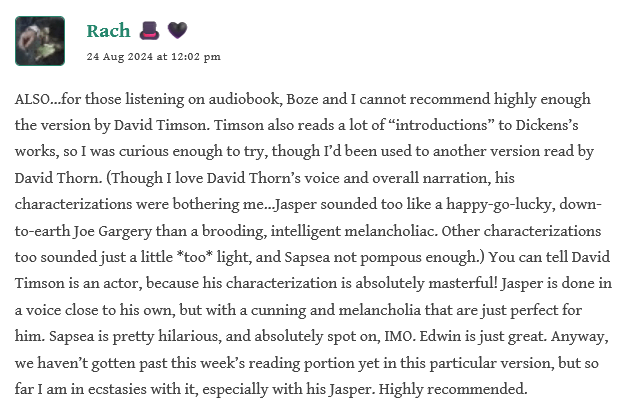
And in answer to her audiobook recommendation question, I just cannot say enough about David Timson’s so far…
Boze and I are THRILLED that Fr. Matthew Knight is back to join in for our final read together! As he is a newly-ordained priest in an incredibly busy parish, we’re so honored & thrilled he’s able to take the time to join in!

Daniel very kindly comments on the Intro, and what impressed him most strongly about the content:

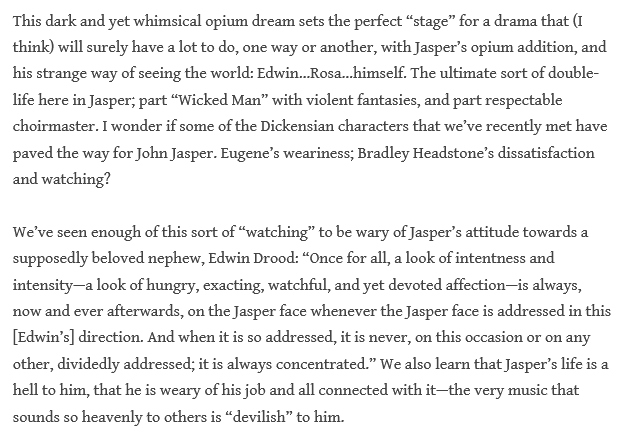
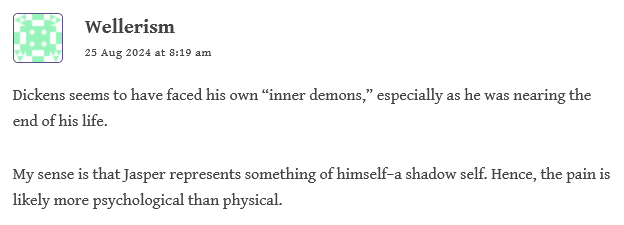
Character Spotlight on John Jasper: Addiction; Mental Health; Obsessive “Watching”; Bradley Headstone as Forerunner?
No doubt, the exploration of Jasper’s psychology will be an ongoing theme in our Drood detection, and Chris starts us out by commenting on the pervasive “watching” which was also prevalent in Our Mutual Friend. Everyone is “watching” one another–and themselves–and this creates, as she says, a “claustrophobic” atmosphere, as suggested by the very name of “Cloisterham”:

I comment along the same lines, wondering whether Eugene and Bradley are in some sense forerunners of Jasper:
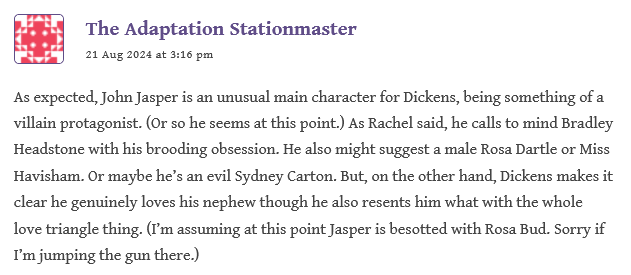
The Stationmaster is already considering Jasper as Dickens’s atypical “villain protagonist”:
More watching and strange behavior from Jasper, who remains a mystery to the reader. Chris comments on the wonderful nut-cracking scene between Edwin and “Jack” Jasper, and the tension created:


Dickens’s “Writing Lab”: Cloisterham/Rochester; Atmosphere; Characterization
The Pickwickians traveled to Rochester early on, and now “we’ve come full circle,” and the atmosphere is palpable:

I also comment on the reader’s early impressions of Crisparkle:

Daniel highlights a wonderful quote about Crisparkle, and those like him:

The Stationmaster is loving Mr. Sapsea, and finds his pomposity funnier than Podsnap’s:

The Women in Dickens: First Impressions of Rosa; the Relationship Between Edwin and Rosa
The Stationmaster finds a lot of similarities between Rosa and Bella, one of our former heroines in Our Mutual Friend; and there is a further connection in the two engagements–John’s and Bella’s; Edwin’s and Rosa’s–that had been the result of parental wishes and wills, rather than on personal inclination or choice:

Questions, Theories, & Polls…
For fun, we’ve created this separate section in our weekly wrap-ups, to consider some of the many unanswered questions. For Drood, these questions only seem to multiply and deepen over the course of the novel, whether you’re reading it for the first time, or the tenth…
I ask:

Daniel responds:
And a little poll about Jasper:

A Look-Ahead to Week 2 of The Mystery of Edwin Drood (27 Aug to 2 Sept, 2024)
This week, we’ll be reading the second installment, Chapters 5-9, of The Mystery of Edwin Drood. This section was published in All the Year Round in May of 1870.
Please share your thoughts on this section in the comments below, or use the hashtag #DickensClub if commenting on Twitter/X.
If you’d like to read it online, it can be found at sites like Gutenberg.
 All the (Dickensian) Year Round
Hello, friends.
Just popping by at long last to say I’m keeping up and joining in with this final read. When I say joining in, I mean keeping up and hoping to comment. Was a little late in finishing the week one section and no time to get thoughts together, but just wanted to say thanks to Boze and Rach for the wonderful intro and also this great recap. 😀
LikeLiked by 2 people
Well, I’m good and hooked, just by the “enigmatic” (insufficient word!) John Jasper.
Potential SPOILER alert???
I’ve not read this book before, only seen an adaptation a while back which I barely remember, But I remember enough to think, based on the first nine chapters, that if ED is about to be killed, or disappeared, there is no question in my mind Whodunnit, only whether he *knows* hedunnit…or else was in an opium dream the while in which his Darker Self took over.
Rach, I had the exact question in my mind about JJ’s reasons for taking the opium, his unnamed agony. I was waiting for some mention later of the infirmity, and since it never comes, per se, must conclude that it is his existential angst over his hatred of his life, his work, and his unspoken passion for Rosa, so intense it looms over her and terrifies her like a horror movie monster.
And as for JJ’s fierce (hate-love?) feelings towards Edwin, whom he must wish out-of-the-way at the very least bc of Rosa, Dickens’ portrayal of him reminds me a good deal of Melville’s Claggert in BILLY BUDD, which I just read. JJ, like Claggert, is an otherwise “respectable” man who harbors a darkness within, and it drives him to want to destroy the “Handsome Sailor” Billy who seems to have everything he does not–above all a sunny, “innocent” disposition.
JJ strikes me as one of those men who is ruled by impulses not entirely conscious. Which reminds me of the Jung quote, “Until you make the unconscious conscious, it will direct your life and you will call it fate.”
So, yes, I’m in the “villain protag” camp.
LikeLiked by 3 people
Love the comparison of JJ’s love-hate of Edwin to that of Claggart for Billy Budd! There seems to be an envy of…”contentment.” Of a sunny disposition. Of, in Edwin’s case, privilege and carelessness.
Love the idea that JJ might have done it but not fully realize he had done it…
LikeLiked by 1 person
One thing I forgot to mention about The Mystery of Edwin Drood last week was its use of present tense. While Dickens has used present tense on occasion in the past, I can’t remember any other Dickens where the first five chapters were all that way. I was rather disappointed when he switched to past tense in Chapter 6 and then went back to present tense in Chapter 8 and back to past tense in Chapter 9. Does anyone have any thoughts on what the purpose is of these changes?
I love to hate Mr. Honeythunder! He might be even funnier than Mrs. Jellyby and Mrs. Pardiggle in Bleak House though not quite as hilariously annoying as Chadband. His exchange with the driver about “brotherhood” is great, and I also love this bit.
“Mrs. Crisparkle had need of her own share of philanthropy when she beheld this very large and very loud excrescence on the little party. Always something in the nature of a Boil upon the face of society, Mr. Honeythunder expanded into an inflammatory Wen in Minor Canon Corner. Though it was not literally true, as was facetiously charged against him by public unbelievers, that he called aloud to his fellow-creatures: ‘Curse your souls and bodies, come here and be blessed!’ still his philanthropy was of that gunpowderous sort that the difference between it and animosity was hard to determine. You were to abolish military force, but you were first to bring all commanding officers who had done their duty, to trial by court-martial for that offence, and shoot them. You were to abolish war, but were to make converts by making war upon them, and charging them with loving war as the apple of their eye. You were to have no capital punishment, but were first to sweep off the face of the earth all legislators, jurists, and judges, who were of the contrary opinion. You were to have universal concord, and were to get it by eliminating all the people who wouldn’t, or conscientiously couldn’t, be concordant. You were to love your brother as yourself, but after an indefinite interval of maligning him (very much as if you hated him), and calling him all manner of names. Above all things, you were to do nothing in private, or on your own account. You were to go to the offices of the Haven of Philanthropy, and put your name down as a Member and a Professing Philanthropist. Then, you were to pay up your subscription, get your card of membership and your riband and medal, and were evermore to live upon a platform, and evermore to say what Mr. Honeythunder said, and what the Treasurer said, and what the sub-Treasurer said, and what the Committee said, and what the sub-Committee said, and what the Secretary said, and what the Vice-Secretary said. And this was usually said in the unanimously-carried resolution under hand and seal, to the effect: ‘That this assembled Body of Professing Philanthropists views, with indignant scorn and contempt, not unmixed with utter detestation and loathing abhorrence’—in short, the baseness of all those who do not belong to it, and pledges itself to make as many obnoxious statements as possible about them, without being at all particular as to facts.
The dinner was a most doleful breakdown. The philanthropist deranged the symmetry of the table, sat himself in the way of the waiting, blocked up the thoroughfare, and drove Mr. Tope (who assisted the parlour-maid) to the verge of distraction by passing plates and dishes on, over his own head. Nobody could talk to anybody, because he held forth to everybody at once, as if the company had no individual existence, but were a Meeting. He impounded the Reverend Mr. Septimus, as an official personage to be addressed, or kind of human peg to hang his oratorical hat on, and fell into the exasperating habit, common among such orators, of impersonating him as a wicked and weak opponent. Thus, he would ask: ‘And will you, sir, now stultify yourself by telling me’—and so forth, when the innocent man had not opened his lips, nor meant to open them. Or he would say: ‘Now see, sir, to what a position you are reduced. I will leave you no escape. After exhausting all the resources of fraud and falsehood, during years upon years; after exhibiting a combination of dastardly meanness with ensanguined daring, such as the world has not often witnessed; you have now the hypocrisy to bend the knee before the most degraded of mankind, and to sue and whine and howl for mercy!’ Whereat the unfortunate Minor Canon would look, in part indignant and in part perplexed; while his worthy mother sat bridling, with tears in her eyes, and the remainder of the party lapsed into a sort of gelatinous state, in which there was no flavour or solidity, and very little resistance.”
The Landless twins are certainly intriguing. Helena seems like the soul sister of Edith Dombey. Neville is what David Copperfield might have grown to be if not for Betsey Trotwood.
For better and for worse, Dickens seems to have wanted to give this book an exotic flavor. A “Chinaman” and a “Lascar” appear in the first chapter. Edwin intends to go to the East and the Landless twins were raised in Ceylon. This is unfortunate in that anything an author from Dickens’s culture wrote about such nationalities is going to be racist by our standards anyway. (Neville resents having been brought by members “of an inferior race” and everyone seems to blame some of his disturbing tendencies on their influence.) But I’d lying if I didn’t say all these characters from and references to (what were for the author) distant countries didn’t make for a nice break from Dickens’s unrelenting Englishness. It’s a change I didn’t realize I wanted.
Jasper grows creepier in this section as we learn of Rosa’s fear of him and see how he subtly sets Edwin and Neville against each other while still giving the appearance of a moderator. It’s frustrating how Rosa doesn’t tell anyone besides Helena how Jasper makes her feel, but I suppose it’s not unrealistic. Even today, when women are encouraged to tell people if men are making them uncomfortable with their advances, some of them are still afraid to do so.
I wonder if Reverend Septimus Crisparkle is the hero of this book in the sense that he’s the most positive character.
I’m enjoying the beginning of Edwin Drood better than the beginning of Our Mutual Friend. There were so many subplots being set up in the first quarter of that book with so little actually happening that it just felt unfocused to me (though it got much better as it went on.) Edwin Drood has stayed focused so far on the central characters who all live in the same community while still making time for great comedic supporting characters like Miss Twinkleton.
LikeLiked by 4 people
Rev. Mr. Crisparkle is certainly my favorite character so far, and it’s not especially close!
LikeLiked by 1 person
I, too, noticed the frequent present tense and thought it remarkable.
Any English Lit folks out there who can say when, where, or by whom this was used in novels before? It seems so very “now” to me, it is used so frequently in our time; but I can’t remember seeing it in Victorian (or earlier) times.
LikeLiked by 2 people
Great question! Boze and I are both giving it a ponder!
LikeLiked by 2 people
Boze just found this article which might shed light, suggesting that Dickens was the first to use the present tense in a systematic/sustained way!
LikeLiked by 2 people
Here is another link to an article regarding present tense usage specific to Dickens and Collins. The Dickens section begins on page 306 and deals quite a bit with Drood. Specific to your question, Dana, this article says, “Clarissa [1748] and other diary and epistolary novels had exploited the mode long before” Dickens and Collins. (299)
“Impounding the Future: Some Uses of the Present Tense in Dickens and Collins” by Susan Lynn Beckwith and John R. Reed. Dickens Studies Annual. 2002, Vol 32.
https://drive.google.com/file/d/1htx-wtK2K1Gi7g1yqwM6lOTecmXHQ_he/view?usp=sharing
LikeLiked by 2 people
Note re the above – very minimum spoiler alert in this article
LikeLiked by 1 person
How nice to have a truly good clergyman in Minor Cannon Crisparkle! He is the direct descendant of the Rev Frank Milvey from OMF; I’m trying hard to think of other “good” clergy in Dickens but I’m only bringing to mind clergy who either provide comic relief or are downright despicable. Crisparkle is “within five years of forty” (Ch 6) yet still very athletic which signals that, as his name suggests, he is experienced and capable. His relationship with his mother is refreshing. It is happy, playful, loving. She is neither domineering nor cowering as we’ve seen in past mother-son relationships. Rather, she fully supports her son, yet does not hold back her opinion but states it clearly and fairly rationally. She has her prejudices, but they are honest ones.
Mr Grewgious is another good man – another Brownlow, Cheeryble, Jarndyce, Lorry type. Like Mr Lorry, Mr Grewgious has a delicacy, thoughtfulness and directness about him that engenders trust. His name – “grew” with the “ious” suffix (meaning “having qualities of” or “characterized by”) – seems to imply that he is still or capable of growing, or of changing.
Indeed, the narrator tells us he “looked as though Nature had been about to touch [him] into sensibility or refinement, when she had impatiently thrown away the chisel, and said: ‘I really cannot be worried to finish off this man; let him go as he is.’” (Ch 9) I think perhaps his dried angularity is more absorbent (if you will) and rounded than it appears.
The jousting between Neville and Edwin in Ch 8 is nicely rendered and seems to disprove Mr Crisparkle’s prediction that “like takes to like, and youth takes to youth” (Ch 6) unless one considers that untested young bucks WILL spare for dominance. Jasper takes advantage of this and exacerbates the situation with especial “mixing and compounding”, including running to Mr Crisparkle’s to tattle on Neville. One must also wonder if Jasper might not also be the “means” by which “the news” of the “quarrel between the two young men” had “got into Miss Twinkleton’s establishment before breakfast” (Ch 9)
Neville and Helena are an interesting brother-sister duo. They are unique in that they are twins but differ from other twins we have met – the Cheeryble Brothers, the Flintwinch brothers, and perhaps Mrs Micawber’s twins (whose sex is never mentioned) – in that they are fraternal. Close-knit brother-sister relationships we have had, most notably Nicholas & Kate Nickleby, Sampson & Sally Brass, and Tom & Louisa Gradgrind. But what sets Neville and Helena apart from these is their symbiosis. In his book, Dickens and Mesmerism: The Hidden Springs of Fiction, Fred Kaplan describes their bond this way:
“They are the single psychological self divided, each incomplete alone, two parts of a metaphor of wholeness. They have special means of sympathetic communication, a kind of mesmeric telepathy or clairvoyance. Their communications are carried on special waves of fluidic sympathy . . . But there are differences between them. They are not a simple replication of the original bit of protoplasm. They are different and complementary. They must be joined together to make one, but that joined one is different from each separate one.” (122)
Dickens was a student and practitioner of mesmerism so his use of it here is informed and it will be interesting to see how he utilizes it as the novel progresses. In addition to Neville and Helena, Kaplan explains that Dickens has given Jasper “a full armament of mesmeric weapons: the power of his music, eyes, hands, touch, voice, presence.” Jasper’s “’optic vision’ is extraordinary” in that he has both “eyes that are closed in upon themselves, which see nothing, and stare with a blindness to self and others that is the result of loss of power to communicate. And . . . eyes that reach outward toward others to establish a subject-operator relationship, intent upon the transmission of mesmeric influence.” (131) The former presents during his opium use and at odd times when his habit seems to catch up with him (see Ch 2 when “a strange film come[s] over [his] eyes” e.g.,); the latter during his interactions with others he wishes to dominate (e.g. Rosa).
But just how powerful are Jasper’s eyes? Clearly they affect Rosa during her after-dinner performance and, she reports to Helena, during her music lessons with him. And though she feels “He has made a slave of me with his looks. He has forced me to understand him, without his saying a word; and he has forced me to keep silence, without his uttering a threat”, Rosa seems to be able to combat his “power” to a certain extent. (Ch 6) Says Kaplan, “She seems able to protect herself at the edge of domination by the interruption of hysteria.” (183) How long she will be able to protect herself remains to be seen – but at least now she has a champion of sorts in Helena. And I wonder if, as Rosa grows through the novel, she finds strengths other than hysteria to use against Jasper’s eyes.
LikeLiked by 4 people
That’s an interesting point about Mrs. Crisparkle being a rare positive mother figure in Dickens. Well, it’s not there aren’t good mothers in Dickens, like Mrs. Bagnet in Bleak House, but it seems like that’s only when they’re mothers to background characters. If the main character has a mother, she’s either annoying, like Mrs. Nickleby, weak, like Clara Copperfield or Mrs. Gradgrind, or downright evil like Mrs. Skewton.
LikeLiked by 1 person
Thoughts on Chs 5-7:
We have proof of the temper & violence that Jasper is capable of when it comes to the stone-throwing boy, “Deputy.” Obviously, he’s a pretty wild kid and perhaps needs some sternness from an adult, but Jasper’s threat, “…or I’ll kill you!” is terrifying and totally out of proportion, and gives us a clue to Jasper’s character. And is there more to Jasper’s threat than only for Durdles’s sake? It’s both eccentric and rather endearing that Durdles, in his rough way, is trying to help the kid out by paying him a little to use his more destructive or harmful tendencies for a good cause—helping keep watch that Durdles isn’t out too late. But is Jasper threatened by the idea that this kid is on the watch for those out too late? Does Jasper have any late-night plans upcoming, around the Cathedral’s crypt…?
Crisparkle is an absolute gem (no pun intended…sparkle/gem!). He’s seen by the (rightfully) suspicious Landless twins, though they have both suffered such terrible treatment and were determined not to like him, as one who proves himself trustworthy right away, as we see in their warmth and confidence with him.
I LOVE the immediate characterization of Helena as strong, fearless, protective. The way Neville talks about her as one who “would have let him [their cruel stepfather] tear her to pieces, before she would have let him believe that he could make her shed a tear.” We find other fascinating tidbits that may or may not come into play later: she has “the daring of a man”; she even dressed herself up as a boy during their attempts to escape their cruel treatment. I also love the intimation of telepathy between the Landless twins: the “complete understanding” that exists between them, “though no spoken word—perhaps hardly as much as a look—may have passed between us.” As Chris writes of above, the suggestion of a telepathic connection. Helena also instantly takes a protective position vis-a-vis Rosa, who is Helena’s opposite: timid, anxious, threatened.
Honeythunder—what a boil on the face of society…love that whole passage! He is pretty hilarious. 😉 Can’t decide whether he or Sapsea deserves the award for pomposity!
Anyway, more anon re: the final 2 chapters of this installment.
LikeLiked by 3 people
Thoughts on Chapter Eight:
Chapter Eight, “Daggers Drawn,” is a doozy. Forgive the bluntness, but I find Edwin to be a real jerk in this scene. Privileged, careless in the worst way, and racist. Though Neville could perhaps have acted with less emotionality, frankly I’m entirely with Neville here, and find Edwin exasperating. I find that Neville’s honest disdain of Edwin’s carelessly proprietary attitude about Rosa is endearing, and much more worthy of respect than Edwin’s attitude. Also, the fact that, charged as he was, Neville went right to Crisparkle to confess everything, says a good deal.
Jasper’s stance during the scene at the Gatehouse is a very murky one. He seems at first all good humor and good fellowship with these two as he leads them off to his place for a drink and a chat. Then, however, he seems to provoke them to anger, and to observe with too much interest their dislike of one another. These lines (and the way the drink affects the young men after) suggests to me that Jasper has put something into the drink to heighten their emotions: “Jasper looks observantly from the one to the other, slightly smiles, and turns his back to mix a jug of mulled wine at the fire. It seems to require much mixing and compounding.”
Jasper also seems to suggest to Neville some of the reasons to dislike Edwin that (perhaps?) he, Jasper himself, dislikes Edwin for: “Look at him [Edwin]!…See where he lounges so easily, Mr Neville! The world is all before him where to choose. A life of stirring work and interest, a life of change and excitement, a life of domestic ease and love! Look at him!”
LikeLiked by 2 people
Yes! I also wondered if Jasper might have put something more than sugar and spice into their wine. This footnote in the Penguin Classics edition seems to suggest as much:
“a blood-red whirl, waiting to be struggled with, and to struggle to the death: The toxic effects of the drug resemble those experienced by John Harmon. On drinking some coffee, he finds himself in a whirling state as he drops down on the ground with a sense of flames flashing before his eyes (Our Mutual Friend, 2.13)” [fn. 8]
Of course, we’re not dealing with coffee in this case, but something stronger … maybe some of that “doctor’s stuff” Mr. Jasper claims to dislike?
LikeLiked by 3 people
Fr Matthew, I *love* this idea about the kind of thing that Jasper might’ve put into the wine, and thanks for the note about the connection with OMF…I didn’t even think about that! That falls right…!
LikeLiked by 2 people
I didn’t pick up on that hint that Jasper drugged Edwin and Neville. Thanks for pointing that out! I hesitate to say I like Neville (except in the sense that he’s a larger-than-life character) but I’d agree that he come across as a more sympathetic figure than Edwin here.
LikeLike
Agreed, I’m finding it hard to like Edwin much. Not that he’s malicious, mind you, just clueless about his own advantages. And perhaps even a bit of a narcissist in his seeming inability to imagine Rosa’s value beyond a reference to himself.
LikeLiked by 2 people
I listened to the first four chapters last night (the Audible “Dickens Collection” edition narrated by Billy Howle and Lucinda Hawksley—highly recommended!) and read on through chapter nine today in the print edition. First impressions:
LikeLiked by 3 people
Darn, WordPress edited out all my paragraph breaks!
LikeLiked by 1 person
Fr Matthew, what a *marvelous* collection of thoughts here!
(Btw, I tried to edit the comment from my end to add the breaks, but it looked like it was going to mess up the list format…so strange that it shows it in the editing section as having a space between, but doesn’t end up doing so when the comment is posted! Hmm…)
Love the source you found for the rest of the phrase in the hymn, “When the wicked man…”! Fantastic. I can totally see Dickens going that route with JJ. At least, that JJ has the opportunity to repent. Would it have come to ultimate despair, or would he have taken the opportunity…? Anyway, there are some things that Dana and I were discussing about this, but it gets a bit ahead of the reading portion, so we’ll add that later.
I too LOVE the “disorienting” opening, and I don’t think that there is anything else quite like it in Dickens. Certainly, he has some of the most memorable, atmospheric openings, and even adds elements of the fantastical–e.g. imagining a “megalosaurus” waddling up Holborn Hill in the fog of Bleak House. But nothing quite so like a dream or vision as here.
Agreed about Minor Canon Crisparkle; he is absolutely marvelous. Love his good humor, his utter acceptance of people, while still calling a spade a spade. I love his mentorship of Neville. It is so great that you mention Kit Nubbles! In a moment of his usual humor, George Bernard Shaw, who acted as foreman in the “Trial of John Jasper” that the Dickens Fellowship put on (with G.K. Chesterton as Judge), quipped that Minor Canon Crisparkle was actually Kit Nubbles full grown! Love that.
LikeLiked by 1 person
I looked up some of the completions/adaptations of Edwin Drood, & after some hunting found a BBC radio version of Leon Garfield’s completion. Leon Garfield wrote *Devil in the Fog* and *Smith*, dark novels for children about Victorian London. It was broadcast in 1990. Anyway, here it is on Internet Archive: https://archive.org/details/EdwinDrood1990
LikeLiked by 3 people