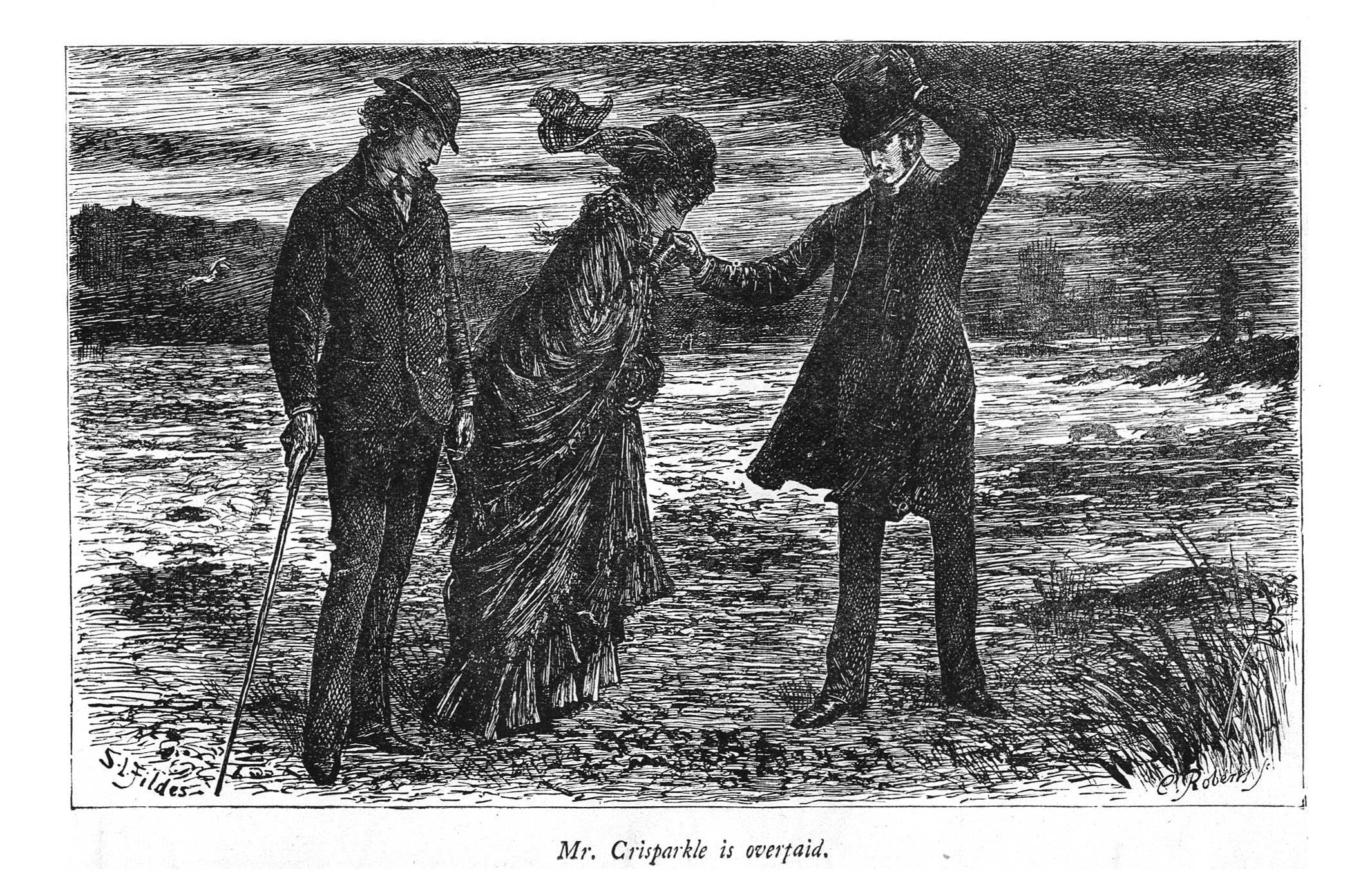
Wherein your co-hosts of The Dickens Chronological Reading Club 2022-24 (#DickensClub) wrap up Week 3 (Installment 3) of our twenty-fifth read, The Mystery of Edwin Drood; with a chapter summary and discussion wrap-up.
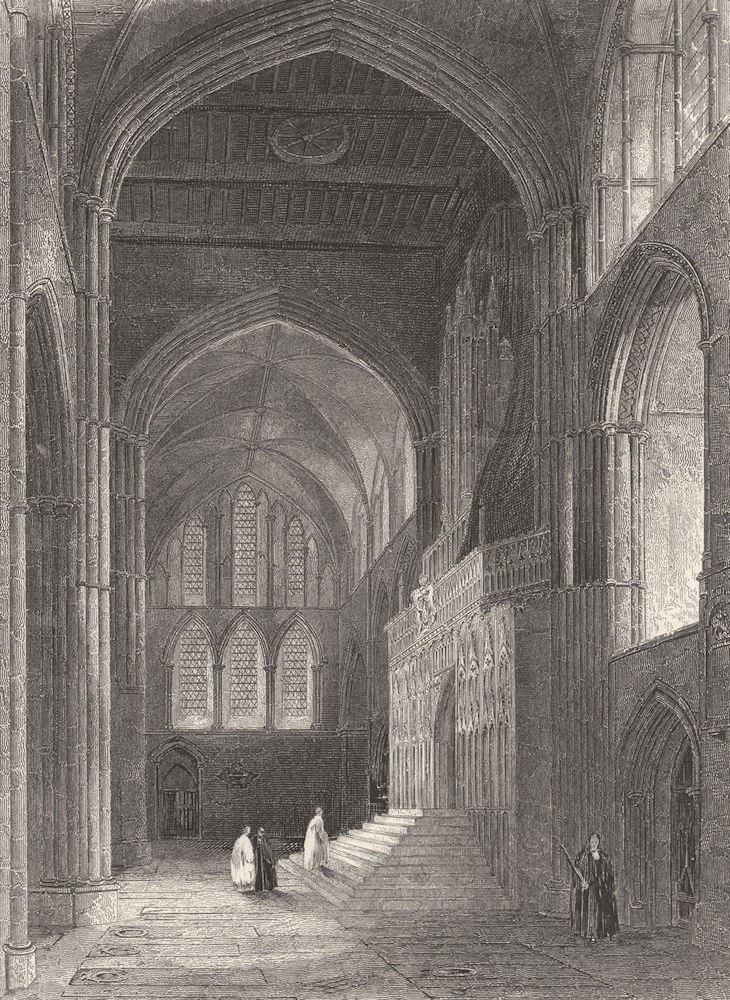
By the members of the #DickensClub, edited/compiled by Rach
Friends, as Chris writes, the plot thickens! What was Jasper up to during those hours–perhaps as long as 4-5 hours–while Durdles was asleep during the nighttime tour of the Cathedral?
Does Edwin, perhaps for the first time, begin to take something truly seriously–e.g. the commission from Grewgious about the ring? Or, as Dana has said, is Edwin beginning to think of Rosa as an independent and worthy being, apart from his own needs/wants?
These and many other questions are part of this week’s Drood discussion. Please let us know in the comments–and in the poll below–what you think!
- General Mems
- The Mystery of Edwin Drood, Chapters 10-12 (Installment 3): A Summary
- Discussion Wrap-Up (Week 3)
- Questions, Theories, & Polls…
- A Look-Ahead to Week 4 of The Mystery of Edwin Drood (10-16 Sept, 2024)
General Mems
SAVE THE DATE: Our final Zoom chat of The Dickens Chronological Reading Club (#DickensClub) will focus on The Mystery of Edwin Drood. Join us on Saturday, 5 October, 2024! 11am Pacific (US) / 2pm Eastern (US) / 7pm GMT (London)! Email Rach if you’d like the link; she will send out the link via email the week of the Zoom chat.
If you’re counting, today is Day 980 (and week 141) in our #DickensClub! This week, we’ll be reading the fourth installment, or Chapters 13-16, of The Mystery of Edwin Drood, our twenty-fifth read as a group. Please feel free to comment below this post for the fourth week’s chapters or use the hashtag #DickensClub if you’re commenting on twitter.
For Boze & Rach’s “introduction” to Drood, including our reading schedule, please click here. For Chris’s supplement with additional resources for consideration, please click here.
No matter where you’re at in the reading process, a huge “thank you” for reading along with us. Heartfelt thanks to our dear Dickens Fellowship, The Dickens Society, and the Charles Dickens Letters Project for retweets, and to all those liking, sharing, and encouraging our Club, including Gina Dalfonzo, Dr. Christian Lehmann and Dr. Pete Orford. Huge “thank you” also to The Circumlocution Office (on twitter also!) for providing such a marvellous online resource for us. And for any more recent members or for those who might be interested in joining: the revised two-and-a-half year reading schedule can be found here. If you’ve been reading along with us but aren’t yet on the Member List, we would love to add you! Please feel free to message Rach here on the site, or on twitter.
The Mystery of Edwin Drood, Chapters 10-12 (Installment 3): A Summary
(Illustrated by Luke Fildes. Images below are from the Charles Dickens Illustrated Gallery.)
Crisparkle and his mother discuss the altercation between Drood and Neville; his mother is prejudiced against Neville, and her son defends him, reiterating how sorry he is. Crisparkle then begins to reflect and reminisce on the times that he has seen Neville and his sister together; of their strong connection, and feels a tenderness about it—that, in teaching Neville, he is, in some way, teaching Helena, too. On seeing the twins walking together, Crisparkle joins them, urging Neville to make an apology to Drood. That he should not undertake to be Rosa’s champion when another man is intended for her husband. Though Neville refuses at first, he agrees when Crisparkle says that he will speak to Drood, and encourage Drood to do the same and to meet Neville halfway. Helena gratefully acknowledges the good influence that Crisparkle has over her brother.
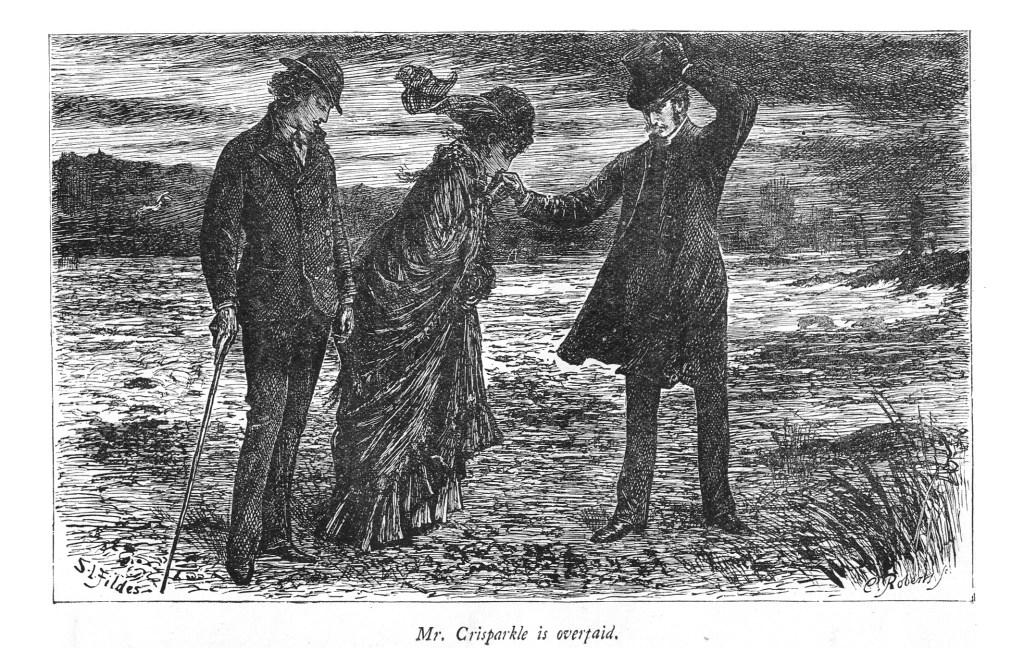
“She took the hand he [Crisparkle] offered her, and gratefully and almost reverently raised it to her lips. ‘Tut!’ said the Minor Canon, softly, ‘I am much overpaid!’ And turned away.”
Crisparkle visits Jasper, convincing him to speak to Drood about making peace with Neville, and Jasper agrees, though he seems to have an enigmatic reluctance about it all, and makes a point of showing Crisparkle his diary entries where he recounts visions of dread he has about Neville’s murderous intent about Drood.
We then visit Mr Grewgious—with his eccentric clerk, Mr Bazzard—at Staple Inn. Bazzard seems to have a kind of hold over Grewgious, though not in a malicious way; it is as though Grewgious feels that Bazzard’s life were intended for greater things, and that Grewgious should always show proper respect and gratitude for his having remained his mere clerk. (We come to find out that Bazzard, who had written a play—the Thorn of Anxiety—has had no success in his theatrical endeavours.) Drood visits. After Grewgious states what he believes to be the frame of mind of one who truly loves—unconsciously making Drood uncomfortable, as he cannot recognize the description in himself—he gives Drood a ring “of diamonds and rubies delicately set in gold” which had belonged to Rosa’s mother, to whom Grewgious clearly had a special devotion. It is to be given to Rosa, except in the case that Edwin and Rosa should not be married; in which case it is to return to Grewgious for his keeping. Grewgious lays stress on this; it is a sacred trust.
“Your placing it on her finger…will be the solemn seal upon your strict fidelity to the living and the dead…If anything should be amiss, if anything should be even slightly wrong, between you; if you should have any secret consciousness that you are committing yourself to this step for no higher reason than because you have long been accustomed to look forward to it; then…I charge you once more, by the living and by the dead, to bring that ring back to me!”
Grewgious calls upon Bazzard—to whom he had suggested to not pay too much attention to their conversation until this moment—to witness the transaction; the gift of the ring.
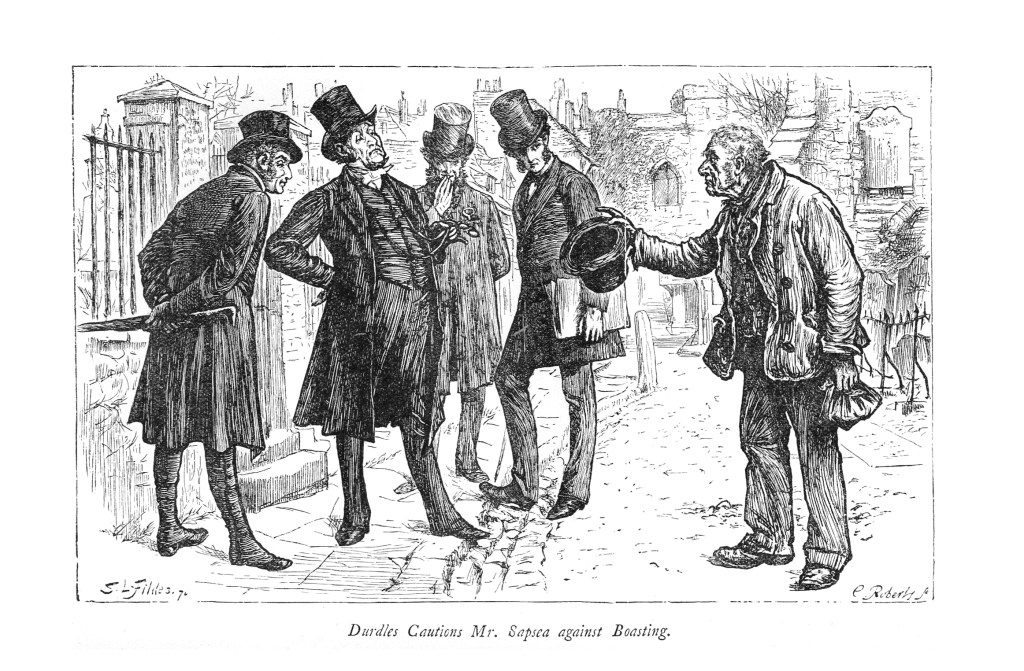
After a conversation with Sapsea–who has some idea that Jasper is going to write a book about the cathedral–Jasper goes on his nightly expedition with Durdles among the crypts of Cloisterham Cathedral, armed with a bottle of strong wine in payment of Durdles’ time.
“…its [the wine bottle’s] contents enter freely into Mr Durdles’s circulation, while Mr Jasper only rinses his mouth once, and casts off the rinsing.”
They ascend the great tower of the cathedral, and fall into discussion about strange cries heard there by Durdles in the past—specifically, a “ghost of a cry” that Durdles heard last Christmas Eve. Durdles then grows extremely drowsy, and falls into a kind of “dream” state, where he is watching Jasper walk to and fro, and of something falling from his hand and something being taken by Jasper, and of a clinking, and then Jasper’s footsteps seem to die away for a long time before returning. When he finally wakes, he wonders why Jasper didn’t wake him sooner, for a couple of hours have passed. Jasper claims that he had tried, but “I might as well have tried to wake the dead.” Upon leaving the cathedral, stones start flying from the hand of the “baby-devil,” known as Deputy. Jasper is so angered at having been watched that he violently threatens and collars the boy, who escapes from his clutches. Durdles asks Jasper not to hurt the boy.
Discussion Wrap-Up (Week 3)
Friends, for the discussion wrap-up this week, I was inclined to keep the comments more intact and to organize them by chapter rather than thematically–except for the first two–because of the nature of the discussion.
Miscellany & What We Loved
I posted a short piece on some visuals for the real-life Rochester, model of Cloisterham, based on Robert Langton’s 1880 book.
Character Spotlight on John Jasper & the Double Life
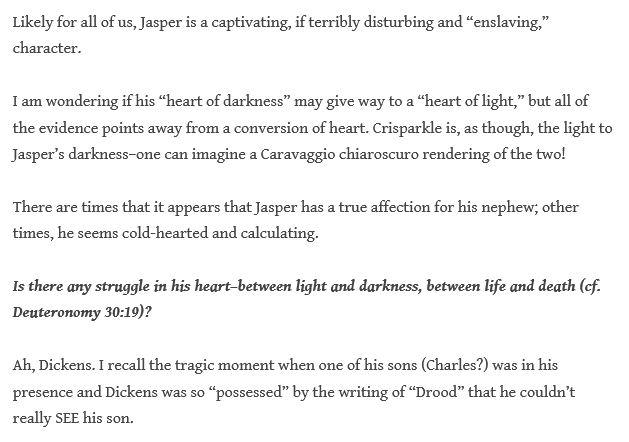
Daniel loved the wrap-up last week, and follows up on the comments surrounding the light/darkness of John Jasper, and where such struggles perhaps found an echo in Dickens himself, as in all of us:
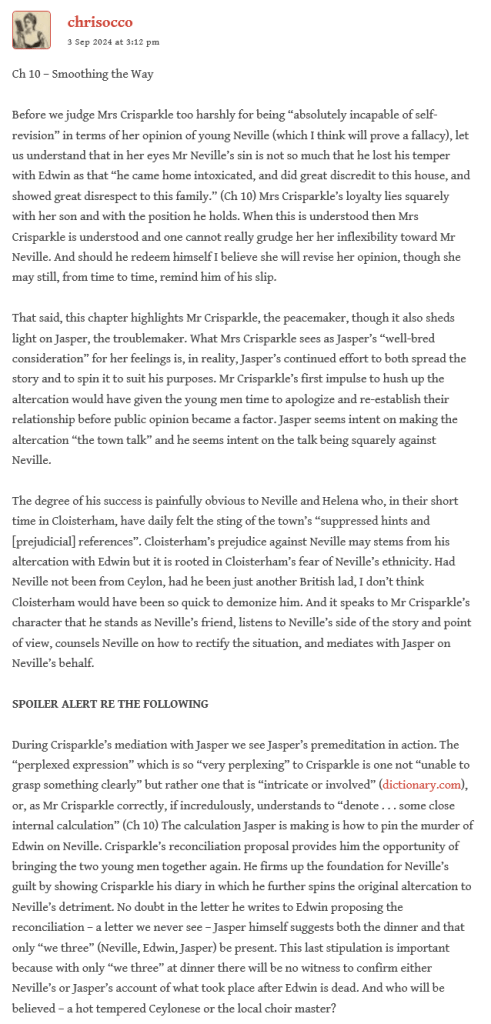
Chapter 10, “Smoothing the Way”: Apologia for Mrs Crisparkle; Mr Crisparkle as Peacemaker; Prejudice against Neville; Jasper as “Iago”
Chris defends Mrs Crisparkle for her sternness about Neville, arguing that her indignation has more to do with discredit to her family and her beloved son Septimus than anything else, and that she would amend her opinion, given time. She also commends our “hero,” Crisparkle, for defending Neville in the face of the prejudice the Landless twins are subject to. In addition, she considers Jasper’s premeditation:
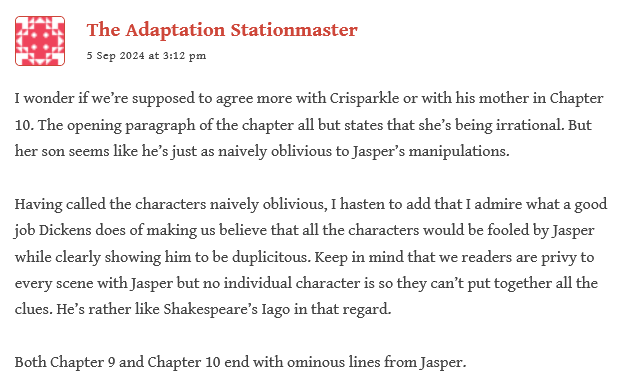
The Stationmaster admires “what a good job Dickens does of making us believe that all the characters would be fooled by Jasper while clearly showing him to be duplicitous” & that he is “rather like Shakespeare’s Iago in that regard”:
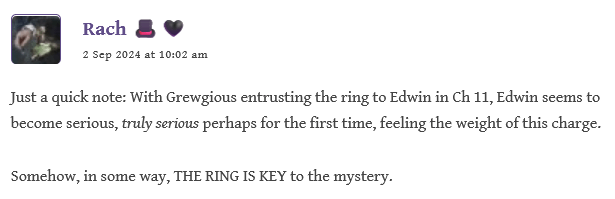
Chapter 11, “A Picture and a Ring”: The Ring as Possible Key to the Mystery; A Serious Moment for Edwin; Mr Grewgious
In Chapter 11, Edwin is faced with a more serious and sacred commission and charge than he has faced during the brief time the reader has spent with him. Grewgious insists that unless his intentions towards Rosa are of the most serious and devoted nature–untainted by doubt or the careless acceptance of the long-held belief that they should be together–he must absolutely return the ring to Grewgious.
I believe that this ring would have proven to be a key to the mystery of what happened:
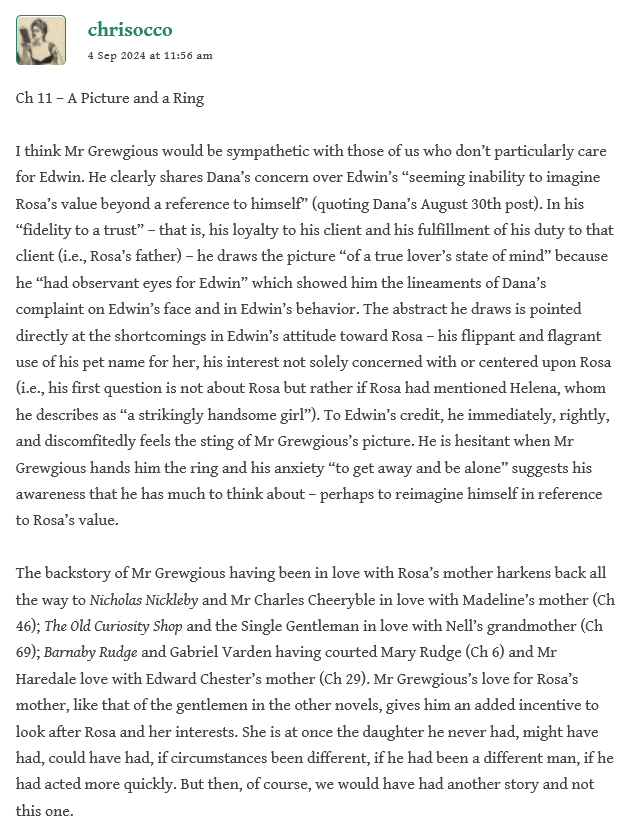
Chris considers Grewgious’s stance–and ours–towards Edwin, though the latter does himself some credit during this scene, when he shows the more earnest side of his nature. She also considers Grewgious and his history:
The Stationmaster is intrigued by the same thing:

Chapter 12, “A Night With Durdles”: Jasper’s Actions while Durdles Was Sleeping; Durdles’s “Dreams”; Deputy’s Threat to Jasper’s power
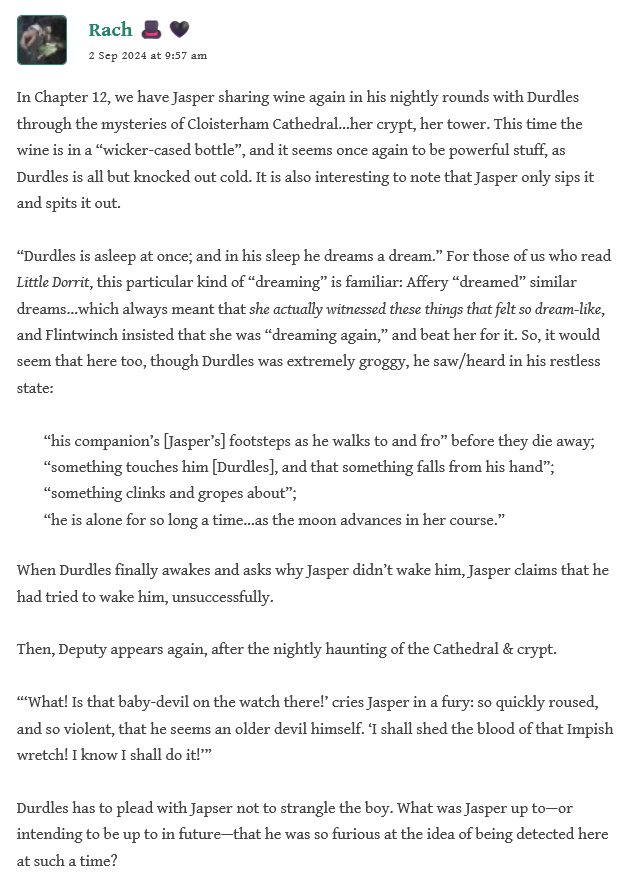
I consider Jasper’s actions during the Cathedral tour, and the way in which Durdles’s “dream” is described, which is reminiscent of Affery’s “dreams” in Little Dorrit, which the reader knows to be actual occurrences and things she has witnessed, though they have a nightmare or strange quality about them:
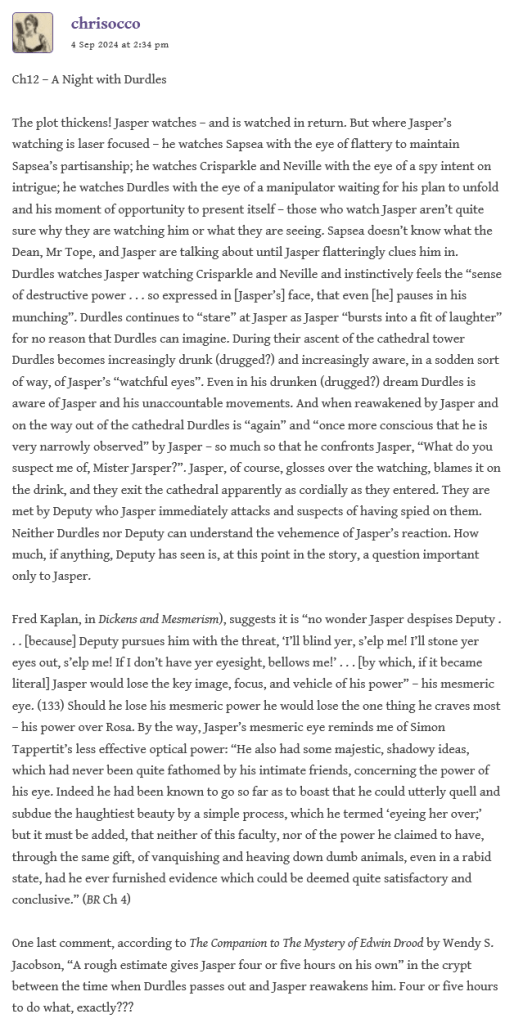
Chris writes of the possible drugged wine, and of the watching & being watched that is going on in this scene. She also gives us a possible interpretation, from Fred Kaplan, about the source of Jasper’s ire at Deputy:
The Stationmaster writes:
Aggravating, indeed!
Questions, Theories, & Polls…
Both Chris and I ask about what Jasper was up to while Durdles was sleeping, and Chris’s source suggests that it could have been as long as 4-5 hours!

I respond with a few ideas of what Jasper might have been up to.
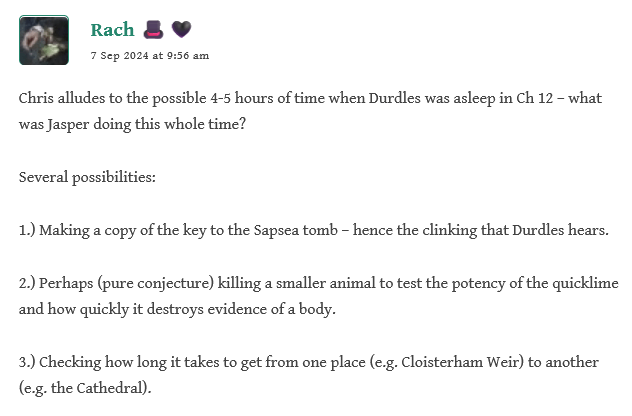
But what do you all think?
A Look-Ahead to Week 4 of The Mystery of Edwin Drood (10-16 Sept, 2024)
This week, we’ll be reading the fourth installment, Chapters 13-16, of The Mystery of Edwin Drood. This section was published in All the Year Round in July of 1870.
Please share your thoughts on this section in the comments below, or use the hashtag #DickensClub if commenting on Twitter/X.
If you’d like to read it online, it can be found at sites like Gutenberg.


Marvelous summary, as always, Rachel! When J.J. gave Durdles the bottle to drink, I wanted to cry out, “Don’t drink the wine!” So, yes — I think he drugged or ‘fortified’ it with something to make the sexton sleep. The fact that Jasper himself doesn’t drink it is just too suspicious, to say nothing of this line: “I have suspicions that my bottle was filled with something stiffer than either of us supposed” (p. 139). (Of course, one might say, if Jaspers drugged the wine, why call special attention to it in this way? I’m not sure, other than that the remark might serve his sense of humor; Durdles “condescends to laugh” at it, but perhaps Jaspers is having his own private laugh at the other man’s expense, knowing what the bottle really contained?)I
I loved Mr. Grewgious in chapter 11. He’s a good man, very much in the Mr. Lorry way, as Chris pointed out before — and he has more than a bit of “a true lover’s heart” about him, despite his protestations about being all businesslike and ‘angular’! His care for odd Mr. Bazzard is delightful—”he mightn’t like it else”—and the scene at the fireside where he indirectly rebukes Edwin and takes him to task for his treatment of Rosa was a tour de force. Edwin was absolutely outmatched from the start of their conversation:
Mr. Grewgious is straight as an arrow, and he pierces Edwin’s devil-may-care attitude like no one else. An extremely satisfying scene. More so, to see Edwin actually take his advice to heart: “He must not make a plaything of a treasure. Woe betide him if he does!” (p. 122)
I keep thinking, if this were a romance (or perhaps, the work of a lesser writer), all signs would point to a double marriage: Edwin marrying Helena Landless and Neville marrying Rosa. The set-up is there in the first half: Edwin clearly admires Helena—calls her a “strikingly handsome girl” (p. 117); Neville admires Rosa and hates Edwin’s casual treatment of her; and now Edwin and Rosa’s engagement is broken off, leaving the way free and clear for each to end up with the “right” partners. But Edwin’s upcoming disappearance is going to throw a wrench in the works. What do we think, DCRC? Could the Imitable have intended a happy ending for Edwin Drood after all? Or is all this set-up so much red herring?
LikeLiked by 3 people
SUCH wonderful thoughts, Fr. Matthew. As to the double marriage, I agree that initially things point that way. I won’t say anything about Rosa as yet, but my theory about Helena is that Rev Crisparkle is the likeliest candidate. The way it is hinted that, by teaching Neville, he is somewhat imparting his learning to Helena too, shows his regard for her. I think the moment where she kisses his hand and he “is much overpaid” might be another hint in that direction. I’m not sure, but I think that’s where I’d like to see it.
Even though Edwin, if he is alive, has the potential to have a Martin Chuzzlewit-like character arc (from selfishness to humility and respect of others), he seems like such a relatively weak character in contrast with Helena & Crisparkle?
But I 100% agree that this kind of Shakespearean double-marriage does seem to be the way indicated at the opening, and IF Edwin is alive…!!
Ah, so many possibilities…!!
LikeLiked by 1 person
Ch 13 – Both at their Best
Bravo! I love this chapter because finally we have two Dickens characters acting sensibly with each other without highfalutin language or overdramatized action. Just straight, to the point, statements of understanding of what is obviously the situation between two people. And the fact that the two people are neither sadder but wiser middle-agers nor sage Aged Parents who have seen it all but teenagers who have no experience and only themselves to consider emphasizes the impact.
Rosa could have simply pouted and whimpered about her situation; Edwin could have “drifted . . . without another pause for real thought”. Instead, both take to heart Mr Grewgious’s suggestion to give serious and careful thought to their futures: Rosa “ponder[s]” her situation while Edwin “consider[s]” his. That they do so shows maturity beyond their years. Rosa who until now appeared to be simply another Dickensian charming little coquette, speaks seriously, courageously, composedly and immediately from her heart. And she is met by an equally serious, courageous, and composed Edwin. Edwin’s wise decision not to show Rosa the ring also points to his maturing attitude. He is still, however, a bit of a coward in his quick and easy acquiescence to Rosa’s suggestion that Mr Grewgious be the one to break the news of their separation to Uncle Jack. Yet here I cannot blame him – I’m a little afraid of Jack, too! Edwin’s and Rosa’s joint desire to avoid Uncle Jack at this time stems from their very different understanding of what his response will be to the news. Edwin’s concern is that Jack will “be struck all of a heap by such a sudden and complete change” and will be disappointed in him. Rosa’s concern, as she shared with Helena in Ch 7, runs much deeper.
Rosa’s character takes a big leap forward in this chapter. She begins to move from being, as I said above, another Dickensian charming little coquette to being a thoughtful, serious person. In further praise of Rosa I submit this chapter by Dr Pete Orford, “The Unfinished Picture: The Mystery of Rosa Bud”, from Dickens After Dickens, ed. Emily Bell. The first section wherein Orford “re-evaluat[es] Rosa as she appears in Dickens’s text, arguing for the potential blossoming of her character” can be read without worrying about spoilers. BUT SPOILER ALERT in the remaining sections which discuss what might have been for Rosa had Dickens lived to complete her story and in Droodists completions/solutions to the story.
https://drive.google.com/file/d/1BI4fhIZSYKz7rZCMn5W9FMCbMrlnmC7R/view?usp=sharing
LikeLiked by 4 people
Greetings, Inimitables!
What a strange and captivating story and journey we are all on!
I resonate with so much that has been observed and shared, including the ever-haunting wondering about what Dickens was thinking and where he was heading . . . realizing with dismay that we shall never know!
I try to imagine the readers of the time, waiting with held breath until the next installment would see the light of day. What they must have experienced at the news of THE INIMITABLE’S death and the veritable end of his story. Oh, my!
I appreciate your questions, Father Matthew: What do we think, DCRC? Could the Imitable have intended a happy ending for Edwin Drood after all? Or is all this set-up so much red herring?
Sensing that Dickens was essentially a true romantic–someone who believed in the goodness of things overall and the possibility of deep and enduring love, I am intrigued by the possibility that Edwin Drood is missing, not dead. That he, who has shown signs of maturing, would find true romance, along with the other worthy characters such as Neville, Crisparkle, and Grewgious, et al.
One of my favorite experiences in reading Dickens is the meting out of justice and mercy in right proportion . . . in the end.
Blessings, All,
Daniel
LikeLiked by 4 people
I was surprised, not unpleasantly so, by Rosa and Edwin mutually agreeing to break off their sparkless engagement in Chapter 13. Ordinarily, that’s something that wouldn’t happen until the last act of a story if at all. But while I was impressed by the characters acting so reasonably, I was also baffled as to what Dickens could be doing. Didn’t this eliminate both Jasper’s and Neville’s motives for hating Edwin thus resolving everything? Only when I read Chapter 15 did I appreciate the story’s delicious irony. It elevated the whole thing.
What was up with the beggar woman in Chapter 14 with the seemingly prophetic powers? Was Dickens ever going to explain why she told Edwin to beware the name Ned? I assumed the Shakespearean allusion in the title (When Shall These Three Meet Again?) was just a joke about how the chapter was about three characters planning on meeting. Maybe it’s also supposed to draw a parallel between the homeless woman and the witches in Macbeth. On reflection though, she’s more like the soothsayer in Julius Caesar. The descriptions of the storm in that chapter recall the descriptions of portentous storms in those plays.
The night has been unruly: where we lay,
Our chimneys were blown down; and, as they say,
Lamentings heard i’ the air; strange screams of death,
And prophesying with accents terrible
Of dire combustion and confused events
New hatch’d to the woeful time: the obscure bird
Clamour’d the livelong night: some say, the earth
Was feverous and did shake.
I have seen tempests, when the scolding winds
Have rived the knotty oaks, and I have seen
The ambitious ocean swell and rage and foam,
To be exalted with the threatening clouds:
But never till to-night, never till now,
Did I go through a tempest dropping fire.
Either there is a civil strife in heaven,
Or else the world, too saucy with the gods,
Incenses them to send destruction.
“The red light burns steadily all the evening in the lighthouse on the margin of the tide of busy life. Softened sounds and hum of traffic pass it and flow on irregularly into the lonely Precincts; but very little else goes by, save violent rushes of wind. It comes on to blow a boisterous gale.
The Precincts are never particularly well lighted; but the strong blasts of wind blowing out many of the lamps (in some instances shattering the frames too, and bringing the glass rattling to the ground), they are unusually dark to-night. The darkness is augmented and confused, by flying dust from the earth, dry twigs from the trees, and great ragged fragments from the rooks’ nests up in the tower. The trees themselves so toss and creak, as this tangible part of the darkness madly whirls about, that they seem in peril of being torn out of the earth: while ever and again a crack, and a rushing fall, denote that some large branch has yielded to the storm.
Not such power of wind has blown for many a winter night. Chimneys topple in the streets, and people hold to posts and corners, and to one another, to keep themselves upon their feet. The violent rushes abate not, but increase in frequency and fury until at midnight, when the streets are empty, the storm goes thundering along them, rattling at all the latches, and tearing at all the shutters, as if warning the people to get up and fly with it, rather than have the roofs brought down upon their brains.
Still, the red light burns steadily. Nothing is steady but the red light.
All through the night the wind blows, and abates not. But early in the morning, when there is barely enough light in the east to dim the stars, it begins to lull. From that time, with occasional wild charges, like a wounded monster dying, it drops and sinks; and at full daylight it is dead.
It is then seen that the hands of the Cathedral clock are torn off; that lead from the roof has been stripped away, rolled up, and blown into the Close; and that some stones have been displaced upon the summit of the great tower. Christmas morning though it be, it is necessary to send up workmen, to ascertain the extent of the damage done. These, led by Durdles, go aloft; while Mr. Tope and a crowd of early idlers gather down in Minor Canon Corner, shading their eyes and watching for their appearance up there.”
All of Chapter 14 is awesomely ominous.
Is Grewgious being so calm after Jasper passes out at the end of Chapter 15 humorous… or suspicious?
In last week’s recap, Rach asked which of Rosa’s potential love interests would prove to be her true love. At this point, I’m wondering if Dickens intended for her to still be single at the end of the book. (Mind you, I don’t necessarily think that was the plan but it’s interesting that it occurs to me at all.) We’ve seen more than one guy be attracted to her, but Dickens hasn’t really shown her being interested in any of them. Of course, he never finished the book, and I haven’t even finished reading what he did write yet. It’s possible, even likely, that he was going to develop a relationship between her and another character later. But I don’t see any sign of that so far. I know every other Dickens book ends with a wedding (except for Hard Times and that one still alludes to Sissy Jupe becoming a mother years later) but we’ve already seen how Our Mutual Friend, Dickens’s previous book, played around with his formula a little, especially when it came to romance. I don’t think we can be sure that just because Dickens had never done something before, he wouldn’t have done it in this book. Of course, that line of thought can be taken to ridiculous extremes. But the fact that I’m wondering whether the heroine would have ended up married at all testifies to this book’s mysteriousness.
LikeLiked by 3 people
I’m looking forward to seeing a production of Macbeth next week at the Oregon Shakespeare Festival, and like you, I’m delighting in the nods to Shakespeare! Of course, the title of ch. 14 directly references the opening line of that play. There’s also a footnote in the Penguin edition on the line where Mr. Crisparkle asks Neville, “Do you come back for dinner?” (p. 155), referencing Macbeth’s invitation to Banquo: “Tonight we hold a solemn supper, sir, / And I’ll request your presence” (III.i.14-15). Of course, that invitation was a harbinger of doom! And at the end of the chapter, another footnote compares the description of the storm at Cloisterham on Christmas Eve to the night when Duncan was murdered: “Our chimneys were blown down; and, as they say, / Lamentings heard i’ th’ air, strange screams of death!” (II.iii.51-2).
I caught one more reference in ch. 15: Dickens tells us that Jasper “washed his hands as clean as he could of all horrible suspicions” (p. 171), but when Mr Grewgious visits him at home, he “saw a staring white face, and two quivering white lips, in the easy chair, and saw two muddy hands gripping its sides. But for the hands, he might have thought he had never seen the face” (174).
Maybe it’s a stretch, and I’m just in a Shakespearean frame of mind, but I can’t help but think of Lady Macbeth: “Out, out, damned spot!” No matter how he tries to wash his hands clean, the stain remains…
LikeLiked by 3 people
Ch 14 – When Shall These Three Meet Again?
How different are these three young men on the day of the reconciliation than on the day of the altercation!
Then Neville was new in town, unsure of himself in the new surroundings, equally asserting and defending himself to Edwin whom he sees as both privileged and beneath him. Now Neville is familiar and a bit more comfortable in his surroundings yet still on the defensive due to the reputation he unfortunately earned from the altercation (and mainly from the mouth of Jasper). He has benefitted from his time with Mr Crisparkle especially to the extent that he is willing to reconcile with Edwin – to both apologize to Edwin and accept Edwin’s apology – in the hope that it will allow him to reestablish himself in Cloisterham on a better footing. He also understands his love for Rosa is a dead end street and so willingly makes plans to absent himself to try to forget her, or at least, to not be distressed by her impending marriage.
Then Edwin was self-satisfied and clueless with a sense of entitlement; he “accept[ed] his lot in life as an inheritance of course”. Yet he, too, became defensive when his, as yet, unacknowledged feelings regarding Rosa were put so plainly to him by a stranger – an foreign, fatherless, dependent stranger. Now Edwin is wiser, after his talks with Mr Grewgious and with Rosa, and not so smug or settled. His frame of mind is open to being both forgiving and contrite. No doubt his thoughts about Helena give him added impetus to be generous to her brother.
Then Jasper was in anguish over his feelings for Rosa and his position with Edwin. His outward show of love and devotion to Edwin hid his resentment at Edwin’s possession, if you will, of Rosa. Jasper was desperate to find a way to possess Rosa himself and be rid of Edwin. He was depressed, morose, out of tune. Enter, then, Neville and the altercation. A situation which Jasper was quick to exploit as he saw the potential for its lending itself to his desires. Now Jasper is “in beautiful voice”, is “wonderfully well”, buoyant, optimistic even. As he was during his performance at services, this day he is primed – “Nothing unequal . . . nothing unsteady, nothing forced, nothing avoided; all thoroughly done in a masterly manner, with perfect self-command” – to put his carefully laid plan into action and to spring his trap.
As with the original meeting between these three young men, there is no other witness at this reconciliation dinner. Indeed, not even we, the readers, are witness. So now, with the disappearance of Edwin, who do we – who does Cloisterham – believe? Choir Master Jasper or “the inflammable young spark” Neville Landless?
An additional mystery arises in this chapter – why has the woman from the opium den come to Cloisterham, what or who is the needle in the haystack she is looking for, and what does she know about “Ned” and the threat he lives under? But like Edwin, we must put these questions off for another day.
Ch 15 – Impeached
Neville is indeed impeached by Jasper’s leading questions and suggestions rather than by anything he, Neville, says or does. We now see how Jasper’s flattery and deference to Mr Sapsea plays into his scheme as Sapsea is all too willing to lay blame on Neville. Only Mr Crisparkle takes Neville’s side.
Jasper suggests, “There was no conceivable reason why his nephew should have suddenly absconded”, but Mr Grewgious suggests one – Edwin, “fearful” that Jasper “would be bitterly disappointed” by the broken engagement, “left it to be disclosed by” Grewgious after he, Edwin, left town. But whether Edwin ever actually saw Mr Grewgious is not explicitly stated; Grewgious could have come to Jasper on Rosa’s behest. So, we don’t have any evidence, really, of any foul play for Edwin’s disappearance – as yet. (See below) So Jasper’s extraordinary response to Mr Grewgious’s disclosure is, indeed, curious. I suppose we could attribute it to his heightened state of “oppress[ion] . . . horror and amazement”, and to his exhaustion after a day searching for Edwin. But the fit he has after being told of the broken engagement is worse than any he’s experienced to date.
Ch 16 – Devoted
Jasper picks up and is comforted by the notion that perhaps Edwin simply left town. And Jasper reports that all went well at the reconciliation dinner. Further still, Jasper acknowledges his “prepossession against” Neville. These confessions, if you will, of Jasper’s compel (manipulate?) Mr Crisparkle into breaking his vow – a vow he likewise imposed on Neville and Helena – of keeping secret Neville’s feelings for Rosa. This conference ends with Mr Grewgious being “surpassingly Angular” and Mr Crisparkle being “still very uneasy in his mind”. But “[t]he sanguine reaction manifest in Mr Jasper” is ambiguous – does “sanguine” here mean “hopeful” or does it mean “bloodthirsty”? (dictionary.com)
These arguments become moot, however, because by the end of this chapter Mr Crisparkle has found Edwin’s watch and shirt-pin, Neville is detained, but, upon nothing more being found to either incriminate or acquit him, he is released. Unfortunately the damage to Neville’s reputation in Cloisterham is complete and he must leave town.
Jasper’s diary entry vowing to find Edwin’s murderer reminds me of so many present day murderers who, before their own guilt is proved, go on TV and social media to protest their innocence, point the finger at someone else, and/or vow to find the guilty party. Another allusion to Shakespeare, Jasper doth protest too much, methinks!
LikeLiked by 1 person
One of my favorite openings to any chapter is the opening to Chapter 14. “Christmas Eve in Cloisterham.” For Dickens, who contributed so much to what we think of as the “Christmas spirit,” he sets the stage with “red berries” and “sprigs of holly…currants, raisins, spices, candied peel, and moist sugar.”
But there is also a storm coming—literally and figuratively.
“The trees themselves so toss and creak, as this tangible part of the darkness madly whirls about, that they seem in peril of being torn out of the earth: while ever and again a crack, and a rushing fall, denote that some large branch has yielded to the storm. No such power of wind has blown for many a winter night. Chimneys topple in the streets…”
As has been mentioned (so beautifully) above, this is Shakespearean in its power, and almost in the very rhythm of the lines. As in Macbeth’s first line, “So foul and fair a day I have not seen.” And the very chapter title references the first line of the play. And as with the witches’ closing line there at the outset, “Fair is foul, and foul is fair”—and isn’t this Jasper, too? The fair choirmaster “in beautiful voice” is perhaps, at heart, as foul as the ruthless ambition in Macbeth and his formidable wife.
And could our opium den friend, who we find out soon is often called “Princess Puffer,” be ONE witch/soothsayer in replacement of the three? She is predicting a dire fortune for this “Ned,” whose name has been so threatened.
I LOVE Dickens’s use of repetition, with the three men going up the postern stair, and the red lights burning.
A few notes, or perhaps “clues” to take into our subsequent chapters:
#1: Dickens had told his illustrator of the importance of Jasper’s “large black scarf of strong close-woven silk.” What do we make of that? Potential murder weapon for strangulation?
#2: Jasper has “an inventory in his mind of all the jewellery his gentleman relative [Edwin] ever wore; namely, his watch and chain, and shirt-pin.” Interesting! And these are items that can be used to place guilt on someone else (Crisparkle finds them at the Weir, implicating Neville); they are also items that presumably would not dissolve in quicklime.
#3: Jasper’s disproportionately strong reaction—the “terrible shriek”—to the news of the broken engagement between Edwin and Rosa.
#4: Jasper’s harping on his diary.
#5: Again back to the watch & shirt-pin. Why does Dickens point our attention to these items in this way, unless he is giving us a clue: “Why [were the watch and shirt-pin] thrown away? If he [Edwin] had been murdered, and so artfully disfigured, or concealed, or both, as that the murderer hoped identification to be impossible, except from something that he wore, assuredly the murderer would seek to remove from the body the most lasting, the best known, and the most easily recognizable, things upon it.” What he writes of as giving a reason for the possibility of Edwin’s survival (that the watch and shirt-pin were found) might also be taken in another way: what is another item that could identify a body, which Jasper wouldn’t have known about, if the body were unrecognizable or concealed or both? I suggest: THE RING.
LikeLiked by 1 person