
Wherein your co-hosts of The Dickens Chronological Reading Club 2022-24 (#DickensClub) wrap up Week 4 (Installment 4) of our twenty-fifth read, The Mystery of Edwin Drood; with a chapter summary and discussion wrap-up.
By the members of the #DickensClub, edited/compiled by Rach
Friends, what a week! And is there a better chapter opening than “Christmas Eve in Cloisterham”…?
Edwin Drood has disappeared. Jasper has a fit of disproportionate shock and horror at the news that Edwin and Rosa had broken off their engagement.
With all eyes on Neville as the most likely candidate for doing harm to Edwin, Neville finds himself an outcast–except for the friendship and faith in him shown by the kind Mr Crisparkle.
What are we to make of it all? Will John Japser indeed fulfill his vow to devote himself to the destruction of Edwin’s murderer? And HAS he actually been murdered?
- General Mems
- The Mystery of Edwin Drood, Chapters 13-16 (Installment 4): A Summary
- Discussion Wrap-Up (Week 4)
- Questions, Clues, Theories, & Polls…
- A Look-Ahead to Week 5 of The Mystery of Edwin Drood (17-23 Sept, 2024)
General Mems
SAVE THE DATE: Our final Zoom chat of The Dickens Chronological Reading Club (#DickensClub) will focus on The Mystery of Edwin Drood. Join us on Saturday, 5 October, 2024! 11am Pacific (US) / 2pm Eastern (US) / 7pm GMT (London)! Email Rach if you’d like the link; she will send out the link via email the week of the Zoom chat.
If you’re counting, today is Day 987 (and week 142) in our #DickensClub! This week, we’ll be reading the fifth installment, or Chapters 17-20, of The Mystery of Edwin Drood, our twenty-fifth read as a group. Please feel free to comment below this post for the fifth week’s chapters or use the hashtag #DickensClub if you’re commenting on twitter.
For Boze & Rach’s “introduction” to Drood, including our reading schedule, please click here. For Chris’s supplement with additional resources for consideration, please click here.
No matter where you’re at in the reading process, a huge “thank you” for reading along with us. Heartfelt thanks to our dear Dickens Fellowship, The Dickens Society, and the Charles Dickens Letters Project for retweets, and to all those liking, sharing, and encouraging our Club, including Gina Dalfonzo, Dr. Christian Lehmann and Dr. Pete Orford. Huge “thank you” also to The Circumlocution Office (on twitter also!) for providing such a marvellous online resource for us. And for any more recent members or for those who might be interested in joining: the revised two-and-a-half year reading schedule can be found here. If you’ve been reading along with us but aren’t yet on the Member List, we would love to add you! Please feel free to message Rach here on the site, or on twitter.
The Mystery of Edwin Drood, Chapters 13-16 (Installment 4): A Summary
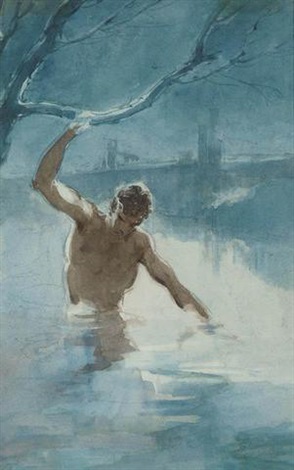
(Illustrated by Luke Fildes. Images below are from the Charles Dickens Illustrated Gallery.)

Edwin Drood feels the solemn charge laid upon him by Mr Grewgious in relation to the ring, as he had seldom felt anything before. Visiting Rosa, it is Rosa who first suggests what they have both long been wondering, but which Drood half-dreads, too: they should not be married, but remain like brother and sister. Both seem to grow in their respect for one another at this decision, and know it to be the right course. But as they kiss for a last time in preparation for parting and moving into this new state of existence, they feel the presence of John Jasper, who seems to have been watching their embrace from a distance.
“He has just passed out under the gateway. The dear sympathetic old fellow likes to keep us in sight. I am afraid he will be bitterly disappointed!”
Now, it is “Christmas Eve in Cloisterham.” Neville is not looking forward to the dinner at Jasper’s, where he and Drood are to reconcile, but he is willing. Meanwhile, he is packed for a long walking journey which he will begin the following morning. Crisparkle comments on his too-heavy walking stick.
On Drood’s way to Jasper’s, he ponders his situation. Suddenly, he is met by a woman who has a strange fit and film come over her eyes, which reminds Drood of Jasper. She comes from London, but she was looking for “a needle in a haystack.” She asks him for three and sixpence, and she will tell him a secret. He tells her that his name is Edwin.
“You be thankful that your name ain’t Ned…it’s a bad name to have just now…A threatened name. A dangerous name.”
Drood quips that threatened men live long.
“Then Ned—so threatened is he, wherever he may be while I am a talking to you, deary—should live to all eternity!”
Meanwhile, Jasper has been “in beautiful voice” all day, and is unaccountably cheerful, reassuring Crisparkle that he intends to burn his diary and the dark thoughts that went with it.
A terrible storm comes up on that Christmas Eve night, when the three men meet together.
Christmas morning. Jasper is frantic, and calls out at Crisparkle’s window to demand where his nephew is. Drood is gone.
Neville, meanwhile, having started off on his walking journey, is unexpectedly met by a gang of threatening men, who won’t explain what they want of him. Feeling that he is beset by thieves, Neville fights with one of them, and gets blood on him. They take him back to Cloisterham and to the presence of Crisparkle and Jasper, who demands where his nephew is, as Neville is apparently the last one to have been in his presence. Neville explains that they went down to the river together to watch the storm. They walked back to Crisparkle’s, and Drood took his leave at the door.
They all go to Sapsea, where Jasper makes an obsequious comment about relying on Sapsea’s judgement on the whole case, to which Sapsea responds that the whole case “had a dark look…an Un-English complexion”—while staring at Neville.
A search party forms in order to find the missing Edwin Drood who had apparently not returned to the Gate House that night.
“But no trace of Edwin Drood revisited the light of the sun.”

Jasper tells Grewgious about the whole scenario, and the latter asks whether Neville is suspected. Grewgious then tells Jasper what Edwin had wanted to keep a secret from him, in fear of Jasper’s taking it too hard: that Edwin and Rosa had broken their engagement, and determined to live forever as brother and sister. Jasper shrieks, and faints.
“Mr Grewgious heard a terrible shriek, and saw no ghastly figure, sitting or standing; saw nothing but a heap of torn and miry clothes upon the floor.”
Crisparkle, on some inspiration that he can’t quite fathom, goes for a swim at Cloisterham Weir, and, being attracted to one spot in particular which he had seen from a distance, finds Edwin’s watch and chain there, with his initials engraved. More deep suspicion is cast against Neville, though Crisparkle maintains his faith in him. It comes to such a point, however, that Neville must leave Cloisterham, but Crisparkle takes charge of vouchsafing for Neville’s return if his presence should be required, e.g. if new evidence shows up.
Jasper, raggedly returning to his choir duties, shows his diary to Crisparkle again. The passage he reads begins with the words, “My dear boy is murdered.” He vows to devote himself completely to the search for–and destruction of–the murderer.
“I now swear…That I never will relax in my secresy or in my search. That I will fasten the crime of the murder of my dear dead boy upon the murderer. And That I devote myself to his destruction.”
Discussion Wrap-Up (Week 4)
Miscellany & What we Loved
Daniel laments the fact that we will forever wonder what Dickens would have done, and what his readers must have felt at the time:
Chapter 13, “Both at Their Best”: a “Double marriage”?; Spotlight on Rosa; Dickensian Character Growth and Second Chances
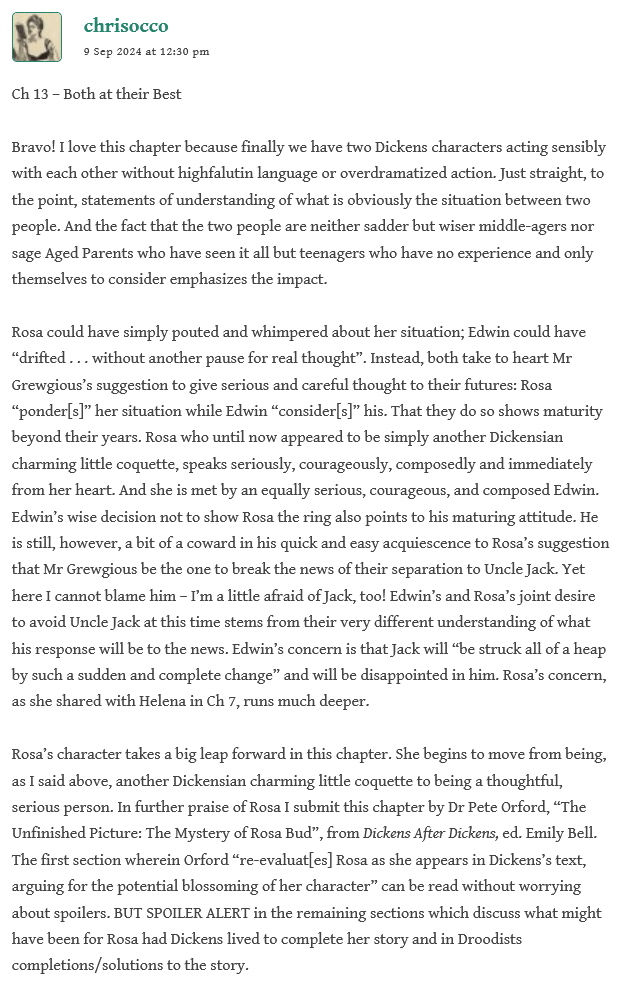
Chris analyzes Chapter 14, and applauds the young couple for coming to such a mature decision. She also considers Rosa’s “big leap forward” in this chapter:
Dr. Pete Orford’s article is attached below:
And on the subject of Rosa: the Stationmaster asks whether she might have been intended to remain single by Drood‘s end:
And what of the idea of “a double marriage: Edwin marrying Helena Landless and Neville marrying Rosa”? Father Matthew considers:

I’m voting for Crisparkle for Helena:

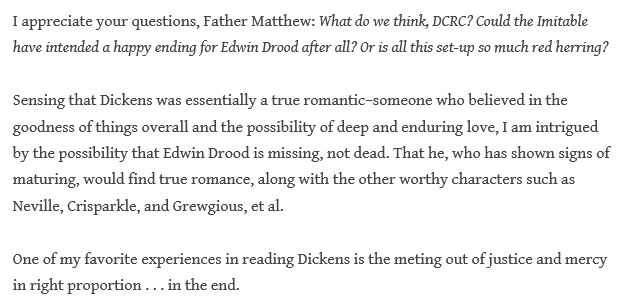
Daniel considers Father Matthew’s question as inspiring hope for Edwin’s survival and potential to change, in true Dickensian spirit, with the “meeting out of justice and mercy in right proportion…in the end”:
And while we’re discussing this chapter, let’s give a shout-out to the marvelous Mr Grewgious, as Fr. Matthew does here, referencing the earlier scene which influences Edwin in being at his best:

Chapter 14, “When Shall We Three Meet Again?”: Atmosphere; Juxtaposition of Christmas & the Storm; Dickens & Shakespeare
Clearly, Chapter 14 is the big one here, somewhat akin to the “Tempest” chapter in David Copperfield, where the elements reflect either the interior turmoil of the characters, or the impending dire events, or both.
Here, Chris gives us so much to think about with her analysis of Chapter 14:

Typically, I will shorten the quotations for these wrap-ups, but here, as the Stationmaster analyzes the Shakespearean dimension of the book and this chapter in particular, the references and passages are simply too marvelous to shorten:


Father Matthew has been thinking along the same Shakespearean lines, with additional marvelous references:
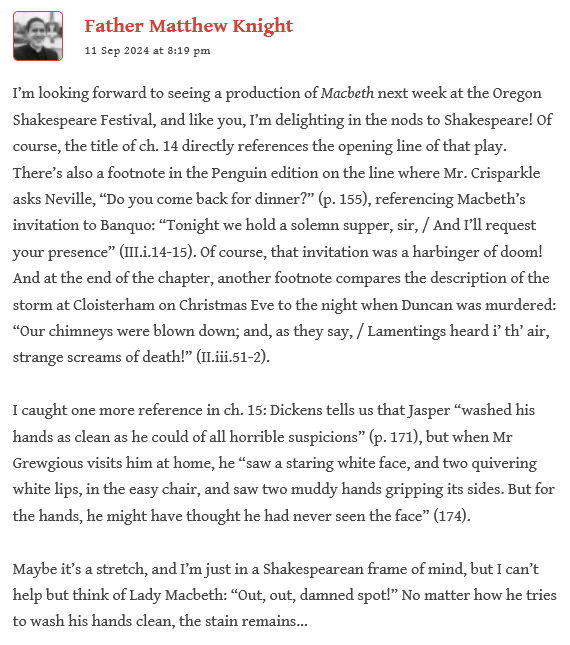
I jump into this Shakespearean comparison after praising the opening and the strange juxtaposition of a Dickensian Christmas with the coming storm. Might “Princess Puffer” be our three witches in one? Here, “fair is foul and foul is fair”:

Chapter 15, “Impeached”:
Chris beautifully analyzes Chapter 15 and Jasper’s response to Grewgious’s news:

Chapter 16, “Devoted”: Jasper “Doth Protest too much…”
More clues and strange happenings. Chris analyzes the “sanguine” reaction in Jasper. Does he “protest too much”?

Questions, Clues, Theories, & Polls…
Last week, we asked the group about what Jasper was doing while Durdles was asleep–for as much as 4-5 hours!–during their nighttime cathedral tour. Overwhelmingly, we all thought he was up to no good in order to do several things, e.g.: making a copy of the key to the crypt/Sapsea tomb, checking time to get from one place to another, etc.
As to the poll about whether or not Durdles’s wine was drugged by Jasper, we overwhelmingly voted YES.
As to the above, Fr. Matthew wrote:

Now, Father Matthew brings up another great question, mentioned above, in the Chapter 13 section of the discussion: Would Dickens have gone the early, obvious route of a double-marriage? Edwin/Helena, Rosa/Neville? I confessed to a hope/belief that it would be Rev Crisparkle for Helena. Since we focused on Rosa’s potential spouses the week before last, let’s see if we can get a vote on Helena:
Chris asks us another question, about our mysterious soothsayer:

And I wrote up a few clues that strike me from our current chapters, to consider as we move forward:

What do you think, fellow Dickensians?
A Look-Ahead to Week 5 of The Mystery of Edwin Drood (17-23 Sept, 2024)
This week, we’ll be reading the fifth installment, Chapters 17-20, of The Mystery of Edwin Drood. This section was published in All the Year Round in August of 1870.
Please share your thoughts on this section in the comments below, or use the hashtag #DickensClub if commenting on Twitter/X.
If you’d like to read it online, it can be found at sites like Gutenberg.
 All the (Dickensian) Year Round
Hi, Rach.
I emailed you the other week (technically, I think it was the weekend before last) asking about an article I want to do for Dickens Club before it’s over. Could you respond? If you think my idea is terrible and are reluctant my feelings, I’d rather know it’s bad right away and end the suspense.
Thank you.
LikeLiked by 2 people
Sorry about that, Stationmaster! I missed that one…My work at the high school just started up again in late-Aug, so I’ve been a little swamped by the jobs! I will go back and look, but honestly, anything you’d like to post would be fantastic. Since you’re one of the authors on the site, you’re able to post anytime. But happy to help if you need illustrations, etc. And anything you post would be enriching to the doscussion.
LikeLiked by 2 people
Also, just to add another note about posting: it would be absolutely AMAZING if anyone wanted to have a separate post(s) at the conclusion of the Dickens Club…whether it be a personal take on Drood, or on something thematic about Dickens/his writing/the Club experience overall, personal retrospectives, or rankings of all the Dickens novels for you personally! Boze and I want to do the latter. I think that, although the readalong portion of the Club will be done by Sept 30, we see October as a kind of a retrospective month, and a time to share overall thoughts about one or more works, and/or the whole reading experience! 🎩🖤
LikeLiked by 3 people
Definitely, Rach!
LikeLiked by 2 people
Dickens has been railing against professional philanthropists and misplaced/misdirected philanthropy since Sketches by Boz and devoted much space to defining and presenting his position. We knew the denunciation of Honeythunder and his kind was coming from the moment he was introduced in Ch 6. That it comes from Mr Crisparkle, the most charitable of men, isn’t surprising. Nor is it surprising that after ~40 years of consideration and craft Crisparkle’s speech is perhaps Dickens’s most succinct definition of true charity – “its first duty is towards those who are in necessity and tribulation, who are desolate and oppressed” – and most succinct argument against such philanthropy – “They are detestable.” (Ch 17)
And who could be more in need of such true charity and more in peril of such false philanthropy than Neville who is a minority, a foreigner, friendless, circumstantially accused, and shunned by the court of public opinion as a result? Dickens hits all the hot-buttons and forces us to re-evaluate what we think we know regarding the events that led up to the case against Neville.
Certainly Mr Crisparkle and Mr Grewgious are doing so. They’ve both been troubled, if subconsciously, by Jasper’s curious words and behavior, the most troubling of which is his often repeated bespoke version of events which implicates Neville. And now Jasper is lurking around Neville’s chambers. “[W]hat should you say that our local friend was up to?” is a more than reasonable question.
And then the crux of the Jasper mystery comes fully to light. Jasper is the quintessential melodramatic villain – right down to his depiction in the illustration “Jasper’s sacrifice”. Poor Rosa knows she is in for a trial the moment Jasper is announced by the servant. But, kudos to Rosa for holding her own, standing her ground, not swooning until she’s away from him, and especially – and this is huge – for running away to Mr Grewgious! Immediately removing herself from proximity to Jasper and into proximity of safety shows, once again, that Rosa is a rational person. (See my 9/9/24 post.) Additional kudos for telling Mr Grewgious everything in spite of Jasper’s threat, “Not a word of this to any one or it will bring down the blow, as certainly as night follows day” (Ch 19)
Mr Grewgious now has the key to Jasper’s behavior and to Jasper’s lurking around Neville’s chambers. No doubt he will confer with Mr Crisparkle about how to proceed in light of this new information.
SPOILER ALERT HERE: And it appears they have an ally in the newly introduced character Dick Datchery (Ch 18). One thing I notice about Mr Datchery in this latest reading is his manner of addressing Mr Sapsea. Mr Sapsea is such a “Jackass . . . of self-sufficient stupidity and conceit” (Ch 4) that Mr Datchery’s highly formal and deferential manner of address will allow him to manipulate Mr Sapsea as easily as does Mr Jasper. I suspect Mr Datchery will learn all sorts of things from Mr Sapsea. And also from Deputy whom he courts just as skillfully as he courts Mr Sapsea.
The other new character, Mr Tartar, is a bright spot, especially for Neville. Perhaps Neville will have a friend closer to his own age who will help him through this rough time.
LikeLiked by 1 person
I love the comparison Dickens draws between boxers and philanthropists!
“In his college days of athletic exercises, Mr. Crisparkle had known professors of the Noble Art of fisticuffs, and had attended two or three of their gloved gatherings. He had now an opportunity of observing that as to the phrenological formation of the backs of their heads, the Professing Philanthropists were uncommonly like the Pugilists. In the development of all those organs which constitute, or attend, a propensity to “pitch into” your fellow-creatures, the Philanthropists were remarkably favoured. There were several Professors passing in and out, with exactly the aggressive air upon them of being ready for a turn-up with any Novice who might happen to be on hand, that Mr. Crisparkle well remembered in the circles of the Fancy. Preparations were in progress for a moral little Mill somewhere on the rural circuit, and other Professors were backing this or that Heavy-Weight as good for such or such speech-making hits, so very much after the manner of the sporting publicans, that the intended Resolutions might have been Rounds. In an official manager of these displays much celebrated for his platform tactics, Mr. Crisparkle recognised (in a suit of black) the counterpart of a deceased benefactor of his species, an eminent public character, once known to fame as Frosty-faced Fogo, who in days of yore superintended the formation of the magic circle with the ropes and stakes. There were only three conditions of resemblance wanting between these Professors and those. Firstly, the Philanthropists were in very bad training: much too fleshy, and presenting, both in face and figure, a superabundance of what is known to Pugilistic Experts as Suet Pudding. Secondly, the Philanthropists had not the good temper of the Pugilists, and used worse language. Thirdly, their fighting code stood in great need of revision, as empowering them not only to bore their man to the ropes, but to bore him to the confines of distraction; also to hit him when he was down, hit him anywhere and anyhow, kick him, stamp upon him, gouge him, and maul him behind his back without mercy. In these last particulars the Professors of the Noble Art were much nobler than the Professors of Philanthropy.”
And I love Crisparkle’s big denunciation of Mr. Honeythunder’s “platform manners.”
“You assume a great crime to have been committed by one whom I, acquainted with the attendant circumstances, and having numerous reasons on my side, devoutly believe to be innocent of it. Because I differ from you on that vital point, what is your platform resource? Instantly to turn upon me, charging that I have no sense of the enormity of the crime itself, but am its aider and abettor! So, another time—taking me as representing your opponent in other cases—you set up a platform credulity; a moved and seconded and carried-unanimously profession of faith in some ridiculous delusion or mischievous imposition. I decline to believe it, and you fall back upon your platform resource of proclaiming that I believe nothing; that because I will not bow down to a false God of your making, I deny the true God! Another time you make the platform discovery that War is a calamity, and you propose to abolish it by a string of twisted resolutions tossed into the air like the tail of a kite. I do not admit the discovery to be yours in the least, and I have not a grain of faith in your remedy. Again, your platform resource of representing me as revelling in the horrors of a battle-field like a fiend incarnate! Another time, in another of your undiscriminating platform rushes, you would punish the sober for the drunken. I claim consideration for the comfort, convenience, and refreshment of the sober; and you presently make platform proclamation that I have a depraved desire to turn Heaven’s creatures into swine and wild beasts! In all such cases your movers, and your seconders, and your supporters—your regular Professors of all degrees, run amuck like so many mad Malays; habitually attributing the lowest and basest motives with the utmost recklessness (let me call your attention to a recent instance in yourself for which you should blush), and quoting figures which you know to be as wilfully onesided as a statement of any complicated account that should be all Creditor side and no Debtor, or all Debtor side and no Creditor. Therefore it is, Mr. Honeythunder, that I consider the platform a sufficiently bad example and a sufficiently bad school, even in public life; but hold that, carried into private life, it becomes an unendurable nuisance.”
(Sorry for the long quotes but they’re just so good!)
I feel like “platform manners” are still recognizable in political discussions today. Online discussions, that is. When debating politics face to face, I’ve found that both liberals and conservatives can calm and (granting their respective positions) reasonable. But for whatever reason, when discussing politics, they’re ready to condemn anyone who even mildly disagrees with them or who credits someone on the other side with anything remotely good. It’s all very frustrating and wearisome.
It’s interesting that Dickens introduces new characters at this point in Mr. Tartar and Mr. Datchery. You’d think he’d introduce them before Edwin Drood’s disappearance so they could be suspects. These characters seem more like potential detectives than potential culprits though.
Jasper’s creepiness crescendos in Chapter 19. At the beginning I thought he was a more sympathetic or potentially sympathetic version of Bradley Headstone. Now I think he might be worse! What is this strange magnetic power of personality he holds over Rosa?
Rosa might be the most rational of Dickens’s heroines. Actually, she might be the most rational of any of his protagonists, male or female. First, she decided to put aside her parents’ wishes and amicably break off her engagement to Edwin. (Contrast this with Esther Summerson who persists in her engagement to John Jarndyce out of a sense of duty until he realizes it’s a lost cause and breaks it off for her sake.) Now she’s telling Grewgious about Jasper’s harassment and seeking his protection. (When Kate Nickleby and Mary Graham were persecuted, by contrast, they only confided about it in characters who wouldn’t or couldn’t help them.) It’s amazing that Rosa hasn’t ruined the whole story since rational decisions tend to quash drama by easily resolving conflicts.
I’m certain now that Rosa was going to end up with Tartar by the end of the book. More than one man has been attracted to her so far, but the end of Chapter 21 is the first time she has ever been attracted to one of them. Of course, it’s possible Tartar was going to die by the end of the book or (less likely) turn out to be a villain or something like that. It’s so frustrating that we’ll never know!
We’ve only one week left of reading. Can someone remind me how many more chapters this book would have had if Dickens had finished it? Was there half a book to go or a third of one or what?
LikeLiked by 1 person
It’s annoying that you can’t edit WordPress comments! When I wrote “when discussing politics” in paragraph 6, I meant to write “when discussing politics online.” My point was that people seem like they can debate politics reasonably in person but in online discussions, they sound like Mr. Honeythunder.
LikeLike
Great comments, Stationmaster. As to the length, we know that he planned twelve numbers, so he only got halfway through. What is additionally strange and aggravating is why we don’t have extant notes for the final six numbers!
LikeLiked by 1 person
Inimitables,
We are nearing the end of our Dickens Chronological Reading Club journey! Such a rich, deep, and joyous trip it has been.
I have benefited much from the insights that you capture and distill, Rachel. I won’t comment on them. They are all excellent–from insight about Rosa’s unique stature as a character to Jasper’s, and so many in-between.
Just three quick additions.
Blessings and good wishes to all Initimables!
Daniel
P.S. Does anyone know the answer to The Adaptation Stationmaster’s questions about how many more chapters were envisioned by Dickens?
LikeLiked by 1 person
The source for below is wikipedia.
The Mystery of Edwin Drood was scheduled to be published in twelve installments (shorter than Dickens’s usual twenty) from April 1870 to February 1871, each costing one shilling and illustrated by Luke Fildes. Only six of the installments were completed before Dickens’s death in 1870. It was therefore approximately half finished.
Planned instalments never published:
LikeLiked by 2 people
Friends, I’ll make another comment below, but I mostly just wanted to say how much I’ve been enjoying reading this week’s discussion! Thanks so much, everyone! I know that as our reading portion was a bit smaller and we’re so nearing the end, much of our discussion about various theories will probably be coming during this coming week and in the retrospective time following the final wrap-up. But just wanted to thank everyone so much for such wonderful insights!!!
LikeLiked by 1 person
Dick Datchery, as little as we get to see him, is nonetheless one of my favorite characters ever.
Datchery is clearly smart, with a certain joie and eccentricity that I find really captivating. It is one of the great tragedies of Drood that we don’t get to see him in action longer, as he doubtless would be key to bringing the murderer to justice, and in contributing to our overall entertainment.
Because we are moving into our final week–with only three chapters left–I don’t think it is a spoiler at this point to begin discussing theories about the identity of Datchery. BUT IF YOU PREFER TO WAIT, THEN HOLD OFF ON THIS NEXT PORTION…
Of course, Datchery might be a new character altogether, like Tartar. But I find this unlikely…
For one, the emphasis on his large white hair (i.e. WIG), with black eyebrows.
Most Droodists seem to assume that Datchery is one of our already-known characters in disguise. Most often, it is either: 1.) Bazzard, 2.) Helena, or 3.) Drood himself, if he is still alive.
For me, I’m 100% of the Bazzardian school. Even if Drood is alive–e.g. if Jasper had tried but failed to kill him–as Dana and I were talking about recently, I do think it is likely that he, like Rosa, would come to Grewgious first. But I think Bazzard is the far likelier candidate as the one Grewgious would assign to detective work in Cloisterham, not only because of the danger that lies in that city to Edwin himself, but because Datchery appears to the reader as genuinely new to Cloisterham, and one chapter is written from the perspective of one who is genuinely a stranger, and neither Helena nor Drood would be in that position. Bazzard, we find out, is currently on leave on business for Grewgious, which is another point in Bazzard’s favor. Additionally, THEATRICALITY: the reverential tone he adopts towards Sapsea, as Chris alluded to above (while he TOTALLY has Sapsea’s number), is, to me, very theatrical! “Your Worishipful the Mayor,” etc. Datchery’s every interaction has a touch of the theatrical, as when he is introducing himself and seeking lodgings: “Dick Datchery. Hang it up again. I was saying something old is what I should prefer, something odd and out of the way; something venerable, architectural, and inconvenient.” And who do we know who is discontented with his ordinary rounds of business, and a failed playwright? Bazzard.
Anyway, more anon. But I thought I would put this out there for consideration…
LikeLiked by 1 person
As more support for Bazzard to claim the title of Dick Datchery I offer the following as evidence: In Ch 11 he says “I follow you” or is said to follow someone/something 8 times (9 times if you include “witness”) – “I follow you, sir”; “I follow you, sir, and I thank you.”; “I follow you, sir, . . . and I pledge you!”; “Let us follow you, sir . . . and have the picture.”; “I follow you, sir, . . . and I have been following you.”; “I follow you both, sir, . . . and I witness the transaction.”; Edwin leaves the office and “Bazzard, after his manner, ‘followed’ him.” The only other characters who do so much following are Jasper, Deputy, and Princess Puffer who obviously cannot be Datchery.
LikeLiked by 1 person
I LOVE that!!! I follow you!
LikeLike