
Wherein your co-hosts of The Dickens Chronological Reading Club 2022-24 (#DickensClub) wrap up Week 6 (Installment 6) of our twenty-fifth read, The Mystery of Edwin Drood; with a chapter summary and The beginning of our discussion of Final Thoughts & Theories…

By the members of the #DickensClub, edited/compiled by Rach
Friends, we began this journey together 1,001 days ago. The number is appropriate: Dickens was hugely influenced by the One Thousand and One Nights and referenced it constantly. We, too, have had our 1,001 nights & days of Dickensian magic.
From our first two months with Sketches by Boz in January and February of 2022, reading a Sketch per day, we then made our way through Dickens’s novels, essay collections and Christmas books in chronological order, ending with his unfinished masterpiece The Mystery of Edwin Drood. It has truly been a masterclass in characterization, plot, imagery, and thematic circularity from the consummate storyteller.
Today’s final “wrap-up” is a little different, in that it feels appropriate with this final, unfinished work to begin rather than summarize and end the discussion. We will have our usual chapter summary, but not a “final thematic wrap-up,” as the story itself remains unfinished. Since October is something of a “retrospective” month about our journey, I suggest that anyone who would like to continue commenting and asking questions, posing theories, and reading some of the marvelous supplemental material on Drood, should feel very welcome and encouraged to do so! I also encourage anyone who would like to write a special interest post on any/all of Dickens’s works, or simply a list of your favorite Dickens books in order, to email us so that we can assist you in making your post for others to enjoy and comment on.
- General Mems
- The Mystery of Edwin Drood, Chapters 21-23 (Installment 6): A Summary
- Final Thoughts, Impressions, & Theories: The Discussion Begins…
- Where Do We Go From Here?
General Mems
SAVE THE DATE: Our final Zoom chat of The Dickens Chronological Reading Club (#DickensClub) will focus on The Mystery of Edwin Drood. Join us this Saturday, 5 October, 2024! 11am Pacific (US) / 2pm Eastern (US) / 7pm GMT (London)! Email Rach if you’d like the link; she will send it out this week.
If you’re counting, today is Day 1001 (and week 144) in our #DickensClub! Today’s final wrap-up of Drood officially ends our twenty-five reads together, beginning with Sketches by Boz and ending with The Mystery of Edwin Drood. We have some polls below, and would love to hear your final impressions of this novel. We hope you can join in our final Zoom chat this Saturday!
No matter whether you’ve joined in for one work or all twenty-five, a huge “thank you” for reading along with us for these two years and nine months. Heartfelt thanks to our dear Dickens Fellowship, The Dickens Society, and the Charles Dickens Letters Project for retweets, and to all those liking, sharing, and encouraging our Club, including Gina Dalfonzo, Dr. Christian Lehmann and Dr. Pete Orford. Huge “thank you” also to The Circumlocution Office (on twitter also!) for providing such a marvelous online resource for us. As a retrospective: the revised schedule that we have just completed can be found here. If you’ve been reading along with us but aren’t yet on the Member List, we would love to add you! Please feel free to message Rach here on the site, or on twitter.
The Mystery of Edwin Drood, Chapters 21-23 (Installment 6): A Summary
(Illustrated by Luke Fildes. Images below are from the Charles Dickens Illustrated Gallery.)
Crisparkle, who has been something of the “mutual friend” connecting all of our characters together, visits Rosa and Grewgious after Miss Twinkleton’s scare at Rosa’s note and sudden departure. Rosa says that she would have come to Crisparkle immediately, but for his living proximity to Jasper.
Mr Tartar comes in, and Crisparkle and he recognize one another and embrace heartily on the instant—they had been schoolfellows together, and Tartar had saved Crisparkle from drowning (after which Crisparkle took to becoming an expert swimmer). Grewgious comes up with a plan, to which Tartar heartily agrees—there seems to be an immediate attraction between him and Rosa—that Tartar’s rooms should be a kind of meeting place for Rosa, Helena and all; Jasper, who is on the watch for Neville and Rosa, wouldn’t think to look there.
“Mr Tartar’s chambers were the neatest, the cleanest, and the best-ordered chambers ever seen under the sun, moon, and stars.”

Mr Tartar’s curiosities are all neatly ordered, and everything is kept ship-shape; his garden is a haven. Here, Helena and Rosa finally meet again. Tartar, with his man Lobley, take Rosa and Grewgious on a ride on his boat.
Grewgious then takes Rosa to her new establishment where she will remain with Miss Twinkleton (who reads her own kind of “censored” versions of novels aloud to Rosa). The lady of the house—who tends only to use her surname “Billickin” so as not to give out that she is a lone widow—is a cousin of Mr Bazzard’s several times removed, who lives in Bloomsbury Square. This Billickin, a woman with an almost militant honesty and affinity for going into the smallest details about her lodgings, has an instant dislike for Miss Twinkleton, and it is mutual; “from that time Rosa occupied the restless position of shuttlecock between these two battledores.”
Back in Cloisterham, with Crisparkle and Jasper silent with one another about Drood and each a mystery to the other, things go on as usual; opinion in general was pretty divided as to whether “Jasper’s beloved nephew had been killed by his passionate rival treacherously, or in an open struggle; or had, for his own purposes, spirited himself away.”
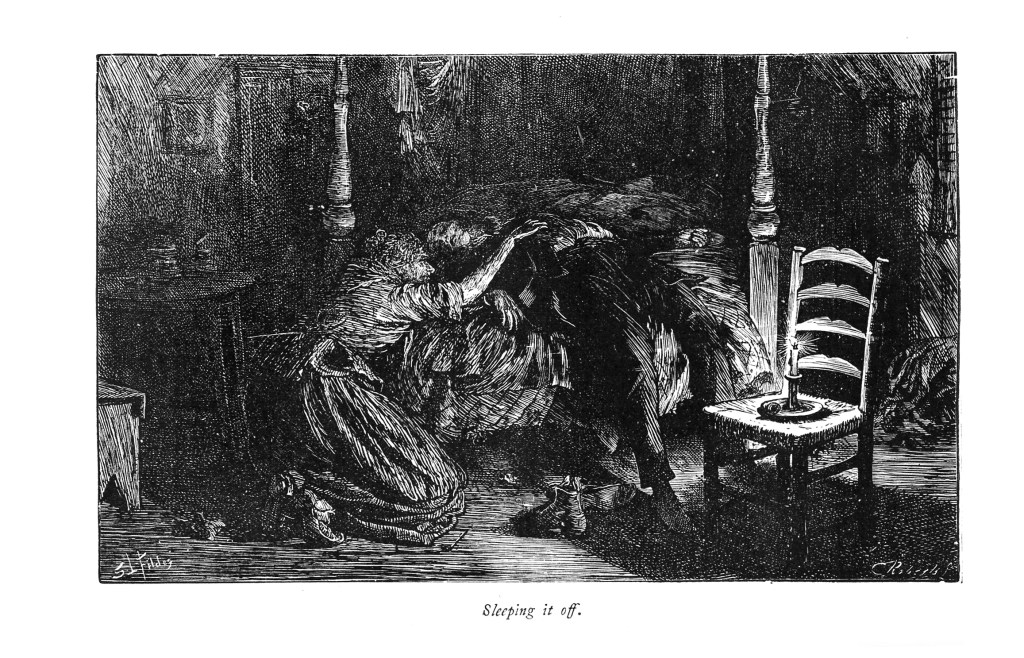
Jasper visits Princess Puffer’s opium den again after a long absence where he had fended for himself; he has a morbid disposition with much on his mind. He talks of the “journey” or “deed” that he had made/done many times in his opium dream-state, and the reality of it.
“I did it, here, hundreds of thousands of times. What do I say? I did it millions and billions of times. I did it so often, and through such vast expanses of times, that when it was really done, it seemed not worth the doing, it was done so soon.”
She follows Jasper in secret, determined not to miss him again; she seems to have something to blackmail him for; something to hold over him. She meets with Dick Datchery, who tells the woman about Jasper’s lodging and occupation in the cathedral, saying that she could see him again the next morning if she wanted to attend the service. She tells him of her meeting with Edwin before his disappearance, and her trade in opium. He gives her money for the night’s lodgings, assisted by Deputy—with whom Datchery is now on a familiar footing.
When Datchery returns to his lodging, he makes a curious mark (“a moderate stroke”) with chalk upon the cupboard door, like “the old tavern way of keeping scores.”
The next morning, Datchery goes to the cathedral for the early service, and sees Princess Puffer there, eyeing Jasper—and shaking her fist at him—from behind a pillar. He questions her after, about whether she has seen Jasper, and whether she knows him.
“Know him! Better far, than all the Reverend Parsons put together know him.”
Datchery adds “one thick line to the score, extending from the top of the cupboard-door to the bottom,” before eating his breakfast with an appetite.
Final Thoughts, Impressions, & Theories: The Discussion Begins…
Miscellany & What We Loved–and Didn’t: The Billickin & Miss Twinkleton; the Opium Den Scene; Datchery; Dr. Christian’s Gift; the Garfield “Completion” of the Novel
The Stationmaster enjoyed how the characterization of “the Billickin” grew on him, as well as Miss Twinkleton’s pious bowdlerization of novels as she reads to Rosa. He is also glad that certain things have come back around again, including Jasper’s opium addiction:
NOTE: The Stationmaster did a wonderful write-up about the Garfield completion, which would be a fantastic standalone post for discussion. To summarize: the Stationmaster was distracted by wondering whether Dickens would have used certain turns of phrase, and felt the book “changed direction” with Garfield’s portion. He felt Garfield also overdid the Shakespeare allusions, but that “Garfield does a great job of recreating Dickensian horror and Dickens’s sense of humor.” He felt Garfield “flipped a switch” too hastily with Helena’s character, but wonderfully paid off Jasper’s interior meltdown when he considers the murder as if it were committed by another man–as Forster suggested Dickens intended.
“Do I recommend the conclusion though? Well, I think whether or not to read a conclusion to a Dickens book written by another author is a decision that every Dickens fan has to make for themself. I suspect this is the one with the greatest prose though perhaps some others do better by the characters-apart from that last scene with Jasper.”
~Adaptation Stationmaster
Daniel highlights some things he has been loving about the reading and discussion: the identity of Datchery, Dr. Christian’s wonderful gift, Princess Puffer and the opium den, and the possibility of a redemptive arc:

The Divisions of Chapter 22
Chris takes us through the several passages in Chapter 22, suggesting that certain divisions might be made. She also analyzes our characters: Helena’s cleverness, and Miss Twinkleton’s possible sisters–e.g. Miss Tox–in other Dickensian works:
“Dawn”–“Noontide”–“Dusk”: An Amendment to Forster
Chapter 23 was certainly our “big” climactic chapter in this installment, and Chris analyzes it, and how various characters coming together (Princess Puffer, Datchery, Deputy) would have contributed to the solving of the mystery. She also considers the cyclical nature of the last completed chapter, with the first. John Forster suggested the name, but she would propose another: “Noontide,” since this comes exactly in the middle of what would have been the completed novel, therefore making the opening, middle, and final chapters a complete cycle: “Dawn”–“Noontide”–“Dusk”.

The Identity of Dick Datchery
The Stationmaster links to Andrew Lang’s article (which I have linked below), and lays out for us the different theories about the identity of Dick Datchery, which I am posting here in full:

The 2012 Film Adaptation
Though this might be an entire separate post, I figured that a number of our members either have watched, or might soon watch, the 2012 BBC adaptation of The Mystery of Edwin Drood. Please avoid if you don’t want spoilers about this version--but we’d love to hear your own analysis! Here’s the Stationmaster’s:

Solutions, Resolutions, & Supplemental Reading
The Stationmaster shared a piece by Andrew Lang on “The Puzzle of Dickens’s Last Plot,” linked here.
Chris shared an article by Gerhard Joseph:
Of course, both Chris and I have been adamantly recommending the marvelous book by Dr. Pete Orford, which is truly comprehensive. I would like to venture into a few notes on this book during our retrospective month.
For now, we’d love to have your vote on three key questions:
Where Do We Go From Here?
In other words, where does one go from Dickens?
Of course, today officially ends our group readalong and “wrap-ups.” But we hope it doesn’t end our final comments, theories, and retrospective posts. And who knows? It might not be the end of reading together, for those who wish to embark on a new venture in future…
October 2024: A Retrospective Month
As mentioned above, we would love to think of October as a kind of “retrospective month,” open to any posts/lists of Dickensian novels from favorite to least-favorite, or the other way around! If you have a special interest topic you’d like to write about, we’d love to have you share it in a special post. If you’re already an “author” on the site, please post away! If you’re not yet listed as an author, please contact Rach and she will make it happen.
January 2025: The Lesser-Known Dickens?
Boze, Chris and I have been discussing the possibility of a more permanent, ongoing, slower-paced continuation of Dickensian reading, as something separate from–though, one might say, an appendix of sorts to–The Dickens Chronological Reading Club. Perhaps beginning with reading some of his lesser-read stories, e.g. The Mudfog Papers. If we go that route, we will wait until some time has passed to allow for our retrospective month followed by the holidays. Also, we need some time to consider which of the different available online spaces might be used in conjunction with the WordPress blog to facilitate user-friendly, quicker, text-style back-and-forth discussion on various topics, chapters, etc. So, if you have any interest in venturing into a new Dickensian project, look for the possibility of more nerdery in the New Year!
An Affectionate Farewell…
Meanwhile, we truly look forward to our final Zoom chat this Saturday, where we can delve into more solutions and resolutions of The Mystery of Edwin Drood! (Be on the lookout for the Zoom link in your inbox shortly after this is posted.) We would also love to hear–from anyone willing to share–about your overall impressions of Dickens’s trajectory as a writer, or your personal favorite novels.
Friends, Boze and I cannot thank you enough for joining us on this journey, and leading us all in discussion. It has truly been a group-led, community-led project. For us, with the intros, summaries, and wrap-ups, it has occasionally been a consuming labor of love, but, as I was recently telling Boze, it is one of the most special things I’ve ever done. Thank you for making the experience of reading Dickens chronologically enriching beyond belief. There’s nothing better than reading, unless it is reading with friends. And Dickens has a gift for bringing people together!
And thank you to all of our “hidden” readers–we have heard from a number of people by email or postal mail that there are more following the discussions and reading along with us than are commenting here. Boze and I would love to wish you all, as Dickens said at the end of his public readings, “a heartfelt, grateful, respectful, and affectionate farewell.”
THANK YOU!

 All the (Dickensian) Year Round
A bittersweet wrapping up indeed! Surely not an ending!!
A HUGE THANK YOU to Rach and Boze for guiding us through this journey! You two have done a masterful job of organizing, introducing, synthesizing, and wrapping up our readings and discussions. Truly a labor of love!
Personally, I am grateful for the new friends made through this journey. I’ve learned so much and gained new insights into Dickens and writing and adaptations and scripture and Shakespeare, and the so many influences on Dickens and by Dickens that, well I just want to start all over again at the beginning! My reading and experience of Dickens is and will continue to be enriched by this experience!
Thank you all!
Chris
LikeLiked by 1 person
Aw, Chris, thank you SO MUCH!! I am just seeing your response right as I post my thoughts on the 2012 adaptation…
I couldn’t agree with you more, about the wonderful and enriching insights and friends made, and the desire to simply start over from the beginning! I confess that Boze and I have been rereading the Sketches…just read the one about the Marine Store Shops! I’m with you, whenever we want to properly begin again. I think that this could be an ongoing, slower-paced journey; perhaps with a new format, but…Dickens is truly inexhaustible!
LikeLiked by 1 person
I had such a big editing project to finish in my off-time this week, that there were several things I didn’t end up getting to comment about, as I focused on the final wrap-up ❤ …but I did want to respond to the Stationmaster’s thoughts on the 2012 BBC adaptation.
I’ve watched it several times, and really enjoy it, though it is flawed. I think my favorite things about it are: 1.) Matthew Rhys as Jasper; 2.) Alun Armstrong as Grewgious; 3.) the Landless twins; 4.) the gothic atmosphere; and 5.) DAVID DAWSON as Bazzard/Datchery, who, for me, lights up the screen whenever he comes on–he’s like a burst of eccentric energy.
I also thought the Jasper-killing-his/their-father bit was clever, which explains the odd cry from one year earlier that Durdles hears. I don’t think it appears to be where Dickens was going (but who knows?); nonetheless, it is clever.
The thing I really DIDN’T buy/like was Edwin’s casual disappearance. It doesn’t make sense to me whatsoever. As I recall, they have the ring just drop or get lost or something, whereas I think the ring would have played a KEY role in the solution. AND, flippant as Edwin generally is, the bestowal of the ring and the injunction that goes with it from Grewgious is absolutely CRUCIAL–this is the one moment where Edwin finally begins to take things seriously, and so I don’t believe for a moment that Edwin would simply go off with the ring lost somewhere, without letting Grewgious know.
But I do recommend it for the acting and atmosphere overall, and for a fun take on the ending, with the exception of the Edwin casually spiriting himself away bit! 🙂
LikeLiked by 1 person
I’ve been wanting to share this since we began reading Drood. A very interesting take on this novel and Dickens’s intent is “Jasper’s Plot: Inventing The Mystery of Edwin Drood” by Robert Tracy (link below)
Tracy posits that Jasper “is writing a variorum version of the novel in which he appears, attempting to control its plot and define some of its characters. Jasper as novelist is a projection of Dickens himself, who has imagined so many crimes and murdered so many characters in so many novels. Jasper’s book is his diary, but it is also a detailed biography of his nephew, Edwin Drood, and it celebrates Jasper’s apparent devotion to Drood. . . It is also to be a diary of Ned’s death, and a fiction about the identity of his murderer.” (29)
“Writing The Mystery of Edwin Drood, Dickens was less interested in a murder mystery and its solution than he was in studying Jasper and finding a new narrative technique to tell his story. In this last novel he is still experimenting. His most important innovation was to be the narrative method he planned to employ.” (33)
“Dickens’s ‘curious and new idea’ for narrating The Mystery of Edwin Drood was for the murderer to write a confession of his crime ‘as if told to another,’ that is, in the third person. The problem lay in how the story was to be told, how Jasper was to appear simultaneously as the persona the story is about and the persona telling/writing the story, without using the first person. Jasper was to be at once object and subject, to leap over the ‘boundary line that separates reader and actor.’” (36)
It is suggested here that “This is the mystery that Dickens failed to solve, and was perhaps unable to solve”; “that Dickens became ‘hopelessly entangled’ in his own plot”. (36) Be this as it may, I have faith that the great Inimitable Charles Dickens would, at last, have found the solution and that The Mystery of Edwin Drood would thus have been ground-breaking. I have faith that the final scene(s) of Jasper in his cell, finally confessing all, would have been as riveting as the final scenes and anguish of Fagin, Bill Sikes, Ralph Nickleby, Quilp, Dennis the Hangman, Jonas Chuzzlewit, Mr Carker, and Bradley Headstone.
https://drive.google.com/file/d/1Hk_BhGFmMUK_ojodiiOi3TLvVngK8dJ9/view?usp=sharing
LikeLiked by 2 people
“He was simply and staunchly true to his duty alike in the large case and in the small. So all true souls ever are. So every true soul ever was, ever is, and ever will be. There is nothing little to the really great in spirit.”
― Charles Dickens, The Mystery of Edwin Drood
Dear Fellow Inimitables,
As Chris points out, this is a truly bitter-sweet moment: 1001 days of journeying together in the magical, mystical, wild-and-crazy, and wonderful world of Dickens!
Quotes such as the above one always endear me to Dickens, who is surely describing himself–a man of true greatness of spirit and imagination. Beyond imagining.
Without the DCRC, I would not have walked this wonderful path, including the strange and mysterious “Drood”! So, a major THANKS to Rachel and Boze for their diligence, intelligence, passion, and persistence. You held this little “fellowship of the Inimitable” together!
A few more comments/observations:
The last words belong to Rachel and Boze:
Friends, Boze and I cannot thank you enough for joining us on this journey, and leading us all in discussion. It has truly been a group-led, community-led project.
Daniel
LikeLiked by 1 person
I’m not sure why the numbers disappeared on the above post. Sorry about that!
LikeLiked by 1 person
You know, I thought I would have this feeling of completion now that I’d finally read every one of Dickens’s novels and novellas. But somehow, I still feel like there’s more out there. Maybe it’s just the missing half of Edwin Drood. Technically, of course, I still haven’t read all of Dickens’s short stories or magazine articles so even if Drood were complete, there’d still be more out there. But I can’t shake the feeling that there is still another major novel or two waiting for me to read it-or at least the rest of The Mystery of Edwin Drood.
LikeLiked by 2 people
Make ’em laugh; make ’em cry; make ’em wait!
As many of us are lamenting the unfinished nature of Drood I am reminded of this famous phrase of Charles Reade but made famous by Wilkie Collins “as a sort of manifesto of the Victorian sensation novel”. (https://essenglish.org/messenger/wp-content/uploads/sites/2/2021/02/29-2-W2020-rationale.pdf)
Clearly it was not Dickens’s intent that his readers wait forever for the solution to Drood, but it is rather fitting that his career, based on serial publication, should end thus. (I’m not the first to suggest this; see Dr Pete Orford, among others). I think Dickens would have been tickled with this irony and would have enjoyed the many attempts to solve the case he presents. This unfinished version holds our attention in a way a finished product never could, and the continuing Droodism maintains the relationship Dickens cultivated so fervently with his readers. While a finished product may very well have been another masterpiece and a groundbreaking step forward in literary style and technique (which is not to say that the extant version isn’t), I like the what-if-ness of Drood and its legacy of participation as I am always left pondering not simply the solution but the manner in which Dickens would have taken us there.
LikeLiked by 3 people
I’m not sure how many more comments I’ll be leaving on this site in the future (hopefully, one or two) so I thought I’d take this opportunity to say something.
People these days tend to sneer at “Victorian morality”, but I feel like the moral language Dickens uses is a lot more sensible than ours today. I mean, we still condemn things all the time but instead of calling them “wicked,” we call them “toxic,” which is a boring, clinical (and increasingly overused) word by comparison. We still care about things like goodness and wickedness but it’s like we won’t admit it because we’re scared of sounding Victorian. It’s something about modern culture that makes reading Dickens kind of refreshing to me.
LikeLiked by 3 people
Boze & I have started watching a 1935 adaptation of The Mystery of Edwin Drood, & the highlight is definitely Claude Rains as Jasper. He’s keeping me in, when I nearly stopped after realizing from the cast list that there is no Bazzard, no Datchery!
And unfortunately, Neville appears to be a white actor with just a bit of “tint” or something. Anyway, they are definitely choosing to go with a Rosa/Neville romance, and at first I thought it would be the Edwin alive/double marriage. But we shall see…
Unfortunate too that Grewgious is a bit of a caricature, and Crisparkle is not all as described. He is supposed to be cheerful, buoyant, athletic, about the same age as Tartar bc they were at school together, and obviously trustworthy. This Crisparkle is staid and rather stuffy, appearing like a stock character of a mentor (?), but without showing us the importance of his relationship to the Landlesses, and his connections with others. It’s disappointing.
The music, too, is very intrusive.
Still, I am curious about how they will end it!
LikeLike
I’m planning on watching that movie tonight.
LikeLiked by 1 person
I look forward to hearing your thoughts!
LikeLiked by 1 person
Well, here they are. I liked the movie more than you did though I can’t say I totally loved it. To be honest, I probably enjoyed it and the miniseries equally though they have very different pros and cons. A pro they both have IMO is a really strong opening scene that is very true to the beginning of the book.
I agree with you that Crisparkle (Francis Sullivan) was a lot better in the miniseries (where he was played by Rory Kinnear) as were the Landless twins (Douglass Montgomery and Valerie Hobson.) In fact, the Landless twins are my biggest issue with this take on Edwin Drood. But I liked the 1935 Grewgious (Walter Kingsford) more than you did, and I think I prefer the movie’s versions of Edwin Drood (David Manners) and Rosa Bud (Heather Angel) to those in the miniseries. I should stress that I really like Tamzin Merchant’s Rosa from 2012 too, but they made it really obvious that she resented her engagement to Edwin. I think it’s more interesting how in the book and the movie, she initially tries to play the part of his doting fiancée before the facade cracks, and I buy more that the two of them could be friends once they broke up.
This was definitely a different experience that either the Leon Garfield continuation or the 2012 miniseries. Garfield obviously only added to what Dickens wrote (from what I can tell anyway) and the miniseries changed a couple of details about his setup for their purposes but clearly tried to stay generally true to it. With the 1935 movie, on the other hand, you can tell they were writing with the ending they had created in mind and changed the beginning accordingly, mainly the character of Neville. This bugged me since I think Neville’s character is great as it is in the book. However, there’s a case to be made that changing more things about the beginning, the part that’s based on what Dickens wrote before he died, makes it easier to enjoy the ending without wondering if it’s what he had in mind. I had the easiest time letting go of any hopes that the 1935 movie would answer the question of what Dickens would have written and just enjoyed what the screenwriters did in fact write.
I will say though I didn’t really like the change of dynamic that making Neville Rosa’s love interest made to the scene of Jasper threatening her. I feel like it’s a more interesting dynamic if she doesn’t return Neville’s feelings, she just doesn’t want to see an innocent man punished. And, yeah, I know when commenting on the miniseries, I wished that adaptation had made them love interests. I guess there’s no pleasing me. Or maybe it’s that I really liked the romance Dickens was setting up with her and Tartar in the book. Not that there was much to it, but I loved the writing.
“Rosa wondered what the girls would say if they could see her crossing the wide street on the sailor’s arm. And she fancied that the passers-by must think her very little and very helpless, contrasted with the strong figure that could have caught her up and carried her out of any danger, miles and miles without resting. She was thinking further, that his far-seeing blue eyes looked as if they had been used to watch danger afar off, and to watch it without flinching, drawing nearer and nearer: when, happening to raise her own eyes, she found that he seemed to be thinking something about them. This a little confused Rosebud, and may account for her never afterwards quite knowing how she ascended (with his help) to his garden in the air, and seemed to get into a marvellous country that came into sudden bloom like the country on the summit of the magic bean-stalk. May it flourish for ever!”
Helena’s character really got neutered by the movie. When she says her line about never being afraid of Jasper, she sounds downright playful rather than defiant. If I decide I prefer the miniseries (which I haven’t as of yet), it’ll likely be because of that. However, on reflection, I can kind of see the reasoning behind it. I commented earlier that if Dickens wasn’t planning on Helena doing anything major, it’d be a flaw in the book that he lavished so much charisma on a character who amounted to little more than a confidant to others. Since the filmmakers didn’t have any ideas for what to do with Helena besides her being a confidant, it was probably more practical for them not to give her much personality.
What this adaptation did with “Princess Puffer” (Zeffie Tillbury) felt much more like what I felt Dickens was building up to with her than what either Leon Garfield or the 2012 miniseries did.
Miss Twinkleton (Ethel Griffies) was hilarious, one of my favorite things about this version.
It’s interesting that both the movie and the miniseries include Sapsea (E. E. Clive in 1935-pardon the rhyme-and Ian MacNeice in 2012) but not Honeythunder.
The movie is the only version of the ending that includes the ring being used to identify Edwin’s body as Dickens apparently told Forster it would. Props to it for that.
Whatever my reservations about this movie or the miniseries, both of them really do have that Dickensian feel and I enjoyed watching them. My new goal is to read all the continuations and see all the adaptations so I can pick the best bits of each and use them for my version that I’m going to write someday (though that could run into copyright problems.)
LikeLiked by 2 people
Forgot to say I’m a bigger fan of Matthew Rhys’s portrayal of John Jasper but I thought Claude Raines was great in the role too.
LikeLiked by 1 person
Rach and Boze, thanks SO much for captaining this voyage of discovery these last almost three years! I know well how much time and work went into it, but also how much you enjoyed it…and the rest of us as well!
Just for the sake of being on the record, as it were, here’s my own version of how the Inimitable might have finished what he had set up, and based on my own experience of writing a mystery and having to set up and pay off clues:
1, Yes, of course, Jasper killed Drood (out of jealousy over Rosa) and limed his body in the cathedral crypt, having put Durdles off the scent with some spiked liquor.
2. However, Jasper has become so crazed and drug-addled by this time (after all those evenings spent in Princess Puff’s establishment, and probably on his own as well) that he’s no longer entirely either in his right mind or in full grasp of the reality of the situation. I think CD was setting up a sort of Victorian version of an opium-fueled “split personality”, where one half of him loves Edwin and the other hates him; one half has vowed to “destroy” Edwin’s murderer and the other IS that murderer, and is so at war with himself. I suspect CD was intending to unfold the denouement with Jasper somehow causing his own undoing. How precisely, I’m not sure, and am desperately sorry that I shall never know!
3. Just to venture some guesses, based on the setup, I suspect Jasper’s undoing might come from eventually killing Puff, who was intending to blackmail him, and liming her in the crypt the way he did for Edwin. Only this time the Deputy (who has reason to hate Jasper, who has threatened to kill him) sees something and says something, identifying Jasper. Upon investigation of the crypt–I see Datchery (aka Bazzard) and Crisparkle having a hand in this–they find not only something identifying Princess P, but Edwin’s ring as well, so they know Jasper killed him, too.
Something like that.
As to happy endings and marriages, I very much like the idea of Crisparkle and Helen, and Rosa and Tartar.
LikeLiked by 3 people
Dear Dickensians,
I heartily add my voice to this chorus of thanks! I was already planning to spend 2022 reading through a few of Dickens’ better-known novels before I met Rachel and heartily accepted her invitation to join a much grander adventure: to read all of his published works over the course of two years (which, like all great adventures, ended up taking some twists and turns and carrying on a good deal longer than we expected!) Although I’ve had to come and go since first joining the DCRC in earnest at TOCS, it has been a joy to walk with all of you, now, through 13 masterpieces of the Inimitable. I have been truly edified by the experience, not only of reading Dickens, but delighting in these summaries, discussions, and the insights and expertise of this Club.
Special thanks, of course, are due to Rach and Boze for their tremendous efforts in organizing the DCRC and keeping it going, lo, these many months! I am excited to see what new adventures you may have in store for us, and, like Mr. Bazzard, I shall “follow you” as far as I’m able!
Dana’s last comment sums up my own thoughts at the end of Drood almost exactly. From the very first chapter, Dickens set up the disturbing “double character” of John Jasper, at once the mild-mannered choirmaster and the opium addict, concealing unknown possibilities of violence. (Indeed, the “war with himself” Dana mentions might have been foreshadowed from that very first chapter, too, with his opium dreams of armies marching and heads mounted on pikes!)
It seems likely that Jasper’s “shadow self” committed the murder in an opium-induced frenzy. In his visit to Princess Puff, he seems to be alluding to the murder when he says he “did it over and over again … in this room” (p. 259). When the deed at last was really done, would he not have done it under the influence of opium? I think this would have been the “curious and new idea” that Dickens was exploring in Drood—that Jasper was at once innocent and guilty, or rather, guilty but unconscious or in denial of his guilt, insofar as he committed the actual murder in an opium dream, just as he had done “millions and billions of times” before (p. 260).
(Telling, too, is the quotation from Garfield that the Stationmaster provided last week: if Dickens had completed Drood, Robert Louis Stevenson wouldn’t have needed to write Dr. Jekyll and Mr. Hyde!)
I can’t predict how Dickens might have exposed Jasper’s guilt in the end. I’m intrigued by Dana’s suggestion that he might have eventually killed Princess Puff to keep her quiet and been sighted disposing of her body by Deputy, leading to his eventual discovery by Bazzard/Datchery and (no doubt) Crisparkle and Grewgious. This strikes me as a pretty neat way of wrapping up all the threads. I’m certain that the discovery of the RING (in the quick-lime?) would have played a key role in his indictment!
BTW, I do think Bazzard as Datchery is the likeliest solution, and it follows Mr Grewgious’s “sort of fancy for having [Jasper] under my eye” (p. 197).
And, like the Stationmaster, I’ve come around to the idea that Rosa would most likely have ended up with Tartar, and Crisparkle with Helena—but I do hope poor Neville would find love, too!
Final note: I do hope to write up a little post with my impressions on the novels I’ve read and a sort of ranking, sometime during the month of October. And I’m entertaining a ‘sort of fancy’ myself for going back and reading the novels I missed during the initial run of the DCRC!
LikeLiked by 2 people
Probably, no one is reading this comments section anymore, but I wanted to do another comment anyway. (Actually, I’m going to do two. This one and one about the 1935 movie later.)
I’ve gone on record as saying I buy that John Jasper could fool everyone in Cloisterham into thinking he’s this great guy and that some of his friendliness might even be genuine. In our zoom meeting, Chris, reasonably enough, argued that the very lavishness of Jasper’s expressions of devotion and friendship makes them suspicious. On reflection, I agree but I still buy him fooling everyone (except for Rosa and Helena of course) because of how, well, cloistered the people of Cloisterham are. The Crisparkles, Edwin, Durdles, Miss Twinkleton, they’re all so innocent in their individual ways that it wouldn’t occur to them to suspect Jasper. (Even the negative characters of Sapsea and Honeythunder are kind of innocent, not in the moral sense but in the sense of being oblivious.)
LikeLiked by 2 people
We’ll still be reading! I still have a couple of small things to post. I always leave it so late: always trying to catch my own tail.
LikeLiked by 1 person
Stationmaster – Agreed! Your statement “they’re all so innocent in their individual ways that it wouldn’t occur to them to suspect Jasper” is absolutely true. And all readers – their first time around – are taken in too. My comment is based on my jadedness of having read the book several times – I know Jasper too well to be fooled again.
Which makes me wonder about Mr Grewgious and if there’s something he knows beyond his conversation with Jasper in Ch 9 and having experienced Jasper’s fit in Ch 15. Maybe Edwin’s father dropped some clues before he died – but this is pure speculation on the unfinished second half.
LikeLiked by 1 person